Israel
in Western Asia
Asia
 Egypt
Egypt Jordan
 Lebanon
 Palestinian Territory
 Syria
Syria- Currency and Currency Code:
- Shekel - ILS
- Spoken languages:
- Hebrew, Arabic, English
- Local electricity:
- 230 V - 50 Hz (plugs: C, H)
- Mobile phone / cellular frequencies (MHz):
- 900 MHz, 1800 MHz, 3G, 4G
- ISO 2-Letter code:
- IL
- Internet top level domain:
- .il
- Country phone prefix:
- +972
- Local Time (capital):
- Timezone:
- UTC/GMT offset: hours
Safety Score: 4,2 of 5.0 based on data from 9 authorites. Meaning please reconsider your need to travel to Israel.
Travel warnings are updated daily. Source: Travel Warning Israel. Last Update: 2024-04-26 08:02:42
Explore Israel
Israel with its capital Jerusalem is located in Asia (Middle East, bordering the Mediterranean Sea). It covers some 20,771 square kilometers (slightly larger than New Jersey) with 8,299,710 citizens. Hebrew, Arabic and English are the common languages used in Israel (consider regional differences). Egypt, Jordan, Lebanon, Palestinian Territory and Syria are bordering countries.
Israel is a small yet diverse Middle Eastern country with a long coastline on the eastern Mediterranean Sea and a small window on the Red Sea at the Gulf of Eilat (Aqaba). Israel possesses a number of diverse regions, with landscapes varying between coast, mountain, valley and desert landscapes, with just about everything in between. Beyond the towns and cities, each region of Israel holds its own unique attractions. In getting around Israel, be aware of the Sabbath: from Friday sundown to Saturday sundown, train and bus services are not available in Israel (except in Haifa, Nazareth and Eilat, and limited sherut services - shared taxis, see below).
Popular Destinations in Israel
Administrative regions of Israel
About the country
Website: Israel Tourism
The topography is Negev desert in the south with low coastal plain, central mountains as well as Jordan Rift Valley. The average density of population is about 400 per km². The climate in Israel can be described as temperate with hot and dry in southern and eastern desert areas. Potential natural disasters are droughts, periodic earthquakes and sandstorms may occur during spring and summer.
To reach someone Israel dial +972 prior to a number. The local cellular networks are operated on 900 MHz, 1800 MHz, 3G, 4G. Websites typically end with the top level domain ".il". If you want to bring electric appliances (e.g. battery chaarger), keep in min the local 230 V - 50 Hz (plugs: C, H). The sign for the locally used currency Shekel is ILS.
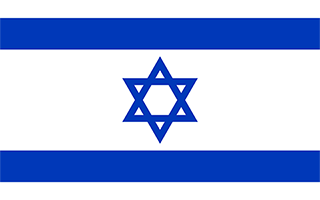
White with a blue hexagram (six-pointed linear star) known as the Magen David (Star of David or Shield of David) centered between two equal horizontal blue bands near the top and bottom edges of the flag; the basic design resembles a traditional Jewish prayer shawl (tallit), which is white with blue stripes; the hexagram as a Jewish symbol dates back to medieval times.
Following World War II, Britain withdrew from its mandate of Palestine, and the UN proposed partitioning the area into Arab and Jewish states, an arrangement rejected by the Arabs. Nonetheless, an Israeli state was declared in 1948, and Israel subsequently defeated the Arab armies in a series of wars that did not end deep tensions between the two sides. (The territories Israel has occupied since the 1967 war are not included in the Israel country profile, unless otherwise noted.) On 25 April 1982, Israel withdrew from the Sinai Peninsula pursuant to the 1979 Israel-Egypt Peace Treaty. In keeping with the framework established at the Madrid Conference in October 1991, Israel conducted bilateral negotiations with Palestinian representatives and Syria to achieve a permanent settlement with each. Israel and Palestinian officials on 13 September 1993 signed a Declaration of Principles (also known as the "Oslo Accords"), enshrining the idea of a two-state solution to their conflict and guiding an interim period of Palestinian self-rule. The parties achieved six additional significant interim agreements between 1994 and 1999 aimed at creating the conditions for a two-state solution, but most were never fully realized. Outstanding territorial and other disputes with Jordan were resolved in the 26 October 1994 Israel-Jordan Peace Treaty. Progress toward a final status agreement with the Palestinians was undermined by Israeli-Palestinian violence between 2001 and February 2005. Israel in 2005 unilaterally disengaged from the Gaza Strip, evacuating settlers and its military while retaining control over most points of entry into the Gaza Strip. The election of HAMAS to head the Palestinian Legislative Council in 2006 temporarily froze relations between Israel and the Palestinian Authority (PA). Israel engaged in a 34-day conflict with Hizballah in Lebanon from July-August 2006 and a 23-day conflict with HAMAS in the Gaza Strip from December 2008-January 2009. In November 2012, Israel engaged in a seven-day conflict with HAMAS in the Gaza Strip. Direct talks with the Palestinians most recently launched in July 2013 but were suspended in April 2014. The talks represented the fourth concerted effort to resolve final status issues between the sides since they were first discussed at Camp David in 2000. Three months later HAMAS and other militant groups launched rockets into Israel, which led to a 51-day conflict between Israel and militants in Gaza.
Geography
| Area | ||
|---|---|---|
| Total (World Rank: 154) | 20,770 | sq km |
| Land (World Rank: 152) | 20,330 | sq km |
| Water (World Rank: 122) | 440 | sq km |
| Forest (World Rank: 146) | 6.30 | % |
| Comparative | slightly larger than New Jersey | |
| Coastline | ||
| 273 | ||
| Landborder | ||
| 1068 | ||
| Elevation | ||
| Lowest point (World Rank: 75) | -431 | m |
| Highest point (World Rank: 156) | 1,208 | m |
| Agricultural land | ||
| Total (World Rank: 149) | 23.80 | % |
| Arable (World Rank: 86) | 13.70 | % |
| Permanent crops (World Rank: 68) | 3.80 | % |
| Permanent pastures (World Rank: 146) | 6.30 | % |
| Irrigated land (World Rank: 75) | 2,250 | sq km |
| Map reference | ||
| Middle East | ||
| Environment | ||
| Issues |
| |
| Agreement party |
| |
| Agreement signed | Marine Life Conservation | |
| Hazzards |
| |
| Location | ||
| Middle East, bordering the Mediterranean Sea, between Egypt and Lebanon | ||
| Climate | ||
| temperate; hot and dry in southern and eastern desert areas | ||
| Terrain | ||
| Negev desert in the south; low coastal plain; central mountains; Jordan Rift Valley | ||
People
| Population | ||
|---|---|---|
| Total (World Rank: 97) | 8,299,710 | |
| Deathrate (World Rank: 186) | 0.52 | % |
| Birthrate (World Rank: 97) | 1.81 | % |
| Growthrate (World Rank: 75) | 1.51 | % |
| Migration rate (World Rank: 41) | 0.22 | % |
| Fertility rate (World Rank: 70) | 2.64 | % |
| Median age | ||
| Male (World Rank: 118) | 29.30 | |
| Female (World Rank: 112) | 30.60 | |
| Age structure | ||
| 0 14 male (World Rank: 93) | 1,168,350 | |
| 0 14 female (World Rank: 93) | 1,114,900 | |
| 15 24 male (World Rank: 94) | 658,572 | |
| 15 24 female (World Rank: 95) | 630,675 | |
| 25 54 male (World Rank: 99) | 1,577,190 | |
| 25 54 female (World Rank: 100) | 1,507,790 | |
| 55 64 male (World Rank: 85) | 344,922 | |
| 55 64 female (World Rank: 85) | 357,301 | |
| 65 x male (World Rank: 71) | 421,660 | |
| 65 x female (World Rank: 69) | 518,343 | |
| Health | ||
| Infant mortality rate (World Rank: 200) | 0.34 | % |
| Life expectancy total (World Rank: 11) | 83 | years |
| Life expectancy female (World Rank: 21) | 85 | years |
| Life expectancy male (World Rank: 7) | 81 | years |
| Physicians per 1000 (World Rank: 25) | 3.62 | |
| Hospital bed per 1000 (World Rank: 69) | 3.30 | |
| Sanitation access total (World Rank: 1) | 100.00 | % |
| Obesity adult (World Rank: 45) | 26.10 | % |
| Drinking water access (World Rank: 20) | 100.00 | % |
Energy
| Electricity | ||
|---|---|---|
| Production (World Rank: 47) | 60,440,000,000 | kWh |
| Consumption (World Rank: 48) | 52,780,000,000 | kWh |
| Export (World Rank: 35) | 5,200,000,000 | kWh |
| Source fossil (World Rank: 56) | 95.50 | % |
| Source renew (World Rank: 96) | 4.90 | % |
| Crude oil | ||
| Production (World Rank: 94) | 390 | bbl / day |
| Imports (World Rank: 31) | 215,600 | bbl / day |
| Proved reserves (World Rank: 89) | 12,730,000 | bbl |
| Refined products | ||
| Production (World Rank: 42) | 278,300 | bbl / day |
| Consumption (World Rank: 55) | 199,900 | bbl / day |
| Export (World Rank: 39) | 115,700 | bbl / day |
| Import (World Rank: 56) | 98,020 | bbl / day |
| Natural gas | ||
| Production (World Rank: 44) | 8,500,000,000 | m³ |
| Consumption (World Rank: 48) | 13,610,000,000 | m³ |
| Export (World Rank: 35) | 2,605,000,000 | m³ |
| Import (World Rank: 65) | 0 | m³ |
| Carbon footprint | ||
| 62500000 | ||
Nation
| Budget | ||
|---|---|---|
| Education (World Rank: 36) | 6 | % of GDP |
| Military (World Rank: 7) | 6 | % of GDP |
| Health (World Rank: 57) | 8 | % of GDP |
| Surplus (World Rank: 89) | -2 | % of GDP |
| National symbol | ||
| Star of David | ||
| National colours | ||
| white | ||
| Adjective | ||
| Israeli | ||
| Noun | ||
| Israeli(s) | ||
| Background | ||
| Following World War II, Britain withdrew from its mandate of Palestine, and the UN proposed partitioning the area into Arab and Jewish states, an arrangement rejected by the Arabs. Nonetheless, an Israeli state was declared in 1948, and Israel subsequently defeated the Arab armies in a series of wars that did not end deep tensions between the two sides. (The territories Israel has occupied since the 1967 war are not included in the Israel country profile, unless otherwise noted.) On 25 April 1982, Israel withdrew from the Sinai Peninsula pursuant to the 1979 Israel-Egypt Peace Treaty. In keeping with the framework established at the Madrid Conference in October 1991, Israel conducted bilateral negotiations with Palestinian representatives and Syria to achieve a permanent settlement with each. Israel and Palestinian officials on 13 September 1993 signed a Declaration of Principles (also known as the "Oslo Accords"), enshrining the idea of a two-state solution to their conflict and guiding an interim period of Palestinian self-rule. The parties achieved six additional significant interim agreements between 1994 and 1999 aimed at creating the conditions for a two-state solution, but most were never fully realized. Outstanding territorial and other disputes with Jordan were resolved in the 26 October 1994 Israel-Jordan Peace Treaty. Progress toward a final status agreement with the Palestinians was undermined by Israeli-Palestinian violence between 2001 and February 2005. Israel in 2005 unilaterally disengaged from the Gaza Strip, evacuating settlers and its military while retaining control over most points of entry into the Gaza Strip. The election of HAMAS to head the Palestinian Legislative Council in 2006 temporarily froze relations between Israel and the Palestinian Authority (PA). Israel engaged in a 34-day conflict with Hizballah in Lebanon from July-August 2006 and a 23-day conflict with HAMAS in the Gaza Strip from December 2008-January 2009. In November 2012, Israel engaged in a seven-day conflict with HAMAS in the Gaza Strip. Direct talks with the Palestinians most recently launched in July 2013 but were suspended in April 2014. The talks represented the fourth concerted effort to resolve final status issues between the sides since they were first discussed at Camp David in 2000. Three months later HAMAS and other militant groups launched rockets into Israel, which led to a 51-day conflict between Israel and militants in Gaza. | ||
| Flag description | ||
| white with a blue hexagram (six-pointed linear star) known as the Magen David (Star of David or Shield of David) centered between two equal horizontal blue bands near the top and bottom edges of the flag; the basic design resembles a traditional Jewish prayer shawl (tallit), which is white with blue stripes; the hexagram as a Jewish symbol dates back to medieval times | ||
Economy
| Gdp | ||
|---|---|---|
| Purchasing power parity (World Rank: 55) | 300,900,000,000 | USD |
| Real growth rate (World Rank: 67) | 4.00 | % |
| Per capita purchasing power parity (World Rank: 52) | 35,200 | USD |
| Source agriculture (World Rank: 169) | 2.30 | % |
| Source industry (World Rank: 107) | 26.40 | % |
| Source service (World Rank: 69) | 69.60 | % |
| Labourforce | ||
| Total (World Rank: 93) | 3,925,000 | |
| In poverty (World Rank: 95) | 22.00 | % |
| Products | ||
| Industries |
| |
| Agriculture |
| |
| Exports |
| |
| Imports |
| |
Communication
| Phone | ||
|---|---|---|
| Landline total (World Rank: 46) | 3,340,220 | |
| Landline per 100 (World Rank: 35) | 41.00 | |
| Mobile per 100 (World Rank: 56) | 129.00 | |
| Assessment | 0 | |
| Internet | ||
| Users (World Rank: 64) | 6,521,540 | |
| Population (World Rank: 45) | 79.80 | % |
Transport
| Air | ||
|---|---|---|
| Airports paved (World Rank: 61) | 29.00 | |
| Airports unpaved (World Rank: 110) | 18.00 | |
| Heliports (World Rank: 49) | 3.00 | |
| Rail | ||
| Total length (World Rank: 84) | 1,250 | |
| Road | ||
| Total length (World Rank: 116) | 18,566 | |
| Paved length (World Rank: 61) | 18,566 | |
This is a list of famous places in this country in alphabetical order.
 Abu Ghosh
- Acre
- Afula
- Arad
- Ariel
- Ashdod
- Ashqelon
- Azor
- Basmat Tab`un
- Bat Yam
- Beersheba
- Beit Jann
- Bet Dagan
- Bet Shean
- Bet Shemesh
- Bnei Ayish
- Bnei Brak
- Bu`eina
- Buqei`a
- Cesarea
- Dabburiya
- Daliyat al Karmel
- Deir Hanna
- Dimona
- Eilat
- El Fureidis
- El Mazra`a
- Er Reina
- Et Taiyiba
- Gan Yavne
- Ganei Tikva
- Gedera
- Giv-at Shmuel
- Giv-atayim
- Hadera
- Haifa
- Herzliya
- Hod HaSharon
- Holon
- Hurfeish
- Iksal
- Jerusalem
- Jish
- Kafir Yasif
- Kafr Kanna
- Kafr Manda
- Kafr Qasim
- Karmiel
- Kfar Saba
- Kfar Vradim
- Kfar Yona
- Kiryat Ata
- Kiryat Bialik
- Kiryat Gat
- Kiryat Motzkin
- Kiryat Shmona
- Lod
- Ma-alot-Tarshiha
- Maghar
- Mazkeret Batya
- Mevaseret Zion
- Migdal HaEmeq
- Mitzpe Ramon
- Modiin
- Modiin Ilit
- Nahariya
- Nahf
- Nazareth
- Nesher
- Ness Ziona
- Netanya
- Netivot
- Ofakim
- Or Yehuda
- Petah Tikva
- Qalansuwa
- Qiryat Yam
- Raanana
- Ramat Gan
- Ramat HaSharon
- Ramla
- Rehovot
- Rishon LeZiyyon
- Rosh HaAyin
- Rosh Pinna
- Safed
- Sakhnin
- Sderot
- Shibli
- Tamra
- Tel Aviv
- Tel Mond
- Tiberias
- Tirah
- Tirat Carmel
- Umm el Fahm
- Yavne
- Yavne'el
- Yehud
- Yeruham