China
in Eastern Asia
Asia
 Afghanistan
 Bhutan
 India
India Kazakhstan
 Kyrgyzstan
 Laos
Laos Mongolia
 Myanmar
 Nepal
Nepal North Korea
 Pakistan
 Russia
 Tajikistan
 Vietnam
- Currency and Currency Code:
- Yuan Renminbi - CNY
- Spoken languages:
- Chinese, Uighur, Zhuang
- Local electricity:
- 220 V - 50 Hz (plugs: A, C, I)
- Mobile phone / cellular frequencies (MHz):
- 900 MHz, 3G, 4G
- ISO 2-Letter code:
- CN
- Internet top level domain:
- .cn
- Country phone prefix:
- +86
- Local Time (capital):
- Timezone:
- UTC/GMT offset: hours
Safety Score: 3,4 of 5.0 based on data from 9 authorites. Meaning please reconsider your need to travel to China.
Travel warnings are updated daily. Source: Travel Warning China. Last Update: 2024-04-26 08:02:42
Explore China
China with its capital Beijing is located in Asia (Eastern Asia, bordering the East China Sea). It covers some 9,596,961 square kilometers (slightly smaller than the US) with a population of 1,379,300,000. Chinese, Uighur and Zhuang are the languages spoken by people in China (consider regional differences). Afghanistan, Bhutan, India, Kazakhstan, Kyrgyzstan, Laos, Mongolia, Myanmar, Nepal, North Korea, Pakistan, Russia, Tajikistan and Vietnam are bordering countries.
China is a vast country in Eastern Asia with the world's largest population. For centuries China stood as a leading civilization, outpacing the rest of the world in the arts and sciences. Paper, gunpowder, the compass or printing. China is a one-party authoritarian state ruled by the Communist Party of China. The government consists of an executive branch known as the State Council. China is a very diverse place with large variations in culture, language, customs and economic levels. China is a huge country with endless and affordable travel opportunities. During holidays, however, millions of migrant workers return home and millions of other Chinese travel within the country. Travelers may want to seriously consider scheduling to avoid being on the road or air during the major holidays. Generally International Driving Permits are not recognized, which doesn't allows foreigners to drive in China without a Chinese license. China's attractions are endless and you will never run out of things to see. Especially near the coastal areas, if you run out of things to see in one city, the next one is usually just a short train ride away. If you are planning to spend a longer time in China then you may want to consider learning some of the traditional arts. Food in China varies widely from region to region so the term Chinese food is pretty much a blanket term, just like Western food. While visiting, relax your inhibitions and try a bit of everything. Although you may hear locals complain about increasing crime rate, violent crime remains low. Many tourists will more likely feel safer in China than in their home country.
Popular Destinations in China
Administrative regions of China
- Anhui
- Beijing Municipality
- Chongqing Municipality
- Fujian Sheng
- Gansu
- Guangdong
- Guangxi Zhuang Autonomous Region
- Guizhou
- Hainan Sheng
- Hebei
- Heilongjiang
- Henan
- Hubei Sheng
- Hunan Sheng
- Inner Mongolia Autonomous Region
- Jiangsu
- Jiangxi
- Jilin
- Liaoning Sheng
- Ningsia Hui Autonomous Region
- Qinghai
- Shaanxi
- Shandong
- Shanghai Municipality
- Shanxi
- Sichuan
- Tianjin Municipality
- Tibet Autonomous Region
- Xinjiang Uyghur Autonomous Region
- Yunnan Sheng
- Zhejiang
About the country
The terrain is mostly mountains, high plateaus, deserts in west having plains, deltas, and hills in east. The average density of population is about 144 per km². The climate in China can be described as extremely diverse with tropical in south to subarctic in north. Possible natural disasters include China contains some historically active volcanoes including Changbaishan (also known as Baitoushan, Baegdu, or P'aektu-san), Hainan Dao, and Kunlun although most have been relatively inactive in recent centuries, damaging floods, droughts, earthquakes, frequent typhoons (about five per year along southern and eastern coasts), land subsidence and tsunamis.
To reach someone China dial +86 prior to a number. The local cellular networks are operated on 900 MHz, 3G, 4G. Websites typically end with the top level domain ".cn". If you want to bring electric appliances (e.g. battery chaarger), keep in min the local 220 V - 50 Hz (plugs: A, C, I). The sign for the locally used currency Yuan Renminbi is CNY.
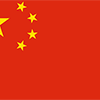
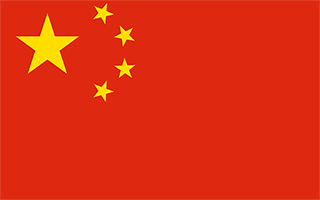
Red with a large yellow five-pointed star and four smaller yellow five-pointed stars (arranged in a vertical arc toward the middle of the flag) in the upper hoist-side corner; the color red represents revolution, while the stars symbolize the four social classes - the working class, the peasantry, the urban petty bourgeoisie, and the national bourgeoisie (capitalists) - united under the Communist Party of China.
For centuries China stood as a leading civilization, outpacing the rest of the world in the arts and sciences, but in the 19th and early 20th centuries, the country was beset by civil unrest, major famines, military defeats, and foreign occupation. After World War II, the communists under MAO Zedong established an autocratic socialist system that, while ensuring China's sovereignty, imposed strict controls over everyday life and cost the lives of tens of millions of people. After 1978, MAO's successor DENG Xiaoping and other leaders focused on market-oriented economic development and by 2000 output had quadrupled. For much of the population, living standards have improved dramatically and the room for personal choice has expanded, yet political controls remain tight. Since the early 1990s, China has increased its global outreach and participation in international organizations.
Geography
| Area | ||
|---|---|---|
| Total (World Rank: 5) | 9,596,960 | sq km |
| Land (World Rank: 3) | 9,326,410 | sq km |
| Water (World Rank: 5) | 270,550 | sq km |
| Forest (World Rank: 32) | 41.80 | % |
| Comparative | slightly smaller than the US | |
| Coastline | ||
| 14500 | ||
| Landborder | ||
| 22457 | ||
| Elevation | ||
| Lowest point (World Rank: 70) | -154 | m |
| Highest point (World Rank: 2) | 8,848 | m |
| Agricultural land | ||
| Total (World Rank: 59) | 54.70 | % |
| Arable (World Rank: 100) | 11.30 | % |
| Permanent crops (World Rank: 102) | 1.60 | % |
| Permanent pastures (World Rank: 32) | 41.80 | % |
| Irrigated land (World Rank: 1) | 690,070 | sq km |
| Map reference | ||
| Asia | ||
| Environment | ||
| Issues |
| |
| Agreement party |
| |
| Hazzards |
| |
| Location | ||
| Eastern Asia, bordering the East China Sea, Korea Bay, Yellow Sea, and South China Sea, between North Korea and Vietnam | ||
| Climate | ||
| extremely diverse; tropical in south to subarctic in north | ||
| Terrain | ||
| mostly mountains, high plateaus, deserts in west; plains, deltas, and hills in east | ||
People
| Population | ||
|---|---|---|
| Total (World Rank: 1) | 1,379,300,000 | |
| Deathrate (World Rank: 100) | 0.78 | % |
| Birthrate (World Rank: 159) | 1.23 | % |
| Growthrate (World Rank: 159) | 0.41 | % |
| Migration rate (World Rank: 86) | -0.04 | % |
| Fertility rate (World Rank: 180) | 1.60 | % |
| Median age | ||
| Male (World Rank: 63) | 36.50 | |
| Female (World Rank: 65) | 38.40 | |
| Age structure | ||
| 0 14 male (World Rank: 2) | 127,484,000 | |
| 0 14 female (World Rank: 2) | 109,113,000 | |
| 15 24 male (World Rank: 2) | 94,215,600 | |
| 15 24 female (World Rank: 2) | 82,050,600 | |
| 25 54 male (World Rank: 1) | 341,466,000 | |
| 25 54 female (World Rank: 1) | 327,661,000 | |
| 55 64 male (World Rank: 1) | 74,771,000 | |
| 55 64 female (World Rank: 1) | 73,441,200 | |
| 65 x male (World Rank: 1) | 71,103,000 | |
| 65 x female (World Rank: 1) | 77,996,000 | |
| Health | ||
| Infant mortality rate (World Rank: 120) | 1.20 | % |
| Life expectancy total (World Rank: 98) | 76 | years |
| Life expectancy female (World Rank: 110) | 78 | years |
| Life expectancy male (World Rank: 87) | 74 | years |
| Physicians per 1000 (World Rank: 96) | 1.49 | |
| Hospital bed per 1000 (World Rank: 55) | 3.80 | |
| Sanitation access total (World Rank: 131) | 76.50 | % |
| Obesity adult (World Rank: 169) | 6.20 | % |
| Drinking water access (World Rank: 107) | 95.50 | % |
Energy
| Electricity | ||
|---|---|---|
| Production (World Rank: 1) | 6,142,000,000,000 | kWh |
| Consumption (World Rank: 1) | 5,920,000,000,000 | kWh |
| Export (World Rank: 10) | 18,910,000,000 | kWh |
| Import (World Rank: 33) | 6,185,000,000 | kWh |
| Source fossil (World Rank: 118) | 64.00 | % |
| Source nuclear (World Rank: 137) | 2.00 | % |
| Source renew (World Rank: 51) | 13.70 | % |
| Crude oil | ||
| Production (World Rank: 6) | 3,981,000 | bbl / day |
| Exports (World Rank: 47) | 32,000 | bbl / day |
| Imports (World Rank: 2) | 6,167,000 | bbl / day |
| Proved reserves (World Rank: 13) | 25,620,000,000 | bbl |
| Refined products | ||
| Production (World Rank: 2) | 10,850,000 | bbl / day |
| Consumption (World Rank: 2) | 11,750,000 | bbl / day |
| Export (World Rank: 9) | 709,900 | bbl / day |
| Import (World Rank: 5) | 971,900 | bbl / day |
| Natural gas | ||
| Production (World Rank: 6) | 138,400,000,000 | m³ |
| Consumption (World Rank: 5) | 210,300,000,000 | m³ |
| Export (World Rank: 34) | 3,243,000,000 | m³ |
| Import (World Rank: 45) | 0 | m³ |
| Carbon footprint | ||
| 9135000000 | ||
Nation
| Budget | ||
|---|---|---|
| Military (World Rank: 51) | 2 | % of GDP |
| Health (World Rank: 128) | 6 | % of GDP |
| Surplus (World Rank: 127) | -4 | % of GDP |
| National symbol | ||
| giant panda | ||
| National colours | ||
| yellow | ||
| Adjective | ||
| Chinese | ||
| Noun | ||
| Chinese (singular and plural) | ||
| Background | ||
| For centuries China stood as a leading civilization, outpacing the rest of the world in the arts and sciences, but in the 19th and early 20th centuries, the country was beset by civil unrest, major famines, military defeats, and foreign occupation. After World War II, the communists under MAO Zedong established an autocratic socialist system that, while ensuring China's sovereignty, imposed strict controls over everyday life and cost the lives of tens of millions of people. After 1978, MAO's successor DENG Xiaoping and other leaders focused on market-oriented economic development and by 2000 output had quadrupled. For much of the population, living standards have improved dramatically and the room for personal choice has expanded, yet political controls remain tight. Since the early 1990s, China has increased its global outreach and participation in international organizations. | ||
| Flag description | ||
| red with a large yellow five-pointed star and four smaller yellow five-pointed stars (arranged in a vertical arc toward the middle of the flag) in the upper hoist-side corner; the color red represents revolution, while the stars symbolize the four social classes - the working class, the peasantry, the urban petty bourgeoisie, and the national bourgeoisie (capitalists) - united under the Communist Party of China | ||
Economy
| Gdp | ||
|---|---|---|
| Purchasing power parity (World Rank: 1) | 21,290,000,000,000 | USD |
| Real growth rate (World Rank: 18) | 6.70 | % |
| Per capita purchasing power parity (World Rank: 104) | 15,400 | USD |
| Source agriculture (World Rank: 99) | 8.60 | % |
| Source industry (World Rank: 23) | 39.80 | % |
| Source service (World Rank: 167) | 51.60 | % |
| Labourforce | ||
| Total (World Rank: 1) | 807,100,000 | |
| In poverty (World Rank: 167) | 3.30 | % |
| Products | ||
| Industries |
| |
| Agriculture |
| |
| Exports |
| |
| Imports |
| |
Communication
| Phone | ||
|---|---|---|
| Landline total (World Rank: 1) | 206,624,000 | |
| Landline per 100 (World Rank: 118) | 15.00 | |
| Mobile per 100 (World Rank: 136) | 99.00 | |
| Assessment | 0 | |
| Internet | ||
| Users (World Rank: 1) | 730,724,000 | |
| Population (World Rank: 115) | 53.20 | % |
Transport
| Air | ||
|---|---|---|
| Airports paved (World Rank: 5) | 463 | |
| Airports unpaved (World Rank: 63) | 44.00 | |
| Heliports (World Rank: 6) | 47.00 | |
| Rail | ||
| Total length (World Rank: 2) | 124,000 | |
| Road | ||
| Total length (World Rank: 3) | 4,577,300 | |
| Paved length (World Rank: 2) | 4,046,300 | |
| Unpaved length (World Rank: 5) | 531,000 | |
| Water | ||
| Total length (World Rank: 1) | 110,000 | |
This is a list of famous places in this country in alphabetical order.
 Anqing
- Anyang
- Baotou
- Beijing
- Changchun
- Changsha
- Changzhou
- Chaozhou
- Chengdu
- Chongqing
- Dalian
- Dezhou
- Dongguan
- Foshan
- Fuzhou
- Guangzhou
- Guilin
- Guiyang
- Haikou
- Hangzhou
- Harbin
- Hefei
- Hegang
- Heze
- Hohhot
- Huangshi
- Huizhou
- Ji'an
- Jiangmen
- Jiaxing
- Jieyang
- Jilin
- Jinan
- Jingdezhen
- Jinhua
- Jiujiang
- Jixi
- Kashgar
- Korla
- Kunming
- Lanzhou
- Lhasa
- Mudanjiang
- Nanchang
- Nanchong
- Nanjing
- Nanning
- Nanping
- Nantong
- Neijiang
- Ningbo
- Pingxiang
- Putian
- Puyang
- Qingdao
- Qinhuangdao
- Qiqihar
- Quanzhou
- Sanya
- Shanghai
- Shangrao
- Shantou
- Shaoguan
- Shaoxing
- Shenyang
- Shenzhen
- Shijiazhuang
- Shiyan
- Suzhou
- Taiyuan
- Taizhou
- Tianjin
- Tongliao
- Tongshan
- UEruemqi
- Weihai
- Wuhai
- Wuhan
- Wuhu
- Wuxi
- Wuzhou
- Xi-an
- Xiamen
- Xiangyang
- Xianyang
- Xining
- Yancheng
- Yangjiang
- Yangquan
- Yinchuan
- Yingkou
- Yunfu
- Zhangzhou
- Zhanjiang
- Zhaoqing
- Zhengzhou
- Zhenjiang
- Zhoukou
- Zhuhai
- Zhuzhou