Hungary
in Eastern Europe
Europe
 Austria
 Croatia
 Romania
 Serbia
 Slovakia
 Slovenia
 Ukraine
- Currency and Currency Code:
- Forint - HUF
- Spoken languages:
- Hungarian
- Local electricity:
- 230 V - 50 Hz (plugs: C, F)
- Mobile phone / cellular frequencies (MHz):
- 900 MHz, 1800 MHz, 3G, 4G
- ISO 2-Letter code:
- HU
- Internet top level domain:
- .hu
- Country phone prefix:
- +36
- Local Time (capital):
- Timezone:
- UTC/GMT offset: hours
Safety Score: 2,8 of 5.0 based on data from 9 authorites. Meaning we advice caution when travelling to Hungary.
Travel warnings are updated daily. Source: Travel Warning Hungary. Last Update: 2024-04-26 08:02:42
Explore Hungary
Hungary with its capital Budapest is located in Europe (Central Europe, northwest of Romania). It covers some 93,029 square kilometers (slightly smaller than Virginia) with 9,850,840 citizens. Hungarian is the language commonly spoken used by the people in Hungary. Austria, Croatia, Romania, Serbia, Slovakia, Slovenia and Ukraine are bordering countries.
Hungary is a country in Central Europe. Hungary is one of the 15 most popular tourist destinations in the world, with a capital regarded as one of the most beautiful in the world. Despite its relatively small size, the country is home to numerous World Heritage Sites, UNESCO Biosphere reserves, the second largest thermal lake in the world (Lake Hévíz), the largest lake in Central Europe (Lake Balaton), and the largest natural grassland in Europe (Hortobágy).
Popular Destinations in Hungary
Administrative regions of Hungary
- Bacs-Kiskun county
- Baranya
- Bekes
- Borsod-Abauj Zemplen county
- Budapest
- Csongrad megye
- Fejer megye
- Gyor-Moson-Sopron megye
- Hajdu-Bihar
- Heves megye
- Jasz-Nagykun-Szolnok
- Komarom-Esztergom
- Nograd megye
- Pest megye
- Somogy megye
- Szabolcs-Szatmar-Bereg
- Tolna megye
- Vas megye
- Veszprem megye
- Zala megye
About the country
Website: Hungary Tourism
The landscape is mostly flat to rolling plains and hills and low mountains on the Slovakian border. The average density of population is about 106 per km². The climate in Hungary can be described as temperatecold, cloudy, humid winters, warm summers.
To reach someone Hungary dial +36 prior to a number. The local cellular networks are operated on 900 MHz, 1800 MHz, 3G, 4G. Websites typically end with the top level domain ".hu". If you want to bring electric appliances (e.g. battery chaarger), keep in min the local 230 V - 50 Hz (plugs: C, F). The sign for the locally used currency Forint is HUF.
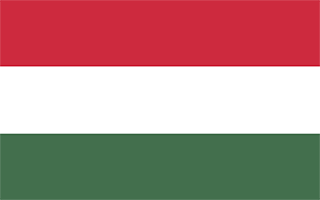
Three equal horizontal bands of red (top), white, and green; the flag dates to the national movement of the 18th and 19th centuries, and fuses the medieval colors of the Hungarian coat of arms with the revolutionary tricolor form of the French flag; folklore attributes virtues to the colors: red for strength, white for faithfulness, and green for hope; alternatively, the red is seen as being for the blood spilled in defense of the land, white for freedom, and green for the pasturelands that make up so much of the country.
Hungary became a Christian kingdom in A.D. 1000 and for many centuries served as a bulwark against Ottoman Turkish expansion in Europe. The kingdom eventually became part of the polyglot Austro-Hungarian Empire, which collapsed during World War I. The country fell under communist rule following World War II. In 1956, a revolt and an announced withdrawal from the Warsaw Pact were met with a massive military intervention by Moscow. Under the leadership of Janos KADAR in 1968, Hungary began liberalizing its economy, introducing so-called "Goulash Communism." Hungary held its first multiparty elections in 1990 and initiated a free market economy. It joined NATO in 1999 and the EU five years later.
Geography
| Area | ||
|---|---|---|
| Total (World Rank: 111) | 93,028 | sq km |
| Land (World Rank: 110) | 89,608 | sq km |
| Water (World Rank: 78) | 3,420 | sq km |
| Forest (World Rank: 136) | 8.40 | % |
| Comparative | slightly smaller than Virginia; about the same size as Indiana | |
| Landborder | ||
| 2106 | ||
| Elevation | ||
| Lowest point (World Rank: 29) | 78 | m |
| Highest point (World Rank: 163) | 1,014 | m |
| Agricultural land | ||
| Total (World Rank: 47) | 58.90 | % |
| Arable (World Rank: 8) | 48.50 | % |
| Permanent crops (World Rank: 92) | 2.00 | % |
| Permanent pastures (World Rank: 136) | 8.40 | % |
| Irrigated land (World Rank: 80) | 1,721 | sq km |
| Map reference | ||
| Europe | ||
| Environment | ||
| Issues |
| |
| Agreement party |
| |
| Location | ||
| Central Europe, northwest of Romania | ||
| Climate | ||
| temperate; cold, cloudy, humid winters; warm summers | ||
| Terrain | ||
| mostly flat to rolling plains; hills and low mountains on the Slovakian border | ||
People
| Population | ||
|---|---|---|
| Total (World Rank: 92) | 9,850,840 | |
| Deathrate (World Rank: 16) | 1.28 | % |
| Birthrate (World Rank: 203) | 0.90 | % |
| Growthrate (World Rank: 208) | -0.25 | % |
| Migration rate (World Rank: 53) | 0.13 | % |
| Fertility rate (World Rank: 201) | 1.45 | % |
| Median age | ||
| Male (World Rank: 31) | 40.40 | |
| Female (World Rank: 23) | 44.30 | |
| Age structure | ||
| 0 14 male (World Rank: 110) | 746,043 | |
| 0 14 female (World Rank: 111) | 702,792 | |
| 15 24 male (World Rank: 102) | 557,655 | |
| 15 24 female (World Rank: 103) | 522,324 | |
| 25 54 male (World Rank: 83) | 2,075,100 | |
| 25 54 female (World Rank: 84) | 2,050,480 | |
| 55 64 male (World Rank: 60) | 608,734 | |
| 55 64 female (World Rank: 55) | 711,602 | |
| 65 x male (World Rank: 53) | 708,214 | |
| 65 x female (World Rank: 47) | 1,167,900 | |
| Health | ||
| Infant mortality rate (World Rank: 174) | 0.49 | % |
| Life expectancy total (World Rank: 87) | 76 | years |
| Life expectancy female (World Rank: 78) | 80 | years |
| Life expectancy male (World Rank: 112) | 72 | years |
| Physicians per 1000 (World Rank: 30) | 3.32 | |
| Hospital bed per 1000 (World Rank: 11) | 7.20 | |
| Sanitation access total (World Rank: 45) | 98.00 | % |
| Obesity adult (World Rank: 42) | 26.40 | % |
| Drinking water access (World Rank: 15) | 100.00 | % |
Energy
| Electricity | ||
|---|---|---|
| Production (World Rank: 65) | 28,670,000,000 | kWh |
| Consumption (World Rank: 57) | 38,660,000,000 | kWh |
| Export (World Rank: 34) | 5,240,000,000 | kWh |
| Import (World Rank: 12) | 17,950,000,000 | kWh |
| Source fossil (World Rank: 116) | 64.50 | % |
| Source nuclear (World Rank: 81) | 22.30 | % |
| Source renew (World Rank: 50) | 14.10 | % |
| Crude oil | ||
| Production (World Rank: 76) | 13,830 | bbl / day |
| Exports (World Rank: 72) | 1,042 | bbl / day |
| Imports (World Rank: 41) | 120,400 | bbl / day |
| Proved reserves (World Rank: 84) | 25,100,000 | bbl |
| Refined products | ||
| Production (World Rank: 57) | 156,100 | bbl / day |
| Consumption (World Rank: 66) | 157,200 | bbl / day |
| Export (World Rank: 51) | 50,510 | bbl / day |
| Import (World Rank: 69) | 67,860 | bbl / day |
| Natural gas | ||
| Production (World Rank: 59) | 1,772,000,000 | m³ |
| Consumption (World Rank: 46) | 17,140,000,000 | m³ |
| Export (World Rank: 41) | 545,000,000 | m³ |
| Import (World Rank: 62) | 0 | m³ |
| Carbon footprint | ||
| 44200000 | ||
Nation
| Budget | ||
|---|---|---|
| Education (World Rank: 101) | 4 | % of GDP |
| Military (World Rank: 112) | 1 | % of GDP |
| Health (World Rank: 67) | 7 | % of GDP |
| Surplus (World Rank: 77) | -2 | % of GDP |
| National symbol | ||
| Holy Crown of Hungary | ||
| National colours | ||
| white | ||
| Adjective | ||
| Hungarian | ||
| Noun | ||
| Hungarian(s) | ||
| Background | ||
| Hungary became a Christian kingdom in A.D. 1000 and for many centuries served as a bulwark against Ottoman Turkish expansion in Europe. The kingdom eventually became part of the polyglot Austro-Hungarian Empire, which collapsed during World War I. The country fell under communist rule following World War II. In 1956, a revolt and an announced withdrawal from the Warsaw Pact were met with a massive military intervention by Moscow. Under the leadership of Janos KADAR in 1968, Hungary began liberalizing its economy, introducing so-called "Goulash Communism." Hungary held its first multiparty elections in 1990 and initiated a free market economy. It joined NATO in 1999 and the EU five years later. | ||
| Flag description | ||
| three equal horizontal bands of red (top), white, and green; the flag dates to the national movement of the 18th and 19th centuries, and fuses the medieval colors of the Hungarian coat of arms with the revolutionary tricolor form of the French flag; folklore attributes virtues to the colors: red for strength, white for faithfulness, and green for hope; alternatively, the red is seen as being for the blood spilled in defense of the land, white for freedom, and green for the pasturelands that make up so much of the country | ||
Economy
| Gdp | ||
|---|---|---|
| Purchasing power parity (World Rank: 60) | 270,100,000,000 | USD |
| Real growth rate (World Rank: 139) | 2.00 | % |
| Per capita purchasing power parity (World Rank: 66) | 27,500 | USD |
| Source agriculture (World Rank: 130) | 4.50 | % |
| Source industry (World Rank: 74) | 30.40 | % |
| Source service (World Rank: 90) | 65.10 | % |
| Labourforce | ||
| Total (World Rank: 88) | 4,586,000 | |
| In poverty (World Rank: 133) | 14.90 | % |
| Products | ||
| Industries |
| |
| Agriculture |
| |
| Exports |
| |
| Imports |
| |
Communication
| Phone | ||
|---|---|---|
| Landline total (World Rank: 48) | 3,119,740 | |
| Landline per 100 (World Rank: 61) | 32.00 | |
| Mobile per 100 (World Rank: 79) | 119.00 | |
| Assessment | 0 | |
| Internet | ||
| Users (World Rank: 54) | 7,826,700 | |
| Population (World Rank: 48) | 79.30 | % |
Transport
| Air | ||
|---|---|---|
| Airports paved (World Rank: 80) | 20.00 | |
| Airports unpaved (World Rank: 103) | 21.00 | |
| Heliports (World Rank: 50) | 3.00 | |
| Rail | ||
| Total length (World Rank: 28) | 8,049 | |
| Road | ||
| Total length (World Rank: 26) | 203,601 | |
| Paved length (World Rank: 32) | 77,087 | |
| Unpaved length (World Rank: 19) | 126,514 | |
| Water | ||
| Total length (World Rank: 49) | 1,622 | |
This is a list of famous places in this country in alphabetical order.
 Ajka
Ajka- Baja
- Balassagyarmat
- Balatonfured
- Barcs
- Bekes
- Bekescsaba
- Budapest
- Cegled
- Celldomolk
- Csongrad
- Dabas
- Debrecen
- Dombovar
- Dunakeszi
- Dunaujvaros
- Edeleny
- Eger
- Erd
- Esztergom
- Godollo
- Gyal
- Gyomaendrod
- Gyongyos
- Gyor
- Gyula
- Hajduboszormeny
- Hajduszoboszlo
- Hatvan
- Heves
- Hodmezovasarhely
- Janoshalma
- Jaszbereny
- Kalocsa
- Kaposvar
- Karcag
- Kazincbarcika
- Kecskemet
- Keszthely
- Kiskoros
- Kiskunfelegyhaza
- Kiskunhalas
- Kistelek
- Komarom
- Koszeg
- Kunszentmarton
- Kunszentmiklos
- Lenti
- Mako
- Mateszalka
- Mezokovacshaza
- Mezotur
- Miskolc
- Mohacs
- Monor
- Mor
- Mosonmagyarovar
- Nagykanizsa
- Nagykata
- Nagykoros
- Nyirbator
- Nyiregyhaza
- Oroshaza
- Ozd
- Papa
- Paszto
- Pecs
- Puspokladany
- Rackeve
- Salgotarjan
- Sarkad
- Sarospatak
- Satoraljaujhely
- Siklos
- Siofok
- Sopron
- Szarvas
- Szeged
- Szekesfehervar
- Szekszard
- Szentendre
- Szerencs
- Szigetszentmiklos
- Szigetvar
- Szolnok
- Szombathely
- Tamasi
- Tata
- Tatabanya
- Tiszafured
- Tiszakecske
- Tiszavasvari
- Tokaj
- Tolna
- Torokszentmiklos
- Vac
- Varpalota
- Veszprem
- Zalaegerszeg
- Zalaszentgrot