Slovenia
in Southern Europe
Europe
 Austria
 Croatia
 Hungary
 Italy
Italy- Currency and Currency Code:
- Euro - EUR
- Spoken languages:
- Slovenian, Serbo-Croatian
- Local electricity:
- 230 V - 50 Hz (plugs: C, F)
- Mobile phone / cellular frequencies (MHz):
- 900 MHz, 1800 MHz, 3G, 4G
- ISO 2-Letter code:
- SI
- Internet top level domain:
- .si
- Country phone prefix:
- +386
- Local Time (capital):
- Timezone:
- UTC/GMT offset: hours
Safety Score: 3,0 of 5.0 based on data from 9 authorites. Meaning we advice caution when travelling to Slovenia.
Travel warnings are updated daily. Source: Travel Warning Slovenia. Last Update: 2024-04-26 08:02:42
Explore Slovenia
Slovenia with its capital Ljubljana is located in Europe (south Central Europe, Julian Alps between Austria and Croatia). It covers some 20,274 square kilometers (slightly smaller than New Jersey) with 1,972,130 citizens. Slovenian and Serbo-Croatian are the common languages used in Slovenia. Austria, Croatia, Hungary and Italy are bordering countries.
Slovenia is a country in Central Europe that lies in the eastern Alps at the northern end of the Adriatic Sea, with Austria to the north, Italy to the southwest, Hungary to the northeast and Croatia to the south. There are many great opportunities for activity holidays in Slovenia: The mountains and rivers of the Julian Alps provide the perfect location for hiking, mountain biking, rafting and kayaking. The southern part of Slovenia is an area of numerous caves. You can enjoy different spa resorts in the eastern part, take a dive in the Adriatic Sea, experience the Slovene cities, go skiing, or enjoy in the countryside tasting Slovene cuisine and local wine.
Popular Destinations in Slovenia
Administrative regions of Slovenia
- Beltinci
- Benedikt
- Bistrica ob Sotli
- Bloke
- Bohinj
- Borovnica
- Brda
- Brezovica
- Cankova
- Celje
- Cerklje na Gorenjskem
- Cerknica
- Cerkno
- Cerkvenjak
- Cirkulane
- Comune di Ancarano
- Destrnik
- Dobje
- Dobrepolje
- Dobrna
- Dobrova-Polhov Gradec
- Dobrovnik
- Dol pri Ljubljani
- Dolenjske Toplice
- Dornava
- Dravograd
- Duplek
- Gorenja Vas-Poljane
- Gorje
- Gornja Radgona
- Gornji Grad
- Gornji Petrovci
- Grad
- Grosuplje
- Hajdina
- Hodos
- Horjul
- Hrastnik
- Hrpelje-Kozina
- Idrija
- Ig
- Ilirska Bistrica
- Izola
- Jesenice
- Jezersko
- Kamnik
- Kanal
- Kobilje
- Komen
- Komenda
- Koper
- Kostanjevica na Krki
- Kostel
- Kozje
- Kranj
- Kranjska Gora
- Kungota
- Kuzma
- Lenart
- Lendava
- Litija
- Ljubljana
- Ljubno
- Ljutomer
- Log-Dragomer
- Logatec
- Lovrenc na Pohorju
- Lukovica
- Makole
- Maribor
- Markovci
- Medvode
- Mestna Obcina Novo mesto
- Metlika
- Miren-Kostanjevica
- Mirna
- Mislinja
- Mokronog-Trebelno
- Moravske Toplice
- Mozirje
- Murska Sobota
- Muta
- Naklo
- Nazarje
- Nova Gorica
- Obcina Ajdovscina
- Obcina Apace
- Obcina Bled
- Obcina Bovec
- Obcina Braslovce
- Obcina Brezice
- Obcina Crensovci
- Obcina Crna na Koroskem
- Obcina Crnomelj
- Obcina Divaca
- Obcina Domzale
- Obcina Gorisnica
- Obcina Hoce-Slivnica
- Obcina Ivancna Gorica
- Obcina Jursinci
- Obcina Kidricevo
- Obcina Kobarid
- Obcina Kocevje
- Obcina Krizevci
- Obcina Krsko
- Obcina Lasko
- Obcina Loska Dolina
- Obcina Loski Potok
- Obcina Luce
- Obcina Majsperk
- Obcina Menges
- Obcina Mezica
- Obcina Miklavz na Dravskem Polju
- Obcina Mirna Pec
- Obcina Moravce
- Obcina Ormoz
- Obcina Podcetrtek
- Obcina Poljcane
- Obcina Race-Fram
- Obcina Radece
- Obcina Ravne na Koroskem
- Obcina Razkrizje
- Obcina Recica ob Savinji
- Obcina Rence-Vogrsko
- Obcina Rogaska Slatina
- Obcina Rogasovci
- Obcina Ruse
- Obcina Salovci
- Obcina Semic
- Obcina Sempeter-Vrtojba
- Obcina Sencur
- Obcina Sentilj
- Obcina Sentjernej
- Obcina Sentjur
- Obcina Sentrupert
- Obcina Sezana
- Obcina Skocjan
- Obcina Skofja Loka
- Obcina Skofljica
- Obcina Smarje pri Jelsah
- Obcina Smarjeske Toplice
- Obcina Smartno ob Paki
- Obcina Smartno pri Litiji
- Obcina Sodrazica
- Obcina Solcava
- Obcina Sostanj
- Obcina Sredisce ob Dravi
- Obcina Starse
- Obcina Store
- Obcina Straza
- Obcina Sveti Andraz v Slovenskih Goricah
- Obcina Sveti Jurij ob Scavnici
- Obcina Sveti Tomaz
- Obcina Tisina
- Obcina Tolmin
- Obcina Trnovska vas
- Obcina Trzic
- Obcina Turnisce
- Obcina Velike Lasce
- Obcina Verzej
- Obcina Zalec
- Obcina Zavrc
- Obcina Zelezniki
- Obcina Zetale
- Obcina Ziri
- Obcina Zirovnica
- Obcina Zrece
- Obcina Zuzemberk
- Odranci
- Oplotnica
- Osilnica
- Pesnica
- Piran
- Pivka
- Podlehnik
- Podvelka
- Polzela
- Postojna
- Prebold
- Preddvor
- Prevalje
- Ptuj
- Puconci
- Radenci
- Radlje ob Dravi
- Radovljica
- Ribnica
- Ribnica na Pohorju
- Rogatec
- Selnica ob Dravi
- Sevnica
- Slovenj Gradec
- Slovenska Bistrica
- Slovenske Konjice
- Sveta Ana
- Sveta Trojica v Slovenskih Goricah
- Sveti Jurij v Slovenskih Goricah
- Tabor
- Trbovlje
- Trebnje
- Trzin
- Velenje
- Velika Polana
- Videm
- Vipava
- Vitanje
- Vodice
- Vojnik
- Vransko
- Vrhnika
- Vuzenica
- Zagorje ob Savi
About the country
Website: Slovenia Tourism
Dimiceva 13
1504 Ljubljana
Slovenia
Phone: +386 1 58 98 000
Fax: +386 1 58 98 100 or 58 98 200
Mail: infolink@gzs.si
The landscape is a short southwestern coastal strip of Karst topography on the Adriatic with an alpine mountain region lies adjacent to Italy and Austria in the north as well as mixed mountains and valleys with numerous rivers to the east. The average density of population is about 97 per km². The climate in Slovenia can be described as Mediterranean climate on the coast, continental climate with mild to hot summers and cold winters in the plateaus and valleys to the east. Potential threats by nature are earthquakes flooding
To reach someone Slovenia dial +386 prior to a number. The local cellular networks are operated on 900 MHz, 1800 MHz, 3G, 4G. Websites typically end with the top level domain ".si". If you want to bring electric appliances (e.g. battery chaarger), keep in min the local 230 V - 50 Hz (plugs: C, F). The sign for the locally used currency Euro is EUR.
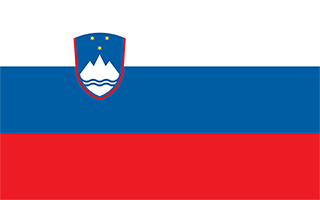
Three equal horizontal bands of white (top), blue, and red, derive from the medieval coat of arms of the Duchy of Carniola; the Slovenian seal (a shield with the image of Triglav, Slovenia's highest peak, in white against a blue background at the center; beneath it are two wavy blue lines depicting seas and rivers, and above it are three six-pointed stars arranged in an inverted triangle, which are taken from the coat of arms of the Counts of Celje, the prominent Slovene dynastic house of the late 14th and early 15th centuries) appears in the upper hoist side of the flag centered on the white and blue bands.
The Slovene lands were part of the Austro-Hungarian Empire until the latter's dissolution at the end of World War I. In 1918, the Slovenes joined the Serbs and Croats in forming a new multinational state, which was named Yugoslavia in 1929. After World War II, Slovenia became a republic of the renewed Yugoslavia, which though communist, distanced itself from Moscow's rule. Dissatisfied with the exercise of power by the majority Serbs, the Slovenes succeeded in establishing their independence in 1991 after a short 10-day war. Historical ties to Western Europe, a strong economy, and a stable democracy have assisted in Slovenia's transformation to a modern state. Slovenia acceded to both NATO and the EU in the spring of 2004; it joined the euro zone and the Schengen zone in 2007.
Geography
| Area | ||
|---|---|---|
| Total (World Rank: 155) | 20,273 | sq km |
| Land (World Rank: 153) | 20,151 | sq km |
| Water (World Rank: 143) | 122 | sq km |
| Forest (World Rank: 118) | 13.10 | % |
| Comparative | slightly smaller than New Jersey | |
| Coastline | ||
| 46.6 | ||
| Landborder | ||
| 1211 | ||
| Elevation | ||
| Highest point (World Rank: 80) | 2,864 | m |
| Agricultural land | ||
| Total (World Rank: 155) | 22.80 | % |
| Arable (World Rank: 126) | 8.40 | % |
| Permanent crops (World Rank: 111) | 1.30 | % |
| Permanent pastures (World Rank: 118) | 13.10 | % |
| Irrigated land (World Rank: 147) | 60 | sq km |
| Map reference | ||
| Europe | ||
| Environment | ||
| Issues |
| |
| Agreement party |
| |
| Hazzards |
| |
| Location | ||
| south Central Europe, Julian Alps between Austria and Croatia | ||
| Climate | ||
| Mediterranean climate on the coast, continental climate with mild to hot summers and cold winters in the plateaus and valleys to the east | ||
| Terrain | ||
| a short southwestern coastal strip of Karst topography on the Adriatic; an alpine mountain region lies adjacent to Italy and Austria in the north; mixed mountains and valleys with numerous rivers to the east | ||
People
| Population | ||
|---|---|---|
| Total (World Rank: 147) | 1,972,130 | |
| Deathrate (World Rank: 26) | 1.16 | % |
| Birthrate (World Rank: 218) | 0.82 | % |
| Growthrate (World Rank: 212) | -0.31 | % |
| Migration rate (World Rank: 63) | 0.04 | % |
| Fertility rate (World Rank: 210) | 1.36 | % |
| Median age | ||
| Male (World Rank: 13) | 42.80 | |
| Female (World Rank: 8) | 46.20 | |
| Age structure | ||
| 0 14 male (World Rank: 158) | 135,371 | |
| 0 14 female (World Rank: 159) | 127,246 | |
| 15 24 male (World Rank: 155) | 95,546 | |
| 15 24 female (World Rank: 155) | 90,744 | |
| 25 54 male (World Rank: 145) | 427,723 | |
| 25 54 female (World Rank: 145) | 418,349 | |
| 55 64 male (World Rank: 131) | 143,642 | |
| 55 64 female (World Rank: 131) | 148,821 | |
| 65 x male (World Rank: 114) | 157,794 | |
| 65 x female (World Rank: 110) | 226,890 | |
| Health | ||
| Infant mortality rate (World Rank: 190) | 0.39 | % |
| Life expectancy total (World Rank: 60) | 78 | years |
| Life expectancy female (World Rank: 48) | 82 | years |
| Life expectancy male (World Rank: 71) | 75 | years |
| Physicians per 1000 (World Rank: 51) | 2.77 | |
| Hospital bed per 1000 (World Rank: 45) | 4.60 | |
| Sanitation access total (World Rank: 34) | 99.10 | % |
| Obesity adult (World Rank: 103) | 20.20 | % |
| Drinking water access (World Rank: 57) | 99.50 | % |
Energy
| Electricity | ||
|---|---|---|
| Production (World Rank: 83) | 16,530,000,000 | kWh |
| Consumption (World Rank: 79) | 14,570,000,000 | kWh |
| Export (World Rank: 21) | 10,280,000,000 | kWh |
| Import (World Rank: 29) | 8,325,000,000 | kWh |
| Source fossil (World Rank: 183) | 31.80 | % |
| Source nuclear (World Rank: 58) | 34.40 | % |
| Source renew (World Rank: 123) | 1.70 | % |
| Crude oil | ||
| Production (World Rank: 100) | 5 | bbl / day |
| Refined products | ||
| Consumption (World Rank: 102) | 52,300 | bbl / day |
| Export (World Rank: 61) | 28,400 | bbl / day |
| Import (World Rank: 59) | 87,530 | bbl / day |
| Natural gas | ||
| Production (World Rank: 98) | 4,500,000 | m³ |
| Consumption (World Rank: 101) | 836,500,000 | m³ |
| Import (World Rank: 38) | 0 | m³ |
| Carbon footprint | ||
| 14300000 | ||
Nation
| Budget | ||
|---|---|---|
| Education (World Rank: 44) | 6 | % of GDP |
| Military (World Rank: 121) | 1 | % of GDP |
| Health (World Rank: 36) | 9 | % of GDP |
| Surplus (World Rank: 79) | -2 | % of GDP |
| National symbol | ||
| Mount Triglav | ||
| National colours | ||
| white | ||
| Adjective | ||
| Slovenian | ||
| Noun | ||
| Slovene(s) | ||
| Background | ||
| The Slovene lands were part of the Austro-Hungarian Empire until the latter's dissolution at the end of World War I. In 1918, the Slovenes joined the Serbs and Croats in forming a new multinational state, which was named Yugoslavia in 1929. After World War II, Slovenia became a republic of the renewed Yugoslavia, which though communist, distanced itself from Moscow's rule. Dissatisfied with the exercise of power by the majority Serbs, the Slovenes succeeded in establishing their independence in 1991 after a short 10-day war. Historical ties to Western Europe, a strong economy, and a stable democracy have assisted in Slovenia's transformation to a modern state. Slovenia acceded to both NATO and the EU in the spring of 2004; it joined the euro zone and the Schengen zone in 2007. | ||
| Flag description | ||
| three equal horizontal bands of white (top), blue, and red, derive from the medieval coat of arms of the Duchy of Carniola; the Slovenian seal (a shield with the image of Triglav, Slovenia's highest peak, in white against a blue background at the center; beneath it are two wavy blue lines depicting seas and rivers, and above it are three six-pointed stars arranged in an inverted triangle, which are taken from the coat of arms of the Counts of Celje, the prominent Slovene dynastic house of the late 14th and early 15th centuries) appears in the upper hoist side of the flag centered on the white and blue bands | ||
Economy
| Gdp | ||
|---|---|---|
| Purchasing power parity (World Rank: 99) | 66,500,000,000 | USD |
| Real growth rate (World Rank: 94) | 3.10 | % |
| Per capita purchasing power parity (World Rank: 56) | 32,200 | USD |
| Source agriculture (World Rank: 166) | 2.30 | % |
| Source industry (World Rank: 65) | 32.40 | % |
| Source service (World Rank: 87) | 65.30 | % |
| Labourforce | ||
| Total (World Rank: 147) | 920,400 | |
| In poverty (World Rank: 135) | 14.30 | % |
| Products | ||
| Industries |
| |
| Agriculture |
| |
| Exports |
| |
| Imports |
| |
Communication
| Phone | ||
|---|---|---|
| Landline total (World Rank: 88) | 731,320 | |
| Landline per 100 (World Rank: 45) | 37.00 | |
| Mobile per 100 (World Rank: 73) | 121.00 | |
| Assessment | 0 | |
| Internet | ||
| Users (World Rank: 120) | 1,493,380 | |
| Population (World Rank: 63) | 75.50 | % |
Transport
| Air | ||
|---|---|---|
| Airports paved (World Rank: 131) | 7.00 | |
| Airports unpaved (World Rank: 135) | 9.00 | |
| Rail | ||
| Total length (World Rank: 86) | 1,229 | |
| Road | ||
| Total length (World Rank: 91) | 38,985 | |
| Paved length (World Rank: 52) | 38,985 | |
This is a list of famous places in this country in alphabetical order.
 Ajdovscina
- Ankaran
- Beltinci
- Bled
- Bohinjska Bistrica
- Borovnica
- Bovec
- Brezice
- Celje
- Cerklje na Gorenjskem
- Cerknica
- Crnomelj
- Divaca
- Domzale
- Dornava
- Dravograd
- Gornja Radgona
- Grad
- Grosuplje
- Hrastnik
- Idrija
- Izola
- Jesenice
- Kamnik
- Kanal
- Kobarid
- Kocevje
- Koper
- Kostanjevica na Krki
- Kranj
- Krsko
- Lasko
- Lenart v Slov. Goricah
- Lendava
- Litija
- Ljubljana
- Ljutomer
- Logatec
- Maribor
- Medvode
- Menges
- Metlika
- Mezica
- Miklavz na Dravskem Polju
- Mirna
- Mirna Pec
- Mislinja
- Mozirje
- Murska Sobota
- Muta
- Nova Gorica
- Novo Mesto
- Odranci
- Oplotnica
- Ormoz
- Piran
- Pivka
- Podcetrtek
- Polzela
- Postojna
- Prebold
- Prevalje
- Ptuj
- Race
- Radece
- Radenci
- Radlje ob Dravi
- Radovljica
- Ravne na Koroskem
- Ribnica
- Rogaska Slatina
- Rogatec
- Ruse
- Semic
- Sempeter pri Gorici
- Sentilj v Slov. Goricah
- Sentjur
- Sezana
- Skofja Loka
- Slovenj Gradec
- Slovenska Bistrica
- Slovenske Konjice
- Smartno pri Litiji
- Sostanj
- Spodnje Hoce
- Sredisce ob Dravi
- Store
- Straza
- Tolmin
- Trbovlje
- Trebnje
- Trzic
- Velenje
- Vipava
- Vrhnika
- Zagorje ob Savi
- Zalec
- Ziri
- Zirovnica
- Zuzemberk