Uganda
in Eastern Africa
Africa
 Democratic Republic of the Congo
 Kenya
Kenya Rwanda
 South Sudan
 Tanzania
- Currency and Currency Code:
- Shilling - UGX
- Spoken languages:
- English, Ganda, Swahili, Arabic
- Local electricity:
- 240 V - 50 Hz (plugs: G)
- Mobile phone / cellular frequencies (MHz):
- 900 MHz, 1800 MHz, 3G, 4G
- ISO 2-Letter code:
- UG
- Internet top level domain:
- .ug
- Country phone prefix:
- +256
- Local Time (capital):
- Timezone:
- UTC/GMT offset: hours
Safety Score: 3,5 of 5.0 based on data from 9 authorites. Meaning please reconsider your need to travel to Uganda.
Travel warnings are updated daily. Source: Travel Warning Uganda. Last Update: 2024-05-04 08:22:41
Explore Uganda
Uganda with its capital Kampala is located in Africa (East-Central Africa, west of Kenya). It covers some 241,039 square kilometers (slightly more than two times the size of Pennsylvania) with 39,570,100 citizens. English, Ganda, Swahili and Arabic are the common languages used in Uganda (consider regional differences). Democratic Republic of the Congo, Kenya, Rwanda, South Sudan and Tanzania are bordering countries.
Uganda is a country in East Africa. It is bordered to the east by Kenya, to the north by South Sudan, to the west by the Democratic Republic of the Congo, to the southwest by Rwanda, and to the south by Tanzania. Most travellers come for the gorilla Safari, but other major draws are the chimpanzees, ornithology, trekking the Rwenzoris and visiting the source of The Nile river. Uganda has a variety of landscapes which most tourists find interesting. The North is relatively flat and dry savanna while the East is mountainous and lush and the centre of Uganda hosts larges forests. The national parks are beautiful and, on the whole, uncrowded. See the Uganda Wildlife Authority (UWA) website [3] or for details of gorilla tracking, safaris, chimpanzee tracking and more. Prices in several parks seem to be set at 20 (1 day), 35 (2 days). An ISIC student card cuts you a 25% off the entrance fees these days.
Popular Destinations in Uganda
Administrative regions of Uganda
About the country
The landscape is mostly plateau with rim of mountains. The average density of population is about 164 per km². The climate in Uganda can be described as tropicalgenerally rainy with two dry seasons (December to February, June to August), semiarid in northeast. Potential threats by nature are droughts, earthquakes, floods, hailstorms and landslides.
To reach someone Uganda dial +256 prior to a number. The local cellular networks are operated on 900 MHz, 1800 MHz, 3G, 4G. Websites typically end with the top level domain ".ug". If you want to bring electric appliances (e.g. battery chaarger), keep in min the local 240 V - 50 Hz (plugs: G). The sign for the locally used currency Shilling is UGX.
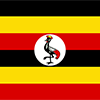
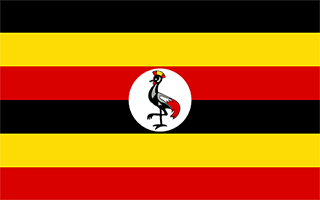
Six equal horizontal bands of black (top), yellow, red, black, yellow, and red; a white disk is superimposed at the center and depicts a grey crowned crane (the national symbol) facing the hoist side; black symbolizes the African people, yellow sunshine and vitality, red African brotherhood; the crane was the military badge of Ugandan soldiers under the UK.
The colonial boundaries created by Britain to delimit Uganda grouped together a wide range of ethnic groups with different political systems and cultures. These differences complicated the establishment of a working political community after independence was achieved in 1962. The dictatorial regime of Idi AMIN (1971-79) was responsible for the deaths of some 300,000 opponents; guerrilla war and human rights abuses under Milton OBOTE (1980-85) claimed at least another 100,000 lives. The rule of Yoweri MUSEVENI since 1986 has brought relative stability and economic growth to Uganda. A constitutional referendum in 2005 cancelled a 19-year ban on multi-party politics and lifted presidential term limits.
Geography
| Area | ||
|---|---|---|
| Total (World Rank: 82) | 241,038 | sq km |
| Land (World Rank: 84) | 197,100 | sq km |
| Water (World Rank: 15) | 43,938 | sq km |
| Forest (World Rank: 69) | 25.60 | % |
| Comparative | slightly more than two times the size of Pennsylvania; slightly smaller than Oregon | |
| Landborder | ||
| 2729 | ||
| Elevation | ||
| Lowest point (World Rank: 5) | 614 | m |
| Highest point (World Rank: 27) | 5,110 | m |
| Agricultural land | ||
| Total (World Rank: 21) | 71.20 | % |
| Arable (World Rank: 24) | 34.30 | % |
| Permanent crops (World Rank: 26) | 11.30 | % |
| Permanent pastures (World Rank: 69) | 25.60 | % |
| Irrigated land (World Rank: 137) | 140 | sq km |
| Map reference | ||
| Africa | ||
| Environment | ||
| Issues |
| |
| Agreement party |
| |
| Agreement signed | Environmental Modification | |
| Hazzards |
| |
| Location | ||
| East-Central Africa, west of Kenya, east of the Democratic Republic of the Congo | ||
| Climate | ||
| tropical; generally rainy with two dry seasons (December to February, June to August); semiarid in northeast | ||
| Terrain | ||
| mostly plateau with rim of mountains | ||
People
| Population | ||
|---|---|---|
| Total (World Rank: 34) | 39,570,100 | |
| Deathrate (World Rank: 37) | 1.02 | % |
| Birthrate (World Rank: 4) | 4.29 | % |
| Growthrate (World Rank: 6) | 3.20 | % |
| Migration rate (World Rank: 97) | -0.07 | % |
| Fertility rate (World Rank: 7) | 5.71 | % |
| Median age | ||
| Male (World Rank: 222) | 15.70 | |
| Female (World Rank: 224) | 15.90 | |
| Age structure | ||
| 0 14 male (World Rank: 20) | 9,486,320 | |
| 0 14 female (World Rank: 19) | 9,526,710 | |
| 15 24 male (World Rank: 26) | 4,130,360 | |
| 15 24 female (World Rank: 24) | 4,217,680 | |
| 25 54 male (World Rank: 47) | 5,208,820 | |
| 25 54 female (World Rank: 47) | 5,199,560 | |
| 55 64 male (World Rank: 71) | 491,397 | |
| 55 64 female (World Rank: 72) | 525,064 | |
| 65 x male (World Rank: 80) | 343,805 | |
| 65 x female (World Rank: 80) | 440,411 | |
| Health | ||
| Infant mortality rate (World Rank: 20) | 5.61 | % |
| Life expectancy total (World Rank: 209) | 56 | years |
| Life expectancy female (World Rank: 210) | 57 | years |
| Life expectancy male (World Rank: 209) | 54 | years |
| Hospital bed per 1000 (World Rank: 170) | 0.50 | |
| Sanitation access total (World Rank: 196) | 19.10 | % |
| Obesity adult (World Rank: 179) | 5.30 | % |
| Drinking water access (World Rank: 162) | 79.00 | % |
Energy
| Electricity | ||
|---|---|---|
| Production (World Rank: 130) | 3,235,000,000 | kWh |
| Consumption (World Rank: 135) | 2,936,000,000 | kWh |
| Export (World Rank: 79) | 121,000,000 | kWh |
| Import (World Rank: 102) | 48,000,000 | kWh |
| Source fossil (World Rank: 197) | 14.80 | % |
| Source nuclear (World Rank: 16) | 76.60 | % |
| Source renew (World Rank: 67) | 10.20 | % |
| Crude oil | ||
| Proved reserves (World Rank: 32) | 2,500,000,000 | bbl |
| Refined products | ||
| Consumption (World Rank: 123) | 27,000 | bbl / day |
| Import (World Rank: 104) | 26,290 | bbl / day |
| Natural gas | ||
| Consumption (World Rank: 148) | 12 | m³ |
| Carbon footprint | ||
| 2700000 | ||
Nation
| Budget | ||
|---|---|---|
| Education (World Rank: 168) | 2 | % of GDP |
| Military (World Rank: 70) | 2 | % of GDP |
| Health (World Rank: 75) | 7 | % of GDP |
| Surplus (World Rank: 140) | -5 | % of GDP |
| National symbol | ||
| grey crowned crane | ||
| National colours | ||
| yellow | ||
| Adjective | ||
| Ugandan | ||
| Noun | ||
| Ugandan(s) | ||
| Background | ||
| The colonial boundaries created by Britain to delimit Uganda grouped together a wide range of ethnic groups with different political systems and cultures. These differences complicated the establishment of a working political community after independence was achieved in 1962. The dictatorial regime of Idi AMIN (1971-79) was responsible for the deaths of some 300,000 opponents; guerrilla war and human rights abuses under Milton OBOTE (1980-85) claimed at least another 100,000 lives. The rule of Yoweri MUSEVENI since 1986 has brought relative stability and economic growth to Uganda. A constitutional referendum in 2005 cancelled a 19-year ban on multi-party politics and lifted presidential term limits. | ||
| Flag description | ||
| six equal horizontal bands of black (top), yellow, red, black, yellow, and red; a white disk is superimposed at the center and depicts a grey crowned crane (the national symbol) facing the hoist side; black symbolizes the African people, yellow sunshine and vitality, red African brotherhood; the crane was the military badge of Ugandan soldiers under the UK | ||
Economy
| Gdp | ||
|---|---|---|
| Purchasing power parity (World Rank: 90) | 83,390,000,000 | USD |
| Real growth rate (World Rank: 119) | 2.30 | % |
| Per capita purchasing power parity (World Rank: 198) | 2,300 | USD |
| Source agriculture (World Rank: 28) | 25.40 | % |
| Source industry (World Rank: 127) | 22.70 | % |
| Source service (World Rank: 166) | 51.90 | % |
| Labourforce | ||
| Total (World Rank: 31) | 19,400,000 | |
| In poverty (World Rank: 109) | 19.70 | % |
| Products | ||
| Industries |
| |
| Agriculture |
| |
| Exports |
| |
| Imports |
| |
Communication
| Phone | ||
|---|---|---|
| Landline total (World Rank: 104) | 368,243 | |
| Landline per 100 (World Rank: 192) | 1.00 | |
| Mobile per 100 (World Rank: 195) | 60.00 | |
| Assessment | 0 | |
| Internet | ||
| Users (World Rank: 51) | 8,382,780 | |
| Population (World Rank: 183) | 21.90 | % |
Transport
| Air | ||
|---|---|---|
| Airports paved (World Rank: 146) | 5.00 | |
| Airports unpaved (World Rank: 66) | 42.00 | |
| Rail | ||
| Total length (World Rank: 85) | 1,244 | |
| Road | ||
| Total length (World Rank: 110) | 20,000 | |
| Paved length (World Rank: 114) | 3,264 | |
| Unpaved length (World Rank: 68) | 16,736 | |
This is a list of famous places in this country in alphabetical order.
 Adjumani
- Alebtong
- Amolatar
- Amudat
- Amuru
- Apac
- Arua
- Binyin
- Bududa
- Bugembe
- Bugiri
- Bukedea
- Bukomansimbi
- Bukwa
- Bundibugyo
- Busembatia
- Bushenyi
- Busia
- Buwenge
- Bweyogerere
- Bwizibwera
- Byakabanda
- Entebbe
- Fort Portal
- Gulu
- Hoima
- Ibanda
- Iganga
- Jinja
- Kabale
- Kagadi
- Kajansi
- Kalangala
- Kampala
- Kampala Central Division
- Kamuli
- Kamwenge
- Kanungu
- Kapchorwa
- Kasese
- Kayunga
- Kibale
- Kiboga
- Kigorobya
- Kilembe
- Kireka
- Kiruhura
- Kisoro
- Kitgum
- Kitoro
- Kitubulu
- Koboko
- Kotido
- Kumi
- Kyebando
- Kyenjojo
- Kyotera
- Lira
- Lugazi
- Luwero
- Lweeza
- Lyantonde
- Margherita
- Masaka
- Masindi
- Masindi Port
- Mayuge
- Mbale
- Mbarara
- Mityana
- Moroto
- Moyo
- Mpigi
- Mubende
- Muhororo
- Mukono
- Murchison Falls
- Nakasongola
- Nalufenya
- Namasuba
- Nebbi
- Njeru
- Nsika
- Ntungamo
- Ntungamo
- Nyachera
- Pader
- Pader Palwo
- Paidha
- Pajao
- Pallisa
- Paraa
- Rukungiri
- Sembabule
- Sironko
- Soroti
- Tororo
- Wakiso
- Wobulenzi
- Yumbe