Ethiopia
in Eastern Africa
Africa
 Djibouti
 Eritrea
 Kenya
Kenya Somalia
 South Sudan
 Sudan
Sudan- Currency and Currency Code:
- Birr - ETB
- Spoken languages:
- Amharic, English, Oromo, Tigrinya, Somali
- Local electricity:
- 220 V - 50 Hz (plugs: C, F)
- Mobile phone / cellular frequencies (MHz):
- 900 MHz, 3G, 4G
- ISO 2-Letter code:
- ET
- Internet top level domain:
- .et
- Country phone prefix:
- +251
- Local Time (capital):
- Timezone:
- UTC/GMT offset: hours
Safety Score: 3,5 of 5.0 based on data from 9 authorites. Meaning please reconsider your need to travel to Ethiopia.
Travel warnings are updated daily. Source: Travel Warning Ethiopia. Last Update: 2024-04-26 08:02:42
Explore Ethiopia
Ethiopia with its capital Addis Ababa is located in Africa (Eastern Africa, west of Somalia). It covers some 1,104,301 square kilometers (slightly less than twice the size of Texas) with a population of 105,350,000. Amharic, English, Oromo, Tigrinya and Somali are some of the languages spoken by the majority in Ethiopia (consider regional differences). Djibouti, Eritrea, Kenya, Somalia, South Sudan and Sudan are bordering countries.
Ethiopia is a country situated in the Horn of Africa. It is the 2nd-most populous nation in Africa (after Nigeria), bordered by Eritrea to the north, Djibouti to the northeast, Somalia to the east, Kenya to the south, and Sudan and South Sudan to the west. Ethiopia is the oldest independent country in Africa and the second-oldest official Christian nation in the world after Armenia. The predominant climate type is tropical monsoon, with wide topographic-induced variation. As a highland country, Ethiopia has a climate which is generally considerably cooler than other regions at similar proximity to the Equator.
Popular Destinations in Ethiopia
Administrative regions of Ethiopia
- Adis Abeba Astedader
- Afar Region
- Amhara
- Binshangul Gumuz
- Dire Dawa
- Gambella Region
- Harari Region
- Oromiya
- Somali
- Southern Nations, Nationalities, and People's Region
- Tigray
About the country
The terrain is high plateau with central mountain range divided by Great Rift Valley. The average density of population is about 95 per km². The climate in Ethiopia can be described as tropical monsoon with wide topographic-induced variation. Possible natural disasters include frequent droughts, geologically active Great Rift Valley susceptible to earthquakes, volcanic eruptions and volcanic activity in the Great Rift Valley; Erta Ale (613 m), which has caused frequent lava flows in recent years, is the country's most active volcano; Dabbahu became active in 2005, forcing evacuations; other historically active volcanoes include Alayt.
To reach someone Ethiopia dial +251 prior to a number. The local cellular networks are operated on 900 MHz, 3G, 4G. Websites typically end with the top level domain ".et". If you want to bring electric appliances (e.g. battery chaarger), keep in min the local 220 V - 50 Hz (plugs: C, F). The sign for the locally used currency Birr is ETB.
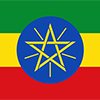
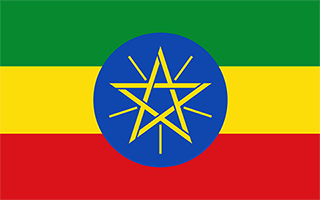
Three equal horizontal bands of green (top), yellow, and red, with a yellow pentagram and single yellow rays emanating from the angles between the points on a light blue disk centered on the three bands; green represents hope and the fertility of the land, yellow symbolizes justice and harmony, while red stands for sacrifice and heroism in the defense of the land; the blue of the disk symbolizes peace and the pentagram represents the unity and equality of the nationalities and peoples of Ethiopia.
Unique among African countries, the ancient Ethiopian monarchy maintained its freedom from colonial rule with the exception of a short-lived Italian occupation from 1936-41. In 1974, a military junta, the Derg, deposed Emperor Haile SELASSIE (who had ruled since 1930) and established a socialist state. Torn by bloody coups, uprisings, wide-scale drought, and massive refugee problems, the regime was finally toppled in 1991 by a coalition of rebel forces, the Ethiopian People's Revolutionary Democratic Front. A constitution was adopted in 1994, and Ethiopia's first multiparty elections were held in 1995. A border war with Eritrea in the late 1990s ended with a peace treaty in December 2000. In November 2007, the Eritrea-Ethiopia Border Commission (EEBC) issued specific coordinates as virtually demarcating the border and pronounced its work finished. Alleging that the EEBC acted beyond its mandate in issuing the coordinates, Ethiopia has not accepted them and has not withdrawn troops from previously contested areas pronounced by the EEBC as belonging to Eritrea. In August 2012, longtime leader Prime Minister MELES Zenawi died in office and was replaced by his Deputy Prime Minister HAILEMARIAM Desalegn, marking the first peaceful transition of power in decades.
Geography
| Area | ||
|---|---|---|
| Total (World Rank: 28) | 1,104,300 | sq km |
| Land (World Rank: 29) | 1,000,000 | sq km |
| Water (World Rank: 8) | 104,300 | sq km |
| Forest (World Rank: 90) | 20.00 | % |
| Comparative | slightly less than twice the size of Texas | |
| Landborder | ||
| 5925 | ||
| Elevation | ||
| Lowest point (World Rank: 67) | -125 | m |
| Highest point (World Rank: 34) | 4,550 | m |
| Agricultural land | ||
| Total (World Rank: 116) | 36.30 | % |
| Arable (World Rank: 79) | 15.20 | % |
| Permanent crops (World Rank: 119) | 1.10 | % |
| Permanent pastures (World Rank: 90) | 20.00 | % |
| Irrigated land (World Rank: 71) | 2,900 | sq km |
| Map reference | ||
| Africa | ||
| Environment | ||
| Issues |
| |
| Agreement party |
| |
| Agreement signed |
| |
| Hazzards |
| |
| Location | ||
| Eastern Africa, west of Somalia | ||
| Climate | ||
| tropical monsoon with wide topographic-induced variation | ||
| Terrain | ||
| high plateau with central mountain range divided by Great Rift Valley | ||
People
| Population | ||
|---|---|---|
| Total (World Rank: 12) | 105,350,000 | |
| Deathrate (World Rank: 103) | 0.77 | % |
| Birthrate (World Rank: 14) | 3.65 | % |
| Growthrate (World Rank: 11) | 2.85 | % |
| Migration rate (World Rank: 78) | -0.02 | % |
| Fertility rate (World Rank: 15) | 4.99 | % |
| Median age | ||
| Male (World Rank: 212) | 17.70 | |
| Female (World Rank: 212) | 18.10 | |
| Age structure | ||
| 0 14 male (World Rank: 8) | 22,963,500 | |
| 0 14 female (World Rank: 7) | 22,827,000 | |
| 15 24 male (World Rank: 10) | 10,516,600 | |
| 15 24 female (World Rank: 10) | 10,669,700 | |
| 25 54 male (World Rank: 19) | 15,464,200 | |
| 25 54 female (World Rank: 19) | 15,702,100 | |
| 55 64 male (World Rank: 28) | 1,998,710 | |
| 55 64 female (World Rank: 29) | 2,115,210 | |
| 65 x male (World Rank: 33) | 1,391,340 | |
| 65 x female (World Rank: 35) | 1,701,740 | |
| Health | ||
| Infant mortality rate (World Rank: 31) | 4.96 | % |
| Life expectancy total (World Rank: 193) | 63 | years |
| Life expectancy female (World Rank: 193) | 65 | years |
| Life expectancy male (World Rank: 195) | 60 | years |
| Physicians per 1000 (World Rank: 179) | 0.03 | |
| Hospital bed per 1000 (World Rank: 21) | 6.30 | |
| Sanitation access total (World Rank: 184) | 28.00 | % |
| Obesity adult (World Rank: 185) | 4.50 | % |
| Drinking water access (World Rank: 193) | 57.30 | % |
Energy
| Electricity | ||
|---|---|---|
| Production (World Rank: 99) | 10,080,000,000 | kWh |
| Consumption (World Rank: 102) | 8,143,000,000 | kWh |
| Export (World Rank: 76) | 166,000,000 | kWh |
| Source fossil (World Rank: 200) | 7.50 | % |
| Source nuclear (World Rank: 14) | 79.50 | % |
| Source renew (World Rank: 52) | 13.40 | % |
| Crude oil | ||
| Proved reserves (World Rank: 100) | 428,000 | bbl |
| Refined products | ||
| Consumption (World Rank: 93) | 65,000 | bbl / day |
| Import (World Rank: 71) | 64,380 | bbl / day |
| Natural gas | ||
| Consumption (World Rank: 129) | 24 | m³ |
| Carbon footprint | ||
| 9300000 | ||
Nation
| Budget | ||
|---|---|---|
| Education (World Rank: 91) | 5 | % of GDP |
| Military (World Rank: 134) | 1 | % of GDP |
| Health (World Rank: 144) | 5 | % of GDP |
| Surplus (World Rank: 121) | -3 | % of GDP |
| National symbol | ||
| yellow pentagram with five rays of light on a blue field | ||
| National colours | ||
| yellow | ||
| Adjective | ||
| Ethiopian | ||
| Noun | ||
| Ethiopian(s) | ||
| Background | ||
| Unique among African countries, the ancient Ethiopian monarchy maintained its freedom from colonial rule with the exception of a short-lived Italian occupation from 1936-41. In 1974, a military junta, the Derg, deposed Emperor Haile SELASSIE (who had ruled since 1930) and established a socialist state. Torn by bloody coups, uprisings, wide-scale drought, and massive refugee problems, the regime was finally toppled in 1991 by a coalition of rebel forces, the Ethiopian People's Revolutionary Democratic Front. A constitution was adopted in 1994, and Ethiopia's first multiparty elections were held in 1995. A border war with Eritrea in the late 1990s ended with a peace treaty in December 2000. In November 2007, the Eritrea-Ethiopia Border Commission (EEBC) issued specific coordinates as virtually demarcating the border and pronounced its work finished. Alleging that the EEBC acted beyond its mandate in issuing the coordinates, Ethiopia has not accepted them and has not withdrawn troops from previously contested areas pronounced by the EEBC as belonging to Eritrea. In August 2012, longtime leader Prime Minister MELES Zenawi died in office and was replaced by his Deputy Prime Minister HAILEMARIAM Desalegn, marking the first peaceful transition of power in decades. | ||
| Flag description | ||
| three equal horizontal bands of green (top), yellow, and red, with a yellow pentagram and single yellow rays emanating from the angles between the points on a light blue disk centered on the three bands; green represents hope and the fertility of the land, yellow symbolizes justice and harmony, while red stands for sacrifice and heroism in the defense of the land; the blue of the disk symbolizes peace and the pentagram represents the unity and equality of the nationalities and peoples of Ethiopia | ||
Economy
| Gdp | ||
|---|---|---|
| Purchasing power parity (World Rank: 67) | 177,400,000,000 | USD |
| Real growth rate (World Rank: 5) | 8.00 | % |
| Per capita purchasing power parity (World Rank: 205) | 1,900 | USD |
| Source agriculture (World Rank: 12) | 37.20 | % |
| Source industry (World Rank: 140) | 21.30 | % |
| Source service (World Rank: 200) | 41.50 | % |
| Labourforce | ||
| Total (World Rank: 13) | 51,050,000 | |
| In poverty (World Rank: 66) | 29.60 | % |
| Products | ||
| Industries |
| |
| Agriculture |
| |
| Exports |
| |
| Imports |
| |
Communication
| Phone | ||
|---|---|---|
| Landline total (World Rank: 73) | 1,147,000 | |
| Landline per 100 (World Rank: 209) | 1.00 | |
| Mobile per 100 (World Rank: 202) | 50.00 | |
| Assessment | 0 | |
| Internet | ||
| Users (World Rank: 37) | 15,731,700 | |
| Population (World Rank: 196) | 15.40 | % |
Transport
| Air | ||
|---|---|---|
| Airports paved (World Rank: 86) | 17.00 | |
| Airports unpaved (World Rank: 69) | 40.00 | |
| Rail | ||
| Total length (World Rank: 106) | 659 | |
| Road | ||
| Total length (World Rank: 44) | 110,414 | |
| Paved length (World Rank: 69) | 14,354 | |
| Unpaved length (World Rank: 21) | 96,060 | |
This is a list of famous places in this country in alphabetical order.
 Abomsa
- Addiet Canna
- Addis Ababa
- Adigrat
- Adis Zemen
- Adis `Alem
- Agaro
- Arba Minch
- Areka
- Asaita
- Asasa
- Asbe Teferi
- Asosa
- Awash
- Axum
- Bahir Dar
- Bako
- Bati
- Bedele
- Bedesa
- Bichena
- Bishoftu
- Boditi
- Bonga
- Bure
- Butajira
- Dabat
- Debark'
- Debre Birhan
- Debre Mark'os
- Debre Sina
- Debre Tabor
- Debre Werk'
- Dejen
- Dembi Dolo
- Dese
- Dila
- Dire Dawa
- Dodola
- Dubti
- Felege Neway
- Fiche
- Finote Selam
- Gambela
- Gebre Guracha
- Gelemso
- Genet
- Gewane
- Gidole
- Gimbi
- Ginir
- Goba
- Gonder
- Gore
- Hagere Hiywet
- Hagere Maryam
- Hagere Selam
- Harar
- Hawassa
- Hirna
- Huruta
- Inda Silase
- Jijiga
- Jimma
- Jinka
- K'olito
- Kemise
- Kibre Mengist
- Kofele
- Kombolcha
- Korem
- Lalibela
- Leku
- Maych'ew
- Mek'ele
- Mendi
- Metahara
- Metu
- Mizan Teferi
- Mojo
- Nazret
- Nejo
- Sebeta
- Semera
- Sendafa
- Shakiso
- Shambu
- Shashemene
- Sirre
- Tippi
- Tulu Bolo
- Turmi
- Waliso
- Wendo
- Wenji
- Were Ilu
- Werota
- Yabelo
- Yirga `Alem
- Ziway