Argentina
in South America
South America
 Bolivia
 Brazil
 Chile
Chile Paraguay
 Uruguay
- Currency and Currency Code:
- Peso - ARS
- Spoken languages:
- Spanish, English, Italian, German, French, Guarani
- Local electricity:
- 220 V - 50 Hz (plugs: I)
- Mobile phone / cellular frequencies (MHz):
- 850 MHz, 1900 MHz, 3G, 4G
- ISO 2-Letter code:
- AR
- Internet top level domain:
- .ar
- Country phone prefix:
- +54
- Local Time (capital):
- Timezone:
- UTC/GMT offset: hours
Safety Score: 3,2 of 5.0 based on data from 9 authorites. Meaning please reconsider your need to travel to Argentina.
Travel warnings are updated daily. Source: Travel Warning Argentina. Last Update: 2024-04-26 08:02:42
Explore Argentina
Argentina with its capital Buenos Aires is located in South America (Southern South America, bordering the South Atlantic Ocean). It covers some 2,780,401 square kilometers (slightly less than three-tenths the size of the US) with 44,293,300 citizens. Spanish, English, Italian, German, French and Guarani are the languages commonly used by the people in Argentina (consider regional differences). Bolivia, Brazil, Chile, Paraguay and Uruguay are bordering countries.
Argentina is a large, elongated country in the southern part of South America. Argentina is the second-largest country in [[South America]] and the eighth-largest in the world. The name Argentina derives from argentum, the Latin word for silver, which is what early Spanish explorers sought when they first reached the region in the sixteenth century. The central region of Argentina is the rich plain known as La Pampa. There is jungle in the extreme northeast. The southern half of Argentina is dominated by the flat to rolling plateau of Patagonia. The western border with Chile is along the rugged Andes mountains, including the Aconcagua, the highest mountain outside the Himalayas.
Popular Destinations in Argentina
Administrative regions of Argentina
- Buenos Aires FD
- Catamarca Province
- Chaco Province
- Chubut Province
- Cordoba Province
- Corrientes Province
- Entre Rios Province
- Formosa Province
- Jujuy Province
- La Pampa Province
- La Rioja Province
- Mendoza Province
- Misiones Province
- Neuquen Province
- Provincia de Buenos Aires
- Rio Negro Province
- Salta Province
- San Juan Province
- San Luis Province
- Santa Cruz Province
- Santa Fe Province
- Santiago del Estero Province
- Tierra del Fuego Province
- Tucuman Province
About the country
Website: Argentina Tourism
The landscape is rich plains of the Pampas in northern half, flat to rolling plateau of Patagonia in south, rugged Andes along western border. The average density of population is about 16 per km². The climate in Argentina can be described as mostly temperatearid in southeast, subantarctic in southwest. Potential threats by nature are heavy flooding in some areas, pamperos are violent windstorms that can strike the pampas and northeast, San Miguel de Tucuman and Mendoza areas in the Andes subject to earthquakes and volcanic activity in the Andes Mountains along the Chilean border; Copahue (2,997 m) last erupted in 2000; other historically active volcanoes include Llullaillaco, Maipo, Planchon-Peteroa, San Jose, Tromen, Tupungatito, and Viedma.
To reach someone Argentina dial +54 prior to a number. The local cellular networks are operated on 850 MHz, 1900 MHz, 3G, 4G. Websites typically end with the top level domain ".ar". If you want to bring electric appliances (e.g. battery chaarger), keep in min the local 220 V - 50 Hz (plugs: I). The sign for the locally used currency Peso is ARS.
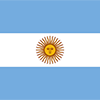
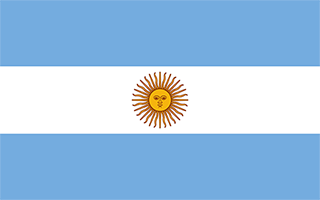
Three equal horizontal bands of sky blue (top), white, and sky blue; centered in the white band is a radiant yellow sun with a human face (delineated in brown) known as the Sun of May; the colors represent the clear skies and snow of the Andes; the sun symbol commemorates the appearance of the sun through cloudy skies on 25 May 1810 during the first mass demonstration in favor of independence; the sun features are those of Inti, the Inca god of the sun.
In 1816, the United Provinces of the Rio Plata declared their independence from Spain. After Bolivia, Paraguay, and Uruguay went their separate ways, the area that remained became Argentina. The country's population and culture were heavily shaped by immigrants from throughout Europe, with Italy and Spain providing the largest percentage of newcomers from 1860 to 1930. Up until about the mid-20th century, much of Argentina's history was dominated by periods of internal political conflict between Federalists and Unitarians and between civilian and military factions. After World War II, an era of Peronist populism and direct and indirect military interference in subsequent governments was followed by a military junta that took power in 1976. Democracy returned in 1983 after a failed bid to seize the Falkland Islands (Islas Malvinas) by force, and has persisted despite numerous challenges, the most formidable of which was a severe economic crisis in 2001-02 that led to violent public protests and the successive resignations of several presidents. The years 2003-15 saw Peronist rule by Nestor and Cristina FERNANDEZ de KIRCHNER, whose policies isolated Argentina and caused economic stagnation. With the election of Mauricio MACRI in November 2015, Argentina began a period of reform and international reintegration.
Geography
| Area | ||
|---|---|---|
| Total (World Rank: 9) | 2,780,400 | sq km |
| Land (World Rank: 9) | 2,736,690 | sq km |
| Water (World Rank: 16) | 43,710 | sq km |
| Forest (World Rank: 38) | 39.60 | % |
| Comparative | slightly less than three-tenths the size of the US | |
| Coastline | ||
| 4989 | ||
| Landborder | ||
| 11968 | ||
| Elevation | ||
| Lowest point (World Rank: 66) | -105 | m |
| Highest point (World Rank: 10) | 6,962 | m |
| Agricultural land | ||
| Total (World Rank: 61) | 53.90 | % |
| Arable (World Rank: 85) | 13.90 | % |
| Permanent crops (World Rank: 155) | 0.40 | % |
| Permanent pastures (World Rank: 38) | 39.60 | % |
| Irrigated land (World Rank: 25) | 23,600 | sq km |
| Map reference | ||
| South America | ||
| Environment | ||
| Issues |
| |
| Agreement party |
| |
| Agreement signed | Marine Life Conservation | |
| Hazzards |
| |
| Location | ||
| Southern South America, bordering the South Atlantic Ocean, between Chile and Uruguay | ||
| Climate | ||
| mostly temperate; arid in southeast; subantarctic in southwest | ||
| Terrain | ||
| rich plains of the Pampas in northern half, flat to rolling plateau of Patagonia in south, rugged Andes along western border | ||
People
| Population | ||
|---|---|---|
| Total (World Rank: 31) | 44,293,300 | |
| Deathrate (World Rank: 109) | 0.75 | % |
| Birthrate (World Rank: 109) | 1.67 | % |
| Growthrate (World Rank: 121) | 0.91 | % |
| Migration rate (World Rank: 69) | -0.01 | % |
| Fertility rate (World Rank: 92) | 2.26 | % |
| Median age | ||
| Male (World Rank: 106) | 30.50 | |
| Female (World Rank: 95) | 32.90 | |
| Age structure | ||
| 0 14 male (World Rank: 35) | 5,612,770 | |
| 0 14 female (World Rank: 35) | 5,278,860 | |
| 15 24 male (World Rank: 32) | 3,460,280 | |
| 15 24 female (World Rank: 32) | 3,307,230 | |
| 25 54 male (World Rank: 31) | 8,707,820 | |
| 25 54 female (World Rank: 30) | 8,733,370 | |
| 55 64 male (World Rank: 29) | 1,963,920 | |
| 55 64 female (World Rank: 30) | 2,081,800 | |
| 65 x male (World Rank: 24) | 2,159,810 | |
| 65 x female (World Rank: 24) | 2,987,450 | |
| Health | ||
| Infant mortality rate (World Rank: 136) | 0.98 | % |
| Life expectancy total (World Rank: 72) | 77 | years |
| Life expectancy female (World Rank: 68) | 81 | years |
| Life expectancy male (World Rank: 74) | 74 | years |
| Physicians per 1000 (World Rank: 21) | 3.76 | |
| Hospital bed per 1000 (World Rank: 42) | 4.70 | |
| Sanitation access total (World Rank: 64) | 96.40 | % |
| Obesity adult (World Rank: 30) | 28.30 | % |
| Drinking water access (World Rank: 64) | 99.10 | % |
Energy
| Electricity | ||
|---|---|---|
| Production (World Rank: 30) | 133,800,000,000 | kWh |
| Consumption (World Rank: 30) | 122,500,000,000 | kWh |
| Export (World Rank: 83) | 55,000,000 | kWh |
| Import (World Rank: 27) | 9,018,000,000 | kWh |
| Source fossil (World Rank: 113) | 66.90 | % |
| Source nuclear (World Rank: 128) | 4.30 | % |
| Source renew (World Rank: 110) | 2.50 | % |
| Crude oil | ||
| Production (World Rank: 27) | 510,600 | bbl / day |
| Exports (World Rank: 44) | 38,600 | bbl / day |
| Imports (World Rank: 76) | 10,180 | bbl / day |
| Proved reserves (World Rank: 35) | 2,185,000,000 | bbl |
| Refined products | ||
| Production (World Rank: 25) | 687,100 | bbl / day |
| Consumption (World Rank: 26) | 803,000 | bbl / day |
| Export (World Rank: 50) | 52,500 | bbl / day |
| Import (World Rank: 46) | 145,000 | bbl / day |
| Natural gas | ||
| Production (World Rank: 23) | 36,400,000,000 | m³ |
| Consumption (World Rank: 16) | 72,030,000,000 | m³ |
| Export (World Rank: 48) | 80,000,000 | m³ |
| Import (World Rank: 52) | 0 | m³ |
| Carbon footprint | ||
| 202000000 | ||
Nation
| Budget | ||
|---|---|---|
| Education (World Rank: 47) | 6 | % of GDP |
| Military (World Rank: 119) | 1 | % of GDP |
| Health (World Rank: 148) | 5 | % of GDP |
| Surplus (World Rank: 161) | -6 | % of GDP |
| National symbol | ||
| Sun of May | ||
| National colours | ||
| white | ||
| Adjective | ||
| Argentine | ||
| Noun | ||
| Argentine(s) | ||
| Background | ||
| In 1816, the United Provinces of the Rio Plata declared their independence from Spain. After Bolivia, Paraguay, and Uruguay went their separate ways, the area that remained became Argentina. The country's population and culture were heavily shaped by immigrants from throughout Europe, with Italy and Spain providing the largest percentage of newcomers from 1860 to 1930. Up until about the mid-20th century, much of Argentina's history was dominated by periods of internal political conflict between Federalists and Unitarians and between civilian and military factions. After World War II, an era of Peronist populism and direct and indirect military interference in subsequent governments was followed by a military junta that took power in 1976. Democracy returned in 1983 after a failed bid to seize the Falkland Islands (Islas Malvinas) by force, and has persisted despite numerous challenges, the most formidable of which was a severe economic crisis in 2001-02 that led to violent public protests and the successive resignations of several presidents. The years 2003-15 saw Peronist rule by Nestor and Cristina FERNANDEZ de KIRCHNER, whose policies isolated Argentina and caused economic stagnation. With the election of Mauricio MACRI in November 2015, Argentina began a period of reform and international reintegration. | ||
| Flag description | ||
| three equal horizontal bands of sky blue (top), white, and sky blue; centered in the white band is a radiant yellow sun with a human face (delineated in brown) known as the Sun of May; the colors represent the clear skies and snow of the Andes; the sun symbol commemorates the appearance of the sun through cloudy skies on 25 May 1810 during the first mass demonstration in favor of independence; the sun features are those of Inti, the Inca god of the sun | ||
Economy
| Gdp | ||
|---|---|---|
| Purchasing power parity (World Rank: 26) | 874,300,000,000 | USD |
| Real growth rate (World Rank: 198) | -2.20 | % |
| Per capita purchasing power parity (World Rank: 85) | 20,100 | USD |
| Source agriculture (World Rank: 84) | 10.60 | % |
| Source industry (World Rank: 90) | 28.30 | % |
| Source service (World Rank: 112) | 61.10 | % |
| Labourforce | ||
| Total (World Rank: 35) | 17,760,000 | |
| In poverty (World Rank: 51) | 32.20 | % |
| Products | ||
| Industries |
| |
| Agriculture |
| |
| Exports |
| |
| Imports |
| |
Communication
| Phone | ||
|---|---|---|
| Landline total (World Rank: 19) | 9,938,630 | |
| Landline per 100 (World Rank: 76) | 23.00 | |
| Mobile per 100 (World Rank: 31) | 146.00 | |
| Assessment | 0 | |
| Internet | ||
| Users (World Rank: 24) | 30,786,900 | |
| Population (World Rank: 73) | 70.20 | % |
Transport
| Air | ||
|---|---|---|
| Airports paved (World Rank: 13) | 161.00 | |
| Airports unpaved (World Rank: 4) | 977 | |
| Heliports (World Rank: 67) | 2.00 | |
| Rail | ||
| Total length (World Rank: 8) | 36,917 | |
| Road | ||
| Total length (World Rank: 22) | 231,374 | |
| Paved length (World Rank: 40) | 69,412 | |
| Unpaved length (World Rank: 14) | 161,962 | |
| Water | ||
| Total length (World Rank: 12) | 11,000 | |
This is a list of famous places in this country in alphabetical order.
 Alta Gracia
- Azul
- Bahia Blanca
- Bariloche
- Bell Ville
- Buenos Aires
- Campana
- Canada de Gomez
- Castelli
- Caucete
- Chacabuco
- Charata
- Chilecito
- Chivilcoy
- Clorinda
- Comodoro Rivadavia
- Concepcion del Uruguay
- Concordia
- Cordoba
- Coronel Suarez
- Corrientes
- Cosquin
- Curuzu Cuatia
- Esperanza
- Famailla
- Formosa
- General Jose de San Martin
- General Pico
- General Roca
- Goya
- Gualeguay
- Gualeguaychu
- Junin
- La Plata
- La Quiaca
- La Rioja
- Libertador General San Martin
- Lincoln
- Lujan
- Mar del Plata
- Marcos Juarez
- Mendoza
- Mercedes
- Mercedes
- Monte Caseros
- Moron
- Necochea
- Neuquen
- Nueve de Julio
- Obera
- Olavarria
- Palpala
- Parana
- Paso de los Libres
- Pergamino
- Posadas
- Presidencia Roque Saenz Pena
- Puerto Iguazu
- Puerto Madryn
- Punta Alta
- Quilmes
- Rafaela
- Rawson
- Reconquista
- Recreo
- Resistencia
- Rio Cuarto
- Rio Gallegos
- Rosario
- Salta
- San Antonio Oeste
- San Fernando del Valle de Catamarca
- San Francisco
- San Isidro
- San Jose de Jachal
- San Juan
- San Luis
- San Martin
- San Miguel de Tucuman
- San Nicolas de los Arroyos
- San Pedro
- San Rafael
- San Salvador de Jujuy
- Santa Fe de la Vera Cruz
- Santa Rosa
- Santiago del Estero
- Tafi Viejo
- Tandil
- Tartagal
- Termas de Rio Hondo
- Trelew
- Tres Arroyos
- Ushuaia
- Viedma
- Villa Angela
- Villa Constitucion
- Villa Maria
- Yerba Buena
- Zapala
- Zarate