Paraguay
in South America
South America
 Argentina
 Bolivia
 Brazil
- Currency and Currency Code:
- Guarani - PYG
- Spoken languages:
- Spanish, Guarani
- Local electricity:
- 220 V - 50 Hz (plugs: C)
- Mobile phone / cellular frequencies (MHz):
- 850 MHz, 1900 MHz, 3G, 4G
- ISO 2-Letter code:
- PY
- Internet top level domain:
- .py
- Country phone prefix:
- +595
- Local Time (capital):
- Timezone:
- UTC/GMT offset: hours
Safety Score: 3,0 of 5.0 based on data from 9 authorites. Meaning we advice caution when travelling to Paraguay.
Travel warnings are updated daily. Source: Travel Warning Paraguay. Last Update: 2024-04-26 08:02:42
Explore Paraguay
Paraguay with its capital Asuncion is located in South America (Central South America, northeast of Argentina). It covers some 406,753 square kilometers (about three times the size of New York state) with a population of 6,943,740. Spanish and Guarani are the languages spoken by people in Paraguay. Argentina, Bolivia and Brazil are bordering countries.
Paraguay is a landlocked country in South America bordering Argentina, Bolivia, and Brazil. Walk through the historic Asuncion city center- many former grand buildings are suffering from great decay, but if you look past grafitti walls, you can imagines Asuncions past splendour. At nights, you can take a cab ride and enjoy it fully illuminated. There are many bars, restaurantes in this area. Don Vito is paraguayan fast food at its best. Home of the paraguayan empanada, they have been in business for over 30 years. The original spot is just behind the Iglesia de san Jose, and if you are lucky enough to be in paraguay around may-June, you can order a pastel mandi'o, which is make of mandioca and beef. Best enjoyed with a cold pulp, a paraguayan soft drink made with natural fruit juice.
Popular Destinations in Paraguay
Administrative regions of Paraguay
- Asuncion
- Departamento Central
- Departamento de Alto Paraguay
- Departamento de Boqueron
- Departamento de Caaguazu
- Departamento de Caazapa
- Departamento de Canindeyu
- Departamento de Concepcion
- Departamento de Itapua
- Departamento de Misiones
- Departamento de Neembucu
- Departamento de Paraguari
- Departamento de Presidente Hayes
- Departamento de San Pedro
- Departamento de la Cordillera
- Departamento del Alto Parana
- Departamento del Amambay
- Departamento del Guaira
About the country
Ministerio de Obras Públicas y Communicaciones
Palma 468
Asunción
Paraguay
The topography is grassy plains and wooded hills east of Rio Paraguay with Gran Chaco region west of Rio Paraguay mostly low, marshy plain near the river, and dry forest and thorny scrub elsewhere. The average density of population is about 17 per km². The climate in Paraguay can be described as subtropical to temperate with substantial rainfall in the eastern portions, becoming semiarid in the far west. Potential natural disasters are local flooding in southeast (early September to June) poorly drained plains may become boggy (early October to June)
To reach someone Paraguay dial +595 prior to a number. The local cellular networks are operated on 850 MHz, 1900 MHz, 3G, 4G. Websites typically end with the top level domain ".py". If you want to bring electric appliances (e.g. battery chaarger), keep in min the local 220 V - 50 Hz (plugs: C). The sign for the locally used currency Guarani is PYG.
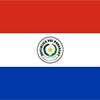
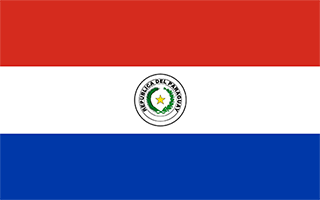
Three equal, horizontal bands of red (top), white, and blue with an emblem centered in the white band; unusual flag in that the emblem is different on each side; the obverse (hoist side at the left) bears the national coat of arms (a yellow five-pointed star within a green wreath capped by the words REPUBLICA DEL PARAGUAY, all within two circles); the reverse (hoist side at the right) bears a circular seal of the treasury (a yellow lion below a red Cap of Liberty and the words PAZ Y JUSTICIA (Peace and Justice)); red symbolizes bravery and patriotism, white represents integrity and peace, and blue denotes liberty and generosity.
Paraguay achieved its independence from Spain in 1811. In the disastrous War of the Triple Alliance (1865-70) - between Paraguay and Argentina, Brazil, and Uruguay - Paraguay lost two-thirds of its adult males and much of its territory. The country stagnated economically for the next half century. Following the Chaco War of 1932-35 with Bolivia, Paraguay gained a large part of the Chaco lowland region. The 35-year military dictatorship of Alfredo STROESSNER ended in 1989, and, despite a marked increase in political infighting in recent years, Paraguay has held relatively free and regular presidential elections since the country's return to democracy.
Geography
| Area | ||
|---|---|---|
| Total (World Rank: 61) | 406,752 | sq km |
| Land (World Rank: 59) | 397,302 | sq km |
| Water (World Rank: 50) | 9,450 | sq km |
| Forest (World Rank: 30) | 42.80 | % |
| Comparative | about three times the size of New York state; slightly smaller than California | |
| Landborder | ||
| 4655 | ||
| Elevation | ||
| Lowest point (World Rank: 34) | 46 | m |
| Highest point (World Rank: 177) | 842 | m |
| Agricultural land | ||
| Total (World Rank: 62) | 53.80 | % |
| Arable (World Rank: 104) | 10.80 | % |
| Permanent crops (World Rank: 174) | 0.20 | % |
| Permanent pastures (World Rank: 30) | 42.80 | % |
| Irrigated land (World Rank: 84) | 1,362 | sq km |
| Map reference | ||
| South America | ||
| Environment | ||
| Issues |
| |
| Agreement party |
| |
| Hazzards |
| |
| Location | ||
| Central South America, northeast of Argentina, southwest of Brazil | ||
| Climate | ||
| subtropical to temperate; substantial rainfall in the eastern portions, becoming semiarid in the far west | ||
| Terrain | ||
| grassy plains and wooded hills east of Rio Paraguay; Gran Chaco region west of Rio Paraguay mostly low, marshy plain near the river, and dry forest and thorny scrub elsewhere | ||
People
| Population | ||
|---|---|---|
| Total (World Rank: 104) | 6,943,740 | |
| Deathrate (World Rank: 197) | 0.48 | % |
| Birthrate (World Rank: 110) | 1.66 | % |
| Growthrate (World Rank: 92) | 1.18 | % |
| Migration rate (World Rank: 71) | -0.01 | % |
| Fertility rate (World Rank: 130) | 1.90 | % |
| Median age | ||
| Male (World Rank: 130) | 28.00 | |
| Female (World Rank: 132) | 28.50 | |
| Age structure | ||
| 0 14 male (World Rank: 102) | 867,854 | |
| 0 14 female (World Rank: 102) | 837,480 | |
| 15 24 male (World Rank: 92) | 673,354 | |
| 15 24 female (World Rank: 91) | 666,053 | |
| 25 54 male (World Rank: 104) | 1,426,940 | |
| 25 54 female (World Rank: 104) | 1,425,280 | |
| 55 64 male (World Rank: 94) | 281,388 | |
| 55 64 female (World Rank: 101) | 270,939 | |
| 65 x male (World Rank: 97) | 232,011 | |
| 65 x female (World Rank: 102) | 262,440 | |
| Health | ||
| Infant mortality rate (World Rank: 86) | 1.87 | % |
| Life expectancy total (World Rank: 68) | 77 | years |
| Life expectancy female (World Rank: 74) | 80 | years |
| Life expectancy male (World Rank: 72) | 75 | years |
| Physicians per 1000 (World Rank: 101) | 1.29 | |
| Hospital bed per 1000 (World Rank: 131) | 1.30 | |
| Sanitation access total (World Rank: 103) | 88.60 | % |
| Obesity adult (World Rank: 100) | 20.30 | % |
| Drinking water access (World Rank: 81) | 98.00 | % |
Energy
| Electricity | ||
|---|---|---|
| Production (World Rank: 51) | 55,190,000,000 | kWh |
| Consumption (World Rank: 91) | 10,470,000,000 | kWh |
| Export (World Rank: 4) | 41,130,000,000 | kWh |
| Source fossil (World Rank: 213) | 0.20 | % |
| Source nuclear (World Rank: 2) | 99.30 | % |
| Source renew (World Rank: 147) | 0.50 | % |
| Refined products | ||
| Consumption (World Rank: 114) | 38,000 | bbl / day |
| Import (World Rank: 92) | 37,610 | bbl / day |
| Natural gas | ||
| Consumption (World Rank: 168) | 3 | m³ |
| Carbon footprint | ||
| 3900000 | ||
Nation
| Budget | ||
|---|---|---|
| Education (World Rank: 69) | 5 | % of GDP |
| Military (World Rank: 93) | 1 | % of GDP |
| Health (World Rank: 26) | 10 | % of GDP |
| Surplus (World Rank: 69) | -2 | % of GDP |
| National symbol | ||
| lion | ||
| National colours | ||
| white | ||
| Adjective | ||
| Paraguayan | ||
| Noun | ||
| Paraguayan(s) | ||
| Background | ||
| Paraguay achieved its independence from Spain in 1811. In the disastrous War of the Triple Alliance (1865-70) - between Paraguay and Argentina, Brazil, and Uruguay - Paraguay lost two-thirds of its adult males and much of its territory. The country stagnated economically for the next half century. Following the Chaco War of 1932-35 with Bolivia, Paraguay gained a large part of the Chaco lowland region. The 35-year military dictatorship of Alfredo STROESSNER ended in 1989, and, despite a marked increase in political infighting in recent years, Paraguay has held relatively free and regular presidential elections since the country's return to democracy. | ||
| Flag description | ||
| three equal, horizontal bands of red (top), white, and blue with an emblem centered in the white band; unusual flag in that the emblem is different on each side; the obverse (hoist side at the left) bears the national coat of arms (a yellow five-pointed star within a green wreath capped by the words REPUBLICA DEL PARAGUAY, all within two circles); the reverse (hoist side at the right) bears a circular seal of the treasury (a yellow lion below a red Cap of Liberty and the words PAZ Y JUSTICIA (Peace and Justice)); red symbolizes bravery and patriotism, white represents integrity and peace, and blue denotes liberty and generosity | ||
Economy
| Gdp | ||
|---|---|---|
| Purchasing power parity (World Rank: 102) | 64,390,000,000 | USD |
| Real growth rate (World Rank: 62) | 4.10 | % |
| Per capita purchasing power parity (World Rank: 137) | 9,400 | USD |
| Source agriculture (World Rank: 48) | 20.00 | % |
| Source industry (World Rank: 75) | 30.30 | % |
| Source service (World Rank: 177) | 49.70 | % |
| Labourforce | ||
| Total (World Rank: 101) | 3,383,000 | |
| In poverty (World Rank: 92) | 22.20 | % |
| Products | ||
| Industries |
| |
| Agriculture |
| |
| Exports |
| |
| Imports |
| |
Communication
| Phone | ||
|---|---|---|
| Landline total (World Rank: 106) | 368,000 | |
| Landline per 100 (World Rank: 155) | 5.00 | |
| Mobile per 100 (World Rank: 110) | 109.00 | |
| Assessment | 0 | |
| Internet | ||
| Users (World Rank: 92) | 3,524,040 | |
| Population (World Rank: 121) | 51.30 | % |
Transport
| Air | ||
|---|---|---|
| Airports paved (World Rank: 100) | 15.00 | |
| Airports unpaved (World Rank: 7) | 784 | |
| Rail | ||
| Total length (World Rank: 133) | 30.00 | |
| Road | ||
| Total length (World Rank: 95) | 32,059 | |
| Paved length (World Rank: 100) | 4,860 | |
| Unpaved length (World Rank: 56) | 27,199 | |
| Water | ||
| Total length (World Rank: 33) | 3,100 | |
This is a list of famous places in this country in alphabetical order.
 Abai
Abai- Altos
- Antequera
- Aregua
- Arroyos y Esteros
- Asuncion
- Ayolas
- Belen
- Bella Vista
- Benjamin Aceval
- Borja
- Buena Vista
- Caacupe
- Caaguazu
- Caazapa
- Capiata
- Capitan Bado
- Capitan Miranda
- Capitan Pablo Lagerenza
- Caraguatay
- Carapegua
- Carmen del Parana
- Ciudad del Este
- Colonia Mariano Roque Alonso
- Colonia Mauricio Jose Troche
- Colonia Menno
- Concepcion
- Coronel Martinez
- Coronel Oviedo
- Doctor Cecilio Baez
- Doctor Juan Leon Mallorquin
- Doctor Juan Manuel Frutos
- Edelira
- Emboscada
- Encarnacion
- Eusebio Ayala
- Felix Perez Cardozo
- Fernando de la Mora
- Filadelfia
- Fuerte Olimpo
- General Artigas
- General Elizardo Aquino
- Guarambare
- Hohenau
- Horqueta
- Isla Pucu
- Ita
- Itacurubi de la Cordillera
- Itacurubi del Rosario
- Itape
- Itaugua
- Iturbe
- La Colmena
- Lambare
- Lima
- Limpio
- Los Cedrales
- Mbocayaty
- Nanawa
- Naranjal
- Natalicio Talavera
- Nemby
- Obligado
- Paraguari
- Pedro Juan Caballero
- Pilar
- Pirapo
- Pirayu
- Piribebuy
- Presidente Franco
- Puerto Mayor Otano
- Puerto Rosario
- Quiindy
- Quyquyo
- Repatriacion
- Salto del Guaira
- San Antonio
- San Bernardino
- San Cosme y Damian
- San Isidro de Curuguaty
- San Jose
- San Juan Bautista
- San Juan Nepomuceno
- San Lorenzo
- San Pedro de Ycuamandiyu
- San Pedro del Parana
- Santa Elena
- Santa Maria
- Santa Rosa
- Santiago
- Sapucai
- Tobati
- Villa Elisa
- Villa Hayes
- Villarrica
- Yaguaron
- Ybycui
- Yegros
- Ypacarai
- Yuty