Cameroon
in Middle Africa
Africa
 Central African Republic
 Chad
Chad Equatorial Guinea
 Gabon
Gabon Nigeria
 Republic of the Congo
- Currency and Currency Code:
- Franc - XAF
- Spoken languages:
- English, French
- Local electricity:
- 220 V - 50 Hz (plugs: C, E)
- Mobile phone / cellular frequencies (MHz):
- 900 MHz, 1800 MHz, 3G, 4G
- ISO 2-Letter code:
- CM
- Internet top level domain:
- .cm
- Country phone prefix:
- +237
- Local Time (capital):
- Timezone:
- UTC/GMT offset: hours
Safety Score: 3,2 of 5.0 based on data from 9 authorites. Meaning please reconsider your need to travel to Cameroon.
Travel warnings are updated daily. Source: Travel Warning Cameroon. Last Update: 2024-04-26 08:02:42
Explore Cameroon
Cameroon with its capital Yaounde is located in Africa (Central Africa, bordering the Bight of Biafra). It covers some 475,441 square kilometers (slightly larger than California) with a population of 24,994,900. English and French are the languages spoken by people in Cameroon. Central African Republic, Chad, Equatorial Guinea, Gabon, Nigeria and Republic of the Congo are bordering countries.
Cameroon is in West Africa. Cameroon is a diverse and multi ethnic country. While it is not the largest country in Africa, in some ways it's as large as Africa itself. Known as Africa in miniature it features French and English speaking portions, Muslim and Christian dominated regions, the tallest mountain in West Africa and terrain that includes rain forest, desert plains, mountains and high plateau. If you are going during the summer, plan on lots of rain every day. It might be cold up in the mountains, especially at nights. Most people will need a visa and it is very advisable to obtain it before arriving. French and English are the official languages in Cameroon although there are over 276 recognized languages in Cameroon. The Northwest and Southwest provinces are anglophone although in some areas pidgin English is more common. The rest of the country is predominantly francophone although almost all areas will also have local languages.
Popular Destinations in Cameroon
Administrative regions of Cameroon
- Adamaoua Region
- Centre Region
- East Region
- Far North
- Littoral Region
- North Region
- North-West Region
- South Region
- South-West Region
- West Region
About the country
The topography is diverse, with coastal plain in southwest, dissected plateau in center, mountains in west, plains in north. The average density of population is about 53 per km². The climate in Cameroon can be described as varying with terrain, from tropical along coast to semiarid and hot in north. Potential natural disasters are Mt. Cameroon (4,095 m), which last erupted in 2000, is the most frequently active volcano in West Africa; lakes in Oku volcanic field have released fatal levels of gas on occasion, killing some 1,700 people in 1986 volcanic activity with periodic releases of poisonous gases from Lake Nyos and Lake Monoun volcanoes
To reach someone Cameroon dial +237 prior to a number. The local cellular networks are operated on 900 MHz, 1800 MHz, 3G, 4G. Websites typically end with the top level domain ".cm". If you want to bring electric appliances (e.g. battery chaarger), keep in min the local 220 V - 50 Hz (plugs: C, E). The sign for the locally used currency Franc is XAF.
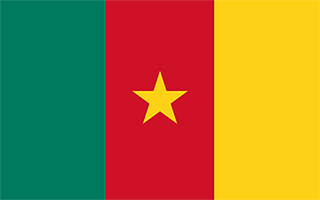
Three equal vertical bands of green (hoist side), red, and yellow, with a yellow five-pointed star centered in the red band; the vertical tricolor recalls the flag of France; red symbolizes unity, yellow the sun, happiness, and the savannahs in the north, and green hope and the forests in the south; the star is referred to as the "star of unity".
French Cameroon became independent in 1960 as the Republic of Cameroon. The following year the southern portion of neighboring British Cameroon voted to merge with the new country to form the Federal Republic of Cameroon. In 1972, a new constitution replaced the federation with a unitary state, the United Republic of Cameroon. The country has generally enjoyed stability, which has enabled the development of agriculture, roads, and railways, as well as a petroleum industry. Despite slow movement toward democratic reform, political power remains firmly in the hands of President Paul BIYA.
Geography
| Area | ||
|---|---|---|
| Total (World Rank: 55) | 475,440 | sq km |
| Land (World Rank: 52) | 472,710 | sq km |
| Water (World Rank: 82) | 2,730 | sq km |
| Forest (World Rank: 166) | 4.20 | % |
| Comparative | slightly larger than California | |
| Coastline | ||
| 402 | ||
| Landborder | ||
| 5018 | ||
| Elevation | ||
| Highest point (World Rank: 44) | 4,045 | m |
| Agricultural land | ||
| Total (World Rank: 162) | 20.60 | % |
| Arable (World Rank: 88) | 13.10 | % |
| Permanent crops (World Rank: 72) | 3.30 | % |
| Permanent pastures (World Rank: 166) | 4.20 | % |
| Irrigated land (World Rank: 126) | 290 | sq km |
| Map reference | ||
| Africa | ||
| Environment | ||
| Issues |
| |
| Agreement party |
| |
| Hazzards |
| |
| Location | ||
| Central Africa, bordering the Bight of Biafra, between Equatorial Guinea and Nigeria | ||
| Climate | ||
| varies with terrain, from tropical along coast to semiarid and hot in north | ||
| Terrain | ||
| diverse, with coastal plain in southwest, dissected plateau in center, mountains in west, plains in north | ||
People
| Population | ||
|---|---|---|
| Total (World Rank: 53) | 24,994,900 | |
| Deathrate (World Rank: 49) | 0.96 | % |
| Birthrate (World Rank: 19) | 3.54 | % |
| Growthrate (World Rank: 17) | 2.56 | % |
| Migration rate (World Rank: 72) | -0.01 | % |
| Fertility rate (World Rank: 21) | 4.64 | % |
| Median age | ||
| Male (World Rank: 201) | 18.40 | |
| Female (World Rank: 209) | 18.70 | |
| Age structure | ||
| 0 14 male (World Rank: 36) | 5,337,880 | |
| 0 14 female (World Rank: 36) | 5,257,030 | |
| 15 24 male (World Rank: 49) | 2,456,060 | |
| 15 24 female (World Rank: 49) | 2,432,500 | |
| 25 54 male (World Rank: 57) | 3,880,910 | |
| 25 54 female (World Rank: 59) | 3,835,110 | |
| 55 64 male (World Rank: 73) | 485,059 | |
| 55 64 female (World Rank: 75) | 509,649 | |
| 65 x male (World Rank: 77) | 372,415 | |
| 65 x female (World Rank: 82) | 428,283 | |
| Health | ||
| Infant mortality rate (World Rank: 28) | 5.10 | % |
| Life expectancy total (World Rank: 205) | 59 | years |
| Life expectancy female (World Rank: 205) | 60 | years |
| Life expectancy male (World Rank: 205) | 58 | years |
| Physicians per 1000 (World Rank: 165) | 0.08 | |
| Hospital bed per 1000 (World Rank: 136) | 1.30 | |
| Sanitation access total (World Rank: 164) | 45.80 | % |
| Obesity adult (World Rank: 135) | 11.40 | % |
| Drinking water access (World Rank: 172) | 75.60 | % |
Energy
| Electricity | ||
|---|---|---|
| Production (World Rank: 113) | 6,800,000,000 | kWh |
| Consumption (World Rank: 114) | 6,100,000,000 | kWh |
| Source fossil (World Rank: 186) | 28.50 | % |
| Source nuclear (World Rank: 19) | 71.50 | % |
| Crude oil | ||
| Production (World Rank: 44) | 95,960 | bbl / day |
| Exports (World Rank: 41) | 50,830 | bbl / day |
| Imports (World Rank: 58) | 37,600 | bbl / day |
| Proved reserves (World Rank: 57) | 200,000,000 | bbl |
| Refined products | ||
| Production (World Rank: 81) | 51,670 | bbl / day |
| Consumption (World Rank: 108) | 43,000 | bbl / day |
| Export (World Rank: 74) | 14,590 | bbl / day |
| Import (World Rank: 168) | 4,134 | bbl / day |
| Natural gas | ||
| Production (World Rank: 71) | 469,000,000 | m³ |
| Consumption (World Rank: 107) | 469,000,000 | m³ |
| Carbon footprint | ||
| 6500000 | ||
Nation
| Budget | ||
|---|---|---|
| Education (World Rank: 136) | 3 | % of GDP |
| Military (World Rank: 68) | 2 | % of GDP |
| Health (World Rank: 164) | 4 | % of GDP |
| Surplus (World Rank: 174) | -7 | % of GDP |
| National symbol | ||
| lion | ||
| National colours | ||
| yellow | ||
| Adjective | ||
| Cameroonian | ||
| Noun | ||
| Cameroonian(s) | ||
| Background | ||
| French Cameroon became independent in 1960 as the Republic of Cameroon. The following year the southern portion of neighboring British Cameroon voted to merge with the new country to form the Federal Republic of Cameroon. In 1972, a new constitution replaced the federation with a unitary state, the United Republic of Cameroon. The country has generally enjoyed stability, which has enabled the development of agriculture, roads, and railways, as well as a petroleum industry. Despite slow movement toward democratic reform, political power remains firmly in the hands of President Paul BIYA. | ||
| Flag description | ||
| three equal vertical bands of green (hoist side), red, and yellow, with a yellow five-pointed star centered in the red band; the vertical tricolor recalls the flag of France; red symbolizes unity, yellow the sun, happiness, and the savannahs in the north, and green hope and the forests in the south; the star is referred to as the "star of unity" | ||
Economy
| Gdp | ||
|---|---|---|
| Purchasing power parity (World Rank: 93) | 77,100,000,000 | USD |
| Real growth rate (World Rank: 45) | 4.70 | % |
| Per capita purchasing power parity (World Rank: 187) | 3,300 | USD |
| Source agriculture (World Rank: 37) | 23.00 | % |
| Source industry (World Rank: 92) | 28.20 | % |
| Source service (World Rank: 180) | 48.80 | % |
| Labourforce | ||
| Total (World Rank: 52) | 9,659,000 | |
| In poverty (World Rank: 61) | 30.00 | % |
| Products | ||
| Industries |
| |
| Agriculture |
| |
| Exports |
| |
| Imports |
| |
Communication
| Phone | ||
|---|---|---|
| Landline total (World Rank: 76) | 1,051,070 | |
| Landline per 100 (World Rank: 162) | 4.00 | |
| Mobile per 100 (World Rank: 187) | 67.00 | |
| Assessment | 0 | |
| Internet | ||
| Users (World Rank: 67) | 6,090,200 | |
| Population (World Rank: 174) | 25.00 | % |
Transport
| Air | ||
|---|---|---|
| Airports paved (World Rank: 112) | 11.00 | |
| Airports unpaved (World Rank: 98) | 22.00 | |
| Rail | ||
| Total length (World Rank: 90) | 987 | |
| Road | ||
| Total length (World Rank: 78) | 51,350 | |
| Paved length (World Rank: 106) | 4,108 | |
| Unpaved length (World Rank: 34) | 47,242 | |
This is a list of famous places in this country in alphabetical order.
 Abong Mbang
- Akom II
- Akonolinga
- Ambam
- Babanki
- Bafang
- Bafia
- Bafoussam
- Bali
- Bamenda
- Bamendjou
- Bamusso
- Bana
- Bandjoun
- Bangangte
- Bankim
- Banyo
- Batouri
- Bazou
- Bekondo
- Belabo
- Belel
- Belo
- Bertoua
- Betare Oya
- Bonaberi
- Buea
- Dimako
- Dizangue
- Djohong
- Douala
- Doume
- Dschang
- Ebolowa
- Edea
- Eseka
- Fontem
- Foumban
- Foumbot
- Fundong
- Garoua
- Garoua Boulai
- Guider
- Idenao
- Kaele
- Kontcha
- Kousseri
- Koza
- Kribi
- Kumba
- Kumbo
- Lagdo
- Limbe
- Lolodorf
- Loum
- Makary
- Mamfe
- Manjo
- Maroua
- Mbalmayo
- Mbandjok
- Mbanga
- Mbengwi
- Mbouda
- Meiganga
- Melong
- Mindif
- Mme-Bafumen
- Mokolo
- Mora
- Mundemba
- Mutengene
- Muyuka
- Nanga Eboko
- Ndelele
- Ndikinimeki
- Ngambe
- Ngaoundere
- Ngou
- Njinikom
- Nkongsamba
- Nkoteng
- Ntui
- Obala
- Okoa
- Penja
- Pitoa
- Rey Bouba
- Saa
- Sangmelima
- Tchollire
- Tibati
- Tignere
- Tiko
- Tonga
- Wum
- Yabassi
- Yagoua
- Yaounde
- Yokadouma