Belarus
in Eastern Europe
Europe
 Latvia
 Lithuania
 Poland
 Russia
 Ukraine
- Currency and Currency Code:
- Ruble - BYR
- Spoken languages:
- Belarusian, Russian
- Local electricity:
- 220 V - 50 Hz (plugs: C, F)
- Mobile phone / cellular frequencies (MHz):
- 900 MHz, 1800 MHz, 3G, 4G
- ISO 2-Letter code:
- BY
- Internet top level domain:
- .by
- Country phone prefix:
- +375
- Local Time (capital):
- Timezone:
- UTC/GMT offset: hours
Safety Score: 4,9 of 5.0 based on data from 9 authorites. Meaning it is not safe to travel Belarus.
Travel warnings are updated daily. Source: Travel Warning Belarus. Last Update: 2024-04-26 08:02:42
Explore Belarus
Belarus with its capital Minsk is located in Europe (Eastern Europe, east of Poland). It covers some 207,601 square kilometers (slightly less than twice the size of Kentucky) with a population of 9,549,750. Belarusian and Russian are the languages spoken by people in Belarus. Latvia, Lithuania, Poland, Russia and Ukraine are bordering countries.
Belarus is in Eastern Europe. Belarus attained its independence in 1991. However, under authoritarian rule, it has retained closer political and economic ties to Russia than any of the other former Soviet republics. Traveling by car will get you far, since the infrastructure in Belarus was well developed after World War II. Gas is relatively cheap by European standards. Traveling by train around the country will get you to a lot of desired destinations relatively cheap and you will get a chance to capture a glimpse of Belarusian nature, as the forests and plains often start right on the edges of the cities. English is not widely spoken in Belarus, even though it is starting to be on the popular uprise. Inside of Belarus, you can get Belarusian rubles (as well as US dollars) from automatic bank machines for standard types of credit/debit card. Be very careful, exchange kiosks will not exchange any bill that is damaged or marked on in any way. Approximately half of the bills you currently have in your wallet will be rejected for exchange in Belarus. Be sure to take ONLY relatively new and undamaged foreign money with you. Fortunately, crimes against foreigners are rare, though criminals have been known to use force if met with resistance from victims. Historically, Belarus maintained an excellent health system, but when the Chernobyl disaster broke out, the medical care has damaged the system severely. Therefore, medical care in Belarus is neither modern nor easily accessible.
Popular Destinations in Belarus
Administrative regions of Belarus
About the country
The topography is generally flat with much marshland. The average density of population is about 46 per km². The climate in Belarus can be described as cold winters, cool and moist summers with transitional between continental and maritime. Potential natural disasters are large tracts of marshy land.
To reach someone Belarus dial +375 prior to a number. The local cellular networks are operated on 900 MHz, 1800 MHz, 3G, 4G. Websites typically end with the top level domain ".by". If you want to bring electric appliances (e.g. battery chaarger), keep in min the local 220 V - 50 Hz (plugs: C, F). The sign for the locally used currency Ruble is BYR.
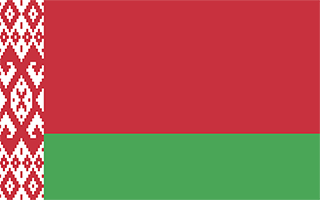
Red horizontal band (top) and green horizontal band one-half the width of the red band; a white vertical stripe on the hoist side bears Belarusian national ornamentation in red; the red band color recalls past struggles from oppression, the green band represents hope and the many forests of the country.
After seven decades as a constituent republic of the USSR, Belarus attained its independence in 1991. It has retained closer political and economic ties to Russia than have any of the other former Soviet republics. Belarus and Russia signed a treaty on a two-state union on 8 December 1999 envisioning greater political and economic integration. Although Belarus agreed to a framework to carry out the accord, serious implementation has yet to take place. Since his election in July 1994 as the country's first and only directly elected president, Aleksandr LUKASHENKO has steadily consolidated his power through authoritarian means and a centralized economic system. Government restrictions on political and civil freedoms, freedom of speech and the press, peaceful assembly, and religion have remained in place.
Geography
| Area | ||
|---|---|---|
| Total (World Rank: 87) | 207,600 | sq km |
| Land (World Rank: 83) | 202,900 | sq km |
| Water (World Rank: 67) | 4,700 | sq km |
| Forest (World Rank: 109) | 15.90 | % |
| Comparative | slightly less than twice the size of Kentucky; slightly smaller than Kansas | |
| Landborder | ||
| 3642 | ||
| Elevation | ||
| Lowest point (World Rank: 27) | 90 | m |
| Highest point (World Rank: 202) | 346 | m |
| Agricultural land | ||
| Total (World Rank: 88) | 43.70 | % |
| Arable (World Rank: 36) | 27.20 | % |
| Permanent crops (World Rank: 141) | 0.60 | % |
| Permanent pastures (World Rank: 109) | 15.90 | % |
| Irrigated land (World Rank: 89) | 1,140 | sq km |
| Map reference | ||
| Europe | ||
| Environment | ||
| Issues |
| |
| Agreement party |
| |
| Hazzards | large tracts of marshy land | |
| Location | ||
| Eastern Europe, east of Poland | ||
| Climate | ||
| cold winters, cool and moist summers; transitional between continental and maritime | ||
| Terrain | ||
| generally flat with much marshland | ||
People
| Population | ||
|---|---|---|
| Total (World Rank: 93) | 9,549,750 | |
| Deathrate (World Rank: 11) | 1.32 | % |
| Birthrate (World Rank: 186) | 1.03 | % |
| Growthrate (World Rank: 206) | -0.22 | % |
| Migration rate (World Rank: 60) | 0.07 | % |
| Fertility rate (World Rank: 196) | 1.48 | % |
| Median age | ||
| Male (World Rank: 57) | 37.10 | |
| Female (World Rank: 38) | 43.10 | |
| Age structure | ||
| 0 14 male (World Rank: 107) | 774,995 | |
| 0 14 female (World Rank: 108) | 732,191 | |
| 15 24 male (World Rank: 107) | 505,420 | |
| 15 24 female (World Rank: 110) | 477,123 | |
| 25 54 male (World Rank: 81) | 2,104,170 | |
| 25 54 female (World Rank: 80) | 2,170,520 | |
| 55 64 male (World Rank: 61) | 599,630 | |
| 55 64 female (World Rank: 52) | 757,744 | |
| 65 x male (World Rank: 69) | 457,766 | |
| 65 x female (World Rank: 51) | 970,193 | |
| Health | ||
| Infant mortality rate (World Rank: 194) | 0.36 | % |
| Life expectancy total (World Rank: 138) | 73 | years |
| Life expectancy female (World Rank: 95) | 79 | years |
| Life expectancy male (World Rank: 150) | 68 | years |
| Physicians per 1000 (World Rank: 14) | 4.07 | |
| Hospital bed per 1000 (World Rank: 4) | 11.30 | |
| Sanitation access total (World Rank: 79) | 94.30 | % |
| Obesity adult (World Rank: 58) | 24.50 | % |
| Drinking water access (World Rank: 49) | 99.70 | % |
Energy
| Electricity | ||
|---|---|---|
| Production (World Rank: 62) | 32,040,000,000 | kWh |
| Consumption (World Rank: 60) | 31,750,000,000 | kWh |
| Export (World Rank: 39) | 3,482,000,000 | kWh |
| Import (World Rank: 34) | 6,104,000,000 | kWh |
| Source fossil (World Rank: 34) | 99.20 | % |
| Source nuclear (World Rank: 151) | 0.40 | % |
| Source renew (World Rank: 139) | 0.90 | % |
| Crude oil | ||
| Production (World Rank: 60) | 32,670 | bbl / day |
| Exports (World Rank: 48) | 31,770 | bbl / day |
| Imports (World Rank: 22) | 450,200 | bbl / day |
| Proved reserves (World Rank: 58) | 198,000,000 | bbl |
| Refined products | ||
| Production (World Rank: 35) | 471,600 | bbl / day |
| Consumption (World Rank: 61) | 172,000 | bbl / day |
| Export (World Rank: 26) | 290,300 | bbl / day |
| Import (World Rank: 182) | 2,387 | bbl / day |
| Natural gas | ||
| Production (World Rank: 87) | 30,000,000 | m³ |
| Consumption (World Rank: 39) | 26,500,000,000 | m³ |
| Import (World Rank: 43) | 0 | m³ |
| Carbon footprint | ||
| 70000000 | ||
Nation
| Budget | ||
|---|---|---|
| Education (World Rank: 78) | 5 | % of GDP |
| Military (World Rank: 98) | 1 | % of GDP |
| Health (World Rank: 114) | 6 | % of GDP |
| Surplus (World Rank: 19) | 1 | % of GDP |
| National symbol | ||
| the mounted knight known as Pahonia is the traditional Belarusian symbol | ||
| National colours | ||
| white | ||
| Adjective | ||
| Belarusian | ||
| Noun | ||
| Belarusian(s) | ||
| Background | ||
| After seven decades as a constituent republic of the USSR, Belarus attained its independence in 1991. It has retained closer political and economic ties to Russia than have any of the other former Soviet republics. Belarus and Russia signed a treaty on a two-state union on 8 December 1999 envisioning greater political and economic integration. Although Belarus agreed to a framework to carry out the accord, serious implementation has yet to take place. Since his election in July 1994 as the country's first and only directly elected president, Aleksandr LUKASHENKO has steadily consolidated his power through authoritarian means and a centralized economic system. Government restrictions on political and civil freedoms, freedom of speech and the press, peaceful assembly, and religion have remained in place. | ||
| Flag description | ||
| red horizontal band (top) and green horizontal band one-half the width of the red band; a white vertical stripe on the hoist side bears Belarusian national ornamentation in red; the red band color recalls past struggles from oppression, the green band represents hope and the many forests of the country | ||
Economy
| Gdp | ||
|---|---|---|
| Purchasing power parity (World Rank: 70) | 171,700,000,000 | USD |
| Real growth rate (World Rank: 202) | -2.60 | % |
| Per capita purchasing power parity (World Rank: 92) | 18,100 | USD |
| Source agriculture (World Rank: 103) | 8.10 | % |
| Source industry (World Rank: 24) | 39.60 | % |
| Source service (World Rank: 162) | 52.30 | % |
| Labourforce | ||
| Total (World Rank: 89) | 4,381,000 | |
| In poverty (World Rank: 161) | 5.70 | % |
| Products | ||
| Industries |
| |
| Agriculture |
| |
| Exports |
| |
| Imports |
| |
Communication
| Phone | ||
|---|---|---|
| Landline total (World Rank: 31) | 4,515,380 | |
| Landline per 100 (World Rank: 25) | 47.00 | |
| Mobile per 100 (World Rank: 76) | 120.00 | |
| Assessment | 0 | |
| Internet | ||
| Users (World Rank: 62) | 6,805,790 | |
| Population (World Rank: 70) | 71.10 | % |
Transport
| Air | ||
|---|---|---|
| Airports paved (World Rank: 57) | 33.00 | |
| Airports unpaved (World Rank: 81) | 32.00 | |
| Heliports (World Rank: 86) | 1.00 | |
| Rail | ||
| Total length (World Rank: 35) | 5,528 | |
| Road | ||
| Total length (World Rank: 57) | 86,392 | |
| Paved length (World Rank: 35) | 74,651 | |
| Unpaved length (World Rank: 75) | 11,741 | |
| Water | ||
| Total length (World Rank: 36) | 2,500 | |
This is a list of famous places in this country in alphabetical order.
 Ashmyany
- Asipovichy
- Astravyets
- Babruysk
- Baranovichi
- Brahin
- Braslaw
- Brest
- Byalynichy
- Byaroza
- Bykhaw
- Chachersk
- Chashniki
- Chavusy
- Cherykaw
- Dobrush
- Dokshytsy
- Dubrowna
- Dzyarzhynsk
- Dzyatlava
- Gomel
- Haradok
- Hlusk
- Hlybokaye
- Horad Barysaw
- Horad Smalyavichy
- Horad Zhodzina
- Horki
- Hrodna
- Ivanava
- Ivatsevichy
- Iwye
- Kalinkavichy
- Kapyl
- Kastsyukovichy
- Khoyniki
- Kirawsk
- Klichaw
- Klimavichy
- Klyetsk
- Kobryn
- Krasnapollye
- Kruhlaye
- Krupki
- Krychaw
- Lahoysk
- Lida
- Loyew
- Luninyets
- Lyakhavichy
- Lyepyel'
- Lyozna
- Lyuban'
- Maladzyechna
- Malaryta
- Mar''ina Horka
- Masty
- Mazyr
- Minsk
- Mogilev
- Mstsislaw
- Myadzyel
- Myory
- Navahrudak
- Navapolatsk
- Novoye Medvezhino
- Nyasvizh
- Orsha
- Pastavy
- Pinsk
- Polatsk
- Pruzhany
- Pyetrykaw
- Rahachow
- Rasony
- Rechytsa
- Salihorsk
- Sharkawshchyna
- Shchuchyn
- Shklow
- Slawharad
- Slonim
- Slutsk
- Smarhon'
- Staryya Darohi
- Stolin
- Stowbtsy
- Svislach
- Svyetlahorsk
- Talachyn
- Valozhyn
- Vawkavysk
- Vilyeyka
- Vitebsk
- Voranava
- Vyerkhnyadzvinsk
- Vyetka
- Zhabinka
- Zhlobin
- Zhytkavichy