Honduras
in Central America
North America
 El Salvador
 Guatemala
 Nicaragua
- Currency and Currency Code:
- Lempira - HNL
- Spoken languages:
- Spanish
- Local electricity:
- 120 V - 60 Hz (plugs: A, B)
- Mobile phone / cellular frequencies (MHz):
- 850 MHz, 1900 MHz, 3G, 4G
- ISO 2-Letter code:
- HN
- Internet top level domain:
- .hn
- Country phone prefix:
- +504
- Local Time (capital):
- Timezone:
- UTC/GMT offset: hours
Safety Score: 3,4 of 5.0 based on data from 9 authorites. Meaning please reconsider your need to travel to Honduras.
Travel warnings are updated daily. Source: Travel Warning Honduras. Last Update: 2024-04-26 08:02:42
Explore Honduras
Honduras with its capital Tegucigalpa is located in North America (Central America, bordering the Caribbean Sea). It covers some 112,091 square kilometers (slightly larger than Tennessee) with a population of 9,038,740. Spanish is the official language spoken by people in Honduras. El Salvador, Guatemala and Nicaragua are bordering countries.
Honduras is the second biggest country in Central America. It has colonial villages (Gracias, Comayagua), ancient Maya ruins (Copan), natural parks (Moskitia), and a Pacific and Caribbean coastline and the Bay Islands, with great beaches and coral reefs where snorkeling and diving are exceptional by any standard. Good amenities can be found in cities like Tegucigalpa, San Pedro Sula, La Ceiba, Tela, Utila, Roatán and at Copan, but elsewhere conditions can be quite basic, especially in the rural areas. Nevertheless a visit is worthwhile, especially to the ancient Maya ruins in Copán, the colonial towns of Gracias and Comayagua, and the fantastic Caribbean Coast.
Popular Destinations in Honduras
Administrative regions of Honduras
- Departamento de Atlantida
- Departamento de Choluteca
- Departamento de Colon
- Departamento de Comayagua
- Departamento de Copan
- Departamento de Cortes
- Departamento de El Paraiso
- Departamento de Francisco Morazan
- Departamento de Gracias a Dios
- Departamento de Intibuca
- Departamento de Islas de la Bahia
- Departamento de La Paz
- Departamento de Lempira
- Departamento de Ocotepeque
- Departamento de Olancho
- Departamento de Santa Barbara
- Departamento de Valle
- Departamento de Yoro
About the country
The topography is mostly mountains in interior, narrow coastal plains. The average density of population is about 81 per km². The climate in Honduras can be described as subtropical in lowlands, temperate in mountains. Potential natural disasters are extremely susceptible to damaging hurricanes and floods along the Caribbean coast frequent, but generally mild, earthquakes
To reach someone Honduras dial +504 prior to a number. The local cellular networks are operated on 850 MHz, 1900 MHz, 3G, 4G. Websites typically end with the top level domain ".hn". If you want to bring electric appliances (e.g. battery chaarger), keep in min the local 120 V - 60 Hz (plugs: A, B). The sign for the locally used currency Lempira is HNL.
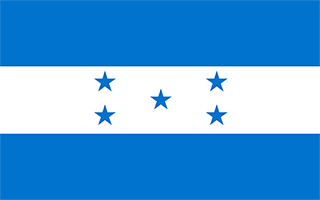
Three equal horizontal bands of cerulean blue (top), white, and cerulean blue, with five cerulean, five-pointed stars arranged in an X pattern centered in the white band; the stars represent the members of the former Federal Republic of Central America: Costa Rica, El Salvador, Guatemala, Honduras, and Nicaragua; the blue bands symbolize the Pacific Ocean and the Caribbean Sea; the white band represents the land between the two bodies of water and the peace and prosperity of its people.
Once part of Spain's vast empire in the New World, Honduras became an independent nation in 1821. After two and a half decades of mostly military rule, a freely elected civilian government came to power in 1982. During the 1980s, Honduras proved a haven for anti-Sandinista contras fighting the Marxist Nicaraguan Government and an ally to Salvadoran Government forces fighting leftist guerrillas. The country was devastated by Hurricane Mitch in 1998, which killed about 5,600 people and caused approximately $2 billion in damage. Since then, the economy has slowly rebounded.
Geography
| Area | ||
|---|---|---|
| Total (World Rank: 104) | 112,090 | sq km |
| Land (World Rank: 99) | 111,890 | sq km |
| Water (World Rank: 134) | 200 | sq km |
| Forest (World Rank: 111) | 15.70 | % |
| Comparative | slightly larger than Tennessee | |
| Coastline | ||
| 823 | ||
| Landborder | ||
| 1575 | ||
| Elevation | ||
| Highest point (World Rank: 79) | 2,870 | m |
| Agricultural land | ||
| Total (World Rank: 142) | 28.80 | % |
| Arable (World Rank: 119) | 9.10 | % |
| Permanent crops (World Rank: 63) | 4.00 | % |
| Permanent pastures (World Rank: 111) | 15.70 | % |
| Irrigated land (World Rank: 104) | 900 | sq km |
| Map reference | ||
| Central America and the Caribbean | ||
| Environment | ||
| Issues |
| |
| Agreement party |
| |
| Hazzards |
| |
| Location | ||
| Central America, bordering the Caribbean Sea, between Guatemala and Nicaragua and bordering the Gulf of Fonseca (North Pacific Ocean), between El Salvador and Nicaragua | ||
| Climate | ||
| subtropical in lowlands, temperate in mountains | ||
| Terrain | ||
| mostly mountains in interior, narrow coastal plains | ||
People
| Population | ||
|---|---|---|
| Total (World Rank: 94) | 9,038,740 | |
| Deathrate (World Rank: 180) | 0.53 | % |
| Birthrate (World Rank: 67) | 2.24 | % |
| Growthrate (World Rank: 67) | 1.60 | % |
| Migration rate (World Rank: 105) | -0.11 | % |
| Fertility rate (World Rank: 69) | 2.67 | % |
| Median age | ||
| Male (World Rank: 171) | 22.60 | |
| Female (World Rank: 169) | 23.30 | |
| Age structure | ||
| 0 14 male (World Rank: 83) | 1,521,300 | |
| 0 14 female (World Rank: 83) | 1,456,730 | |
| 15 24 male (World Rank: 84) | 968,013 | |
| 15 24 female (World Rank: 84) | 930,060 | |
| 25 54 male (World Rank: 96) | 1,675,570 | |
| 25 54 female (World Rank: 98) | 1,635,240 | |
| 55 64 male (World Rank: 109) | 218,342 | |
| 55 64 female (World Rank: 111) | 245,447 | |
| 65 x male (World Rank: 112) | 167,957 | |
| 65 x female (World Rank: 111) | 220,080 | |
| Health | ||
| Infant mortality rate (World Rank: 95) | 1.72 | % |
| Life expectancy total (World Rank: 148) | 71 | years |
| Life expectancy female (World Rank: 155) | 73 | years |
| Life expectancy male (World Rank: 148) | 70 | years |
| Hospital bed per 1000 (World Rank: 162) | 0.70 | |
| Sanitation access total (World Rank: 117) | 82.60 | % |
| Obesity adult (World Rank: 89) | 21.40 | % |
| Drinking water access (World Rank: 132) | 91.20 | % |
Energy
| Electricity | ||
|---|---|---|
| Production (World Rank: 107) | 8,367,000,000 | kWh |
| Consumption (World Rank: 107) | 7,215,000,000 | kWh |
| Export (World Rank: 66) | 536,000,000 | kWh |
| Import (World Rank: 74) | 679,000,000 | kWh |
| Source fossil (World Rank: 156) | 45.60 | % |
| Source nuclear (World Rank: 74) | 25.20 | % |
| Source renew (World Rank: 12) | 32.00 | % |
| Refined products | ||
| Consumption (World Rank: 103) | 52,000 | bbl / day |
| Export (World Rank: 75) | 13,160 | bbl / day |
| Import (World Rank: 70) | 64,820 | bbl / day |
| Natural gas | ||
| Consumption (World Rank: 159) | 7 | m³ |
| Carbon footprint | ||
| 10000000 | ||
Nation
| Budget | ||
|---|---|---|
| Education (World Rank: 37) | 6 | % of GDP |
| Military (World Rank: 69) | 2 | % of GDP |
| Health (World Rank: 45) | 9 | % of GDP |
| Surplus (World Rank: 108) | -3 | % of GDP |
| National symbol | ||
| white-tailed deer | ||
| National colours | ||
| white | ||
| Adjective | ||
| Honduran | ||
| Noun | ||
| Honduran(s) | ||
| Background | ||
| Once part of Spain's vast empire in the New World, Honduras became an independent nation in 1821. After two and a half decades of mostly military rule, a freely elected civilian government came to power in 1982. During the 1980s, Honduras proved a haven for anti-Sandinista contras fighting the Marxist Nicaraguan Government and an ally to Salvadoran Government forces fighting leftist guerrillas. The country was devastated by Hurricane Mitch in 1998, which killed about 5,600 people and caused approximately $2 billion in damage. Since then, the economy has slowly rebounded. | ||
| Flag description | ||
| three equal horizontal bands of cerulean blue (top), white, and cerulean blue, with five cerulean, five-pointed stars arranged in an X pattern centered in the white band; the stars represent the members of the former Federal Republic of Central America: Costa Rica, El Salvador, Guatemala, Honduras, and Nicaragua; the blue bands symbolize the Pacific Ocean and the Caribbean Sea; the white band represents the land between the two bodies of water and the peace and prosperity of its people | ||
Economy
| Gdp | ||
|---|---|---|
| Purchasing power parity (World Rank: 111) | 43,170,000,000 | USD |
| Real growth rate (World Rank: 75) | 3.60 | % |
| Per capita purchasing power parity (World Rank: 167) | 5,300 | USD |
| Source agriculture (World Rank: 71) | 13.50 | % |
| Source industry (World Rank: 91) | 28.20 | % |
| Source service (World Rank: 136) | 58.30 | % |
| Labourforce | ||
| Total (World Rank: 96) | 3,677,000 | |
| In poverty (World Rank: 64) | 29.60 | % |
| Products | ||
| Industries |
| |
| Agriculture |
| |
| Exports |
| |
| Imports |
| |
Communication
| Phone | ||
|---|---|---|
| Landline total (World Rank: 97) | 442,929 | |
| Landline per 100 (World Rank: 158) | 5.00 | |
| Mobile per 100 (World Rank: 153) | 88.00 | |
| Assessment | 0 | |
| Internet | ||
| Users (World Rank: 101) | 2,667,980 | |
| Population (World Rank: 156) | 30.00 | % |
Transport
| Air | ||
|---|---|---|
| Airports paved (World Rank: 104) | 13.00 | |
| Airports unpaved (World Rank: 38) | 90.00 | |
| Rail | ||
| Total length (World Rank: 101) | 699 | |
| Road | ||
| Total length (World Rank: 126) | 14,742 | |
| Paved length (World Rank: 112) | 3,367 | |
| Unpaved length (World Rank: 77) | 11,375 | |
| Water | ||
| Total length (World Rank: 86) | 465 | |
This is a list of famous places in this country in alphabetical order.
 Agua Azul
- Agua Azul Rancho
- Agua Blanca Sur
- Ajuterique
- Amapala
- Arada
- Armenta
- Azacualpa
- Belen Gualcho
- Canaveral
- Choloma
- Ciudad Choluteca
- Cofradia
- Comayagua
- Copan
- Corpus
- Corquin
- Coxen Hole
- Cuyamel
- Danli
- El Mochito
- El Negrito
- El Paraiso
- El Porvenir
- El Progreso
- El Triunfo
- El Zapotal del Norte
- Erandique
- French Harbor
- Gracias
- Gualaco
- Guinope
- Intibuca
- Jesus de Otoro
- Juticalpa
- La Alianza
- La Ceiba
- La Esperanza
- La Libertad
- La Lima
- La Paz
- Lamani
- Langue
- Las Vegas, Santa Barbara
- Lejamani
- Lepaera
- Marcala
- Minas de Oro
- Morazan
- Moroceli
- Nacaome
- Naco
- Naranjito
- Nueva Ocotepeque
- Ojojona
- Olanchito
- Omoa
- Orocuina
- Oropoli
- Pespire
- Potrerillos
- Puerto Cortez
- Puerto Lempira
- Quimistan
- Sabanagrande
- San Antonio del Norte
- San Esteban
- San Francisco de Ojuera
- San Jeronimo
- San Jose de Colinas
- San Lorenzo
- San Manuel
- San Marcos
- San Marcos
- San Marcos de Colon
- San Nicolas
- San Pedro Sula
- Sandy Bay
- Santa Ana de Yusguare
- Santa Barbara
- Santa Cruz de Yojoa
- Santa Rita, Copan
- Santa Rosa de Copan
- Santiago Puringla
- Siguatepeque
- Sinuapa
- Sulaco
- Talanga
- Tegucigalpa
- Tela
- Tocoa
- Trinidad
- Trujillo
- Valle de Angeles
- Villa de San Antonio
- Villa de San Francisco
- Villanueva
- Yorito
- Yoro
- Yuscaran