Bolivia
in South America
South America
 Argentina
 Brazil
 Chile
Chile Paraguay
 Peru
Peru- Currency and Currency Code:
- Boliviano - BOB
- Spoken languages:
- Spanish, Quechua, Aymara
- Local electricity:
- 230 V - 50 Hz (plugs: A, C)
- Mobile phone / cellular frequencies (MHz):
- 850 MHz, 1900 MHz, 3G, 4G
- ISO 2-Letter code:
- BO
- Internet top level domain:
- .bo
- Country phone prefix:
- +591
- Local Time (capital):
- Timezone:
- UTC/GMT offset: hours
Safety Score: 3,2 of 5.0 based on data from 9 authorites. Meaning please reconsider your need to travel to Bolivia.
Travel warnings are updated daily. Source: Travel Warning Bolivia. Last Update: 2024-04-26 08:02:42
Explore Bolivia
Bolivia with its capital Sucre is located in South America (Central South America, southwest of Brazil). It covers some 1,098,581 square kilometers (slightly less than three times the size of Montana) with a population of 11,138,200. Spanish, Quechua and Aymara are some of the languages spoken by the majority in Bolivia (consider regional differences). Argentina, Brazil, Chile, Paraguay and Peru are bordering countries.
Please consult medical advice prior to entering this country, since in August 2010 a suspicious plague was detected.
Bolivia is a beautiful, geographically diverse, multiethnic, and democratic country in the heart of South America. Sometimes referred to as the Tibet of the Americas, Bolivia is one of the most remote countries in the western hemisphere. Bolivia's climate varies drastically with altitude and from one climatic zone to another. It ranges from humid and tropical to cold and semiarid. Bolivia, named after independence fighter Simon Bolivar, broke away from Spanish rule in 1825. Transportation strikes (bloqueos) are a common occurrence in Bolivia, so try to keep tuned to local news. Strikes often affect local taxis as well as long-distance buses; airlines are generally unaffected. Bolivia has 37 official languages -of which Spanish (often called Castellano), Quechua, and Aymara are the main ones. The others are In rural areas, many people do not speak Spanish. Bolivia's traditional alcoholic drink is chicha, a whitish, sour brew made from fermented corn and drunk from a hemispherical bowl fashioned from a hollowed gourd. Offering a favorable exchange for Western tourists, lodging can be found at very reasonable prices throughout the country, from hostels to luxury hotels.
Popular Destinations in Bolivia
Administrative regions of Bolivia
- Departamento de Chuquisaca
- Departamento de Cochabamba
- Departamento de La Paz
- Departamento de Pando
- Departamento de Potosi
- Departamento de Santa Cruz
- Departamento de Tarija
- El Beni
- Oruro
About the country
Ministerio de Comercio Exterior, Inversion y Turismo
Palacio de las Comunicaciones, Piso 16
A. Mcal. Santa Cruz
Bolivia
Phone: +591 2 2367463
Fax: +591 2 2374630
Mail: vturismo@mcei.gov.bo
The terrain is rugged Andes Mountains with a highland plateau (Altiplano), hills, lowland plains of the Amazon Basin. The average density of population is about 10 per km². The climate in Bolivia can be described as varying with altitude with humid and tropical to cold and semiarid. Possible natural disasters include flooding in the northeast (March to April) volcanic activity in Andes Mountains on the border with Chile; historically active volcanoes in this region are Irruputuncu (5,163 m), which last erupted in 1995, and the Olca-Paruma volcanic complex (5,762 m to 5,167 m)
To reach someone Bolivia dial +591 prior to a number. The local cellular networks are operated on 850 MHz, 1900 MHz, 3G, 4G. Websites typically end with the top level domain ".bo". If you want to bring electric appliances (e.g. battery chaarger), keep in min the local 230 V - 50 Hz (plugs: A, C). The sign for the locally used currency Boliviano is BOB.
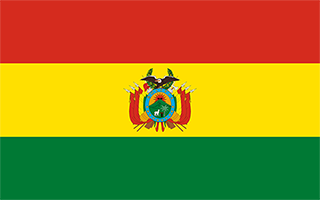
Three equal horizontal bands of red (top), yellow, and green with the coat of arms centered on the yellow band; red stands for bravery and the blood of national heroes, yellow for the nation's mineral resources, and green for the fertility of the land.
Bolivia, named after independence fighter Simon BOLIVAR, broke away from Spanish rule in 1825; much of its subsequent history has consisted of a series of coups and countercoups, with the last coup occurring in 1978. Democratic civilian rule was established in 1982, but leaders have faced difficult problems of deep-seated poverty, social unrest, and illegal drug production. In December 2005, Bolivians elected Movement Toward Socialism leader Evo MORALES president - by the widest margin of any leader since the restoration of civilian rule in 1982 - after he ran on a promise to change the country's traditional political class and empower the nation's poor, indigenous majority. In December 2009 and October 2014, President MORALES easily won reelection. His party maintained control of the legislative branch of the government, which has allowed him to continue his process of change. In February 2016, MORALES narrowly lost a referendum to approve a constitutional amendment that would have allowed him to compete in the 2019 presidential election. Despite the loss, MORALES has already been chosen by his party to run again in 2019, via a still-undetermined method for him to appear on the ballot.
Geography
| Area | ||
|---|---|---|
| Total (World Rank: 29) | 1,098,580 | sq km |
| Land (World Rank: 26) | 1,083,300 | sq km |
| Water (World Rank: 35) | 15,280 | sq km |
| Forest (World Rank: 55) | 30.50 | % |
| Comparative | slightly less than three times the size of Montana | |
| Landborder | ||
| 7252 | ||
| Elevation | ||
| Lowest point (World Rank: 28) | 90 | m |
| Highest point (World Rank: 13) | 6,542 | m |
| Agricultural land | ||
| Total (World Rank: 123) | 34.30 | % |
| Arable (World Rank: 162) | 3.60 | % |
| Permanent crops (World Rank: 169) | 0.20 | % |
| Permanent pastures (World Rank: 55) | 30.50 | % |
| Irrigated land (World Rank: 69) | 3,000 | sq km |
| Map reference | ||
| South America | ||
| Environment | ||
| Issues |
| |
| Agreement party |
| |
| Agreement signed |
| |
| Hazzards |
| |
| Location | ||
| Central South America, southwest of Brazil | ||
| Climate | ||
| varies with altitude; humid and tropical to cold and semiarid | ||
| Terrain | ||
| rugged Andes Mountains with a highland plateau (Altiplano), hills, lowland plains of the Amazon Basin | ||
People
| Population | ||
|---|---|---|
| Total (World Rank: 81) | 11,138,200 | |
| Deathrate (World Rank: 147) | 0.64 | % |
| Birthrate (World Rank: 72) | 2.20 | % |
| Growthrate (World Rank: 77) | 1.51 | % |
| Migration rate (World Rank: 94) | -0.05 | % |
| Fertility rate (World Rank: 73) | 2.63 | % |
| Median age | ||
| Male (World Rank: 161) | 23.60 | |
| Female (World Rank: 159) | 25.00 | |
| Age structure | ||
| 0 14 male (World Rank: 78) | 1,807,740 | |
| 0 14 female (World Rank: 78) | 1,739,760 | |
| 15 24 male (World Rank: 79) | 1,098,100 | |
| 15 24 female (World Rank: 79) | 1,069,950 | |
| 25 54 male (World Rank: 85) | 2,041,870 | |
| 25 54 female (World Rank: 81) | 2,133,060 | |
| 55 64 male (World Rank: 91) | 303,409 | |
| 55 64 female (World Rank: 88) | 353,598 | |
| 65 x male (World Rank: 91) | 260,424 | |
| 65 x female (World Rank: 95) | 330,327 | |
| Health | ||
| Infant mortality rate (World Rank: 52) | 3.53 | % |
| Life expectancy total (World Rank: 158) | 70 | years |
| Life expectancy female (World Rank: 157) | 72 | years |
| Life expectancy male (World Rank: 158) | 67 | years |
| Physicians per 1000 (World Rank: 128) | 0.47 | |
| Hospital bed per 1000 (World Rank: 146) | 1.10 | |
| Sanitation access total (World Rank: 160) | 50.30 | % |
| Obesity adult (World Rank: 101) | 20.20 | % |
| Drinking water access (World Rank: 140) | 90.00 | % |
Energy
| Electricity | ||
|---|---|---|
| Production (World Rank: 109) | 8,147,000,000 | kWh |
| Consumption (World Rank: 106) | 7,332,000,000 | kWh |
| Source fossil (World Rank: 101) | 71.90 | % |
| Source nuclear (World Rank: 84) | 21.00 | % |
| Source renew (World Rank: 76) | 8.00 | % |
| Crude oil | ||
| Production (World Rank: 49) | 59,330 | bbl / day |
| Proved reserves (World Rank: 56) | 211,500,000 | bbl |
| Refined products | ||
| Production (World Rank: 79) | 59,050 | bbl / day |
| Consumption (World Rank: 86) | 86,000 | bbl / day |
| Export (World Rank: 84) | 8,642 | bbl / day |
| Import (World Rank: 111) | 22,340 | bbl / day |
| Natural gas | ||
| Production (World Rank: 30) | 21,100,000,000 | m³ |
| Consumption (World Rank: 61) | 5,366,000,000 | m³ |
| Export (World Rank: 15) | 15,730,000,000 | m³ |
| Carbon footprint | ||
| 16000000 | ||
Nation
| Budget | ||
|---|---|---|
| Education (World Rank: 16) | 7 | % of GDP |
| Military (World Rank: 64) | 2 | % of GDP |
| Health (World Rank: 100) | 6 | % of GDP |
| Surplus (World Rank: 168) | -6 | % of GDP |
| National symbol | ||
| llama | ||
| National colours | ||
| yellow | ||
| Adjective | ||
| Bolivian | ||
| Noun | ||
| Bolivian(s) | ||
| Background | ||
| Bolivia, named after independence fighter Simon BOLIVAR, broke away from Spanish rule in 1825; much of its subsequent history has consisted of a series of coups and countercoups, with the last coup occurring in 1978. Democratic civilian rule was established in 1982, but leaders have faced difficult problems of deep-seated poverty, social unrest, and illegal drug production. In December 2005, Bolivians elected Movement Toward Socialism leader Evo MORALES president - by the widest margin of any leader since the restoration of civilian rule in 1982 - after he ran on a promise to change the country's traditional political class and empower the nation's poor, indigenous majority. In December 2009 and October 2014, President MORALES easily won reelection. His party maintained control of the legislative branch of the government, which has allowed him to continue his process of change. In February 2016, MORALES narrowly lost a referendum to approve a constitutional amendment that would have allowed him to compete in the 2019 presidential election. Despite the loss, MORALES has already been chosen by his party to run again in 2019, via a still-undetermined method for him to appear on the ballot. | ||
| Flag description | ||
| three equal horizontal bands of red (top), yellow, and green with the coat of arms centered on the yellow band; red stands for bravery and the blood of national heroes, yellow for the nation's mineral resources, and green for the fertility of the land | ||
Economy
| Gdp | ||
|---|---|---|
| Purchasing power parity (World Rank: 92) | 78,770,000,000 | USD |
| Real growth rate (World Rank: 55) | 4.30 | % |
| Per capita purchasing power parity (World Rank: 151) | 7,200 | USD |
| Source agriculture (World Rank: 72) | 13.40 | % |
| Source industry (World Rank: 30) | 38.50 | % |
| Source service (World Rank: 158) | 53.80 | % |
| Labourforce | ||
| Total (World Rank: 82) | 4,992,000 | |
| In poverty (World Rank: 41) | 38.60 | % |
| Products | ||
| Industries |
| |
| Agriculture |
| |
| Exports |
| |
| Imports |
| |
Communication
| Phone | ||
|---|---|---|
| Landline total (World Rank: 79) | 867,302 | |
| Landline per 100 (World Rank: 138) | 8.00 | |
| Mobile per 100 (World Rank: 142) | 93.00 | |
| Assessment | 0 | |
| Internet | ||
| Users (World Rank: 83) | 4,354,680 | |
| Population (World Rank: 139) | 39.70 | % |
Transport
| Air | ||
|---|---|---|
| Airports paved (World Rank: 78) | 21.00 | |
| Airports unpaved (World Rank: 6) | 834 | |
| Rail | ||
| Total length (World Rank: 54) | 3,504 | |
| Road | ||
| Total length (World Rank: 54) | 90,568 | |
| Paved length (World Rank: 76) | 9,792 | |
| Unpaved length (World Rank: 23) | 80,776 | |
| Water | ||
| Total length (World Rank: 13) | 10,000 | |
This is a list of famous places in this country in alphabetical order.
 Abapo
Abapo- Achacachi
- Aiquile
- Arani
- Ascension
- Atocha
- Batallas
- Betanzos
- Boyuibe
- Buena Vista
- Camargo
- Camiri
- Capinota
- Challapata
- Charagua
- Chimore
- Chulumani
- Cliza
- Cobija
- Cochabamba
- Colchani
- Colomi
- Colquechaca
- Colquiri
- Comarapa
- Coroico
- Cotoca
- Curahuara de Carangas
- Entre Rios
- Eucaliptus
- Guayaramerin
- Huanuni
- Huarina
- Huatajata
- Ipajama
- Irpa Irpa
- Jorochito
- La Belgica
- La Paz
- La Santisima Trinidad
- Lahuachaca
- Limoncito
- Llallagua
- Los Negros
- Machacamarca
- Mairana
- Mapiri
- Mineros
- Mizque
- Monteagudo
- Montero
- Oruro
- Padilla
- Pailon
- Patacamaya
- Paurito
- Poopo
- Portachuelo
- Potosi
- Puerto Quijarro
- Puesto de Pailas
- Punata
- Quime
- Reyes
- Riberalta
- Robore
- Rurrenabaque
- Samaipata
- San Borja
- San Ignacio de Velasco
- San Juan del Surutu
- San Julian
- San Matias
- San Pablo
- San Pedro
- San Ramon
- Santa Barbara
- Santa Cruz de la Sierra
- Santa Rosa
- Santa Rosa del Sara
- Santiago del Torno
- Sipe Sipe
- Sorata
- Sucre
- Tarabuco
- Tarata
- Tarija
- Tiahuanaco
- Totora
- Totoral
- Tupiza
- Urubicha
- Uyuni
- Vallegrande
- Villa Yapacani
- Villamontes
- Villazon
- Warnes
- Yacuiba
- Yumani