Ghana
in Western Africa
Africa
 Burkina Faso
 Ivory Coast
 Togo
Togo- Currency and Currency Code:
- Cedi - GHC
- Spoken languages:
- English, Akan, Ewe, Twi
- Local electricity:
- 230 V - 50 Hz (plugs: D, G)
- Mobile phone / cellular frequencies (MHz):
- 900 MHz, 1800 MHz, 3G, 4G
- ISO 2-Letter code:
- GH
- Internet top level domain:
- .gh
- Country phone prefix:
- +233
- Local Time (capital):
- Timezone:
- UTC/GMT offset: hours
Safety Score: 3,4 of 5.0 based on data from 9 authorites. Meaning please reconsider your need to travel to Ghana.
Travel warnings are updated daily. Source: Travel Warning Ghana. Last Update: 2024-04-26 08:02:42
Explore Ghana
Ghana with its capital Accra is located in Africa (Western Africa, bordering the Gulf of Guinea). It covers some 238,534 square kilometers (slightly smaller than Oregon) with 27,499,900 citizens. English, Akan, Ewe and Twi are the common languages used in Ghana (consider regional differences). Burkina Faso, Ivory Coast and Togo are bordering countries.
Ghana is in West Africa. It borders Côte d'Ivoire to the west, Burkina Faso to the north and Togo to the east. There are two main seasons in Ghana, the wet and the dry seasons. Northern Ghana experiences its rainy season from March to November while the south, including the capital Accra, experiences the season from April to Mid-November. Among the sites equiped for tourists are the slave castles in coastal towns, including Cape Coast, Elmina and others. A Tro-Tro ride away from Accra is Kakum National Park, where you can walk the wood-and-rope bridges though the rainforest canopy. A wonderful experience, abeit a bit touristy. Prices have skyrocketed in recent years, but nonetheless it is a great opportunity to see some flora and fauna (if there are not too many tourists, you have a fairly good chance of seeing some monkeys in the trees).
Popular Destinations in Ghana
Administrative regions of Ghana
- Ashanti Region
- Brong-Ahafo Region
- Central Region
- Eastern Region
- Greater Accra Region
- Northern Region
- Upper East Region
- Upper West Region
- Volta Region
- Western Region
About the country
Website: Ghana Tourism
P. O. Box 3106
Accra
Ghana
Phone: +233 21 222153
Fax: +233 21 231779
Mail: gtb@africaonline.com.gh
The landscape is mostly low plains with dissected plateau in south-central area. The average density of population is about 115 per km². The climate in Ghana can be described as tropicalwarm and comparatively dry along southeast coast, hot and humid in southwest, hot and dry in north. Potential threats by nature are droughts dry, dusty, northeastern harmattan winds from January to March
To reach someone Ghana dial +233 prior to a number. The local cellular networks are operated on 900 MHz, 1800 MHz, 3G, 4G. Websites typically end with the top level domain ".gh". If you want to bring electric appliances (e.g. battery chaarger), keep in min the local 230 V - 50 Hz (plugs: D, G). The sign for the locally used currency Cedi is GHC.
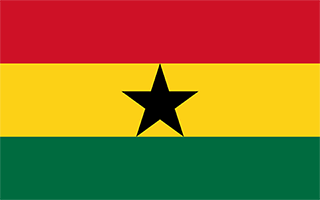
Three equal horizontal bands of red (top), yellow, and green, with a large black five-pointed star centered in the yellow band; red symbolizes the blood shed for independence, yellow represents the country's mineral wealth, while green stands for its forests and natural wealth; the black star is said to be the lodestar of African freedom.
Formed from the merger of the British colony of the Gold Coast and the Togoland trust territory, Ghana in 1957 became the first sub-Saharan country in colonial Africa to gain its independence. Ghana endured a series of coups before Lt. Jerry RAWLINGS took power in 1981 and banned political parties. After approving a new constitution and restoring multiparty politics in 1992, RAWLINGS won presidential elections in 1992 and 1996 but was constitutionally prevented from running for a third term in 2000. John KUFUOR of the opposition New Patriotic Party (NPP) succeeded him and was reelected in 2004. John Atta MILLS of the National Democratic Congress won the 2008 presidential election and took over as head of state, but he died in July 2012 and was constitutionally succeeded by his vice president, John Dramani MAHAMA, who subsequently won the December 2012 presidential election. In 2016, however, Nana Addo Dankwa AKUFO-ADDO of the NPP defeated MAHAMA, marking the third time that the Ghana’s presidency has changed parties since the return to democracy.
Geography
| Area | ||
|---|---|---|
| Total (World Rank: 83) | 238,533 | sq km |
| Land (World Rank: 82) | 227,533 | sq km |
| Water (World Rank: 44) | 11,000 | sq km |
| Forest (World Rank: 43) | 36.50 | % |
| Comparative | slightly smaller than Oregon | |
| Coastline | ||
| 539 | ||
| Landborder | ||
| 2420 | ||
| Elevation | ||
| Highest point (World Rank: 174) | 885 | m |
| Agricultural land | ||
| Total (World Rank: 27) | 69.10 | % |
| Arable (World Rank: 51) | 20.70 | % |
| Permanent crops (World Rank: 23) | 11.90 | % |
| Permanent pastures (World Rank: 43) | 36.50 | % |
| Irrigated land (World Rank: 120) | 340 | sq km |
| Map reference | ||
| Africa | ||
| Environment | ||
| Issues |
| |
| Agreement party |
| |
| Agreement signed | Marine Life Conservation | |
| Hazzards |
| |
| Location | ||
| Western Africa, bordering the Gulf of Guinea, between Cote d'Ivoire and Togo | ||
| Climate | ||
| tropical; warm and comparatively dry along southeast coast; hot and humid in southwest; hot and dry in north | ||
| Terrain | ||
| mostly low plains with dissected plateau in south-central area | ||
People
| Population | ||
|---|---|---|
| Total (World Rank: 49) | 27,499,900 | |
| Deathrate (World Rank: 132) | 0.70 | % |
| Birthrate (World Rank: 35) | 3.05 | % |
| Growthrate (World Rank: 38) | 2.17 | % |
| Migration rate (World Rank: 120) | -0.18 | % |
| Fertility rate (World Rank: 33) | 4.00 | % |
| Median age | ||
| Male (World Rank: 183) | 20.60 | |
| Female (World Rank: 180) | 21.60 | |
| Age structure | ||
| 0 14 male (World Rank: 38) | 5,253,430 | |
| 0 14 female (World Rank: 37) | 5,198,890 | |
| 15 24 male (World Rank: 48) | 2,548,660 | |
| 15 24 female (World Rank: 45) | 2,575,160 | |
| 25 54 male (World Rank: 53) | 4,554,970 | |
| 25 54 female (World Rank: 50) | 4,834,760 | |
| 55 64 male (World Rank: 55) | 664,866 | |
| 55 64 female (World Rank: 57) | 701,277 | |
| 65 x male (World Rank: 64) | 538,790 | |
| 65 x female (World Rank: 65) | 629,111 | |
| Health | ||
| Infant mortality rate (World Rank: 53) | 3.52 | % |
| Life expectancy total (World Rank: 169) | 67 | years |
| Life expectancy female (World Rank: 169) | 70 | years |
| Life expectancy male (World Rank: 170) | 65 | years |
| Physicians per 1000 (World Rank: 162) | 0.10 | |
| Hospital bed per 1000 (World Rank: 154) | 0.90 | |
| Sanitation access total (World Rank: 202) | 14.90 | % |
| Obesity adult (World Rank: 136) | 10.90 | % |
| Drinking water access (World Rank: 142) | 88.70 | % |
Energy
| Electricity | ||
|---|---|---|
| Production (World Rank: 95) | 11,090,000,000 | kWh |
| Consumption (World Rank: 98) | 8,377,000,000 | kWh |
| Export (World Rank: 65) | 552,000,000 | kWh |
| Import (World Rank: 89) | 223,000,000 | kWh |
| Source fossil (World Rank: 162) | 44.10 | % |
| Source nuclear (World Rank: 31) | 55.70 | % |
| Source renew (World Rank: 135) | 1.00 | % |
| Crude oil | ||
| Production (World Rank: 43) | 100,500 | bbl / day |
| Exports (World Rank: 37) | 99,890 | bbl / day |
| Imports (World Rank: 71) | 13,860 | bbl / day |
| Proved reserves (World Rank: 43) | 660,000,000 | bbl |
| Refined products | ||
| Production (World Rank: 102) | 2,815 | bbl / day |
| Consumption (World Rank: 90) | 79,000 | bbl / day |
| Export (World Rank: 102) | 2,761 | bbl / day |
| Import (World Rank: 63) | 80,350 | bbl / day |
| Natural gas | ||
| Production (World Rank: 83) | 63,540,000 | m³ |
| Consumption (World Rank: 91) | 1,325,000,000 | m³ |
| Import (World Rank: 76) | 0 | m³ |
| Carbon footprint | ||
| 11000000 | ||
Nation
| Budget | ||
|---|---|---|
| Education (World Rank: 30) | 6 | % of GDP |
| Military (World Rank: 148) | 0 | % of GDP |
| Health (World Rank: 168) | 4 | % of GDP |
| Surplus (World Rank: 184) | -8 | % of GDP |
| National symbol | ||
| golden eagle | ||
| National colours | ||
| yellow | ||
| Adjective | ||
| Ghanaian | ||
| Noun | ||
| Ghanaian(s) | ||
| Background | ||
| Formed from the merger of the British colony of the Gold Coast and the Togoland trust territory, Ghana in 1957 became the first sub-Saharan country in colonial Africa to gain its independence. Ghana endured a series of coups before Lt. Jerry RAWLINGS took power in 1981 and banned political parties. After approving a new constitution and restoring multiparty politics in 1992, RAWLINGS won presidential elections in 1992 and 1996 but was constitutionally prevented from running for a third term in 2000. John KUFUOR of the opposition New Patriotic Party (NPP) succeeded him and was reelected in 2004. John Atta MILLS of the National Democratic Congress won the 2008 presidential election and took over as head of state, but he died in July 2012 and was constitutionally succeeded by his vice president, John Dramani MAHAMA, who subsequently won the December 2012 presidential election. In 2016, however, Nana Addo Dankwa AKUFO-ADDO of the NPP defeated MAHAMA, marking the third time that the Ghana’s presidency has changed parties since the return to democracy. | ||
| Flag description | ||
| three equal horizontal bands of red (top), yellow, and green, with a large black five-pointed star centered in the yellow band; red symbolizes the blood shed for independence, yellow represents the country's mineral wealth, while green stands for its forests and natural wealth; the black star is said to be the lodestar of African freedom | ||
Economy
| Gdp | ||
|---|---|---|
| Purchasing power parity (World Rank: 81) | 120,900,000,000 | USD |
| Real growth rate (World Rank: 77) | 3.50 | % |
| Per capita purchasing power parity (World Rank: 171) | 4,400 | USD |
| Source agriculture (World Rank: 50) | 19.70 | % |
| Source industry (World Rank: 115) | 25.30 | % |
| Source service (World Rank: 132) | 59.40 | % |
| Labourforce | ||
| Total (World Rank: 45) | 12,130,000 | |
| In poverty (World Rank: 80) | 24.20 | % |
| Products | ||
| Industries |
| |
| Agriculture |
| |
| Exports |
| |
| Imports |
| |
Communication
| Phone | ||
|---|---|---|
| Landline total (World Rank: 119) | 251,490 | |
| Landline per 100 (World Rank: 211) | 1.00 | |
| Mobile per 100 (World Rank: 35) | 142.00 | |
| Assessment | 0 | |
| Internet | ||
| Users (World Rank: 48) | 9,328,020 | |
| Population (World Rank: 146) | 34.70 | % |
Transport
| Air | ||
|---|---|---|
| Airports paved (World Rank: 136) | 7.00 | |
| Airports unpaved (World Rank: 164) | 3.00 | |
| Rail | ||
| Total length (World Rank: 93) | 947 | |
| Road | ||
| Total length (World Rank: 45) | 109,515 | |
| Paved length (World Rank: 70) | 13,787 | |
| Unpaved length (World Rank: 22) | 95,728 | |
| Water | ||
| Total length (World Rank: 58) | 1,293 | |
This is a list of famous places in this country in alphabetical order.
 Aboso
Aboso- Abossey Okai
- Aburi
- Accra
- Achenim
- Achiaman
- Ada
- Adabraka
- Adewuke
- Afegame
- Aflao
- Agogo
- Ajobom
- Akim Oda
- Akim Swedru
- Akosombo
- Akropong
- Akwatia
- Akwida
- Amakom
- Anloga
- Anomabu
- Apam
- Asamang
- Asamankese
- Atimpoko
- Axim
- Bantama
- Bantuma
- Bawku
- Bechem
- Begoro
- Bekwai
- Berekum
- Bibiani
- Bolgatanga
- Bukere
- Busua
- Butre
- Cape Coast
- Dixcove
- Dome
- Duayaw Nkwanta
- Dunkwa
- Efiduasi
- Eja
- Ejura
- Ekuasi
- Elmina
- Foso
- Gbawe
- Great Kromanti Low Town
- Gwira Achinum
- Ho
- Hohoe
- Kasoa
- Katakwo
- Keta
- Kete Krachi
- Kibi
- Kintampo
- Koforidua
- Kokrobite
- Konongo
- Kpandae
- Kpandu
- Kumasi
- Larabanga
- Legon
- Mampong
- Medina Estates
- Mpraeso
- Mumford
- Navrongo
- Nkawkaw
- Nsawam
- Obuasi
- Paga
- Prestea
- Salaga
- Saltpond
- Santienga
- Savelugu
- Sekondi-Takoradi
- Shama Junction
- Suhum
- Sunyani
- Swedru
- Tafo
- Takoradi
- Tamale
- Tarkwa
- Techiman
- Tema
- Tongo
- Wa
- Wenchi
- Winneba
- Yendi
- Zubiong