Peru
in South America
South America
 Bolivia
 Brazil
 Chile
Chile Colombia
 Ecuador
- Currency and Currency Code:
- Sol - PEN
- Spoken languages:
- Spanish, Quechua, Aymara
- Local electricity:
- 220 V - 60 Hz (plugs: A, C)
- Mobile phone / cellular frequencies (MHz):
- 850 MHz, 1900 MHz, 3G, 4G
- ISO 2-Letter code:
- PE
- Internet top level domain:
- .pe
- Country phone prefix:
- +51
- Local Time (capital):
- Timezone:
- UTC/GMT offset: hours
Safety Score: 3,3 of 5.0 based on data from 9 authorites. Meaning please reconsider your need to travel to Peru.
Travel warnings are updated daily. Source: Travel Warning Peru. Last Update: 2024-04-26 08:02:42
Explore Peru
Peru with its capital Lima is located in South America (Western South America, bordering the South Pacific Ocean). It covers some 1,285,221 square kilometers (almost twice the size of Texas) with a population of 31,036,700. Spanish, Quechua and Aymara are the languages spoken by people in Peru (consider regional differences). Bolivia, Brazil, Chile, Colombia and Ecuador are bordering countries.
Peru is a country in South America, situated on the western side of that continent, facing the South Pacific Ocean and straddling part of the Andes mountain range that runs the length of South America. The main attractions are their archaeological patrimony of pre-Columbian cultures and the center of Inca's Empire, their gastronomy, their colonial architecture (has imposing colonial constructions) and their natural resources (a paradise for the ecological tourism). Peruvians do not hesitate to greet you with ¡Hola, gringo!.
Popular Destinations in Peru
Administrative regions of Peru
- Amazonas
- Ancash
- Apurimac
- Arequipa
- Ayacucho
- Cajamarca
- Callao
- Cusco
- Departamento de Moquegua
- Huancavelica
- Ica
- Junin
- La Libertad
- Lambayeque
- Lima region
- Loreto
- Madre de Dios
- Pasco
- Piura
- Provincia de Lima
- Puno
- Region de Huanuco
- Region de San Martin
- Tacna
- Tumbes
- Ucayali
About the country
Website: Peru Tourism
Edificio MITINCI piso 13
Calle Uno oeste No. 50
Urb. Corpac
Lima 27
Peru
Phone: +51 1 224 3279
Fax: +51 1 224 3323
Mail: infoperu@promperu.gob.pe
The topography is western coastal plain (costa), high and rugged Andes in center (sierra), eastern lowland jungle of Amazon Basin (selva). The average density of population is about 24 per km². The climate in Peru can be described as varying from tropical in east to dry desert in west with temperate to frigid in Andes. Potential natural disasters are earthquakes, tsunamis, flooding, landslides, mild volcanic activity volcanic activity in the Andes Mountains; Ubinas (5,672 m), which last erupted in 2009, is the country's most active volcano; other historically active volcanoes include El Misti, Huaynaputina, Sabancaya, and Yucamane
To reach someone Peru dial +51 prior to a number. The local cellular networks are operated on 850 MHz, 1900 MHz, 3G, 4G. Websites typically end with the top level domain ".pe". If you want to bring electric appliances (e.g. battery chaarger), keep in min the local 220 V - 60 Hz (plugs: A, C). The sign for the locally used currency Sol is PEN.
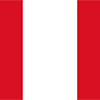
Three equal, vertical bands of red (hoist side), white, and red with the coat of arms centered in the white band; the coat of arms features a shield bearing a vicuna (representing fauna), a cinchona tree (the source of quinine, signifying flora), and a yellow cornucopia spilling out coins (denoting mineral wealth); red recalls blood shed for independence, white symbolizes peace.

Ancient Peru was the seat of several prominent Andean civilizations, most notably that of the Incas whose empire was captured by Spanish conquistadors in 1533. Peru declared its independence in 1821, and remaining Spanish forces were defeated in 1824. After a dozen years of military rule, Peru returned to democratic leadership in 1980, but experienced economic problems and the growth of a violent insurgency. President Alberto FUJIMORI's election in 1990 ushered in a decade that saw a dramatic turnaround in the economy and significant progress in curtailing guerrilla activity. Nevertheless, the president's increasing reliance on authoritarian measures and an economic slump in the late 1990s generated mounting dissatisfaction with his regime, which led to his resignation in 2000. A caretaker government oversaw a new election in the spring of 2001, which installed Alejandro TOLEDO Manrique as the new head of government - Peru's first democratically elected president of indigenous ethnicity. The presidential election of 2006 saw the return of Alan GARCIA Perez who, after a disappointing presidential term from 1985 to 1990, oversaw a robust economic rebound. Former army officer Ollanta HUMALA Tasso was elected president in June 2011, and carried on the sound, market-oriented economic policies of the three preceding administrations. Poverty and unemployment levels have fallen dramatically in the last decade, and today Peru boasts one of the best performing economies in Latin America. Pedro Pablo KUCZYNSKI Godard won a very narrow presidential runoff election in June 2016.
Geography
| Area | ||
|---|---|---|
| Total (World Rank: 21) | 1,285,220 | sq km |
| Land (World Rank: 20) | 1,280,000 | sq km |
| Water (World Rank: 66) | 5,220 | sq km |
| Forest (World Rank: 114) | 14.60 | % |
| Comparative | almost twice the size of Texas; slightly smaller than Alaska | |
| Coastline | ||
| 2414 | ||
| Landborder | ||
| 7062 | ||
| Elevation | ||
| Highest point (World Rank: 12) | 6,746 | m |
| Agricultural land | ||
| Total (World Rank: 168) | 18.80 | % |
| Arable (World Rank: 167) | 3.10 | % |
| Permanent crops (World Rank: 118) | 1.10 | % |
| Permanent pastures (World Rank: 114) | 14.60 | % |
| Irrigated land (World Rank: 22) | 25,800 | sq km |
| Map reference | ||
| South America | ||
| Environment | ||
| Issues |
| |
| Agreement party |
| |
| Hazzards |
| |
| Location | ||
| Western South America, bordering the South Pacific Ocean, between Chile and Ecuador | ||
| Climate | ||
| varies from tropical in east to dry desert in west; temperate to frigid in Andes | ||
| Terrain | ||
| western coastal plain (costa), high and rugged Andes in center (sierra), eastern lowland jungle of Amazon Basin (selva) | ||
People
| Population | ||
|---|---|---|
| Total (World Rank: 43) | 31,036,700 | |
| Deathrate (World Rank: 158) | 0.61 | % |
| Birthrate (World Rank: 102) | 1.78 | % |
| Growthrate (World Rank: 117) | 0.95 | % |
| Migration rate (World Rank: 132) | -0.22 | % |
| Fertility rate (World Rank: 101) | 2.12 | % |
| Median age | ||
| Male (World Rank: 139) | 27.20 | |
| Female (World Rank: 126) | 28.80 | |
| Age structure | ||
| 0 14 male (World Rank: 50) | 4,155,670 | |
| 0 14 female (World Rank: 50) | 4,009,890 | |
| 15 24 male (World Rank: 39) | 2,847,460 | |
| 15 24 female (World Rank: 40) | 2,835,730 | |
| 25 54 male (World Rank: 42) | 5,985,350 | |
| 25 54 female (World Rank: 39) | 6,487,230 | |
| 55 64 male (World Rank: 40) | 1,168,530 | |
| 55 64 female (World Rank: 41) | 1,247,300 | |
| 65 x male (World Rank: 36) | 1,086,790 | |
| 65 x female (World Rank: 44) | 1,212,700 | |
| Health | ||
| Infant mortality rate (World Rank: 88) | 1.84 | % |
| Life expectancy total (World Rank: 123) | 74 | years |
| Life expectancy female (World Rank: 131) | 76 | years |
| Life expectancy male (World Rank: 117) | 72 | years |
| Physicians per 1000 (World Rank: 109) | 1.12 | |
| Hospital bed per 1000 (World Rank: 128) | 1.50 | |
| Sanitation access total (World Rank: 133) | 76.20 | % |
| Obesity adult (World Rank: 109) | 19.70 | % |
| Drinking water access (World Rank: 150) | 86.70 | % |
Energy
| Electricity | ||
|---|---|---|
| Production (World Rank: 55) | 46,310,000,000 | kWh |
| Consumption (World Rank: 55) | 40,930,000,000 | kWh |
| Export (World Rank: 84) | 55,000,000 | kWh |
| Source fossil (World Rank: 121) | 62.60 | % |
| Source nuclear (World Rank: 59) | 33.90 | % |
| Source renew (World Rank: 100) | 4.30 | % |
| Crude oil | ||
| Production (World Rank: 58) | 40,270 | bbl / day |
| Exports (World Rank: 55) | 15,560 | bbl / day |
| Imports (World Rank: 46) | 83,660 | bbl / day |
| Proved reserves (World Rank: 49) | 473,000,000 | bbl |
| Refined products | ||
| Production (World Rank: 53) | 187,200 | bbl / day |
| Consumption (World Rank: 50) | 240,000 | bbl / day |
| Export (World Rank: 47) | 66,650 | bbl / day |
| Import (World Rank: 79) | 52,880 | bbl / day |
| Natural gas | ||
| Production (World Rank: 36) | 12,620,000,000 | m³ |
| Consumption (World Rank: 52) | 10,880,000,000 | m³ |
| Export (World Rank: 32) | 4,830,000,000 | m³ |
| Carbon footprint | ||
| 41000000 | ||
Nation
| Budget | ||
|---|---|---|
| Education (World Rank: 108) | 4 | % of GDP |
| Military (World Rank: 91) | 1 | % of GDP |
| Health (World Rank: 126) | 6 | % of GDP |
| Surplus (World Rank: 98) | -3 | % of GDP |
| National symbol | ||
| vicuna | ||
| National colours | ||
| white | ||
| Adjective | ||
| Peruvian | ||
| Noun | ||
| Peruvian(s) | ||
| Background | ||
| Ancient Peru was the seat of several prominent Andean civilizations, most notably that of the Incas whose empire was captured by Spanish conquistadors in 1533. Peru declared its independence in 1821, and remaining Spanish forces were defeated in 1824. After a dozen years of military rule, Peru returned to democratic leadership in 1980, but experienced economic problems and the growth of a violent insurgency. President Alberto FUJIMORI's election in 1990 ushered in a decade that saw a dramatic turnaround in the economy and significant progress in curtailing guerrilla activity. Nevertheless, the president's increasing reliance on authoritarian measures and an economic slump in the late 1990s generated mounting dissatisfaction with his regime, which led to his resignation in 2000. A caretaker government oversaw a new election in the spring of 2001, which installed Alejandro TOLEDO Manrique as the new head of government - Peru's first democratically elected president of indigenous ethnicity. The presidential election of 2006 saw the return of Alan GARCIA Perez who, after a disappointing presidential term from 1985 to 1990, oversaw a robust economic rebound. Former army officer Ollanta HUMALA Tasso was elected president in June 2011, and carried on the sound, market-oriented economic policies of the three preceding administrations. Poverty and unemployment levels have fallen dramatically in the last decade, and today Peru boasts one of the best performing economies in Latin America. Pedro Pablo KUCZYNSKI Godard won a very narrow presidential runoff election in June 2016. | ||
| Flag description | ||
| three equal, vertical bands of red (hoist side), white, and red with the coat of arms centered in the white band; the coat of arms features a shield bearing a vicuna (representing fauna), a cinchona tree (the source of quinine, signifying flora), and a yellow cornucopia spilling out coins (denoting mineral wealth); red recalls blood shed for independence, white symbolizes peace | ||
Economy
| Gdp | ||
|---|---|---|
| Purchasing power parity (World Rank: 47) | 406,500,000,000 | USD |
| Real growth rate (World Rank: 66) | 4.00 | % |
| Per capita purchasing power parity (World Rank: 117) | 12,900 | USD |
| Source agriculture (World Rank: 106) | 7.60 | % |
| Source industry (World Rank: 46) | 34.70 | % |
| Source service (World Rank: 139) | 57.70 | % |
| Labourforce | ||
| Total (World Rank: 37) | 16,800,000 | |
| In poverty (World Rank: 90) | 22.70 | % |
| Products | ||
| Industries |
| |
| Agriculture |
| |
| Exports |
| |
| Imports |
| |
Communication
| Phone | ||
|---|---|---|
| Landline total (World Rank: 49) | 3,074,460 | |
| Landline per 100 (World Rank: 131) | 10.00 | |
| Mobile per 100 (World Rank: 77) | 120.00 | |
| Assessment | 0 | |
| Internet | ||
| Users (World Rank: 41) | 13,975,400 | |
| Population (World Rank: 130) | 45.50 | % |
Transport
| Air | ||
|---|---|---|
| Airports paved (World Rank: 41) | 59.00 | |
| Airports unpaved (World Rank: 28) | 132.00 | |
| Heliports (World Rank: 35) | 5.00 | |
| Rail | ||
| Total length (World Rank: 76) | 1,854 | |
| Road | ||
| Total length (World Rank: 36) | 140,672 | |
| Water | ||
| Total length (World Rank: 14) | 8,808 | |
This is a list of famous places in this country in alphabetical order.
 Abancay
- Aguas Verdes
- Andahuaylas
- Arequipa
- Ascope
- Ayacucho
- Bagua Grande
- Barranca
- Bellavista
- Cajabamba
- Cajamarca
- Calca
- Callao
- Catacaos
- Cerro de Pasco
- Chachapoyas
- Chancay
- Chepen
- Chiclayo
- Chilca
- Chimbote
- Chincha Alta
- Chivay
- Chocope
- Chosica
- Chulucanas
- Coishco
- Cusco
- Eten
- Ferrenafe
- Huacho
- Huamachuco
- Huancavelica
- Huancayo
- Huanta
- Huanuco
- Huaral
- Huaraz
- Huarmey
- Huaura
- Ica
- Ilo
- Imperial
- Iquitos
- Jaen
- Jauja
- Juanjui
- Juli
- Juliaca
- La Oroya
- Lamas
- Lambayeque
- Laredo
- Lima
- Mala
- Marcavelica
- Mazamari
- Mollendo
- Moquegua
- Morococha
- Moyobamba
- Nazca
- Ollantaytambo
- Oxapampa
- Pacasmayo
- Paita
- Palpa
- Pativilca
- Picsi
- Pimentel
- Pisco
- Piura
- Pucallpa
- Puerto Maldonado
- Puno
- Puquio
- Rioja
- Salaverry
- San Bartolo
- San Isidro
- San Miguel
- Sana
- Saposoa
- Satipo
- Sechura
- Sicuani
- Sullana
- Tacna
- Talara
- Tambo Grande
- Tarma
- Tingo Maria
- Trujillo
- Tumbes
- Urcos
- Urubamba
- Yunguyo
- Yurimaguas
- Zarumilla
- Zorritos