Sudan
in Northern Africa
Africa
 Central African Republic
 Chad
Chad Egypt
Egypt Eritrea
 Ethiopia
 Libya
Libya South Sudan
- Currency and Currency Code:
- Dinar - SDD
- Spoken languages:
- Arabic, English
- Local electricity:
- 230 V - 50 Hz (plugs: C, D)
- Mobile phone / cellular frequencies (MHz):
- 900 MHz, 1800 MHz, 3G, 4G
- ISO 2-Letter code:
- SD
- Internet top level domain:
- .sd
- Country phone prefix:
- +249
- Local Time (capital):
- Timezone:
- UTC/GMT offset: hours
Safety Score: 4,7 of 5.0 based on data from 9 authorites. Meaning it is not safe to travel Sudan.
Travel warnings are updated daily. Source: Travel Warning Sudan. Last Update: 2024-04-19 08:03:45
Explore Sudan
Sudan with its capital Khartoum is located in Africa (north-eastern Africa, bordering the Red Sea). It covers some 1,861,481 square kilometers (slightly less than one-fifth the size of the US) with a population of 37,345,900. Arabic and English are the languages spoken by people in Sudan. Central African Republic, Chad, Egypt, Eritrea, Ethiopia, Libya and South Sudan are bordering countries.
Travel in Sudan outside Khartoum, Omdurman and the Northern State is considered dangerous. Two borderline civil wars continue to see violence, in Southern Sudan and particularly in Darfur, while extremist groups target foreign visitors for attacks and kidnapping, particularly in the Upper Nile regions and near the Ethiopian border.
Popular Destinations in Sudan
Administrative regions of Sudan
- Al Jazirah
- Al Qadarif
- Blue Nile
- Central Darfur
- Eastern Darfur
- Kassala
- Khartoum State
- North Kordofan
- Northern
- Northern Darfur
- Red Sea
- River Nile
- Sinnar
- Southern Darfur
- Southern Kordofan
- West Kordofan State
- Western Darfur
- White Nile
About the country
The topography is generally flat, featureless plain with desert dominates the north. The average density of population is about 20 per km². The climate in Sudan can be described as hot and dryarid desert, rainy season varying by region (April to November). Potential natural disasters are dust storms and periodic persistent droughts.
To reach someone Sudan dial +249 prior to a number. The local cellular networks are operated on 900 MHz, 1800 MHz, 3G, 4G. Websites typically end with the top level domain ".sd". If you want to bring electric appliances (e.g. battery chaarger), keep in min the local 230 V - 50 Hz (plugs: C, D). The sign for the locally used currency Dinar is SDD.
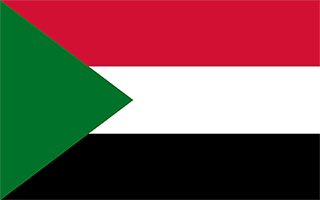
Three equal horizontal bands of red (top), white, and black with a green isosceles triangle based on the hoist side; colors and design based on the Arab Revolt flag of World War I, but the meanings of the colors are expressed as follows: red signifies the struggle for freedom, white is the color of peace, light, and love, black represents the people of Sudan (in Arabic 'Sudan' means black), green is the color of Islam, agriculture, and prosperity.
Military regimes favoring Islamic-oriented governments have dominated national politics since independence from Anglo-Egyptian co-rule in 1956. Sudan was embroiled in two prolonged civil wars during most of the remainder of the 20th century. These conflicts were rooted in northern economic, political, and social domination of largely non-Muslim, non-Arab southern Sudanese. The first civil war ended in 1972 but another broke out in 1983. Peace talks gained momentum in 2002-04 with the signing of several accords. The final North/South Comprehensive Peace Agreement (CPA), signed in January 2005, granted the southern rebels autonomy for six years followed by a referendum on independence for Southern Sudan. The referendum was held in January 2011 and indicated overwhelming support for independence. South Sudan became independent on 9 July 2011. Sudan and South Sudan have yet to fully implement security and economic agreements signed in September 2012 relating to the normalization of relations between the two countries. The final disposition of the contested Abyei region has also to be decided. Following South Sudan's independence, conflict broke out between the government and the Sudan People's Liberation Movement-North in Southern Kordofan and Blue Nile states (together known as the Two Areas), and has resulted in 1.1 million internally displaced persons or severely affected persons needing humanitarian assistance. A separate conflict broke out in the western region of Darfur in 2003, displacing nearly 2 million people and causing thousands of deaths. Fighting in both the Two Areas and Darfur between government forces and opposition has largely subsided, however the civilian populations are affected by low-level violence including inter-tribal conflict and banditry, largely a result of weak rule of law. The UN and the African Union have jointly commanded a Darfur peacekeeping operation (UNAMID) since 2007. Peacekeeping troops have struggled to address insecurity in Darfur and have increasingly become targets for attacks by armed groups. Sudan also has faced refugee influxes from neighboring countries, primarily Ethiopia, Eritrea, Chad, Central African Republic, and South Sudan. Armed conflict, poor transport infrastructure, and denial of access by both the government and armed opposition have impeded the provision of humanitarian assistance to affected populations.
Geography
| Area | ||
|---|---|---|
| Total (World Rank: 17) | 1,861,480 | sq km |
| Forest (World Rank: 3) | 84.20 | % |
| Comparative | slightly less than one-fifth the size of the US | |
| Coastline | ||
| 853 | ||
| Landborder | ||
| 6819 | ||
| Elevation | ||
| Highest point (World Rank: 64) | 3,042 | m |
| Agricultural land | ||
| Total (World Rank: 1) | 100.00 | % |
| Arable (World Rank: 76) | 15.70 | % |
| Permanent crops (World Rank: 173) | 0.20 | % |
| Permanent pastures (World Rank: 3) | 84.20 | % |
| Irrigated land (World Rank: 30) | 18,900 | sq km |
| Map reference | ||
| Africa | ||
| Environment | ||
| Issues |
| |
| Agreement party |
| |
| Hazzards | dust storms and periodic persistent droughts | |
| Location | ||
| north-eastern Africa, bordering the Red Sea, between Egypt and Eritrea | ||
| Climate | ||
| hot and dry; arid desert; rainy season varies by region (April to November) | ||
| Terrain | ||
| generally flat, featureless plain; desert dominates the north | ||
People
| Population | ||
|---|---|---|
| Total (World Rank: 37) | 37,345,900 | |
| Deathrate (World Rank: 119) | 0.73 | % |
| Birthrate (World Rank: 43) | 2.79 | % |
| Growthrate (World Rank: 64) | 1.64 | % |
| Migration rate (World Rank: 149) | -0.41 | % |
| Fertility rate (World Rank: 41) | 3.57 | % |
| Median age | ||
| Male (World Rank: 187) | 19.70 | |
| Female (World Rank: 191) | 20.10 | |
| Age structure | ||
| 0 14 male (World Rank: 25) | 7,335,610 | |
| 0 14 female (World Rank: 25) | 7,111,550 | |
| 15 24 male (World Rank: 28) | 4,033,790 | |
| 15 24 female (World Rank: 28) | 3,823,100 | |
| 25 54 male (World Rank: 43) | 5,943,910 | |
| 25 54 female (World Rank: 42) | 6,293,920 | |
| 55 64 male (World Rank: 49) | 824,577 | |
| 55 64 female (World Rank: 51) | 760,014 | |
| 65 x male (World Rank: 57) | 655,795 | |
| 65 x female (World Rank: 68) | 563,672 | |
| Health | ||
| Infant mortality rate (World Rank: 33) | 4.88 | % |
| Life expectancy total (World Rank: 182) | 64 | years |
| Life expectancy female (World Rank: 182) | 67 | years |
| Life expectancy male (World Rank: 186) | 62 | years |
| Physicians per 1000 (World Rank: 39) | 3.06 | |
| Hospital bed per 1000 (World Rank: 157) | 0.80 | |
| Sanitation access total (World Rank: 187) | 23.60 | % |
| Obesity adult (World Rank: 166) | 6.60 | % |
| Drinking water access (World Rank: 195) | 55.50 | % |
Energy
| Electricity | ||
|---|---|---|
| Production (World Rank: 90) | 12,690,000,000 | kWh |
| Consumption (World Rank: 92) | 10,260,000,000 | kWh |
| Source fossil (World Rank: 179) | 34.40 | % |
| Source nuclear (World Rank: 28) | 60.20 | % |
| Source renew (World Rank: 91) | 5.40 | % |
| Crude oil | ||
| Production (World Rank: 42) | 104,900 | bbl / day |
| Exports (World Rank: 34) | 152,100 | bbl / day |
| Proved reserves (World Rank: 23) | 5,000,000,000 | bbl |
| Refined products | ||
| Production (World Rank: 69) | 89,300 | bbl / day |
| Consumption (World Rank: 77) | 110,000 | bbl / day |
| Export (World Rank: 86) | 7,396 | bbl / day |
| Import (World Rank: 108) | 23,920 | bbl / day |
| Natural gas | ||
| Consumption (World Rank: 118) | 33 | m³ |
| Carbon footprint | ||
| 14000000 | ||
Nation
| Budget | ||
|---|---|---|
| Education (World Rank: 160) | 2 | % of GDP |
| Health (World Rank: 50) | 8 | % of GDP |
| Surplus (World Rank: 147) | -5 | % of GDP |
| National symbol | ||
| secretary bird | ||
| National colours | ||
| white | ||
| Adjective | ||
| Sudanese | ||
| Noun | ||
| Sudanese (singular and plural) | ||
| Background | ||
| Military regimes favoring Islamic-oriented governments have dominated national politics since independence from Anglo-Egyptian co-rule in 1956. Sudan was embroiled in two prolonged civil wars during most of the remainder of the 20th century. These conflicts were rooted in northern economic, political, and social domination of largely non-Muslim, non-Arab southern Sudanese. The first civil war ended in 1972 but another broke out in 1983. Peace talks gained momentum in 2002-04 with the signing of several accords. The final North/South Comprehensive Peace Agreement (CPA), signed in January 2005, granted the southern rebels autonomy for six years followed by a referendum on independence for Southern Sudan. The referendum was held in January 2011 and indicated overwhelming support for independence. South Sudan became independent on 9 July 2011. Sudan and South Sudan have yet to fully implement security and economic agreements signed in September 2012 relating to the normalization of relations between the two countries. The final disposition of the contested Abyei region has also to be decided. Following South Sudan's independence, conflict broke out between the government and the Sudan People's Liberation Movement-North in Southern Kordofan and Blue Nile states (together known as the Two Areas), and has resulted in 1.1 million internally displaced persons or severely affected persons needing humanitarian assistance. A separate conflict broke out in the western region of Darfur in 2003, displacing nearly 2 million people and causing thousands of deaths. Fighting in both the Two Areas and Darfur between government forces and opposition has largely subsided, however the civilian populations are affected by low-level violence including inter-tribal conflict and banditry, largely a result of weak rule of law. The UN and the African Union have jointly commanded a Darfur peacekeeping operation (UNAMID) since 2007. Peacekeeping troops have struggled to address insecurity in Darfur and have increasingly become targets for attacks by armed groups. Sudan also has faced refugee influxes from neighboring countries, primarily Ethiopia, Eritrea, Chad, Central African Republic, and South Sudan. Armed conflict, poor transport infrastructure, and denial of access by both the government and armed opposition have impeded the provision of humanitarian assistance to affected populations. | ||
| Flag description | ||
| three equal horizontal bands of red (top), white, and black with a green isosceles triangle based on the hoist side; colors and design based on the Arab Revolt flag of World War I, but the meanings of the colors are expressed as follows: red signifies the struggle for freedom, white is the color of peace, light, and love, black represents the people of Sudan (in Arabic 'Sudan' means black), green is the color of Islam, agriculture, and prosperity | ||
Economy
| Gdp | ||
|---|---|---|
| Purchasing power parity (World Rank: 68) | 177,000,000,000 | USD |
| Real growth rate (World Rank: 93) | 3.10 | % |
| Per capita purchasing power parity (World Rank: 170) | 4,500 | USD |
| Source agriculture (World Rank: 11) | 39.50 | % |
| Source industry (World Rank: 218) | 2.60 | % |
| Source service (World Rank: 138) | 57.90 | % |
| Labourforce | ||
| Total (World Rank: 49) | 11,920,000 | |
| In poverty (World Rank: 27) | 46.50 | % |
| Products | ||
| Industries |
| |
| Agriculture |
| |
| Exports |
| |
| Imports |
| |
Communication
| Phone | ||
|---|---|---|
| Landline total (World Rank: 134) | 136,472 | |
| Landline per 100 (World Rank: 216) | 1.00 | |
| Mobile per 100 (World Rank: 170) | 76.00 | |
| Assessment | 0 | |
| Internet | ||
| Users (World Rank: 46) | 10,284,300 | |
| Population (World Rank: 162) | 28.00 | % |
Transport
| Air | ||
|---|---|---|
| Airports paved (World Rank: 93) | 16.00 | |
| Airports unpaved (World Rank: 55) | 58.00 | |
| Heliports (World Rank: 33) | 6.00 | |
| Rail | ||
| Total length (World Rank: 31) | 7,251 | |
| Road | ||
| Total length (World Rank: 130) | 11,900 | |
| Paved length (World Rank: 105) | 4,320 | |
| Unpaved length (World Rank: 96) | 7,580 | |
| Water | ||
| Total length (World Rank: 25) | 4,068 | |
This is a list of famous places in this country in alphabetical order.
 Abu Jibeha
- Abu Zabad
- Abyei
- Ad Dabbah
- Ad Dindar
- Ad Douiem
- Ad-Damazin
- Al Fulah
- Al Hasaheisa
- Al Hawatah
- Al Hilaliyya
- Al Kawa
- Al Khandaq
- Al Khatmiyya Gharb
- Al Kiremit al `Arakiyyin
- Al Lagowa
- Al Manaqil
- Al Masallamiyya
- Al Mijlad
- Al Qitena
- Al Qulayd Bahri
- Al-Fashir
- Al-Ubayyid
- An Nuhud
- Andara
- Ar Rahad
- Ar Ruseris
- Argo
- Aroma
- As Sanafa
- As Suki
- Ash Shallal
- Atbara
- Barah
- Barkal
- Berber
- Block 47
- Dalqu
- Daym Bakr
- Dilling
- Doka
- Dongola
- Ed Damer
- El Bauga
- El Daein
- El Fula
- El Geneina Fort
- El Hilla El Jadeda
- El Matama
- El Qoz
- Gebeit
- Gedaref
- Geneina
- Guranei
- Hilat el Qobba
- Hillat `Abbas
- Hillat ed Darqab
- Jalqani
- Kaduqli
- Karmah an Nuzul
- Kassala
- Khartoum
- Kinana
- Kuraymah
- Kurmuk
- Kusti
- Kutum
- Maiurno
- Malkiyah
- Marabba
- Masna `Sukkar Aj Jined
- Merowe
- Nasir
- New Halfa
- Nyala
- Omdurman
- Port Sudan
- Qanis Sharq
- Rabak
- Rihal
- Rumaylah
- Sagai
- Sannum
- Sawakin
- Sennar
- Sharif Barakat
- Shendi
- Singa
- Talodi
- Tandalti
- Tokar
- Um Jar Al Gharbiyya
- Umm Kaddadah
- Umm Ruwaba
- Wad Madani
- Wad Rawah
- Wad az Zaki
- Wadi Halfa
- Wagar
- Zalingei