Spain
in Southern Europe
Europe
 Andorra
 France
 Gibraltar
 Morocco
 Portugal
- Currency and Currency Code:
- Euro - EUR
- Spoken languages:
- Spanish, Catalan, Galician, Basque, Occitan
- Local electricity:
- 230 V - 50 Hz (plugs: C, F)
- Mobile phone / cellular frequencies (MHz):
- 900 MHz, 1800 MHz, 3G, 4G
- ISO 2-Letter code:
- ES
- Internet top level domain:
- .es
- Country phone prefix:
- +34
- Local Time (capital):
- Timezone:
- UTC/GMT offset: hours
Safety Score: 3,0 of 5.0 based on data from 9 authorites. Meaning we advice caution when travelling to Spain.
Travel warnings are updated daily. Source: Travel Warning Spain. Last Update: 2024-04-24 08:14:40
Explore Spain
Spain with its capital Madrid is located in Europe (Southwestern Europe, bordering the Mediterranean Sea). It covers some 505,371 square kilometers (almost five times the size of Kentucky) with a population of 48,958,200. Spanish, Catalan, Galician, Basque and Occitan are the languages spoken by people in Spain (consider regional differences). Andorra, France, Gibraltar, Morocco and Portugal are bordering countries.
Spain is a diverse country sharing the Iberian Peninsula with Portugal at the western end of the Mediterranean Sea. It is the country with the second-largest number of UNESCO World Heritage Sites, after Italy, and the largest number of World Heritage Cities.Spain is considered an exotic country in Europe due to its friendly inhabitants, relaxed lifestyle, its cuisine, vibrant nightlife, and world-famous folklore and festivities. Among many places worth visiting are Spain's thriving capital Madrid, the vibrant coastal city of Barcelona, the famous Running of the Bulls at Pamplona, major Andalusian cities with Islamic architecture, like Seville, Granada and Córdoba, the Way of St. James and the idyllic Balearic and Canary Islands.
Popular Destinations in Spain
Administrative regions of Spain
- Andalusia
- Aragon
- Balearic Islands
- Basque Country
- Canary Islands
- Cantabria
- Castille and Leon
- Castille-La Mancha
- Catalonia
- Ceuta
- Extremadura
- Galicia
- La Rioja
- Madrid
- Melilla
- Murcia
- Navarre
- Principality of Asturias
- Valencia
About the country
Website: Spain Tourism
The terrain is large, flat to dissected plateau surrounded by rugged hills having Pyrenees Mountains in north. The average density of population is about 97 per km². The climate in Spain can be described as temperateclear, hot summers in interior, more moderate and cloudy along coast, cloudy, cold winters in interior, partly cloudy and cool along coast. Possible natural disasters include periodic droughts, occasional flooding volcanic activity in the Canary Islands, located off Africa's northwest coast; Teide (3,715 m) has been deemed a Decade Volcano by the International Association of Volcanology and Chemistry of the Earth's Interior, worthy of study due to its explosive his
To reach someone Spain dial +34 prior to a number. The local cellular networks are operated on 900 MHz, 1800 MHz, 3G, 4G. Websites typically end with the top level domain ".es". If you want to bring electric appliances (e.g. battery chaarger), keep in min the local 230 V - 50 Hz (plugs: C, F). The sign for the locally used currency Euro is EUR.
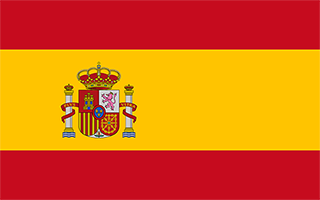
Three horizontal bands of red (top), yellow (double width), and red with the national coat of arms on the hoist side of the yellow band; the coat of arms is quartered to display the emblems of the traditional kingdoms of Spain (clockwise from upper left, Castile, Leon, Navarre, and Aragon) while Granada is represented by the stylized pomegranate at the bottom of the shield; the arms are framed by two columns representing the Pillars of Hercules, which are the two promontories (Gibraltar and Ceuta) on either side of the eastern end of the Strait of Gibraltar; the red scroll across the two columns bears the imperial motto of "Plus Ultra" (further beyond) referring to Spanish lands beyond Europe; the triband arrangement with the center stripe twice the width of the outer dates to the 18th century.
Spain's powerful world empire of the 16th and 17th centuries ultimately yielded command of the seas to England. Subsequent failure to embrace the mercantile and industrial revolutions caused the country to fall behind Britain, France, and Germany in economic and political power. Spain remained neutral in World War I and II but suffered through a devastating civil war (1936-39). A peaceful transition to democracy following the death of dictator Francisco FRANCO in 1975, and rapid economic modernization (Spain joined the EU in 1986) gave Spain a dynamic and rapidly growing economy and made it a global champion of freedom and human rights. More recently Spain has emerged from a severe economic recession that began in mid-2008, posting three straight years of GDP growth above the EU average. Unemployment has fallen, but remains high especially among youth. Spain is the Eurozone’s fourth largest economy.
Geography
| Area | ||
|---|---|---|
| Total (World Rank: 53) | 505,370 | sq km |
| Land (World Rank: 51) | 498,980 | sq km |
| Water (World Rank: 62) | 6,390 | sq km |
| Forest (World Rank: 88) | 20.10 | % |
| Comparative | almost five times the size of Kentucky; slightly more than twice the size of Oregon | |
| Note | there are two autonomous cities - Ceuta and Melilla - and 17 autonomous communities including Balearic Islands and Canary Islands, and three small Spanish possessions off the coast of Morocco - Islas Chafarinas, Penon de Alhucemas, and Penon de Velez de la Gomera | |
| Coastline | ||
| 4964 | ||
| Landborder | ||
| 1952.7 | ||
| Elevation | ||
| Highest point (World Rank: 50) | 3,718 | m |
| Agricultural land | ||
| Total (World Rank: 60) | 54.10 | % |
| Arable (World Rank: 42) | 24.90 | % |
| Permanent crops (World Rank: 36) | 9.10 | % |
| Permanent pastures (World Rank: 88) | 20.10 | % |
| Irrigated land (World Rank: 16) | 38,000 | sq km |
| Map reference | ||
| Europe | ||
| Environment | ||
| Issues |
| |
| Agreement party |
| |
| Agreement signed | Air Pollution-Persistent Organic Pollutants | |
| Hazzards |
| |
| Location | ||
| Southwestern Europe, bordering the Mediterranean Sea, North Atlantic Ocean, Bay of Biscay, and Pyrenees Mountains; southwest of France | ||
| Climate | ||
| temperate; clear, hot summers in interior, more moderate and cloudy along coast; cloudy, cold winters in interior, partly cloudy and cool along coast | ||
| Terrain | ||
| large, flat to dissected plateau surrounded by rugged hills; Pyrenees Mountains in north | ||
People
| Population | ||
|---|---|---|
| Total (World Rank: 28) | 48,958,200 | |
| Deathrate (World Rank: 64) | 0.91 | % |
| Birthrate (World Rank: 201) | 0.92 | % |
| Growthrate (World Rank: 133) | 0.78 | % |
| Migration rate (World Rank: 13) | 0.78 | % |
| Fertility rate (World Rank: 195) | 1.50 | % |
| Median age | ||
| Male (World Rank: 19) | 41.50 | |
| Female (World Rank: 26) | 43.90 | |
| Age structure | ||
| 0 14 male (World Rank: 51) | 3,872,760 | |
| 0 14 female (World Rank: 52) | 3,656,550 | |
| 15 24 male (World Rank: 50) | 2,424,350 | |
| 15 24 female (World Rank: 50) | 2,267,430 | |
| 25 54 male (World Rank: 27) | 11,214,100 | |
| 25 54 female (World Rank: 27) | 10,775,000 | |
| 55 64 male (World Rank: 21) | 2,899,090 | |
| 55 64 female (World Rank: 22) | 3,044,110 | |
| 65 x male (World Rank: 15) | 3,763,990 | |
| 65 x female (World Rank: 13) | 5,040,740 | |
| Health | ||
| Infant mortality rate (World Rank: 207) | 0.33 | % |
| Life expectancy total (World Rank: 22) | 82 | years |
| Life expectancy female (World Rank: 14) | 85 | years |
| Life expectancy male (World Rank: 27) | 79 | years |
| Physicians per 1000 (World Rank: 19) | 3.82 | |
| Hospital bed per 1000 (World Rank: 73) | 3.10 | |
| Sanitation access total (World Rank: 19) | 99.90 | % |
| Obesity adult (World Rank: 62) | 23.80 | % |
| Drinking water access (World Rank: 23) | 100.00 | % |
Energy
| Electricity | ||
|---|---|---|
| Production (World Rank: 15) | 267,100,000,000 | kWh |
| Consumption (World Rank: 16) | 240,400,000,000 | kWh |
| Export (World Rank: 14) | 14,180,000,000 | kWh |
| Import (World Rank: 9) | 21,850,000,000 | kWh |
| Source fossil (World Rank: 158) | 45.10 | % |
| Source nuclear (World Rank: 123) | 6.70 | % |
| Source renew (World Rank: 15) | 29.50 | % |
| Crude oil | ||
| Production (World Rank: 85) | 2,667 | bbl / day |
| Imports (World Rank: 8) | 1,285,000 | bbl / day |
| Proved reserves (World Rank: 64) | 150,000,000 | bbl |
| Refined products | ||
| Production (World Rank: 13) | 1,342,000 | bbl / day |
| Consumption (World Rank: 17) | 1,287,000 | bbl / day |
| Export (World Rank: 15) | 501,100 | bbl / day |
| Import (World Rank: 19) | 421,000 | bbl / day |
| Natural gas | ||
| Production (World Rank: 84) | 62,000,000 | m³ |
| Consumption (World Rank: 31) | 39,840,000,000 | m³ |
| Export (World Rank: 30) | 5,065,000,000 | m³ |
| Import (World Rank: 72) | 0 | m³ |
| Carbon footprint | ||
| 276000000 | ||
Nation
| Budget | ||
|---|---|---|
| Education (World Rank: 96) | 4 | % of GDP |
| Military (World Rank: 123) | 1 | % of GDP |
| Health (World Rank: 40) | 9 | % of GDP |
| Surplus (World Rank: 139) | -5 | % of GDP |
| National symbol | ||
| Pillars of Hercules | ||
| National colours | ||
| yellow | ||
| Adjective | ||
| Spanish | ||
| Noun | ||
| Spaniard(s) | ||
| Background | ||
| Spain's powerful world empire of the 16th and 17th centuries ultimately yielded command of the seas to England. Subsequent failure to embrace the mercantile and industrial revolutions caused the country to fall behind Britain, France, and Germany in economic and political power. Spain remained neutral in World War I and II but suffered through a devastating civil war (1936-39). A peaceful transition to democracy following the death of dictator Francisco FRANCO in 1975, and rapid economic modernization (Spain joined the EU in 1986) gave Spain a dynamic and rapidly growing economy and made it a global champion of freedom and human rights. More recently Spain has emerged from a severe economic recession that began in mid-2008, posting three straight years of GDP growth above the EU average. Unemployment has fallen, but remains high especially among youth. Spain is the Eurozone’s fourth largest economy. | ||
| Flag description | ||
| three horizontal bands of red (top), yellow (double width), and red with the national coat of arms on the hoist side of the yellow band; the coat of arms is quartered to display the emblems of the traditional kingdoms of Spain (clockwise from upper left, Castile, Leon, Navarre, and Aragon) while Granada is represented by the stylized pomegranate at the bottom of the shield; the arms are framed by two columns representing the Pillars of Hercules, which are the two promontories (Gibraltar and Ceuta) on either side of the eastern end of the Strait of Gibraltar; the red scroll across the two columns bears the imperial motto of "Plus Ultra" (further beyond) referring to Spanish lands beyond Europe; the triband arrangement with the center stripe twice the width of the outer dates to the 18th century | ||
Economy
| Gdp | ||
|---|---|---|
| Purchasing power parity (World Rank: 16) | 1,686,000,000,000 | USD |
| Real growth rate (World Rank: 86) | 3.20 | % |
| Per capita purchasing power parity (World Rank: 50) | 36,300 | USD |
| Source agriculture (World Rank: 157) | 2.60 | % |
| Source industry (World Rank: 124) | 23.40 | % |
| Source service (World Rank: 44) | 74.10 | % |
| Labourforce | ||
| Total (World Rank: 27) | 22,820,000 | |
| In poverty (World Rank: 104) | 21.10 | % |
| Products | ||
| Industries |
| |
| Agriculture |
| |
| Exports |
| |
| Imports |
| |
Communication
| Phone | ||
|---|---|---|
| Landline total (World Rank: 14) | 19,557,100 | |
| Landline per 100 (World Rank: 38) | 40.00 | |
| Mobile per 100 (World Rank: 119) | 107.00 | |
| Assessment | 0 | |
| Internet | ||
| Users (World Rank: 17) | 39,123,400 | |
| Population (World Rank: 40) | 80.60 | % |
Transport
| Air | ||
|---|---|---|
| Airports paved (World Rank: 23) | 99.00 | |
| Airports unpaved (World Rank: 59) | 51.00 | |
| Heliports (World Rank: 20) | 10.00 | |
| Rail | ||
| Total length (World Rank: 17) | 16,102 | |
| Road | ||
| Total length (World Rank: 11) | 683,175 | |
| Paved length (World Rank: 6) | 683,175 | |
| Water | ||
| Total length (World Rank: 65) | 1,000 | |
This is a list of famous places in this country in alphabetical order.
 A Coruna
- Albacete
- Alcala de Henares
- Alcobendas
- Alcorcon
- Alcoy
- Algeciras
- Alicante
- Almeria
- Aranjuez
- Avila
- Azpeitia
- Badajoz
- Badalona
- Barakaldo
- Barcelona
- Benidorm
- Bilbao
- Burgos
- Caceres
- Cadiz
- Cartagena
- Castello de la Plana
- Ceuta
- Ciudad Lineal
- Ciudad Real
- Cordoba
- Coslada
- Cuenca
- Dos Hermanas
- Eibar
- Elche
- Ferrol
- Figueres
- Fuengirola
- Fuenlabrada
- Gasteiz / Vitoria
- Getafe
- Gijon
- Girona
- Granada
- Guadalajara
- Huelva
- Huesca
- Ibiza Town
- Irun
- Jaen
- Jerez de la Frontera
- Las Palmas de Gran Canaria
- Leganes
- Leon
- Lleida
- Logrono
- Lorca
- Lugo
- Madrid
- Malaga
- Marbella
- Mataro
- Melilla
- Merida
- Mostoles
- Murcia
- Orihuela
- Ourense
- Oviedo
- Palencia
- Palma
- Pamplona
- Ponferrada
- Pontevedra
- Pozuelo de Alarcon
- Reus
- Roquetas de Mar
- Roses
- Sabadell
- Salamanca
- San Fernando
- San Sebastian
- Sant Cugat del Valles
- Santa Cruz de Tenerife
- Santander
- Santiago de Compostela
- Segovia
- Seville
- Soria
- Talavera de la Reina
- Tarragona
- Teruel
- Toledo
- Torrejon de Ardoz
- Torrevieja
- Ubeda
- Valencia
- Valladolid
- Velez-Malaga
- Vigo
- Zamora
- Zaragoza
- Zarautz