South Africa
in Southern Africa
Africa
 Botswana
 Lesotho
 Mozambique
 Namibia
 Swaziland
 Zimbabwe
- Currency and Currency Code:
- Rand - ZAR
- Spoken languages:
- Zulu, Xhosa, Afrikaans, English, Tswana, Southern Sotho, Tsonga, Swati, Venda, South Ndebele
- Local electricity:
- 230 V - 50 Hz (plugs: C, M, N)
- Mobile phone / cellular frequencies (MHz):
- 900 MHz, 1800 MHz, 3G, 4G
- ISO 2-Letter code:
- ZA
- Internet top level domain:
- .za
- Country phone prefix:
- +27
- Local Time (capital):
- Timezone:
- UTC/GMT offset: hours
Safety Score: 3,4 of 5.0 based on data from 9 authorites. Meaning please reconsider your need to travel to South Africa.
Travel warnings are updated daily. Source: Travel Warning South Africa. Last Update: 2024-04-24 08:14:40
Explore South Africa
South Africa with its capital Pretoria is located in Africa (Southern Africa, at the southern tip of the continent of Africa). It covers some 1,219,091 square kilometers (slightly less than twice the size of Texas) with a population of 54,841,600. Zulu, Xhosa, Afrikaans, English, Tswana, Southern Sotho, Tsonga, Swati, Venda and South Ndebele are the languages spoken by people in South Africa (consider regional differences). Botswana, Lesotho, Mozambique, Namibia, Swaziland and Zimbabwe are bordering countries.
South Africa is located at the southern tip of Africa. The Orange River on the border to Namibia is a popular destination for rafting tours. Several tour operators launch 4-6 day trips in blow-up boats from Vioolsdrif with camping under the stars. South Africa has sites spread along its coast that are perhaps better known for sharks and other large marine life, but also have a wide range of endemic smaller fish and invertebrates. The coastal sites range from tropical coral reefs in the north of KwaZulu-Natal, where the fish are typical Indo-pacific tropical species, and very colourful, to cool temperate rocky reefs on the West Coast, where the fish life is relatively dull, but the invertebrates provide the colour.
Popular Destinations in South Africa
Administrative regions of South Africa
- Eastern Cape
- Gauteng
- KwaZulu-Natal
- Limpopo
- Mpumalanga
- Northern Cape
- Orange Free State
- Province of North West
- Western Cape
About the country
Website: South Africa Tourism
P.O. Box X 02
Southbroom 4277
South Africa
Phone: +27 39 316 6999
Fax: +27 39 316 6999
Mail: southbroom@thehibiscuscoast.co.za
The terrain is vast interior plateau rimmed by rugged hills and narrow coastal plain. The average density of population is about 45 per km². The climate in South Africa can be described as mostly semiaridsubtropical along east coast, sunny days, cool nights. Possible natural disasters include prolonged droughts the volcano forming Marion Island in the Prince Edward Islands, which last erupted in 2004, is South Africa's only active volcano
To reach someone South Africa dial +27 prior to a number. The local cellular networks are operated on 900 MHz, 1800 MHz, 3G, 4G. Websites typically end with the top level domain ".za". If you want to bring electric appliances (e.g. battery chaarger), keep in min the local 230 V - 50 Hz (plugs: C, M, N). The sign for the locally used currency Rand is ZAR.
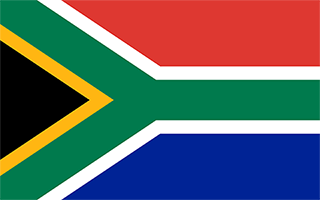
Two equal width horizontal bands of red (top) and blue separated by a central green band that splits into a horizontal Y, the arms of which end at the corners of the hoist side; the Y embraces a black isosceles triangle from which the arms are separated by narrow yellow bands; the red and blue bands are separated from the green band and its arms by narrow white stripes; the flag colors do not have any official symbolism, but the Y stands for the "convergence of diverse elements within South African society, taking the road ahead in unity"; black, yellow, and green are found on the flag of the African National Congress, while red, white, and blue are the colors in the flags of the Netherlands and the UK, whose settlers ruled South Africa during the colonial era.
Dutch traders landed at the southern tip of modern day South Africa in 1652 and established a stopover point on the spice route between the Netherlands and the Far East, founding the city of Cape Town. After the British seized the Cape of Good Hope area in 1806, many of the Dutch settlers (Afrikaners, called "Boers" (farmers) by the British) trekked north to found their own republics, Transvaal and Orange Free State. The discovery of diamonds (1867) and gold (1886) spurred wealth and immigration and intensified the subjugation of the native inhabitants. The Afrikaners resisted British encroachments but were defeated in the Second South African War (1899-1902); however, the British and the Afrikaners, ruled together beginning in 1910 under the Union of South Africa, which became a republic in 1961 after a whites-only referendum. In 1948, the Afrikaner-dominated National Party was voted into power and instituted a policy of apartheid - the separate development of the races - which favored the white minority at the expense of the black majority. The African National Congress (ANC) led the opposition to apartheid and many top ANC leaders, such as Nelson MANDELA, spent decades in South Africa's prisons. Internal protests and insurgency, as well as boycotts by some Western nations and institutions, led to the regime's eventual willingness to negotiate a peaceful transition to majority rule. The first multi-racial elections in 1994 following the end of apartheid ushered in majority rule under an ANC-led government. South Africa has since struggled to address apartheid-era imbalances in decent housing, education, and health care. ANC infighting came to a head in 2008 when President Thabo MBEKI was recalled by Parliament, and Deputy President Kgalema MOTLANTHE, succeeded him as interim president. Jacob ZUMA became president after the ANC won general elections in 2009; he was reelected in 2014.
Geography
| Area | ||
|---|---|---|
| Total (World Rank: 26) | 1,219,090 | sq km |
| Land (World Rank: 25) | 1,214,470 | sq km |
| Water (World Rank: 68) | 4,620 | sq km |
| Forest (World Rank: 10) | 69.20 | % |
| Comparative | slightly less than twice the size of Texas | |
| Note | includes Prince Edward Islands (Marion Island and Prince Edward Island) | |
| Coastline | ||
| 2798 | ||
| Landborder | ||
| 5244 | ||
| Elevation | ||
| Highest point (World Rank: 57) | 3,408 | m |
| Agricultural land | ||
| Total (World Rank: 7) | 79.40 | % |
| Arable (World Rank: 113) | 9.90 | % |
| Permanent crops (World Rank: 162) | 0.30 | % |
| Permanent pastures (World Rank: 10) | 69.20 | % |
| Irrigated land (World Rank: 31) | 16,700 | sq km |
| Map reference | ||
| Africa | ||
| Environment | ||
| Issues |
| |
| Agreement party |
| |
| Hazzards |
| |
| Location | ||
| Southern Africa, at the southern tip of the continent of Africa | ||
| Climate | ||
| mostly semiarid; subtropical along east coast; sunny days, cool nights | ||
| Terrain | ||
| vast interior plateau rimmed by rugged hills and narrow coastal plain | ||
People
| Population | ||
|---|---|---|
| Total (World Rank: 25) | 54,841,600 | |
| Deathrate (World Rank: 55) | 0.94 | % |
| Birthrate (World Rank: 77) | 2.02 | % |
| Growthrate (World Rank: 113) | 0.99 | % |
| Migration rate (World Rank: 101) | -0.09 | % |
| Fertility rate (World Rank: 90) | 2.29 | % |
| Median age | ||
| Male (World Rank: 143) | 26.90 | |
| Female (World Rank: 142) | 27.30 | |
| Age structure | ||
| 0 14 male (World Rank: 23) | 7,768,960 | |
| 0 14 female (World Rank: 22) | 7,733,710 | |
| 15 24 male (World Rank: 22) | 4,776,100 | |
| 15 24 female (World Rank: 20) | 4,881,960 | |
| 25 54 male (World Rank: 25) | 11,589,100 | |
| 25 54 female (World Rank: 25) | 11,323,900 | |
| 55 64 male (World Rank: 31) | 1,694,900 | |
| 55 64 female (World Rank: 31) | 1,955,390 | |
| 65 x male (World Rank: 35) | 1,309,600 | |
| 65 x female (World Rank: 31) | 1,807,970 | |
| Health | ||
| Infant mortality rate (World Rank: 62) | 3.10 | % |
| Life expectancy total (World Rank: 187) | 64 | years |
| Life expectancy female (World Rank: 192) | 65 | years |
| Life expectancy male (World Rank: 181) | 62 | years |
| Physicians per 1000 (World Rank: 122) | 0.77 | |
| Sanitation access total (World Rank: 143) | 66.40 | % |
| Obesity adult (World Rank: 31) | 28.30 | % |
| Drinking water access (World Rank: 123) | 93.20 | % |
Energy
| Electricity | ||
|---|---|---|
| Production (World Rank: 20) | 229,200,000,000 | kWh |
| Consumption (World Rank: 20) | 207,700,000,000 | kWh |
| Export (World Rank: 11) | 16,550,000,000 | kWh |
| Import (World Rank: 22) | 10,560,000,000 | kWh |
| Source fossil (World Rank: 73) | 86.70 | % |
| Source nuclear (World Rank: 129) | 3.90 | % |
| Source renew (World Rank: 79) | 7.10 | % |
| Crude oil | ||
| Production (World Rank: 87) | 2,000 | bbl / day |
| Imports (World Rank: 23) | 434,500 | bbl / day |
| Proved reserves (World Rank: 88) | 15,000,000 | bbl |
| Refined products | ||
| Production (World Rank: 36) | 431,000 | bbl / day |
| Consumption (World Rank: 31) | 660,000 | bbl / day |
| Export (World Rank: 46) | 78,110 | bbl / day |
| Import (World Rank: 39) | 164,700 | bbl / day |
| Natural gas | ||
| Production (World Rank: 64) | 1,100,000,000 | m³ |
| Consumption (World Rank: 56) | 8,660,000,000 | m³ |
| Import (World Rank: 26) | 0 | m³ |
| Carbon footprint | ||
| 482000000 | ||
Nation
| Budget | ||
|---|---|---|
| Education (World Rank: 33) | 6 | % of GDP |
| Military (World Rank: 109) | 1 | % of GDP |
| Health (World Rank: 44) | 9 | % of GDP |
| Surplus (World Rank: 125) | -4 | % of GDP |
| National symbol | ||
| springbok | ||
| National colours | ||
| yellow | ||
| Adjective | ||
| South African | ||
| Noun | ||
| South African(s) | ||
| Background | ||
| Dutch traders landed at the southern tip of modern day South Africa in 1652 and established a stopover point on the spice route between the Netherlands and the Far East, founding the city of Cape Town. After the British seized the Cape of Good Hope area in 1806, many of the Dutch settlers (Afrikaners, called "Boers" (farmers) by the British) trekked north to found their own republics, Transvaal and Orange Free State. The discovery of diamonds (1867) and gold (1886) spurred wealth and immigration and intensified the subjugation of the native inhabitants. The Afrikaners resisted British encroachments but were defeated in the Second South African War (1899-1902); however, the British and the Afrikaners, ruled together beginning in 1910 under the Union of South Africa, which became a republic in 1961 after a whites-only referendum. In 1948, the Afrikaner-dominated National Party was voted into power and instituted a policy of apartheid - the separate development of the races - which favored the white minority at the expense of the black majority. The African National Congress (ANC) led the opposition to apartheid and many top ANC leaders, such as Nelson MANDELA, spent decades in South Africa's prisons. Internal protests and insurgency, as well as boycotts by some Western nations and institutions, led to the regime's eventual willingness to negotiate a peaceful transition to majority rule. The first multi-racial elections in 1994 following the end of apartheid ushered in majority rule under an ANC-led government. South Africa has since struggled to address apartheid-era imbalances in decent housing, education, and health care. ANC infighting came to a head in 2008 when President Thabo MBEKI was recalled by Parliament, and Deputy President Kgalema MOTLANTHE, succeeded him as interim president. Jacob ZUMA became president after the ANC won general elections in 2009; he was reelected in 2014. | ||
| Flag description | ||
| two equal width horizontal bands of red (top) and blue separated by a central green band that splits into a horizontal Y, the arms of which end at the corners of the hoist side; the Y embraces a black isosceles triangle from which the arms are separated by narrow yellow bands; the red and blue bands are separated from the green band and its arms by narrow white stripes; the flag colors do not have any official symbolism, but the Y stands for the "convergence of diverse elements within South African society, taking the road ahead in unity"; black, yellow, and green are found on the flag of the African National Congress, while red, white, and blue are the colors in the flags of the Netherlands and the UK, whose settlers ruled South Africa during the colonial era | ||
Economy
| Gdp | ||
|---|---|---|
| Purchasing power parity (World Rank: 30) | 739,200,000,000 | USD |
| Real growth rate (World Rank: 184) | 0.30 | % |
| Per capita purchasing power parity (World Rank: 115) | 13,300 | USD |
| Source agriculture (World Rank: 165) | 2.40 | % |
| Source industry (World Rank: 84) | 29.00 | % |
| Source service (World Rank: 75) | 68.60 | % |
| Labourforce | ||
| Total (World Rank: 29) | 21,530,000 | |
| In poverty (World Rank: 121) | 16.60 | % |
| Products | ||
| Industries |
| |
| Agriculture |
| |
| Exports |
| |
| Imports |
| |
Communication
| Phone | ||
|---|---|---|
| Landline total (World Rank: 41) | 3,562,980 | |
| Landline per 100 (World Rank: 145) | 7.00 | |
| Mobile per 100 (World Rank: 38) | 141.00 | |
| Assessment | 0 | |
| Internet | ||
| Users (World Rank: 25) | 29,322,400 | |
| Population (World Rank: 112) | 54.00 | % |
Transport
| Air | ||
|---|---|---|
| Airports paved (World Rank: 15) | 144.00 | |
| Airports unpaved (World Rank: 12) | 422 | |
| Heliports (World Rank: 74) | 1.00 | |
| Rail | ||
| Total length (World Rank: 13) | 20,986 | |
| Road | ||
| Total length (World Rank: 10) | 747,014 | |
| Paved length (World Rank: 19) | 158,952 | |
| Unpaved length (World Rank: 4) | 588,062 | |
This is a list of famous places in this country in alphabetical order.
 Aliwal North
- Barberton
- Beaufort West
- Benoni
- Bethlehem
- Bhisho
- Bloemfontein
- Boksburg
- Brakpan
- Bredasdorp
- Brits
- Burgersdorp
- Cape Town
- Centurion
- Ceres
- Cradock
- Cullinan
- De Aar
- Delmas
- Dundee
- Durban
- East London
- Ermelo
- Fort Beaufort
- George
- Giyani
- Graaff-Reinet
- Grahamstown
- Harrismith
- Heidelberg
- Hermanus
- Howick
- Johannesburg
- Kimberley
- Klerksdorp
- Knysna
- Kroonstad
- Krugersdorp
- Kuruman
- Ladismith
- Lichtenburg
- Louis Trichardt
- Lydenburg
- Mahikeng
- Malmesbury
- Margate
- Middelburg
- Midrand
- Mokopane
- Mossel Bay
- Mthatha
- Nelspruit
- Newcastle
- Oudtshoorn
- Paarl
- Parys
- Phalaborwa
- Phuthaditjhaba
- Piet Retief
- Pietermaritzburg
- Plettenberg Bay
- Polokwane
- Port Alfred
- Port Elizabeth
- Port Shepstone
- Potchefstroom
- Pretoria
- Prieska
- Prince Albert
- Queenstown
- Randfontein
- Richards Bay
- Roodepoort
- Rustenburg
- Saldanha
- Sasolburg
- Scottburgh
- Secunda
- Soweto
- Springbok
- Stellenbosch
- Stutterheim
- Swellendam
- Thohoyandou
- Tzaneen
- Uitenhage
- Ulundi
- Upington
- Vanderbijlpark
- Vereeniging
- Volksrust
- Vrede
- Vredendal
- Vryburg
- Vryheid
- Welkom
- Westonaria
- Witbank
- Wolmaransstad
- Worcester