Senegal
in Western Africa
Africa
 Gambia
 Guinea
 Guinea-Bissau
 Mali
Mali Mauritania
- Currency and Currency Code:
- Franc - XOF
- Spoken languages:
- French, Wolof
- Local electricity:
- 230 V - 50 Hz (plugs: C, D, E, K)
- Mobile phone / cellular frequencies (MHz):
- 900 MHz, 1800 MHz, 3G, 4G
- ISO 2-Letter code:
- SN
- Internet top level domain:
- .sn
- Country phone prefix:
- +221
- Local Time (capital):
- Timezone:
- UTC/GMT offset: hours
Safety Score: 3,6 of 5.0 based on data from 9 authorites. Meaning please reconsider your need to travel to Senegal.
Travel warnings are updated daily. Source: Travel Warning Senegal. Last Update: 2024-04-23 08:18:23
Explore Senegal
Senegal with its capital Dakar is located in Africa (Western Africa, bordering the North Atlantic Ocean). It covers some 196,723 square kilometers (slightly smaller than South Dakota) with a population of 14,668,500. French and Wolof are the languages spoken by people in Senegal. Gambia, Guinea, Guinea-Bissau, Mali and Mauritania are bordering countries.
Senegal is a country in Western Africa. With the Atlantic Ocean to the west, Senegal has Guinea-Bissau to the south, Guinea to the southeast, Mali to the east, and Mauritania to the north. Be careful with food prepared by the road, as it could be cooked in unsanitary conditions.
Popular Destinations in Senegal
Administrative regions of Senegal
- Dakar
- Diourbel
- Fatick
- Kaolack
- Kolda
- Louga
- Matam
- Region de Kaffrine
- Region de Kedougou
- Region de Sedhiou
- Region de Thies
- Saint-Louis
- Tambacounda
- Ziguinchor
About the country
The topography is generally low, rolling, plains rising to foothills in southeast. The average density of population is about 75 per km². The climate in Senegal can be described as tropicalhot, humid, rainy season (May to November) has strong southeast winds, dry season (December to April) dominated by hot, dry, harmattan wind. Potential natural disasters are lowlands seasonally flooded periodic droughts
To reach someone Senegal dial +221 prior to a number. The local cellular networks are operated on 900 MHz, 1800 MHz, 3G, 4G. Websites typically end with the top level domain ".sn". If you want to bring electric appliances (e.g. battery chaarger), keep in min the local 230 V - 50 Hz (plugs: C, D, E, K). The sign for the locally used currency Franc is XOF.
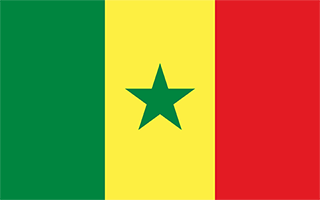
Three equal vertical bands of green (hoist side), yellow, and red with a small green five-pointed star centered in the yellow band; green represents Islam, progress, and hope; yellow signifies natural wealth and progress; red symbolizes sacrifice and determination; the star denotes unity and hope.
The French colonies of Senegal and French Sudan were merged in 1959 and granted independence in 1960 as the Mali Federation. The union broke up after only a few months. Senegal joined with The Gambia to form the nominal confederation of Senegambia in 1982. The envisaged integration of the two countries was never implemented, and the union was dissolved in 1989. The Movement of Democratic Forces in the Casamance has led a low-level separatist insurgency in southern Senegal since the 1980s. Several peace deals have failed to resolve the conflict, but an unofficial cease-fire has remained largely in effect since 2012. Senegal remains one of the most stable democracies in Africa and has a long history of participating in international peacekeeping and regional mediation. Senegal was ruled by a Socialist Party for 40 years until Abdoulaye WADE was elected president in 2000. He was reelected in 2007 and during his two terms amended Senegal's constitution over a dozen times to increase executive power and weaken the opposition. His decision to run for a third presidential term sparked a large public backlash that led to his defeat in a March 2012 runoff with Macky SALL, whose term runs until 2019. A 2016 constitutional referendum reduced the term to five years with a maximum of two consecutive terms for future presidents.
Geography
| Area | ||
|---|---|---|
| Total (World Rank: 89) | 196,722 | sq km |
| Land (World Rank: 86) | 192,530 | sq km |
| Water (World Rank: 72) | 4,192 | sq km |
| Forest (World Rank: 58) | 29.10 | % |
| Comparative | slightly smaller than South Dakota | |
| Coastline | ||
| 531 | ||
| Landborder | ||
| 2684 | ||
| Elevation | ||
| Highest point (World Rank: 237) | 3 | m |
| Agricultural land | ||
| Total (World Rank: 78) | 46.80 | % |
| Arable (World Rank: 66) | 17.40 | % |
| Permanent crops (World Rank: 164) | 0.30 | % |
| Permanent pastures (World Rank: 58) | 29.10 | % |
| Irrigated land (World Rank: 86) | 1,200 | sq km |
| Map reference | ||
| Africa | ||
| Environment | ||
| Issues |
| |
| Agreement party |
| |
| Hazzards |
| |
| Location | ||
| Western Africa, bordering the North Atlantic Ocean, between Guinea-Bissau and Mauritania | ||
| Climate | ||
| tropical; hot, humid; rainy season (May to November) has strong southeast winds; dry season (December to April) dominated by hot, dry, harmattan wind | ||
| Terrain | ||
| generally low, rolling, plains rising to foothills in southeast | ||
People
| Population | ||
|---|---|---|
| Total (World Rank: 71) | 14,668,500 | |
| Deathrate (World Rank: 85) | 0.81 | % |
| Birthrate (World Rank: 27) | 3.34 | % |
| Growthrate (World Rank: 26) | 2.39 | % |
| Migration rate (World Rank: 114) | -0.15 | % |
| Fertility rate (World Rank: 29) | 4.28 | % |
| Median age | ||
| Male (World Rank: 209) | 18.00 | |
| Female (World Rank: 199) | 19.70 | |
| Age structure | ||
| 0 14 male (World Rank: 57) | 3,060,120 | |
| 0 14 female (World Rank: 57) | 3,028,980 | |
| 15 24 male (World Rank: 66) | 1,486,390 | |
| 15 24 female (World Rank: 64) | 1,496,390 | |
| 25 54 male (World Rank: 82) | 2,102,760 | |
| 25 54 female (World Rank: 71) | 2,472,680 | |
| 55 64 male (World Rank: 101) | 251,673 | |
| 55 64 female (World Rank: 90) | 332,113 | |
| 65 x male (World Rank: 103) | 194,491 | |
| 65 x female (World Rank: 108) | 242,926 | |
| Health | ||
| Infant mortality rate (World Rank: 32) | 4.91 | % |
| Life expectancy total (World Rank: 195) | 62 | years |
| Life expectancy female (World Rank: 194) | 64 | years |
| Life expectancy male (World Rank: 196) | 60 | years |
| Physicians per 1000 (World Rank: 173) | 0.06 | |
| Hospital bed per 1000 (World Rank: 179) | 0.30 | |
| Sanitation access total (World Rank: 162) | 47.60 | % |
| Obesity adult (World Rank: 145) | 8.80 | % |
| Drinking water access (World Rank: 163) | 78.50 | % |
Energy
| Electricity | ||
|---|---|---|
| Production (World Rank: 126) | 3,673,000,000 | kWh |
| Consumption (World Rank: 134) | 3,014,000,000 | kWh |
| Source fossil (World Rank: 65) | 88.50 | % |
| Source nuclear (World Rank: 121) | 7.80 | % |
| Source renew (World Rank: 74) | 8.20 | % |
| Crude oil | ||
| Imports (World Rank: 66) | 18,060 | bbl / day |
| Refined products | ||
| Production (World Rank: 91) | 16,850 | bbl / day |
| Consumption (World Rank: 107) | 44,000 | bbl / day |
| Export (World Rank: 99) | 3,892 | bbl / day |
| Import (World Rank: 100) | 30,120 | bbl / day |
| Natural gas | ||
| Production (World Rank: 85) | 62,000,000 | m³ |
| Consumption (World Rank: 105) | 497,000,000 | m³ |
| Carbon footprint | ||
| 7300000 | ||
Nation
| Budget | ||
|---|---|---|
| Education (World Rank: 17) | 7 | % of GDP |
| Military (World Rank: 52) | 2 | % of GDP |
| Health (World Rank: 151) | 5 | % of GDP |
| Surplus (World Rank: 137) | -4 | % of GDP |
| National symbol | ||
| lion | ||
| National colours | ||
| yellow | ||
| Adjective | ||
| Senegalese | ||
| Noun | ||
| Senegalese (singular and plural) | ||
| Background | ||
| The French colonies of Senegal and French Sudan were merged in 1959 and granted independence in 1960 as the Mali Federation. The union broke up after only a few months. Senegal joined with The Gambia to form the nominal confederation of Senegambia in 1982. The envisaged integration of the two countries was never implemented, and the union was dissolved in 1989. The Movement of Democratic Forces in the Casamance has led a low-level separatist insurgency in southern Senegal since the 1980s. Several peace deals have failed to resolve the conflict, but an unofficial cease-fire has remained largely in effect since 2012. Senegal remains one of the most stable democracies in Africa and has a long history of participating in international peacekeeping and regional mediation. Senegal was ruled by a Socialist Party for 40 years until Abdoulaye WADE was elected president in 2000. He was reelected in 2007 and during his two terms amended Senegal's constitution over a dozen times to increase executive power and weaken the opposition. His decision to run for a third presidential term sparked a large public backlash that led to his defeat in a March 2012 runoff with Macky SALL, whose term runs until 2019. A 2016 constitutional referendum reduced the term to five years with a maximum of two consecutive terms for future presidents. | ||
| Flag description | ||
| three equal vertical bands of green (hoist side), yellow, and red with a small green five-pointed star centered in the yellow band; green represents Islam, progress, and hope; yellow signifies natural wealth and progress; red symbolizes sacrifice and determination; the star denotes unity and hope | ||
Economy
| Gdp | ||
|---|---|---|
| Purchasing power parity (World Rank: 115) | 39,640,000,000 | USD |
| Real growth rate (World Rank: 17) | 6.70 | % |
| Per capita purchasing power parity (World Rank: 195) | 2,500 | USD |
| Source agriculture (World Rank: 59) | 17.20 | % |
| Source industry (World Rank: 121) | 23.70 | % |
| Source service (World Rank: 134) | 59.00 | % |
| Labourforce | ||
| Total (World Rank: 67) | 6,737,000 | |
| In poverty (World Rank: 24) | 46.70 | % |
| Products | ||
| Industries |
| |
| Agriculture |
| |
| Exports |
| |
| Imports |
| |
Communication
| Phone | ||
|---|---|---|
| Landline total (World Rank: 116) | 285,933 | |
| Landline per 100 (World Rank: 181) | 2.00 | |
| Mobile per 100 (World Rank: 124) | 106.00 | |
| Assessment | 0 | |
| Internet | ||
| Users (World Rank: 90) | 3,675,210 | |
| Population (World Rank: 167) | 25.70 | % |
Transport
| Air | ||
|---|---|---|
| Airports paved (World Rank: 119) | 9.00 | |
| Airports unpaved (World Rank: 126) | 11.00 | |
| Rail | ||
| Total length (World Rank: 94) | 906 | |
| Road | ||
| Total length (World Rank: 121) | 16,496 | |
| Paved length (World Rank: 95) | 5,957 | |
| Unpaved length (World Rank: 83) | 10,539 | |
| Water | ||
| Total length (World Rank: 66) | 1,000 | |
This is a list of famous places in this country in alphabetical order.
 Adeane
- Affiniam
- Baboucar Toumbou
- Bakel
- Bargny
- Bignona
- Boucotte Ouest
- Cap Skirring
- Cite Avion
- Dagoudane
- Dakar
- Dara
- Diawara
- Diembereng
- Diofior
- Diourbel
- Djifere
- Fas Dieye
- Fatick
- Foundiougne
- Gandiaye
- Golere
- Grand Dakar
- Grand Medine
- Gueoul
- Guinguineo
- Joal-Fadiout
- Kabrousse
- Kaffrine
- Kanel
- Kaolack
- Kayar
- Kedougou
- Keur Babakar Toumbou
- Khombole
- Kolda
- Kolobane
- Koungheul
- Louga
- Marsassoum
- Matam
- Mbake
- Mbouroukh Bambara
- Mekhe
- Mermoz Boabab
- Missira
- Mossor
- N'diareme limamoulaye
- Ndangane
- Ndianghal
- Ndibene Dahra
- Ndioum
- Ndofane
- Ngor
- Nguekhokh
- Nianing
- Niodior
- Nioro du Rip
- Ouakam
- Ouoran
- Ouro Sogui
- Oussouye
- Passi
- Pikine
- Pikine Sud
- Podor
- Pourham
- Pout
- Ranerou
- Richard-Toll
- Rosso
- Rufisque
- Saint-Louis
- Sali
- Sali Niakhniakhal
- Sali Portudal
- Samba Diallo
- Sebikhotane
- Sedhiou
- Seme
- Simenti
- Sokone
- Somone
- Sor
- Tambacounda
- Thies
- Thies Nones
- Tiadiaye
- Tiaroye Guedj
- Tiebo
- Tilel
- Tionk Essil
- Tok Lou Wolof
- Touba
- Toubab Dialaw
- Velingara
- Waounde
- Warang
- Yoff
- Ziguinchor