Russia
in Eastern Europe
Europe
 Azerbaijan
 Belarus
 China
China Estonia
 Finland
 Georgia
 Kazakhstan
 Latvia
 Lithuania
 Mongolia
 North Korea
 Norway
 Poland
 Ukraine
- Currency and Currency Code:
- Ruble - RUB
- Spoken languages:
- Russian, Tatar, Komi, Chechen, Chuvash, Bashkir
- Local electricity:
- 220 V - 50 Hz (plugs: C, F)
- Mobile phone / cellular frequencies (MHz):
- 900 MHz, 1800 MHz, 3G, 4G
- ISO 2-Letter code:
- RU
- Internet top level domain:
- .ru
- Country phone prefix:
- +7
- Local Time (capital):
- Timezone:
- UTC/GMT offset: hours
Safety Score: 4,4 of 5.0 based on data from 9 authorites. Meaning please reconsider your need to travel to Russia.
Travel warnings are updated daily. Source: Travel Warning Russia. Last Update: 2024-04-18 08:12:24
Explore Russia
Russia with its capital Moscow is located in Europe (North Asia bordering the Arctic Ocean, extending from Europe (the portion west of the Urals) to the North Pacific Ocean). It covers some 17,098,201 square kilometers (approximately 1.8 times the size of the US) with 142,258,000 citizens. Russian, Tatar, Komi, Chechen, Chuvash and Bashkir are the common languages used in Russia (consider regional differences). Azerbaijan, Belarus, China, Estonia, Finland, Georgia, Kazakhstan, Latvia, Lithuania, Mongolia, North Korea, Norway, Poland and Ukraine are bordering countries.
Russiaofficially known as the Russian Federation — is the world's largest country, spanning Eastern Europe, and northern Asia, sharing land borders with Norway, Finland, Estonia, Latvia, Lithuania, Poland, Belarus, and Ukraine to the west , Georgia (including the disputed regions of Abkhazia and South Ossetia) and Azerbaijan to the southwest, and Kazakhstan, China, Mongolia, North Korea to the east and much of the south. Russia is immense, and extraordinarily long on attractions for visitors, although many lie in the hard-to-reach stretches of the planet's most remote lands. The best known sights are in and around the nation's principal cities of Moscow and Saint Petersburg. Russia's history is the number one reason why tourists come to this country, following the draw of its fascinating, sometimes surreal, oftentimes brutal, and always consequential national saga.
Popular Destinations in Russia
Administrative regions of Russia
- Altai Republic
- Altayskiy Kray
- Amurskaya Oblast'
- Arkhangelskaya oblast
- Astrakhanskaya Oblast'
- Bashkortostan
- Belgorodskaya Oblast'
- Bryanskaya Oblast'
- Chechenskaya Respublika
- Chelyabinsk Oblast
- Chukotskiy Avtonomnyy Okrug
- Chuvashskaya Respublika
- Dagestan
- Irkutskaya Oblast'
- Ivanovskaya Oblast'
- Kabardino-Balkarskaya Respublika
- Kaliningradskaya Oblast'
- Kalmykiya
- Kaluzhskaya Oblast'
- Kamtchatski Kray
- Karachayevo-Cherkesiya
- Kemerovskaya Oblast'
- Khabarovskiy Kray
- Khanty-Mansiyskiy Avtonomnyy Okrug-Yugra
- Kirovskaya Oblast'
- Komi
- Kostromskaya Oblast'
- Krasnodarskiy Kray
- Krasnoyarskiy Kray
- Kurganskaya Oblast'
- Kurskaya Oblast'
- Leningradskaya Oblast-
- Lipetskaya Oblast'
- Magadanskaya Oblast'
- Moscow
- Moscow Oblast
- Murmanskaya Oblast'
- Nenetskiy Avtonomnyy Okrug
- Nizhegorodskaya Oblast'
- North Ossetia
- Novgorodskaya Oblast'
- Novosibirskaya Oblast'
- Omskaya Oblast'
- Orenburgskaya Oblast'
- Orlovskaya Oblast'
- Penzenskaya Oblast'
- Perm Krai
- Primorskiy Kray
- Pskovskaya Oblast'
- Republic of Karelia
- Respublika Adygeya
- Respublika Buryatiya
- Respublika Ingushetiya
- Respublika Khakasiya
- Respublika Mariy-El
- Respublika Mordoviya
- Respublika Sakha (Yakutiya)
- Respublika Tyva
- Rostov Oblast
- Ryazanskaya Oblast'
- Saint Petersburg
- Sakhalinskaya Oblast'
- Samarskaya Oblast'
- Saratovskaya Oblast'
- Smolenskaya Oblast'
- Stavropol'skiy Kray
- Sverdlovskaya Oblast'
- Tambovskaya Oblast'
- Tatarstan
- Tomskaya Oblast'
- Tul'skaya Oblast'
- Tverskaya Oblast'
- Tyumenskaya Oblast'
- Udmurtskaya Respublika
- Ulyanovsk Oblast
- Vladimirskaya Oblast'
- Volgogradskaya Oblast'
- Vologodskaya Oblast'
- Voronezhskaya Oblast'
- Yamalo-Nenetskiy Avtonomnyy Okrug
- Yaroslavskaya Oblast'
- Yevreyskaya Avtonomnaya Oblast'
- Zabaykal'skiy Kray
About the country
The landscape is broad plain with low hills west of Urals with vast coniferous forest and tundra in Siberia as well as uplands and mountains along southern border regions. The average density of population is about 8 per km². The climate in Russia can be described as ranges from steppes in the south through humid continental in much of European Russiasubarctic in Siberia to tundra climate in the polar north, winters vary from cool along Black Sea coast to frigid in Siberia, summers vary from warm in the steppes to cool along Arctic coast. Potential threats by nature are permafrost over much of Siberia is a major impediment to development, significant volcanic activity on the Kamchatka Peninsula and Kuril Islands; the peninsula alone is home to some 29 historically active volcanoes, with dozens more in the Kuril Islands; Kliuchevskoi (4,835 m), which erupted in 2007 and 2010, is Kamchatka's, spring floods and summer/autumn forest fires throughout Siberia and parts of European Russia, volcanic activity in the Kuril Islands and volcanoes and earthquakes on the Kamchatka Peninsula.
To reach someone Russia dial +7 prior to a number. The local cellular networks are operated on 900 MHz, 1800 MHz, 3G, 4G. Websites typically end with the top level domain ".ru". If you want to bring electric appliances (e.g. battery chaarger), keep in min the local 220 V - 50 Hz (plugs: C, F). The sign for the locally used currency Ruble is RUB.
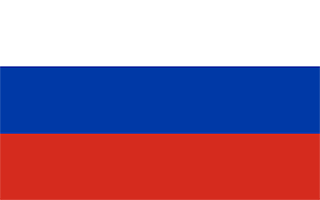
Three equal horizontal bands of white (top), blue, and red.
Founded in the 12th century, the Principality of Muscovy was able to emerge from over 200 years of Mongol domination (13th-15th centuries) and to gradually conquer and absorb surrounding principalities. In the early 17th century, a new ROMANOV Dynasty continued this policy of expansion across Siberia to the Pacific. Under PETER I (ruled 1682-1725), hegemony was extended to the Baltic Sea and the country was renamed the Russian Empire. During the 19th century, more territorial acquisitions were made in Europe and Asia. Defeat in the Russo-Japanese War of 1904-05 contributed to the Revolution of 1905, which resulted in the formation of a parliament and other reforms. Repeated devastating defeats of the Russian army in World War I led to widespread rioting in the major cities of the Russian Empire and to the overthrow in 1917 of the imperial household. The communists under Vladimir LENIN seized power soon after and formed the USSR. The brutal rule of Iosif STALIN (1928-53) strengthened communist rule and Russian dominance of the Soviet Union at a cost of tens of millions of lives. After defeating Germany in World War II as part of an alliance with the US (1939-1945), the USSR expanded its territory and influence in Eastern Europe and emerged as a global power. The USSR was the principal adversary of the US during the Cold War (1947-1991). The Soviet economy and society stagnated in the decades following Stalin’s rule, until General Secretary Mikhail GORBACHEV (1985-91) introduced glasnost (openness) and perestroika (restructuring) in an attempt to modernize communism, but his initiatives inadvertently released forces that by December 1991 splintered the USSR into Russia and 14 other independent republics. Following economic and political turmoil during President Boris YELTSIN's term (1991-99), Russia shifted toward a centralized authoritarian state under the leadership of President Vladimir PUTIN (2000-2008, 2012-present) in which the regime seeks to legitimize its rule through managed elections, populist appeals, a foreign policy focused on enhancing the country's geopolitical influence, and commodity-based economic growth. Russia faces a largely subdued rebel movement in Chechnya and some other surrounding regions, although violence still occurs throughout the North Caucasus.
Geography
| Area | ||
|---|---|---|
| Total (World Rank: 1) | 17,098,200 | sq km |
| Land (World Rank: 1) | 16,377,700 | sq km |
| Water (World Rank: 2) | 720,500 | sq km |
| Forest (World Rank: 152) | 5.70 | % |
| Comparative | approximately 1.8 times the size of the US | |
| Coastline | ||
| 37653 | ||
| Landborder | ||
| 22408 | ||
| Elevation | ||
| Lowest point (World Rank: 56) | -28 | m |
| Highest point (World Rank: 20) | 5,642 | m |
| Agricultural land | ||
| Total (World Rank: 181) | 13.10 | % |
| Arable (World Rank: 133) | 7.30 | % |
| Permanent crops (World Rank: 177) | 0.10 | % |
| Permanent pastures (World Rank: 152) | 5.70 | % |
| Irrigated land (World Rank: 13) | 43,000 | sq km |
| Map reference | ||
| Asia | ||
| Environment | ||
| Issues |
| |
| Agreement party |
| |
| Agreement signed | Air Pollution-Sulfur 94 | |
| Hazzards |
| |
| Location | ||
| North Asia bordering the Arctic Ocean, extending from Europe (the portion west of the Urals) to the North Pacific Ocean | ||
| Climate | ||
| ranges from steppes in the south through humid continental in much of European Russia; subarctic in Siberia to tundra climate in the polar north; winters vary from cool along Black Sea coast to frigid in Siberia; summers vary from warm in the steppes to cool along Arctic coast | ||
| Terrain | ||
| broad plain with low hills west of Urals; vast coniferous forest and tundra in Siberia; uplands and mountains along southern border regions | ||
People
| Population | ||
|---|---|---|
| Total (World Rank: 9) | 142,258,000 | |
| Deathrate (World Rank: 9) | 1.35 | % |
| Birthrate (World Rank: 176) | 1.10 | % |
| Growthrate (World Rank: 199) | -0.08 | % |
| Migration rate (World Rank: 50) | 0.17 | % |
| Fertility rate (World Rank: 176) | 1.61 | % |
| Median age | ||
| Male (World Rank: 62) | 36.60 | |
| Female (World Rank: 43) | 42.50 | |
| Age structure | ||
| 0 14 male (World Rank: 14) | 12,509,600 | |
| 0 14 female (World Rank: 14) | 11,843,300 | |
| 15 24 male (World Rank: 15) | 6,881,880 | |
| 15 24 female (World Rank: 15) | 6,572,190 | |
| 25 54 male (World Rank: 7) | 31,221,000 | |
| 25 54 female (World Rank: 8) | 32,375,500 | |
| 55 64 male (World Rank: 6) | 8,849,710 | |
| 55 64 female (World Rank: 5) | 11,693,100 | |
| 65 x male (World Rank: 8) | 6,352,560 | |
| 65 x female (World Rank: 5) | 13,958,800 | |
| Health | ||
| Infant mortality rate (World Rank: 159) | 0.68 | % |
| Life expectancy total (World Rank: 151) | 71 | years |
| Life expectancy female (World Rank: 125) | 77 | years |
| Life expectancy male (World Rank: 165) | 65 | years |
| Physicians per 1000 (World Rank: 32) | 3.31 | |
| Hospital bed per 1000 (World Rank: 6) | 9.70 | |
| Sanitation access total (World Rank: 139) | 72.20 | % |
| Obesity adult (World Rank: 68) | 23.10 | % |
| Drinking water access (World Rank: 95) | 96.90 | % |
Energy
| Electricity | ||
|---|---|---|
| Production (World Rank: 4) | 1,008,000,000,000 | kWh |
| Consumption (World Rank: 5) | 890,100,000,000 | kWh |
| Export (World Rank: 15) | 13,130,000,000 | kWh |
| Import (World Rank: 49) | 3,194,000,000 | kWh |
| Source fossil (World Rank: 105) | 70.20 | % |
| Source nuclear (World Rank: 113) | 9.70 | % |
| Source renew (World Rank: 142) | 0.60 | % |
| Crude oil | ||
| Production (World Rank: 1) | 10,550,000 | bbl / day |
| Exports (World Rank: 2) | 5,116,000 | bbl / day |
| Imports (World Rank: 68) | 15,110 | bbl / day |
| Proved reserves (World Rank: 8) | 80,000,000,000 | bbl |
| Refined products | ||
| Production (World Rank: 3) | 6,174,000 | bbl / day |
| Consumption (World Rank: 5) | 3,594,000 | bbl / day |
| Export (World Rank: 2) | 3,133,000 | bbl / day |
| Import (World Rank: 81) | 47,770 | bbl / day |
| Natural gas | ||
| Production (World Rank: 2) | 598,600,000,000 | m³ |
| Consumption (World Rank: 3) | 418,900,000,000 | m³ |
| Export (World Rank: 1) | 197,700,000,000 | m³ |
| Import (World Rank: 31) | 0 | m³ |
| Carbon footprint | ||
| 1756000000 | ||
Nation
| Budget | ||
|---|---|---|
| Education (World Rank: 111) | 4 | % of GDP |
| Military (World Rank: 8) | 5 | % of GDP |
| Health (World Rank: 80) | 7 | % of GDP |
| Surplus (World Rank: 122) | -3 | % of GDP |
| National symbol | ||
| double-headed eagle | ||
| National colours | ||
| white | ||
| Adjective | ||
| Russian | ||
| Noun | ||
| Russian(s) | ||
| Background | ||
| Founded in the 12th century, the Principality of Muscovy was able to emerge from over 200 years of Mongol domination (13th-15th centuries) and to gradually conquer and absorb surrounding principalities. In the early 17th century, a new ROMANOV Dynasty continued this policy of expansion across Siberia to the Pacific. Under PETER I (ruled 1682-1725), hegemony was extended to the Baltic Sea and the country was renamed the Russian Empire. During the 19th century, more territorial acquisitions were made in Europe and Asia. Defeat in the Russo-Japanese War of 1904-05 contributed to the Revolution of 1905, which resulted in the formation of a parliament and other reforms. Repeated devastating defeats of the Russian army in World War I led to widespread rioting in the major cities of the Russian Empire and to the overthrow in 1917 of the imperial household. The communists under Vladimir LENIN seized power soon after and formed the USSR. The brutal rule of Iosif STALIN (1928-53) strengthened communist rule and Russian dominance of the Soviet Union at a cost of tens of millions of lives. After defeating Germany in World War II as part of an alliance with the US (1939-1945), the USSR expanded its territory and influence in Eastern Europe and emerged as a global power. The USSR was the principal adversary of the US during the Cold War (1947-1991). The Soviet economy and society stagnated in the decades following Stalin’s rule, until General Secretary Mikhail GORBACHEV (1985-91) introduced glasnost (openness) and perestroika (restructuring) in an attempt to modernize communism, but his initiatives inadvertently released forces that by December 1991 splintered the USSR into Russia and 14 other independent republics. Following economic and political turmoil during President Boris YELTSIN's term (1991-99), Russia shifted toward a centralized authoritarian state under the leadership of President Vladimir PUTIN (2000-2008, 2012-present) in which the regime seeks to legitimize its rule through managed elections, populist appeals, a foreign policy focused on enhancing the country's geopolitical influence, and commodity-based economic growth. Russia faces a largely subdued rebel movement in Chechnya and some other surrounding regions, although violence still occurs throughout the North Caucasus. | ||
| Flag description | ||
| three equal horizontal bands of white (top), blue, and red | ||
Economy
| Gdp | ||
|---|---|---|
| Purchasing power parity (World Rank: 6) | 3,862,000,000,000 | USD |
| Real growth rate (World Rank: 187) | -0.20 | % |
| Per capita purchasing power parity (World Rank: 69) | 26,900 | USD |
| Source agriculture (World Rank: 129) | 4.70 | % |
| Source industry (World Rank: 64) | 32.50 | % |
| Source service (World Rank: 105) | 62.10 | % |
| Labourforce | ||
| Total (World Rank: 6) | 76,640,000 | |
| In poverty (World Rank: 142) | 13.30 | % |
| Products | ||
| Industries |
| |
| Agriculture |
| |
| Exports |
| |
| Imports |
| |
Communication
| Phone | ||
|---|---|---|
| Landline total (World Rank: 8) | 32,276,600 | |
| Landline per 100 (World Rank: 73) | 23.00 | |
| Mobile per 100 (World Rank: 18) | 163.00 | |
| Assessment | 0 | |
| Internet | ||
| Users (World Rank: 6) | 108,772,000 | |
| Population (World Rank: 58) | 76.40 | % |
Transport
| Air | ||
|---|---|---|
| Airports paved (World Rank: 3) | 594 | |
| Airports unpaved (World Rank: 9) | 624 | |
| Heliports (World Rank: 5) | 49.00 | |
| Rail | ||
| Total length (World Rank: 3) | 87,157 | |
| Road | ||
| Total length (World Rank: 5) | 1,283,390 | |
| Paved length (World Rank: 5) | 927,721 | |
| Unpaved length (World Rank: 8) | 355,666 | |
| Water | ||
| Total length (World Rank: 2) | 102,000 | |
This is a list of famous places in this country in alphabetical order.
 Abakan
- Anapa
- Angarsk
- Arkhangel'sk
- Astrakhan
- Azov
- Barnaul
- Belaya Kalitva
- Belgorod
- Birobidzhan
- Blagoveshchensk
- Bryansk
- Cheboksary
- Chelyabinsk
- Cherkessk
- Chernyakhovsk
- Chita
- Dzerzhinsk
- Elista
- Grozny
- Irkutsk
- Ivanovo
- Izhevsk
- Kaliningrad
- Kaluga
- Kazan
- Kemerovo
- Khabarovsk
- Khanty-Mansiysk
- Khasavyurt
- Khimki
- Kirov
- Komsomolsk-on-Amur
- Kostroma
- Krasnodar
- Krasnoyarsk
- Krymsk
- Kungur
- Kurgan
- Kursk
- Kyzyl
- Lipetsk
- Lyubertsy
- Magadan
- Magnitogorsk
- Makhachkala
- Maykop
- Miass
- Moscow
- Murmansk
- Mytishchi
- Nal'chik
- Nizhny Novgorod
- Novokuznetsk
- Novosibirsk
- Omsk
- Orenburg
- Oryol
- Penza
- Perm
- Petropavlovsk-Kamchatskiy
- Petrozavodsk
- Pskov
- Ramenskoye
- Rostov-na-Donu
- Ryazan
- Saint Petersburg
- Salekhard
- Samara
- Saransk
- Saratov
- Smolensk
- Sochi
- Sovetsk
- Stavropol
- Syktyvkar
- Tambov
- Tikhoretsk
- Tomsk
- Tuapse
- Tula
- Tver-
- Tyumen
- Ufa
- Ulan-Ude
- Ulyanovsk
- Velikiy Novgorod
- Vladikavkaz
- Vladimir
- Vladivostok
- Volgograd
- Vologda
- Voronezh
- Yakutsk
- Yaroslavl
- Yekaterinburg
- Yeysk
- Yoshkar-Ola
- Yuzhno-Sakhalinsk
- Zlatoust