
Romania
in Eastern Europe
Europe
 Bulgaria
 Hungary
 Moldova
 Serbia
 Ukraine
- Currency and Currency Code:
- Leu - RON
- Spoken languages:
- Romanian, Hungarian
- Local electricity:
- 230 V - 50 Hz (plugs: C, F)
- Mobile phone / cellular frequencies (MHz):
- 900 MHz, 1800 MHz, 3G, 4G
- ISO 2-Letter code:
- RO
- Internet top level domain:
- .ro
- Country phone prefix:
- +40
- Local Time (capital):
- Timezone:
- UTC/GMT offset: hours
Safety Score: 3,2 of 5.0 based on data from 9 authorites. Meaning please reconsider your need to travel to Romania.
Travel warnings are updated daily. Source: Travel Warning Romania. Last Update: 2024-04-19 08:03:45
Explore Romania
Romania with its capital Bucharest is located in Europe (Southeastern Europe, bordering the Black Sea). It covers some 238,392 square kilometers (twice the size of Pennsylvania) with 21,530,000 citizens. Romanian and Hungarian are the languages commonly used by the people in Romania. Bulgaria, Hungary, Moldova, Serbia and Ukraine are bordering countries.
Romania is a country located north of the Balkan Peninsula on the western shores of the Black Sea. It is a country of great natural beauty and diversity and a rich cultural heritage. Romania enchants visitors with its scenic mountain landscapes and unspoilt rural areas, but also with its historic cities and its busy capital. While it has significant cultural similarities with other Balkan states, it is regarded as unique due to its strong Latin heritage. Things for which Romania is famous include: the Carpathian mountains, Constantin Brancusi, wine, medieval fortresses, Mircea Eliade, Dacia cars, Dracula, stuffed cabbage leaves, Nadia Comaneci, the Black Sea, Gheorghe Hagi, sunflower fields, painted monasteries and the Danube Delta.
Popular Destinations in Romania
Administrative regions of Romania
- Arad
- Bihor
- Bucuresti
- Constanta
- Covasna
- Dolj
- Giurgiu
- Gorj
- Harghita
- Hunedoara
- Ilfov
- Judetul Alba
- Judetul Arges
- Judetul Bacau
- Judetul Bistrita-Nasaud
- Judetul Botosani
- Judetul Braila
- Judetul Brasov
- Judetul Buzau
- Judetul Calarasi
- Judetul Caras-Severin
- Judetul Cluj
- Judetul Dambovita
- Judetul Galati
- Judetul Ialomita
- Judetul Iasi
- Judetul Maramures
- Judetul Mehedinti
- Judetul Mures
- Judetul Neamt
- Judetul Salaj
- Judetul Sibiu
- Judetul Timis
- Judetul Valcea
- Olt
- Prahova
- Satu Mare
- Suceava
- Teleorman
- Tulcea
- Vaslui
- Vrancea
About the country
Website: Romania Tourism
The landscape is central Transylvanian Basin being separated from the Moldavian Plateau on the east by the Eastern Carpathian Mountains and separated from the Walachian Plain on the south by the Transylvanian Alps. The average density of population is about 90 per km². The climate in Romania can be described as temperatecold, cloudy winters with frequent snow and fog, sunny summers with frequent showers and thunderstorms. Potential threats by nature are earthquakes, most severe in south and southwest geologic structure and climate promote landslides
To reach someone Romania dial +40 prior to a number. The local cellular networks are operated on 900 MHz, 1800 MHz, 3G, 4G. Websites typically end with the top level domain ".ro". If you want to bring electric appliances (e.g. battery chaarger), keep in min the local 230 V - 50 Hz (plugs: C, F). The sign for the locally used currency Leu is RON.
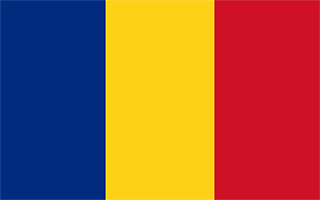
Three equal vertical bands of cobalt blue (hoist side), chrome yellow, and vermilion red; modeled after the flag of France, the colors are those of the principalities of Walachia (red and yellow) and Moldavia (red and blue), which united in 1862 to form Romania; the national coat of arms that used to be centered in the yellow band has been removed.
The principalities of Wallachia and Moldavia - for centuries under the suzerainty of the Turkish Ottoman Empire - secured their autonomy in 1856; they were de facto linked in 1859 and formally united in 1862 under the new name of Romania. The country gained recognition of its independence in 1878. It joined the Allied Powers in World War I and acquired new territories - most notably Transylvania - following the conflict. In 1940, Romania allied with the Axis powers and participated in the 1941 German invasion of the USSR. Three years later, overrun by the Soviets, Romania signed an armistice. The post-war Soviet occupation led to the formation of a communist "people's republic" in 1947 and the abdication of the king. The decades-long rule of dictator Nicolae CEAUSESCU, who took power in 1965, and his Securitate police state became increasingly oppressive and draconian through the 1980s. CEAUSESCU was overthrown and executed in late 1989. Former communists dominated the government until 1996 when they were swept from power. Romania joined NATO in 2004 and the EU in 2007.
Geography
| Area | ||
|---|---|---|
| Total (World Rank: 84) | 238,391 | sq km |
| Land (World Rank: 81) | 229,891 | sq km |
| Water (World Rank: 52) | 8,500 | sq km |
| Forest (World Rank: 91) | 19.70 | % |
| Comparative | twice the size of Pennsylvania; slightly smaller than Oregon | |
| Coastline | ||
| 225 | ||
| Landborder | ||
| 2844 | ||
| Elevation | ||
| Highest point (World Rank: 100) | 2,544 | m |
| Agricultural land | ||
| Total (World Rank: 40) | 60.70 | % |
| Arable (World Rank: 15) | 39.10 | % |
| Permanent crops (World Rank: 96) | 1.90 | % |
| Permanent pastures (World Rank: 91) | 19.70 | % |
| Irrigated land (World Rank: 20) | 31,490 | sq km |
| Map reference | ||
| Europe | ||
| Environment | ||
| Issues |
| |
| Agreement party |
| |
| Hazzards |
| |
| Location | ||
| Southeastern Europe, bordering the Black Sea, between Bulgaria and Ukraine | ||
| Climate | ||
| temperate; cold, cloudy winters with frequent snow and fog; sunny summers with frequent showers and thunderstorms | ||
| Terrain | ||
| central Transylvanian Basin is separated from the Moldavian Plateau on the east by the Eastern Carpathian Mountains and separated from the Walachian Plain on the south by the Transylvanian Alps | ||
People
| Population | ||
|---|---|---|
| Total (World Rank: 58) | 21,530,000 | |
| Deathrate (World Rank: 22) | 1.20 | % |
| Birthrate (World Rank: 205) | 0.89 | % |
| Growthrate (World Rank: 213) | -0.33 | % |
| Migration rate (World Rank: 79) | -0.02 | % |
| Fertility rate (World Rank: 211) | 1.35 | % |
| Median age | ||
| Male (World Rank: 39) | 39.70 | |
| Female (World Rank: 42) | 42.60 | |
| Age structure | ||
| 0 14 male (World Rank: 81) | 1,586,980 | |
| 0 14 female (World Rank: 81) | 1,502,860 | |
| 15 24 male (World Rank: 74) | 1,170,680 | |
| 15 24 female (World Rank: 76) | 1,110,730 | |
| 25 54 male (World Rank: 48) | 5,016,530 | |
| 25 54 female (World Rank: 49) | 4,893,790 | |
| 55 64 male (World Rank: 38) | 1,271,280 | |
| 55 64 female (World Rank: 34) | 1,443,410 | |
| 65 x male (World Rank: 32) | 1,428,600 | |
| 65 x female (World Rank: 27) | 2,105,110 | |
| Health | ||
| Infant mortality rate (World Rank: 141) | 0.94 | % |
| Life expectancy total (World Rank: 105) | 75 | years |
| Life expectancy female (World Rank: 92) | 79 | years |
| Life expectancy male (World Rank: 119) | 72 | years |
| Physicians per 1000 (World Rank: 54) | 2.67 | |
| Hospital bed per 1000 (World Rank: 24) | 6.10 | |
| Sanitation access total (World Rank: 126) | 79.10 | % |
| Obesity adult (World Rank: 75) | 22.50 | % |
| Drinking water access (World Rank: 39) | 100.00 | % |
Energy
| Electricity | ||
|---|---|---|
| Production (World Rank: 46) | 62,160,000,000 | kWh |
| Consumption (World Rank: 50) | 48,280,000,000 | kWh |
| Export (World Rank: 19) | 11,220,000,000 | kWh |
| Import (World Rank: 42) | 4,492,000,000 | kWh |
| Source fossil (World Rank: 154) | 46.70 | % |
| Source nuclear (World Rank: 126) | 5.40 | % |
| Source renew (World Rank: 31) | 18.80 | % |
| Crude oil | ||
| Production (World Rank: 46) | 77,910 | bbl / day |
| Exports (World Rank: 71) | 1,049 | bbl / day |
| Imports (World Rank: 38) | 145,500 | bbl / day |
| Proved reserves (World Rank: 44) | 600,000,000 | bbl |
| Refined products | ||
| Production (World Rank: 47) | 228,100 | bbl / day |
| Consumption (World Rank: 57) | 182,000 | bbl / day |
| Export (World Rank: 45) | 80,400 | bbl / day |
| Import (World Rank: 90) | 40,940 | bbl / day |
| Natural gas | ||
| Production (World Rank: 40) | 11,170,000,000 | m³ |
| Consumption (World Rank: 45) | 17,330,000,000 | m³ |
| Export (World Rank: 54) | 1,078,000 | m³ |
| Import (World Rank: 33) | 0 | m³ |
| Carbon footprint | ||
| 76000000 | ||
Nation
| Budget | ||
|---|---|---|
| Education (World Rank: 140) | 3 | % of GDP |
| Military (World Rank: 82) | 1 | % of GDP |
| Health (World Rank: 118) | 6 | % of GDP |
| Surplus (World Rank: 94) | -2 | % of GDP |
| National symbol | ||
| golden eagle | ||
| National colours | ||
| yellow | ||
| Adjective | ||
| Romanian | ||
| Noun | ||
| Romanian(s) | ||
| Background | ||
| The principalities of Wallachia and Moldavia - for centuries under the suzerainty of the Turkish Ottoman Empire - secured their autonomy in 1856; they were de facto linked in 1859 and formally united in 1862 under the new name of Romania. The country gained recognition of its independence in 1878. It joined the Allied Powers in World War I and acquired new territories - most notably Transylvania - following the conflict. In 1940, Romania allied with the Axis powers and participated in the 1941 German invasion of the USSR. Three years later, overrun by the Soviets, Romania signed an armistice. The post-war Soviet occupation led to the formation of a communist "people's republic" in 1947 and the abdication of the king. The decades-long rule of dictator Nicolae CEAUSESCU, who took power in 1965, and his Securitate police state became increasingly oppressive and draconian through the 1980s. CEAUSESCU was overthrown and executed in late 1989. Former communists dominated the government until 1996 when they were swept from power. Romania joined NATO in 2004 and the EU in 2007. | ||
| Flag description | ||
| three equal vertical bands of cobalt blue (hoist side), chrome yellow, and vermilion red; modeled after the flag of France, the colors are those of the principalities of Walachia (red and yellow) and Moldavia (red and blue), which united in 1862 to form Romania; the national coat of arms that used to be centered in the yellow band has been removed | ||
Economy
| Gdp | ||
|---|---|---|
| Purchasing power parity (World Rank: 42) | 441,600,000,000 | USD |
| Real growth rate (World Rank: 44) | 4.80 | % |
| Per capita purchasing power parity (World Rank: 81) | 22,300 | USD |
| Source agriculture (World Rank: 132) | 4.40 | % |
| Source industry (World Rank: 50) | 34.20 | % |
| Source service (World Rank: 99) | 63.30 | % |
| Labourforce | ||
| Total (World Rank: 54) | 8,979,000 | |
| In poverty (World Rank: 91) | 22.40 | % |
| Products | ||
| Industries |
| |
| Agriculture |
| |
| Exports |
| |
| Imports |
| |
Communication
| Phone | ||
|---|---|---|
| Landline total (World Rank: 35) | 4,110,000 | |
| Landline per 100 (World Rank: 95) | 19.00 | |
| Mobile per 100 (World Rank: 126) | 106.00 | |
| Assessment | 0 | |
| Internet | ||
| Users (World Rank: 43) | 12,852,700 | |
| Population (World Rank: 97) | 59.50 | % |
Transport
| Air | ||
|---|---|---|
| Airports paved (World Rank: 65) | 26.00 | |
| Airports unpaved (World Rank: 109) | 19.00 | |
| Heliports (World Rank: 58) | 2.00 | |
| Rail | ||
| Total length (World Rank: 23) | 11,268 | |
| Road | ||
| Total length (World Rank: 58) | 84,185 | |
| Paved length (World Rank: 46) | 49,873 | |
| Unpaved length (World Rank: 44) | 34,312 | |
| Water | ||
| Total length (World Rank: 47) | 1,731 | |
This is a list of famous places in this country in alphabetical order.
 Abrud
Abrud- Agnita
- Aiud
- Alba Iulia
- Alexandria
- Arad
- Bacau
- Baia Mare
- Barlad
- Bistrita
- Blaj
- Bocsa
- Borsa
- Botosani
- Brad
- Braila
- Brasov
- Breaza
- Bucharest
- Buftea
- Buhusi
- Buzau
- Campia Turzii
- Campina
- Campulung Moldovenesc
- Caracal
- Caransebes
- Carei
- Cluj-Napoca
- Comanesti
- Constanta
- Corabia
- Craiova
- Cugir
- Curtea de Arges
- Dej
- Deva
- Dorohoi
- Drobeta-Turnu Severin
- Fagaras
- Falticeni
- Focsani
- Galati
- Gheorgheni
- Giurgiu
- Gura Humorului
- Hunedoara
- Iasi
- Lipova
- Lugoj
- Mangalia
- Medgidia
- Medias
- Miercurea-Ciuc
- Moinesti
- Moreni
- Odorheiu Secuiesc
- Oradea
- Oravita
- Pascani
- Petrila
- Petrosani
- Piatra Neamt
- Pitesti
- Ploiesti
- Popesti-Leordeni
- Pucioasa
- Radauti
- Ramnicu Sarat
- Ramnicu Valcea
- Resita
- Roman
- Sacele
- Satu Mare
- Sfantu-Gheorghe
- Sibiu
- Sighetu Marmatiei
- Sighisoara
- Simeria
- Sinaia
- Slatina
- Slobozia
- Sovata
- Suceava
- Targoviste
- Targu Jiu
- Targu Neamt
- Targu Ocna
- Targu Secuiesc
- Targu-Mures
- Tarnaveni
- Tecuci
- Timisoara
- Tulcea
- Turda
- Turnu Magurele
- Urziceni
- Vaslui
- Vatra Dornei
- Zalau