Portugal
in Southern Europe
Europe
 Spain
Spain- Currency and Currency Code:
- Euro - EUR
- Spoken languages:
- Portuguese
- Local electricity:
- 230 V - 50 Hz (plugs: C, F)
- Mobile phone / cellular frequencies (MHz):
- 900 MHz, 1800 MHz, 3G, 4G
- ISO 2-Letter code:
- PT
- Internet top level domain:
- .pt
- Country phone prefix:
- +351
- Local Time (capital):
- Timezone:
- UTC/GMT offset: hours
Safety Score: 2,8 of 5.0 based on data from 9 authorites. Meaning we advice caution when travelling to Portugal.
Travel warnings are updated daily. Source: Travel Warning Portugal. Last Update: 2024-04-24 08:14:40
Explore Portugal
Portugal with its capital Lisbon is located in Europe (Southwestern Europe, bordering the North Atlantic Ocean). It covers some 92,091 square kilometers (slightly smaller than Virginia) with a population of 10,839,500. Portuguese is the official language spoken by people in Portugal. As an interesting fact, Spain is the only bordering country.
Portugalin Southern Europe, shares the Iberian peninsula at the western tip of Europe with Spain. Geographically and culturally somewhat isolated from its neighbor, Portugal has a rich, unique culture, lively cities and beautiful countryside. Portugal is one of the warmest European countries. In mainland Portugal, yearly temperature averages are about 15°C (55°F) in the north and 18°C (64°F) in the south. Surrounded by sea in almost its entirety, the Portuguese beaches are well worth visiting. A lot of activities are offered, from surfing, to kite-surfing, and during the summer months the most frequented beaches offer sand based activities such as aerobics. If you're not the type of breaking into a sweat during holidays, almost every single public beach will have a bar where locals sit. There are several Fairs, specially in the Summer months, particularly in Northern Portugal. During the summer, music festivals are also very common. In the north of the country two of the oldest festivals such as Paredes de Coura and Vilar de Mouros.
Popular Destinations in Portugal
Administrative regions of Portugal
- Aveiro District
- Azores
- Beja
- Braga
- Braganza District
- Castelo Branco
- Coimbra
- Evora
- Faro
- Guarda
- Leiria
- Lisbon District
- Madeira
- Portalegre
- Porto
- Santarem
- Setubal
- Viana do Castelo
- Vila Real
- Viseu
About the country
Website: Portugal Tourism
Av. 5 de Outubro, 18
8001-902 Faro
Portugal
Phone: +351 289 800 400
Fax: +351 289 800 489
Mail: rtalgarve@rtalgarve.pt
The topography is the west-flowing Tagus River divides the country: the north being mountainous toward the interior, while the south being characterized by rolling plains. The average density of population is about 118 per km². The climate in Portugal can be described as maritime temperate with cool and rainy in north, warmer and drier in south. Potential natural disasters are Azores subject to severe earthquakes limited volcanic activity in the Azores Islands; Fayal or Faial (1,043 m) last erupted in 1958; most volcanoes have not erupted in centuries; historically active volcanoes include Agua de Pau, Furnas, Pico, Picos Volcanic System, San Jorge, Sete Cidades,
To reach someone Portugal dial +351 prior to a number. The local cellular networks are operated on 900 MHz, 1800 MHz, 3G, 4G. Websites typically end with the top level domain ".pt". If you want to bring electric appliances (e.g. battery chaarger), keep in min the local 230 V - 50 Hz (plugs: C, F). The sign for the locally used currency Euro is EUR.
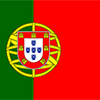
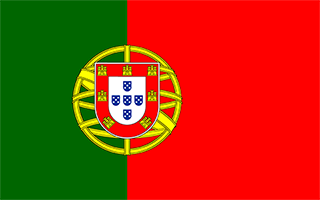
Two vertical bands of green (hoist side, two-fifths) and red (three-fifths) with the national coat of arms (armillary sphere and Portuguese shield) centered on the dividing line; explanations for the color meanings are ambiguous, but a popular interpretation has green symbolizing hope and red the blood of those defending the nation.
Following its heyday as a global maritime power during the 15th and 16th centuries, Portugal lost much of its wealth and status with the destruction of Lisbon in a 1755 earthquake, occupation during the Napoleonic Wars, and the independence of Brazil, its wealthiest colony, in 1822. A 1910 revolution deposed the monarchy; for most of the next six decades, repressive governments ran the country. In 1974, a left-wing military coup installed broad democratic reforms. The following year, Portugal granted independence to all of its African colonies. Portugal is a founding member of NATO and entered the EC (now the EU) in 1986.
Geography
| Area | ||
|---|---|---|
| Total (World Rank: 112) | 92,090 | sq km |
| Land (World Rank: 109) | 91,470 | sq km |
| Water (World Rank: 118) | 620 | sq km |
| Forest (World Rank: 89) | 20.00 | % |
| Comparative | slightly smaller than Virginia | |
| Note | includes Azores and Madeira Islands | |
| Coastline | ||
| 1793 | ||
| Landborder | ||
| 1224 | ||
| Elevation | ||
| Highest point (World Rank: 110) | 2,351 | m |
| Agricultural land | ||
| Total (World Rank: 107) | 39.70 | % |
| Arable (World Rank: 94) | 11.90 | % |
| Permanent crops (World Rank: 42) | 7.80 | % |
| Permanent pastures (World Rank: 89) | 20.00 | % |
| Irrigated land (World Rank: 55) | 5,400 | sq km |
| Map reference | ||
| Europe | ||
| Environment | ||
| Issues |
| |
| Agreement party |
| |
| Agreement signed |
| |
| Hazzards |
| |
| Location | ||
| Southwestern Europe, bordering the North Atlantic Ocean, west of Spain | ||
| Climate | ||
| maritime temperate; cool and rainy in north, warmer and drier in south | ||
| Terrain | ||
| the west-flowing Tagus River divides the country: the north is mountainous toward the interior, while the south is characterized by rolling plains | ||
People
| Population | ||
|---|---|---|
| Total (World Rank: 84) | 10,839,500 | |
| Deathrate (World Rank: 29) | 1.11 | % |
| Birthrate (World Rank: 202) | 0.90 | % |
| Growthrate (World Rank: 186) | 0.04 | % |
| Migration rate (World Rank: 36) | 0.25 | % |
| Fertility rate (World Rank: 190) | 1.53 | % |
| Median age | ||
| Male (World Rank: 32) | 40.20 | |
| Female (World Rank: 21) | 44.40 | |
| Age structure | ||
| 0 14 male (World Rank: 103) | 866,004 | |
| 0 14 female (World Rank: 104) | 797,004 | |
| 15 24 male (World Rank: 95) | 653,672 | |
| 15 24 female (World Rank: 99) | 577,800 | |
| 25 54 male (World Rank: 75) | 2,298,920 | |
| 25 54 female (World Rank: 78) | 2,223,180 | |
| 55 64 male (World Rank: 59) | 617,036 | |
| 55 64 female (World Rank: 56) | 702,992 | |
| 65 x male (World Rank: 46) | 861,270 | |
| 65 x female (World Rank: 41) | 1,241,630 | |
| Health | ||
| Infant mortality rate (World Rank: 182) | 0.43 | % |
| Life expectancy total (World Rank: 48) | 79 | years |
| Life expectancy female (World Rank: 42) | 83 | years |
| Life expectancy male (World Rank: 54) | 76 | years |
| Physicians per 1000 (World Rank: 8) | 4.43 | |
| Hospital bed per 1000 (World Rank: 67) | 3.40 | |
| Sanitation access total (World Rank: 22) | 99.70 | % |
| Obesity adult (World Rank: 95) | 20.80 | % |
| Drinking water access (World Rank: 9) | 100.00 | % |
Energy
| Electricity | ||
|---|---|---|
| Production (World Rank: 52) | 49,660,000,000 | kWh |
| Consumption (World Rank: 52) | 47,030,000,000 | kWh |
| Export (World Rank: 23) | 9,701,000,000 | kWh |
| Import (World Rank: 41) | 4,616,000,000 | kWh |
| Source fossil (World Rank: 169) | 37.90 | % |
| Source nuclear (World Rank: 80) | 22.30 | % |
| Source renew (World Rank: 10) | 32.50 | % |
| Crude oil | ||
| Imports (World Rank: 27) | 270,600 | bbl / day |
| Refined products | ||
| Production (World Rank: 39) | 308,700 | bbl / day |
| Consumption (World Rank: 51) | 234,700 | bbl / day |
| Export (World Rank: 38) | 128,800 | bbl / day |
| Import (World Rank: 68) | 71,920 | bbl / day |
| Natural gas | ||
| Consumption (World Rank: 57) | 8,371,000,000 | m³ |
| Import (World Rank: 20) | 0 | m³ |
| Carbon footprint | ||
| 43980000 | ||
Nation
| Budget | ||
|---|---|---|
| Education (World Rank: 50) | 5 | % of GDP |
| Military (World Rank: 58) | 2 | % of GDP |
| Health (World Rank: 31) | 10 | % of GDP |
| Surplus (World Rank: 84) | -2 | % of GDP |
| National symbol | ||
| armillary sphere | ||
| National colours | ||
| red | ||
| Adjective | ||
| Portuguese | ||
| Noun | ||
| Portuguese (singular and plural) | ||
| Background | ||
| Following its heyday as a global maritime power during the 15th and 16th centuries, Portugal lost much of its wealth and status with the destruction of Lisbon in a 1755 earthquake, occupation during the Napoleonic Wars, and the independence of Brazil, its wealthiest colony, in 1822. A 1910 revolution deposed the monarchy; for most of the next six decades, repressive governments ran the country. In 1974, a left-wing military coup installed broad democratic reforms. The following year, Portugal granted independence to all of its African colonies. Portugal is a founding member of NATO and entered the EC (now the EU) in 1986. | ||
| Flag description | ||
| two vertical bands of green (hoist side, two-fifths) and red (three-fifths) with the national coat of arms (armillary sphere and Portuguese shield) centered on the dividing line; explanations for the color meanings are ambiguous, but a popular interpretation has green symbolizing hope and red the blood of those defending the nation | ||
Economy
| Gdp | ||
|---|---|---|
| Purchasing power parity (World Rank: 56) | 298,600,000,000 | USD |
| Real growth rate (World Rank: 161) | 1.40 | % |
| Per capita purchasing power parity (World Rank: 64) | 28,900 | USD |
| Source agriculture (World Rank: 171) | 2.30 | % |
| Source industry (World Rank: 129) | 22.40 | % |
| Source service (World Rank: 39) | 75.40 | % |
| Labourforce | ||
| Total (World Rank: 79) | 5,178,000 | |
| In poverty (World Rank: 113) | 19.00 | % |
| Products | ||
| Industries |
| |
| Agriculture |
| |
| Exports |
| |
| Imports |
| |
Communication
| Phone | ||
|---|---|---|
| Landline total (World Rank: 29) | 4,787,680 | |
| Landline per 100 (World Rank: 30) | 44.00 | |
| Mobile per 100 (World Rank: 118) | 107.00 | |
| Assessment | 0 | |
| Internet | ||
| Users (World Rank: 56) | 7,629,560 | |
| Population (World Rank: 72) | 70.40 | % |
Transport
| Air | ||
|---|---|---|
| Airports paved (World Rank: 46) | 43.00 | |
| Airports unpaved (World Rank: 99) | 21.00 | |
| Rail | ||
| Total length (World Rank: 59) | 3,075 | |
| Road | ||
| Total length (World Rank: 60) | 82,900 | |
| Paved length (World Rank: 39) | 71,294 | |
| Unpaved length (World Rank: 76) | 11,606 | |
| Water | ||
| Total length (World Rank: 97) | 210.00 | |
This is a list of famous places in this country in alphabetical order.
 Abrantes
- Agueda
- Albergaria-a-Velha
- Albufeira
- Alcacer do Sal
- Alcanena
- Almada
- Amadora
- Aveiro
- Barcelos
- Barreiro
- Batalha
- Beja
- Bombarral
- Braga
- Braganca
- Caldas da Rainha
- Cascais
- Castelo Branco
- Castro Verde
- Chaves
- Coimbra
- Condeixa-a-Nova
- Elvas
- Entroncamento
- Espinho
- Esposende
- Estoril
- Evora
- Fafe
- Faro
- Feira
- Figueira da Foz
- Funchal
- Gondomar
- Grandola
- Guarda
- Guimaraes
- Ilhavo
- Lamego
- Leiria
- Lisbon
- Loule
- Loures
- Lourinha
- Mafra
- Maia
- Mangualde
- Marinha Grande
- Matosinhos
- Miranda do Corvo
- Mirandela
- Moita
- Montemor-o-Novo
- Montemor-o-Velho
- Montijo
- Moura
- Nazare
- Obidos
- Odivelas
- Olhao
- Oliveira de Azemeis
- Oliveira do Hospital
- Ourem
- Pacos de Ferreira
- Palmela
- Penafiel
- Peso da Regua
- Pombal
- Ponta Delgada
- Ponte de Lima
- Portalegre
- Porto
- Povoa de Varzim
- Queluz
- Santarem
- Santiago do Cacem
- Santo Tirso
- Sao Bras de Alportel
- Serta
- Setubal
- Silves
- Sines
- Sintra
- Soure
- Tavira
- Tomar
- Tondela
- Torres Novas
- Torres Vedras
- Valongo
- Viana do Castelo
- Vila Franca de Xira
- Vila Nova de Famalicao
- Vila Nova de Gaia
- Vila Real
- Vila Real de Santo Antonio
- Vila de Porto Santo
- Vila do Conde
- Viseu