Poland
in Eastern Europe
Europe
 Belarus
 Czechia
 Germany
 Lithuania
 Russia
 Slovakia
 Ukraine
- Currency and Currency Code:
- Zloty - PLN
- Spoken languages:
- Polish
- Local electricity:
- 230 V - 50 Hz (plugs: C, E)
- Mobile phone / cellular frequencies (MHz):
- 900 MHz, 1800 MHz, 3G, 4G
- ISO 2-Letter code:
- PL
- Internet top level domain:
- .pl
- Country phone prefix:
- +48
- Local Time (capital):
- Timezone:
- UTC/GMT offset: hours
Safety Score: 2,8 of 5.0 based on data from 9 authorites. Meaning we advice caution when travelling to Poland.
Travel warnings are updated daily. Source: Travel Warning Poland. Last Update: 2024-04-19 08:03:45
Explore Poland
Poland with its capital Warsaw is located in Europe (Central Europe, east of Germany). It covers some 312,686 square kilometers (about twice the size of Georgia) with 38,476,300 citizens. Polish is the language commonly spoken used by the people in Poland. Belarus, Czechia, Germany, Lithuania, Russia, Slovakia and Ukraine are bordering countries.
Polandis a large country in Central Europe. It has a long Baltic Sea coastline and is bordered by Belarus, the Czech Republic, Germany, Lithuania, Russia (Kaliningrad Oblast), Slovakia, and Ukraine. Ever since Poland joined the European Union, international travellers have rapidly rediscovered the country's rich cultural heritage, stunning historic sites and just gorgeous array of landscapes. Whether you're looking for architecture, urban vibes or a taste of the past: Poland's bustling cities and towns offer something for everyone. If you'd rather get away from the crowds and enjoy nature, the country's vast natural areas provide anything from dense forests, high peaks and lush hills to beaches and lake reserves.
Popular Destinations in Poland
Administrative regions of Poland
- Wojewodztwo Dolnoslaskie
- Wojewodztwo Kujawsko-Pomorskie
- Wojewodztwo Lodzkie
- Wojewodztwo Lubelskie
- Wojewodztwo Lubuskie
- Wojewodztwo Malopolskie
- Wojewodztwo Mazowieckie
- Wojewodztwo Opolskie
- Wojewodztwo Podkarpackie
- Wojewodztwo Podlaskie
- Wojewodztwo Pomorskie
- Wojewodztwo Slaskie
- Wojewodztwo Swietokrzyskie
- Wojewodztwo Warminsko-Mazurskie
- Wojewodztwo Wielkopolskie
- Wojewodztwo Zachodniopomorskie
About the country
The landscape is mostly flat plain and mountains along southern border. The average density of population is about 123 per km². The climate in Poland can be described as temperate with cold, cloudy, moderately severe winters with frequent precipitation with mild summers with frequent showers and thundershowers. Potential threats by nature are flooding.
To reach someone Poland dial +48 prior to a number. The local cellular networks are operated on 900 MHz, 1800 MHz, 3G, 4G. Websites typically end with the top level domain ".pl". If you want to bring electric appliances (e.g. battery chaarger), keep in min the local 230 V - 50 Hz (plugs: C, E). The sign for the locally used currency Zloty is PLN.
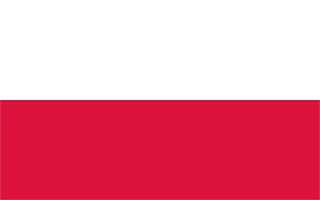
Two equal horizontal bands of white (top) and red; colors derive from the Polish emblem - a white eagle on a red field.
Poland's history as a state began near the middle of the 10th century. By the mid-16th century, the Polish-Lithuanian Commonwealth ruled a vast tract of land in Central and Eastern Europe. During the 18th century, internal disorders weakened the nation, and in a series of agreements between 1772 and 1795, Russia, Prussia, and Austria partitioned Poland among themselves. Poland regained its independence in 1918 only to be overrun by Germany and the Soviet Union in World War II. It became a Soviet satellite state following the war, but its government was comparatively tolerant and progressive. Labor turmoil in 1980 led to the formation of the independent trade union "Solidarity" that over time became a political force with over 10 million members. Free elections in 1989 and 1990 won Solidarity control of the parliament and the presidency, bringing the communist era to a close. A "shock therapy" program during the early 1990s enabled the country to transform its economy into one of the most robust in Central Europe. Poland joined NATO in 1999 and the EU in 2004. With its transformation to a democratic, market-oriented country largely completed and with large investments in defense, energy, and other infrastructure, Poland is an increasingly active member of Euro-Atlantic organizations.
Geography
| Area | ||
|---|---|---|
| Total (World Rank: 71) | 312,685 | sq km |
| Land (World Rank: 69) | 304,255 | sq km |
| Water (World Rank: 53) | 8,430 | sq km |
| Forest (World Rank: 124) | 10.70 | % |
| Comparative | about twice the size of Georgia; slightly smaller than New Mexico | |
| Coastline | ||
| 440 | ||
| Landborder | ||
| 3071 | ||
| Elevation | ||
| Lowest point (World Rank: 42) | -2 | m |
| Highest point (World Rank: 103) | 2,499 | m |
| Agricultural land | ||
| Total (World Rank: 71) | 48.20 | % |
| Arable (World Rank: 22) | 36.20 | % |
| Permanent crops (World Rank: 112) | 1.30 | % |
| Permanent pastures (World Rank: 124) | 10.70 | % |
| Irrigated land (World Rank: 96) | 970 | sq km |
| Map reference | ||
| Europe | ||
| Environment | ||
| Issues |
| |
| Agreement party |
| |
| Agreement signed |
| |
| Hazzards | flooding | |
| Location | ||
| Central Europe, east of Germany | ||
| Climate | ||
| temperate with cold, cloudy, moderately severe winters with frequent precipitation; mild summers with frequent showers and thundershowers | ||
| Terrain | ||
| mostly flat plain; mountains along southern border | ||
People
| Population | ||
|---|---|---|
| Total (World Rank: 36) | 38,476,300 | |
| Deathrate (World Rank: 32) | 1.04 | % |
| Birthrate (World Rank: 199) | 0.95 | % |
| Growthrate (World Rank: 200) | -0.13 | % |
| Migration rate (World Rank: 88) | -0.04 | % |
| Fertility rate (World Rank: 212) | 1.35 | % |
| Median age | ||
| Male (World Rank: 48) | 39.00 | |
| Female (World Rank: 44) | 42.40 | |
| Age structure | ||
| 0 14 male (World Rank: 60) | 2,919,350 | |
| 0 14 female (World Rank: 60) | 2,757,920 | |
| 15 24 male (World Rank: 53) | 2,113,360 | |
| 15 24 female (World Rank: 54) | 2,003,030 | |
| 25 54 male (World Rank: 32) | 8,447,420 | |
| 25 54 female (World Rank: 32) | 8,283,760 | |
| 55 64 male (World Rank: 25) | 2,586,100 | |
| 55 64 female (World Rank: 25) | 2,880,030 | |
| 65 x male (World Rank: 21) | 2,560,850 | |
| 65 x female (World Rank: 19) | 3,924,450 | |
| Health | ||
| Infant mortality rate (World Rank: 181) | 0.44 | % |
| Life expectancy total (World Rank: 66) | 78 | years |
| Life expectancy female (World Rank: 54) | 82 | years |
| Life expectancy male (World Rank: 80) | 74 | years |
| Physicians per 1000 (World Rank: 68) | 2.27 | |
| Hospital bed per 1000 (World Rank: 17) | 6.50 | |
| Sanitation access total (World Rank: 56) | 97.20 | % |
| Obesity adult (World Rank: 67) | 23.10 | % |
| Drinking water access (World Rank: 76) | 98.30 | % |
Energy
| Electricity | ||
|---|---|---|
| Production (World Rank: 26) | 152,100,000,000 | kWh |
| Consumption (World Rank: 24) | 141,300,000,000 | kWh |
| Export (World Rank: 18) | 12,020,000,000 | kWh |
| Import (World Rank: 17) | 14,020,000,000 | kWh |
| Source fossil (World Rank: 92) | 77.70 | % |
| Source nuclear (World Rank: 142) | 1.60 | % |
| Source renew (World Rank: 32) | 18.80 | % |
| Crude oil | ||
| Production (World Rank: 67) | 20,100 | bbl / day |
| Exports (World Rank: 64) | 4,520 | bbl / day |
| Imports (World Rank: 20) | 490,300 | bbl / day |
| Proved reserves (World Rank: 68) | 137,800,000 | bbl |
| Refined products | ||
| Production (World Rank: 29) | 557,700 | bbl / day |
| Consumption (World Rank: 32) | 578,200 | bbl / day |
| Export (World Rank: 36) | 135,000 | bbl / day |
| Import (World Rank: 35) | 173,500 | bbl / day |
| Natural gas | ||
| Production (World Rank: 47) | 6,132,000,000 | m³ |
| Consumption (World Rank: 38) | 26,780,000,000 | m³ |
| Export (World Rank: 49) | 56,000,000 | m³ |
| Import (World Rank: 6) | 0 | m³ |
| Carbon footprint | ||
| 296000000 | ||
Nation
| Budget | ||
|---|---|---|
| Education (World Rank: 77) | 5 | % of GDP |
| Military (World Rank: 50) | 2 | % of GDP |
| Health (World Rank: 95) | 6 | % of GDP |
| Surplus (World Rank: 96) | -3 | % of GDP |
| National symbol | ||
| white eagle | ||
| National colours | ||
| white | ||
| Adjective | ||
| Polish | ||
| Noun | ||
| Pole(s) | ||
| Background | ||
| Poland's history as a state began near the middle of the 10th century. By the mid-16th century, the Polish-Lithuanian Commonwealth ruled a vast tract of land in Central and Eastern Europe. During the 18th century, internal disorders weakened the nation, and in a series of agreements between 1772 and 1795, Russia, Prussia, and Austria partitioned Poland among themselves. Poland regained its independence in 1918 only to be overrun by Germany and the Soviet Union in World War II. It became a Soviet satellite state following the war, but its government was comparatively tolerant and progressive. Labor turmoil in 1980 led to the formation of the independent trade union "Solidarity" that over time became a political force with over 10 million members. Free elections in 1989 and 1990 won Solidarity control of the parliament and the presidency, bringing the communist era to a close. A "shock therapy" program during the early 1990s enabled the country to transform its economy into one of the most robust in Central Europe. Poland joined NATO in 1999 and the EU in 2004. With its transformation to a democratic, market-oriented country largely completed and with large investments in defense, energy, and other infrastructure, Poland is an increasingly active member of Euro-Atlantic organizations. | ||
| Flag description | ||
| two equal horizontal bands of white (top) and red; colors derive from the Polish emblem - a white eagle on a red field | ||
Economy
| Gdp | ||
|---|---|---|
| Purchasing power parity (World Rank: 24) | 1,051,000,000,000 | USD |
| Real growth rate (World Rank: 107) | 2.60 | % |
| Per capita purchasing power parity (World Rank: 65) | 27,700 | USD |
| Source agriculture (World Rank: 164) | 2.40 | % |
| Source industry (World Rank: 22) | 40.20 | % |
| Source service (World Rank: 96) | 64.20 | % |
| Labourforce | ||
| Total (World Rank: 36) | 17,640,000 | |
| In poverty (World Rank: 117) | 17.60 | % |
| Products | ||
| Industries |
| |
| Agriculture |
| |
| Exports |
| |
| Imports |
| |
Communication
| Phone | ||
|---|---|---|
| Landline total (World Rank: 20) | 9,345,000 | |
| Landline per 100 (World Rank: 71) | 24.00 | |
| Mobile per 100 (World Rank: 33) | 145.00 | |
| Assessment | 0 | |
| Internet | ||
| Users (World Rank: 27) | 28,237,800 | |
| Population (World Rank: 67) | 73.30 | % |
Transport
| Air | ||
|---|---|---|
| Airports paved (World Rank: 28) | 87.00 | |
| Airports unpaved (World Rank: 71) | 39.00 | |
| Heliports (World Rank: 31) | 6.00 | |
| Rail | ||
| Total length (World Rank: 15) | 19,231 | |
| Road | ||
| Total length (World Rank: 17) | 417,026 | |
| Paved length (World Rank: 13) | 287,650 | |
| Unpaved length (World Rank: 18) | 129,376 | |
| Water | ||
| Total length (World Rank: 28) | 3,997 | |
This is a list of famous places in this country in alphabetical order.
 Bedzin
- Belchatow
- Biala Podlaska
- Bialystok
- Bielsko-Biala
- Bilgoraj
- Brzeg
- Bydgoszcz
- Bytom
- Chorzow
- Ciechanow
- Cieszyn
- Czestochowa
- Debica
- Elblag
- Elk
- Gdansk
- Gdynia
- Gliwice
- Gniezno
- Gorzow Wielkopolski
- Inowroclaw
- Jaslo
- Jastrzebie Zdroj
- Jaworzno
- Kalisz
- Katowice
- Kedzierzyn-Kozle
- Kielce
- Kolobrzeg
- Koszalin
- Krakow
- Krasnik
- Kutno
- Lancut
- Legnica
- Leszno
- Lodz
- Lowicz
- Lubin
- Lublin
- Minsk Mazowiecki
- Nowy Sacz
- Nowy Targ
- Nysa
- Olsztyn
- Opole
- Ostroleka
- Ostrow Wielkopolski
- Ostrowiec Swietokrzyski
- Otwock
- Pabianice
- Piaseczno
- Piekary Slaskie
- Pila
- Piotrkow Trybunalski
- Plock
- Police
- Poznan
- Pruszkow
- Przemysl
- Pulawy
- Raciborz
- Radom
- Rybnik
- Rzeszow
- Sandomierz
- Sanok
- Siemianowice Slaskie
- Skierniewice
- Slupsk
- Stalowa Wola
- Stargard
- Suwalki
- Swidnica
- Swietochlowice
- Swinoujscie
- Szczecin
- Tarnobrzeg
- Tarnow
- Tarnowskie Gory
- Tomaszow Mazowiecki
- Torun
- Tychy
- Wadowice
- Walbrzych
- Warsaw
- Wejherowo
- Wieliczka
- Wloclawek
- Wodzislaw Slaski
- Wroclaw
- Zabrze
- Zamosc
- Zary
- Zawiercie
- Zgierz
- Zielona Gora
- Zory
- Zyrardow