Papua New Guinea
in Melanesia
Oceania
 Indonesia
- Currency and Currency Code:
- Kina - PGK
- Spoken languages:
- English, Hiri Motu
- Local electricity:
- 240 V - 50 Hz (plugs: I)
- Mobile phone / cellular frequencies (MHz):
- 900 MHz, 3G, 4G
- ISO 2-Letter code:
- PG
- Internet top level domain:
- .pg
- Country phone prefix:
- +675
- Local Time (capital):
- Timezone:
- UTC/GMT offset: hours
Safety Score: 3,8 of 5.0 based on data from 9 authorites. Meaning please reconsider your need to travel to Papua New Guinea.
Travel warnings are updated daily. Source: Travel Warning Papua New Guinea. Last Update: 2024-04-19 08:03:45
Explore Papua New Guinea
Papua New Guinea with its capital Port Moresby is located in Oceania (Oceania, group of islands including the eastern half of the island of New Guinea between the Coral Sea and the South Pacific Ocean). It covers some 462,841 square kilometers (slightly larger than California) with a population of 6,909,700. English and Hiri Motu are the languages spoken by people in Papua New Guinea. As an interesting fact, Indonesia is the only bordering country.
Papua New Guinea is an island nation in Oceania. The country can be conveniently divided into 11 regions (7 on the main island and 4 island regions). In 2009, Papua New Guinea received 125,000 visitors, but only around 20% of these declared themselves as tourists. The country offers the traveler a true paradox. With little tourist infrastructure outside the main tourist areas, getting around can be tough. Tourism is well developed and growing in a handful of locations. Beyond these, the country is 120% adventure travel and not for the inexperienced or faint of heart.
Popular Destinations in Papua New Guinea
Administrative regions of Papua New Guinea
- Bougainville
- Central Province
- Chimbu Province
- East New Britain Province
- East Sepik Province
- Eastern Highlands Province
- Enga Province
- Gulf Province
- Hela
- Jiwaka
- Madang Province
- Manus Province
- Milne Bay Province
- Morobe Province
- National Capital District
- New Ireland Province
- Northern Province
- Southern Highlands Province
- West New Britain Province
- West Sepik Province
- Western Highlands Province
- Western Province
About the country
Website: Papua New Guinea Tourism
2nd Floor MMI Building
Port Moresby
PO Box 1291, Port Moresby
National Capital District
Papua New Guinea
Phone: +675 320 0211
Fax: +675 320 0223
Mail: info@pngtourism.org.pg
The topography is mostly mountains with coastal lowlands and rolling foothills. The average density of population is about 15 per km². The climate in Papua New Guinea can be described as tropicalnorthwest monsoon (December to March), southeast monsoon (May to October), slight seasonal temperature variation. Potential natural disasters are active volcanism, mud slides, severe volcanic activity; Ulawun (2,334 m), one of Papua New Guinea's potentially most dangerous volcanoes, has been deemed a Decade Volcano by the International Association of Volcanology and Chemistry of the Earth's Interior, worthy of study due to its , situated along the Pacific "Ring of Fire", the country is subject to frequent and sometimes severe earthquakes and tsunamis.
To reach someone Papua New Guinea dial +675 prior to a number. The local cellular networks are operated on 900 MHz, 3G, 4G. Websites typically end with the top level domain ".pg". If you want to bring electric appliances (e.g. battery chaarger), keep in min the local 240 V - 50 Hz (plugs: I). The sign for the locally used currency Kina is PGK.
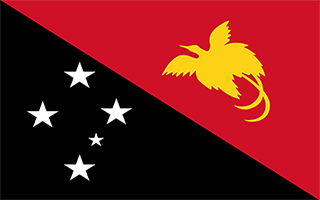
Divided diagonally from upper hoist-side corner; the upper triangle is red with a soaring yellow bird of paradise centered; the lower triangle is black with five, white, five-pointed stars of the Southern Cross constellation centered; red, black, and yellow are traditional colors of Papua New Guinea; the bird of paradise - endemic to the island of New Guinea - is an emblem of regional tribal culture and represents the emergence of Papua New Guinea as a nation; the Southern Cross, visible in the night sky, symbolizes Papua New Guinea's connection with Australia and several other countries in the South Pacific.
The eastern half of the island of New Guinea - second largest in the world - was divided between Germany (north) and the UK (south) in 1885. The latter area was transferred to Australia in 1902, which occupied the northern portion during World War I and continued to administer the combined areas until independence in 1975. A nine-year secessionist revolt on the island of Bougainville ended in 1997 after claiming some 20,000 lives. Since 2001, Bougainville has experienced autonomy. Under the terms of a peace accord, 2015 is the year that a five-year window opens for a referendum on the question of independence.
Geography
| Area | ||
|---|---|---|
| Total (World Rank: 56) | 462,840 | sq km |
| Land (World Rank: 54) | 452,860 | sq km |
| Water (World Rank: 49) | 9,980 | sq km |
| Forest (World Rank: 197) | 0.40 | % |
| Comparative | slightly larger than California | |
| Coastline | ||
| 5152 | ||
| Landborder | ||
| 824 | ||
| Elevation | ||
| Highest point (World Rank: 36) | 4,509 | m |
| Agricultural land | ||
| Total (World Rank: 215) | 2.60 | % |
| Arable (World Rank: 204) | 0.70 | % |
| Permanent crops (World Rank: 104) | 1.50 | % |
| Permanent pastures (World Rank: 197) | 0.40 | % |
| Map reference | ||
| Oceania | ||
| Environment | ||
| Issues |
| |
| Agreement party |
| |
| Hazzards |
| |
| Location | ||
| Oceania, group of islands including the eastern half of the island of New Guinea between the Coral Sea and the South Pacific Ocean, east of Indonesia | ||
| Climate | ||
| tropical; northwest monsoon (December to March), southeast monsoon (May to October); slight seasonal temperature variation | ||
| Terrain | ||
| mostly mountains with coastal lowlands and rolling foothills | ||
People
| Population | ||
|---|---|---|
| Total (World Rank: 105) | 6,909,700 | |
| Deathrate (World Rank: 140) | 0.66 | % |
| Birthrate (World Rank: 60) | 2.37 | % |
| Growthrate (World Rank: 61) | 1.71 | % |
| Fertility rate (World Rank: 53) | 3.03 | % |
| Median age | ||
| Male (World Rank: 164) | 23.20 | |
| Female (World Rank: 171) | 23.10 | |
| Age structure | ||
| 0 14 male (World Rank: 92) | 1,175,930 | |
| 0 14 female (World Rank: 91) | 1,133,880 | |
| 15 24 male (World Rank: 91) | 697,463 | |
| 15 24 female (World Rank: 90) | 678,680 | |
| 25 54 male (World Rank: 108) | 1,309,840 | |
| 25 54 female (World Rank: 110) | 1,238,970 | |
| 55 64 male (World Rank: 119) | 193,273 | |
| 55 64 female (World Rank: 125) | 185,931 | |
| 65 x male (World Rank: 117) | 148,802 | |
| 65 x female (World Rank: 130) | 146,921 | |
| Health | ||
| Infant mortality rate (World Rank: 50) | 3.63 | % |
| Life expectancy total (World Rank: 168) | 67 | years |
| Life expectancy female (World Rank: 168) | 70 | years |
| Life expectancy male (World Rank: 166) | 65 | years |
| Physicians per 1000 (World Rank: 170) | 0.06 | |
| Sanitation access total (World Rank: 197) | 18.90 | % |
| Obesity adult (World Rank: 91) | 21.30 | % |
| Drinking water access (World Rank: 205) | 40.00 | % |
Energy
| Electricity | ||
|---|---|---|
| Production (World Rank: 127) | 3,620,000,000 | kWh |
| Consumption (World Rank: 132) | 3,367,000,000 | kWh |
| Source fossil (World Rank: 124) | 62.10 | % |
| Source nuclear (World Rank: 65) | 31.10 | % |
| Source renew (World Rank: 81) | 6.80 | % |
| Crude oil | ||
| Production (World Rank: 50) | 55,990 | bbl / day |
| Exports (World Rank: 53) | 17,400 | bbl / day |
| Imports (World Rank: 69) | 14,880 | bbl / day |
| Proved reserves (World Rank: 61) | 159,400,000 | bbl |
| Refined products | ||
| Production (World Rank: 86) | 28,340 | bbl / day |
| Consumption (World Rank: 110) | 42,000 | bbl / day |
| Export (World Rank: 85) | 8,062 | bbl / day |
| Import (World Rank: 115) | 21,180 | bbl / day |
| Natural gas | ||
| Production (World Rank: 41) | 9,800,000,000 | m³ |
| Consumption (World Rank: 104) | 680,000,000 | m³ |
| Export (World Rank: 21) | 9,700,000,000 | m³ |
| Carbon footprint | ||
| 3700000 | ||
Nation
| Budget | ||
|---|---|---|
| Military (World Rank: 135) | 1 | % of GDP |
| Health (World Rank: 161) | 4 | % of GDP |
| Surplus (World Rank: 149) | -5 | % of GDP |
| National symbol | ||
| bird of paradise | ||
| National colours | ||
| red | ||
| Adjective | ||
| Papua New Guinean | ||
| Noun | ||
| Papua New Guinean(s) | ||
| Background | ||
| The eastern half of the island of New Guinea - second largest in the world - was divided between Germany (north) and the UK (south) in 1885. The latter area was transferred to Australia in 1902, which occupied the northern portion during World War I and continued to administer the combined areas until independence in 1975. A nine-year secessionist revolt on the island of Bougainville ended in 1997 after claiming some 20,000 lives. Since 2001, Bougainville has experienced autonomy. Under the terms of a peace accord, 2015 is the year that a five-year window opens for a referendum on the question of independence. | ||
| Flag description | ||
| divided diagonally from upper hoist-side corner; the upper triangle is red with a soaring yellow bird of paradise centered; the lower triangle is black with five, white, five-pointed stars of the Southern Cross constellation centered; red, black, and yellow are traditional colors of Papua New Guinea; the bird of paradise - endemic to the island of New Guinea - is an emblem of regional tribal culture and represents the emergence of Papua New Guinea as a nation; the Southern Cross, visible in the night sky, symbolizes Papua New Guinea's connection with Australia and several other countries in the South Pacific | ||
Economy
| Gdp | ||
|---|---|---|
| Purchasing power parity (World Rank: 133) | 29,400,000,000 | USD |
| Real growth rate (World Rank: 116) | 2.40 | % |
| Per capita purchasing power parity (World Rank: 178) | 3,700 | USD |
| Source agriculture (World Rank: 44) | 21.50 | % |
| Source industry (World Rank: 16) | 42.80 | % |
| Source service (World Rank: 215) | 35.70 | % |
| Labourforce | ||
| Total (World Rank: 99) | 3,598,000 | |
| In poverty (World Rank: 43) | 37.00 | % |
| Products | ||
| Industries |
| |
| Agriculture |
| |
| Exports |
| |
| Imports |
| |
Communication
| Phone | ||
|---|---|---|
| Landline total (World Rank: 128) | 154,000 | |
| Landline per 100 (World Rank: 179) | 2.00 | |
| Mobile per 100 (World Rank: 197) | 56.00 | |
| Assessment | 0 | |
| Internet | ||
| Users (World Rank: 143) | 652,071 | |
| Population (World Rank: 211) | 9.60 | % |
Transport
| Air | ||
|---|---|---|
| Airports paved (World Rank: 77) | 21.00 | |
| Airports unpaved (World Rank: 10) | 540 | |
| Heliports (World Rank: 56) | 2.00 | |
| Road | ||
| Total length (World Rank: 139) | 9,349 | |
| Paved length (World Rank: 116) | 3,000 | |
| Unpaved length (World Rank: 100) | 6,349 | |
| Water | ||
| Total length (World Rank: 11) | 11,000 | |
This is a list of famous places in this country in alphabetical order.
 Aitape
- Alotau
- Amboin
- Ambunti
- Amegeau
- Angoram
- Arawa
- Asini
- Barawon
- Bereina
- Bereina
- Bil Bil
- Bitalobo
- Buin
- Buka
- Bulolo
- Daru
- Davaon
- Eboa
- Emeti
- Evara
- Fakonama
- Finschhafen
- Gaile
- Gasmata
- Goroka
- Guari
- Ialibu
- Ieta
- Ihu
- Inauaia
- Inawabui
- Inawaia
- Kainantu
- Kairuku
- Kandrian
- Kanobaba 1
- Kavieng
- Kerema
- Kieta
- Kimbe
- Kiunga
- Kokoda
- Kokopo
- Komasun
- Kosipe
- Kovelo Number 1
- Kranket
- Kundiawa
- Kundiman
- Kwato
- Kwikila
- Lae
- Laiagam
- Lorengau
- Losuia
- Madang
- Malaguna
- Mapaio
- Matalau
- Mendi
- Minj
- Moloi
- Morehead
- Mount Hagen
- Nadzab
- Namatanai
- Nguvalian
- Nodup
- Ombo
- Panguna
- Pomasi Number 2
- Popondetta
- Porebada
- Porgera
- Port Moresby
- Port Moresby
- Rabaul
- Rakunat
- Raluana
- Roku
- Salamaua
- Samarai
- Saraga
- Sogeri
- Sohano
- Taliligap
- Tari
- Telefomin
- Tufi
- Tupuseleia
- Vanimo
- Vanimo
- Veiru
- Wabag
- Wau
- Wewak
- Wewak
- Wutung
- Zagomzuhu