Panama
in Central America
North America
 Colombia
 Costa Rica
- Currency and Currency Code:
- Balboa - PAB
- Spoken languages:
- Spanish, English
- Local electricity:
- 120 V - 60 Hz (plugs: A, B)
- Mobile phone / cellular frequencies (MHz):
- 850 MHz, 1900 MHz, 3G, 4G
- ISO 2-Letter code:
- PA
- Internet top level domain:
- .pa
- Country phone prefix:
- +507
- Local Time (capital):
- Timezone:
- UTC/GMT offset: hours
Safety Score: 3,0 of 5.0 based on data from 9 authorites. Meaning we advice caution when travelling to Panama.
Travel warnings are updated daily. Source: Travel Warning Panama. Last Update: 2024-04-24 08:14:40
Explore Panama
Panama with its capital Panama is located in North America (Central America, bordering both the Caribbean Sea and the North Pacific Ocean). It covers some 75,421 square kilometers (slightly smaller than South Carolina) with 3,753,140 citizens. Spanish and English are the common languages used in Panama. As an interesting fact, is sharing borders with Colombia and Costa Rica.
Panamais a country in Central America with coastlines on both the Caribbean Sea and the North Pacific Ocean, with Colombia (and South America) to the southeast and Costa Rica (and North America) to the northwest. The ease of travel and wide array of experiences are making Panama one of the most attractive emerging tourism destinations in the world. In just one week, visitors can enjoy two different oceans, experience the mountains and rainforest, learn about native cultures and take advantage of vibrant urban life. The capital, Panama City, is a modern, sophisticated metropolis that resembles Miami and has established commerce, arts, fashion and dining. Fodors, Frommers and National Geographic have all recently began publishing guides for Panama, only the second country in Central America, behind Costa Rica, to have such extensive travel coverage.
Popular Destinations in Panama
Administrative regions of Panama
- Embera-Wounaan
- Guna Yala
- Ngoebe-Bugle
- Panama Oeste
- Provincia de Bocas del Toro
- Provincia de Chiriqui
- Provincia de Cocle
- Provincia de Colon
- Provincia de Herrera
- Provincia de Los Santos
- Provincia de Panama
- Provincia de Veraguas
- Provincia del Darien
About the country
Website: Panama Tourism
P.O. Box 4421
Zone 5
The Republic of Panama
Phone: +507 226 7000
Fax: +507 226 3483
The topography is interior mostly steep, rugged mountains with dissected, upland plains with coastal plains with rolling hills. The average density of population is about 50 per km². The climate in Panama can be described as tropical maritimehot, humid, cloudy, prolonged rainy season (May to January), short dry season (January to May). Potential natural disasters are occasional severe storms and forest fires in the Darien area.
To reach someone Panama dial +507 prior to a number. The local cellular networks are operated on 850 MHz, 1900 MHz, 3G, 4G. Websites typically end with the top level domain ".pa". If you want to bring electric appliances (e.g. battery chaarger), keep in min the local 120 V - 60 Hz (plugs: A, B). The sign for the locally used currency Balboa is PAB.
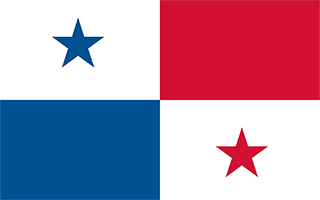
Divided into four, equal rectangles; the top quadrants are white (hoist side) with a blue five-pointed star in the center and plain red; the bottom quadrants are plain blue (hoist side) and white with a red five-pointed star in the center; the blue and red colors are those of the main political parties (Conservatives and Liberals respectively) and the white denotes peace between them; the blue star stands for the civic virtues of purity and honesty, the red star signifies authority and law.
Explored and settled by the Spanish in the 16th century, Panama broke with Spain in 1821 and joined a union of Colombia, Ecuador, and Venezuela - named the Republic of Gran Colombia. When the latter dissolved in 1830, Panama remained part of Colombia. With US backing, Panama seceded from Colombia in 1903 and promptly signed a treaty with the US allowing for the construction of a canal and US sovereignty over a strip of land on either side of the structure (the Panama Canal Zone). The Panama Canal was built by the US Army Corps of Engineers between 1904 and 1914. In 1977, an agreement was signed for the complete transfer of the Canal from the US to Panama by the end of the century. Certain portions of the Zone and increasing responsibility over the Canal were turned over in the subsequent decades. With US help, dictator Manuel NORIEGA was deposed in 1989. The entire Panama Canal, the area supporting the Canal, and remaining US military bases were transferred to Panama by the end of 1999. An ambitious expansion project to more than double the Canal's capacity - by allowing for more Canal transits and larger ships - was carried out between 2007 and 2016.
Geography
| Area | ||
|---|---|---|
| Total (World Rank: 119) | 75,420 | sq km |
| Land (World Rank: 117) | 74,340 | sq km |
| Water (World Rank: 108) | 1,080 | sq km |
| Forest (World Rank: 84) | 20.70 | % |
| Comparative | slightly smaller than South Carolina | |
| Coastline | ||
| 2490 | ||
| Landborder | ||
| 687 | ||
| Elevation | ||
| Highest point (World Rank: 55) | 3,475 | m |
| Agricultural land | ||
| Total (World Rank: 136) | 30.50 | % |
| Arable (World Rank: 134) | 7.30 | % |
| Permanent crops (World Rank: 80) | 2.50 | % |
| Permanent pastures (World Rank: 84) | 20.70 | % |
| Irrigated land (World Rank: 121) | 321 | sq km |
| Map reference | ||
| Central America and the Caribbean | ||
| Environment | ||
| Issues |
| |
| Agreement party |
| |
| Agreement signed | Marine Life Conservation | |
| Hazzards | occasional severe storms and forest fires in the Darien area | |
| Location | ||
| Central America, bordering both the Caribbean Sea and the North Pacific Ocean, between Colombia and Costa Rica | ||
| Climate | ||
| tropical maritime; hot, humid, cloudy; prolonged rainy season (May to January), short dry season (January to May) | ||
| Terrain | ||
| interior mostly steep, rugged mountains with dissected, upland plains; coastal plains with rolling hills | ||
People
| Population | ||
|---|---|---|
| Total (World Rank: 130) | 3,753,140 | |
| Deathrate (World Rank: 193) | 0.49 | % |
| Birthrate (World Rank: 98) | 1.79 | % |
| Growthrate (World Rank: 87) | 1.27 | % |
| Migration rate (World Rank: 73) | -0.02 | % |
| Fertility rate (World Rank: 89) | 2.30 | % |
| Median age | ||
| Male (World Rank: 121) | 28.80 | |
| Female (World Rank: 117) | 29.60 | |
| Age structure | ||
| 0 14 male (World Rank: 122) | 505,711 | |
| 0 14 female (World Rank: 122) | 484,980 | |
| 15 24 male (World Rank: 124) | 324,897 | |
| 15 24 female (World Rank: 123) | 312,729 | |
| 25 54 male (World Rank: 131) | 766,747 | |
| 25 54 female (World Rank: 128) | 747,472 | |
| 55 64 male (World Rank: 130) | 147,069 | |
| 55 64 female (World Rank: 130) | 149,706 | |
| 65 x male (World Rank: 118) | 144,086 | |
| 65 x female (World Rank: 123) | 169,745 | |
| Health | ||
| Infant mortality rate (World Rank: 135) | 0.99 | % |
| Life expectancy total (World Rank: 52) | 79 | years |
| Life expectancy female (World Rank: 56) | 82 | years |
| Life expectancy male (World Rank: 58) | 76 | years |
| Physicians per 1000 (World Rank: 88) | 1.59 | |
| Hospital bed per 1000 (World Rank: 95) | 2.20 | |
| Sanitation access total (World Rank: 135) | 75.00 | % |
| Obesity adult (World Rank: 72) | 22.70 | % |
| Drinking water access (World Rank: 113) | 94.70 | % |
Energy
| Electricity | ||
|---|---|---|
| Production (World Rank: 101) | 9,724,000,000 | kWh |
| Consumption (World Rank: 100) | 8,202,000,000 | kWh |
| Export (World Rank: 78) | 139,000,000 | kWh |
| Import (World Rank: 109) | 17,000,000 | kWh |
| Source fossil (World Rank: 174) | 35.80 | % |
| Source nuclear (World Rank: 36) | 53.90 | % |
| Source renew (World Rank: 62) | 11.60 | % |
| Refined products | ||
| Consumption (World Rank: 68) | 144,000 | bbl / day |
| Export (World Rank: 122) | 66 | bbl / day |
| Import (World Rank: 48) | 131,000 | bbl / day |
| Natural gas | ||
| Consumption (World Rank: 165) | 4 | m³ |
| Carbon footprint | ||
| 17000000 | ||
Nation
| Budget | ||
|---|---|---|
| Education (World Rank: 129) | 3 | % of GDP |
| Health (World Rank: 56) | 8 | % of GDP |
| Surplus (World Rank: 82) | -2 | % of GDP |
| National symbol | ||
| harpy eagle | ||
| National colours | ||
| white | ||
| Adjective | ||
| Panamanian | ||
| Noun | ||
| Panamanian(s) | ||
| Background | ||
| Explored and settled by the Spanish in the 16th century, Panama broke with Spain in 1821 and joined a union of Colombia, Ecuador, and Venezuela - named the Republic of Gran Colombia. When the latter dissolved in 1830, Panama remained part of Colombia. With US backing, Panama seceded from Colombia in 1903 and promptly signed a treaty with the US allowing for the construction of a canal and US sovereignty over a strip of land on either side of the structure (the Panama Canal Zone). The Panama Canal was built by the US Army Corps of Engineers between 1904 and 1914. In 1977, an agreement was signed for the complete transfer of the Canal from the US to Panama by the end of the century. Certain portions of the Zone and increasing responsibility over the Canal were turned over in the subsequent decades. With US help, dictator Manuel NORIEGA was deposed in 1989. The entire Panama Canal, the area supporting the Canal, and remaining US military bases were transferred to Panama by the end of 1999. An ambitious expansion project to more than double the Canal's capacity - by allowing for more Canal transits and larger ships - was carried out between 2007 and 2016. | ||
| Flag description | ||
| divided into four, equal rectangles; the top quadrants are white (hoist side) with a blue five-pointed star in the center and plain red; the bottom quadrants are plain blue (hoist side) and white with a red five-pointed star in the center; the blue and red colors are those of the main political parties (Conservatives and Liberals respectively) and the white denotes peace between them; the blue star stands for the civic virtues of purity and honesty, the red star signifies authority and law | ||
Economy
| Gdp | ||
|---|---|---|
| Purchasing power parity (World Rank: 85) | 92,810,000,000 | USD |
| Real growth rate (World Rank: 43) | 4.90 | % |
| Per capita purchasing power parity (World Rank: 79) | 23,000 | USD |
| Source agriculture (World Rank: 162) | 2.50 | % |
| Source industry (World Rank: 175) | 15.50 | % |
| Source service (World Rank: 34) | 76.70 | % |
| Labourforce | ||
| Total (World Rank: 129) | 1,610,000 | |
| In poverty (World Rank: 87) | 23.00 | % |
| Products | ||
| Industries |
| |
| Agriculture |
| |
| Exports |
| |
| Imports |
| |
Communication
| Phone | ||
|---|---|---|
| Landline total (World Rank: 90) | 641,688 | |
| Landline per 100 (World Rank: 107) | 17.00 | |
| Mobile per 100 (World Rank: 9) | 188.00 | |
| Assessment | 0 | |
| Internet | ||
| Users (World Rank: 112) | 2,000,830 | |
| Population (World Rank: 110) | 54.00 | % |
Transport
| Air | ||
|---|---|---|
| Airports paved (World Rank: 42) | 57.00 | |
| Airports unpaved (World Rank: 54) | 60.00 | |
| Heliports (World Rank: 51) | 3.00 | |
| Rail | ||
| Total length (World Rank: 129) | 77.00 | |
| Road | ||
| Total length (World Rank: 125) | 15,137 | |
| Paved length (World Rank: 92) | 6,351 | |
| Unpaved length (World Rank: 90) | 8,786 | |
| Water | ||
| Total length (World Rank: 73) | 800 | |
This is a list of famous places in this country in alphabetical order.
 Aguadulce
- Alanje
- Alcalde Diaz
- Almirante
- Ancon
- Anton
- Arraijan
- Aserrio de Gariche
- Atalaya
- Balboa
- Bejuco
- Bocas del Toro
- Boqueron
- Boquete
- Calobre
- Canazas
- Capira
- Cativa
- Cerro Punta
- Chame
- Changuinola
- Chigore
- Chiguiri Arriba
- Chilibre
- Chiriqui
- Chiriqui Grande
- Chitre
- Churuquita Chiquita
- Colon
- David
- El Cano
- El Coco
- El Espino
- El Roble
- Escobal
- Finca Blanco
- Guabito
- Guadalupe
- Gualaca
- Guarare
- Horconcitos
- Kusapin
- La Chorrera
- La Concepcion
- La Mesa
- La Mitra
- La Palma
- La Pena
- La Pintada
- Las Lomas
- Las Margaritas
- Las Minas
- Las Palmas
- Las Tablas
- Los Pozos
- Los Santos
- Macaracas
- Maria Chiquita
- Meteti
- Montijo
- Nata
- Nueva Gorgona
- Nuevo Arraijan
- Ocu
- Ola
- Pacora
- Panama
- Parita
- Pedregal
- Penonome
- Pese
- Pocri
- Portobelo
- Potrerillos Arriba
- Puerto Armuelles
- Puerto Caimito
- Puerto Pilon
- Remedios
- Rio Sereno
- Rio de Jesus
- Sabanitas
- San Andres
- San Carlos
- San Miguelito
- Santa Fe
- Santa Fe
- Santa Maria
- Santiago
- Sona
- Sortova
- Taboga
- Tocumen
- Tonosi
- Union Choco
- Ustupo
- Veracruz
- Villa Rosario
- Vista Alegre
- Volcan
- Yaviza