North Korea
in Eastern Asia
Asia
 China
China Russia
 South Korea
- Currency and Currency Code:
- Won - KPW
- Spoken languages:
- Korean
- Local electricity:
- 220 V - 50 Hz (plugs: C)
- Mobile phone / cellular frequencies (MHz):
- 3G
- ISO 2-Letter code:
- KP
- Internet top level domain:
- .kp
- Country phone prefix:
- +850
- Local Time (capital):
- Timezone:
- UTC/GMT offset: hours
Safety Score: 4,4 of 5.0 based on data from 9 authorites. Meaning please reconsider your need to travel to North Korea.
Travel warnings are updated daily. Source: Travel Warning North Korea. Last Update: 2024-04-23 08:18:23
Explore North Korea
North Korea with its capital Pyongyang is located in Asia (Eastern Asia, northern half of the Korean Peninsula bordering the Korea Bay and the Sea of Japan). It covers some 120,539 square kilometers (slightly larger than Virginia) with 25,248,100 citizens. Korean is the language commonly spoken used by the people in North Korea. China, Russia and South Korea are bordering countries.
North Korea is a country in East Asia. North Korea can only be visited by an organized tour, but this can be a large group or a party of one. Prices start from around $1000/€700/£580 for a 5-day group tour including accommodation, meals and transport from Beijing, but can go up considerably if you want to travel around the country or independently (as your own one-person escorted group).
Popular Destinations in North Korea
Administrative regions of North Korea
- Chagang-do
- Hambuk
- Hamnam
- Hwanghae-bukto
- Hwanghae-namdo
- Kangwon-do
- P'yongan-bukto
- P'yongan-namdo
- Pyongyang
- Rason
- Ryanggang
About the country
The landscape is mostly hills and mountains separated by deep, narrow valleys and wide coastal plains in west, discontinuous in east. The average density of population is about 209 per km². The climate in North Korea can be described as temperate, with rainfall concentrated in summer with long, bitter winters. Potential threats by nature are Changbaishan (2,744 m) (also known as Baitoushan, Baegdu or P'aektu-san), on the Chinese border, is considered historically active, late spring droughts often followed by severe flooding and occasional typhoons during the early fall.
To reach someone North Korea dial +850 prior to a number. The local cellular networks are operated on 3G. Websites typically end with the top level domain ".kp". If you want to bring electric appliances (e.g. battery chaarger), keep in min the local 220 V - 50 Hz (plugs: C). The sign for the locally used currency Won is KPW.
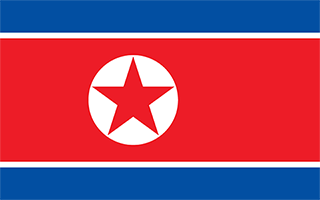
Three horizontal bands of blue (top), red (triple width), and blue; the red band is edged in white; on the hoist side of the red band is a white disk with a red five-pointed star; the broad red band symbolizes revolutionary traditions; the narrow white bands stand for purity, strength, and dignity; the blue bands signify sovereignty, peace, and friendship; the red star represents socialism.
An independent kingdom for much of its long history, Korea was occupied by Japan beginning in 1905 following the Russo-Japanese War. Five years later, Japan formally annexed the entire peninsula. Following World War II, Korea was split with the northern half coming under Soviet-sponsored communist control. After failing in the Korean War (1950-53) to conquer the US-backed Republic of Korea (ROK) in the southern portion by force, North Korea (DPRK), under its founder President KIM Il Sung, adopted a policy of ostensible diplomatic and economic "self-reliance" as a check against outside influence. The DPRK demonized the US as the ultimate threat to its social system through state-funded propaganda, and molded political, economic, and military policies around the core ideological objective of eventual unification of Korea under Pyongyang's control. KIM Il Sung's son, KIM Jong Il, was officially designated as his father's successor in 1980, assuming a growing political and managerial role until the elder KIM's death in 1994. KIM Jong Un was publicly unveiled as his father's successor in 2010. Following KIM Jong Il's death in 2011, KIM Jong Un quickly assumed power and has now taken on most of his father's former titles and duties. After decades of economic mismanagement and resource misallocation, the DPRK since the mid-1990s has faced chronic food shortages. In recent years, the North’s domestic agricultural production has increased, but still falls far short of producing sufficient food to provide for its entire population. The DPRK began to ease restrictions to allow semi-private markets, starting in 2002, but has made few other efforts to meet its goal of improving the overall standard of living. North Korea's history of regional military provocations; proliferation of military-related items; long-range missile development; WMD programs including tests of nuclear devices in 2006, 2009, 2013, 2016, and 2017; and massive conventional armed forces are of major concern to the international community and have limited the DPRK’s international engagement, particularly economically. The regime abides by a policy calling for the simultaneous development of its nuclear weapons program and its economy.
Geography
| Area | ||
|---|---|---|
| Total (World Rank: 100) | 120,538 | sq km |
| Land (World Rank: 97) | 120,408 | sq km |
| Water (World Rank: 142) | 130 | sq km |
| Forest (World Rank: 196) | 0.40 | % |
| Comparative | slightly larger than Virginia; slightly smaller than Mississippi | |
| Coastline | ||
| 2495 | ||
| Landborder | ||
| 1607 | ||
| Elevation | ||
| Highest point (World Rank: 88) | 2,744 | m |
| Agricultural land | ||
| Total (World Rank: 159) | 21.80 | % |
| Arable (World Rank: 58) | 19.50 | % |
| Permanent crops (World Rank: 98) | 1.90 | % |
| Permanent pastures (World Rank: 196) | 0.40 | % |
| Irrigated land (World Rank: 37) | 14,600 | sq km |
| Map reference | ||
| Asia | ||
| Environment | ||
| Issues |
| |
| Agreement party |
| |
| Agreement signed | Law of the Sea | |
| Hazzards |
| |
| Location | ||
| Eastern Asia, northern half of the Korean Peninsula bordering the Korea Bay and the Sea of Japan, between China and South Korea | ||
| Climate | ||
| temperate, with rainfall concentrated in summer; long, bitter winters | ||
| Terrain | ||
| mostly hills and mountains separated by deep, narrow valleys; wide coastal plains in west, discontinuous in east | ||
People
| Population | ||
|---|---|---|
| Total (World Rank: 51) | 25,248,100 | |
| Deathrate (World Rank: 60) | 0.93 | % |
| Birthrate (World Rank: 131) | 1.46 | % |
| Growthrate (World Rank: 151) | 0.53 | % |
| Fertility rate (World Rank: 124) | 1.95 | % |
| Median age | ||
| Male (World Rank: 91) | 32.50 | |
| Female (World Rank: 81) | 35.60 | |
| Age structure | ||
| 0 14 male (World Rank: 64) | 2,670,880 | |
| 0 14 female (World Rank: 66) | 2,576,850 | |
| 15 24 male (World Rank: 55) | 1,982,040 | |
| 15 24 female (World Rank: 56) | 1,955,220 | |
| 25 54 male (World Rank: 44) | 5,608,520 | |
| 25 54 female (World Rank: 45) | 5,572,000 | |
| 55 64 male (World Rank: 41) | 1,166,680 | |
| 55 64 female (World Rank: 38) | 1,301,200 | |
| 65 x male (World Rank: 48) | 826,735 | |
| 65 x female (World Rank: 36) | 1,588,010 | |
| Health | ||
| Infant mortality rate (World Rank: 74) | 2.21 | % |
| Life expectancy total (World Rank: 154) | 71 | years |
| Life expectancy female (World Rank: 148) | 75 | years |
| Life expectancy male (World Rank: 155) | 67 | years |
| Physicians per 1000 (World Rank: 50) | 2.78 | |
| Hospital bed per 1000 (World Rank: 3) | 13.20 | |
| Sanitation access total (World Rank: 118) | 81.90 | % |
| Obesity adult (World Rank: 163) | 6.80 | % |
| Drinking water access (World Rank: 47) | 99.70 | % |
Energy
| Electricity | ||
|---|---|---|
| Production (World Rank: 87) | 13,410,000,000 | kWh |
| Consumption (World Rank: 89) | 11,240,000,000 | kWh |
| Source fossil (World Rank: 159) | 45.00 | % |
| Source nuclear (World Rank: 33) | 55.00 | % |
| Crude oil | ||
| Imports (World Rank: 74) | 10,640 | bbl / day |
| Refined products | ||
| Production (World Rank: 99) | 11,270 | bbl / day |
| Consumption (World Rank: 141) | 18,000 | bbl / day |
| Import (World Rank: 158) | 5,976 | bbl / day |
| Natural gas | ||
| Consumption (World Rank: 142) | 15 | m³ |
| Carbon footprint | ||
| 50000000 | ||
Economy
| Gdp | ||
|---|---|---|
| Purchasing power parity (World Rank: 114) | 40,000,000,000 | USD |
| Real growth rate (World Rank: 193) | -1.10 | % |
| Per capita purchasing power parity (World Rank: 212) | 1,700 | USD |
| Source agriculture (World Rank: 29) | 25.30 | % |
| Source industry (World Rank: 19) | 41.10 | % |
| Source service (World Rank: 216) | 33.60 | % |
| Labourforce | ||
| Total (World Rank: 41) | 14,000,000 | |
| Products | ||
| Industries |
| |
| Agriculture |
| |
| Exports |
| |
| Imports |
| |
Nation
| Budget | ||
|---|---|---|
| Surplus (World Rank: 48) | -0 | % of GDP |
| National symbol | ||
| red star | ||
| National colours | ||
| white | ||
| Adjective | ||
| Korean | ||
| Noun | ||
| Korean(s) | ||
| Background | ||
| An independent kingdom for much of its long history, Korea was occupied by Japan beginning in 1905 following the Russo-Japanese War. Five years later, Japan formally annexed the entire peninsula. Following World War II, Korea was split with the northern half coming under Soviet-sponsored communist control. After failing in the Korean War (1950-53) to conquer the US-backed Republic of Korea (ROK) in the southern portion by force, North Korea (DPRK), under its founder President KIM Il Sung, adopted a policy of ostensible diplomatic and economic "self-reliance" as a check against outside influence. The DPRK demonized the US as the ultimate threat to its social system through state-funded propaganda, and molded political, economic, and military policies around the core ideological objective of eventual unification of Korea under Pyongyang's control. KIM Il Sung's son, KIM Jong Il, was officially designated as his father's successor in 1980, assuming a growing political and managerial role until the elder KIM's death in 1994. KIM Jong Un was publicly unveiled as his father's successor in 2010. Following KIM Jong Il's death in 2011, KIM Jong Un quickly assumed power and has now taken on most of his father's former titles and duties. After decades of economic mismanagement and resource misallocation, the DPRK since the mid-1990s has faced chronic food shortages. In recent years, the North’s domestic agricultural production has increased, but still falls far short of producing sufficient food to provide for its entire population. The DPRK began to ease restrictions to allow semi-private markets, starting in 2002, but has made few other efforts to meet its goal of improving the overall standard of living. North Korea's history of regional military provocations; proliferation of military-related items; long-range missile development; WMD programs including tests of nuclear devices in 2006, 2009, 2013, 2016, and 2017; and massive conventional armed forces are of major concern to the international community and have limited the DPRK’s international engagement, particularly economically. The regime abides by a policy calling for the simultaneous development of its nuclear weapons program and its economy. | ||
| Flag description | ||
| three horizontal bands of blue (top), red (triple width), and blue; the red band is edged in white; on the hoist side of the red band is a white disk with a red five-pointed star; the broad red band symbolizes revolutionary traditions; the narrow white bands stand for purity, strength, and dignity; the blue bands signify sovereignty, peace, and friendship; the red star represents socialism | ||
Communication
| Phone | ||
|---|---|---|
| Landline total (World Rank: 71) | 1,180,000 | |
| Landline per 100 (World Rank: 157) | 5.00 | |
| Mobile per 100 (World Rank: 215) | 13.00 | |
| Assessment | 0 | |
Transport
| Air | ||
|---|---|---|
| Airports paved (World Rank: 51) | 39.00 | |
| Airports unpaved (World Rank: 65) | 43.00 | |
| Heliports (World Rank: 11) | 23.00 | |
| Rail | ||
| Total length (World Rank: 29) | 7,435 | |
| Road | ||
| Total length (World Rank: 101) | 25,554 | |
| Paved length (World Rank: 152) | 724 | |
| Unpaved length (World Rank: 59) | 24,830 | |
| Water | ||
| Total length (World Rank: 39) | 2,250 | |
This is a list of famous places in this country in alphabetical order.
 Anak
Anak- Anbyon-up
- Anju
- Aoji-ri
- Ayang-ni
- Ch'ongsong-nodongjagu
- Ch'ongsongdongchung-ni
- Ch'ongsu-rodongjagu
- Chaeryong-up
- Changyon
- Chasong
- Chom-maul
- Chongjin
- Chongju
- Chungdong-ni
- Chunggang
- Chunghwa
- Hadal-li
- Hadang-dong
- Haeju
- Hamhung
- Hoeyang
- Hongwon
- Hujongbaek-tong
- Hukkyo-ri
- Hungnam
- Hwangju-up
- Hyesan
- Hyesan-dong
- Iwon-up
- Kaesong
- Kangdong-up
- Kanggye
- Kapsan-up
- Kilju
- Kimch'aek-si
- Koksan
- Komusan 1-tong
- Koryo-dong
- Kosan
- Kowon-up
- Kudujin-dong
- Kujang-up
- Kujong-ni
- Kusong
- Kwaksan
- Kyongsong
- Kyongwon
- Manp'o
- Manwol-dong
- Musan-up
- Namp'o
- Namsa-rodongjagu
- Namyang-dong
- Namyang-nodongjagu
- Nanam
- Ojok-tong
- Ojong-ni
- Ongjin
- Onsong
- P'yongsong
- Palsal-li
- Panghyon-dong
- Pukchil-lodongjagu
- Pultang-gol
- Puryong
- Pyoksong-up
- Pyongyang
- Pyont'an-dong
- Pyoro-dong
- Rajin
- Sakchu-up
- Samho-rodongjagu
- Sangsong-ni
- Sariwon
- Sil-li
- Sinanju
- Sinmak
- Sinsang-ni
- Sinuiju
- Sonbong
- Songnim
- Songsal-li
- Sot-pong
- Sunan
- Sungam-nodongjagu
- Sungho 1-tong
- Sungjibaegam
- T'ongch'on-up
- Uiju
- Wiyon-dong
- Wonsan
- Yanggang-ni
- Yangjin-dong
- Yomju-up
- Yonan-up
- Yongbyon
- Yonggang-up
- Yonggwang-up
- Yuktae-dong