Nigeria
in Western Africa
Africa
 Benin
Benin Cameroon
 Chad
Chad Niger
Niger- Currency and Currency Code:
- Naira - NGN
- Spoken languages:
- English, Hausa, Yoruba, Igbo, Fulah
- Local electricity:
- 230 V - 50 Hz (plugs: D, G)
- Mobile phone / cellular frequencies (MHz):
- 900 MHz, 1800 MHz, 3G, 4G
- ISO 2-Letter code:
- NG
- Internet top level domain:
- .ng
- Country phone prefix:
- +234
- Local Time (capital):
- Timezone:
- UTC/GMT offset: hours
Safety Score: 3,8 of 5.0 based on data from 9 authorites. Meaning please reconsider your need to travel to Nigeria.
Travel warnings are updated daily. Source: Travel Warning Nigeria. Last Update: 2024-04-24 08:14:40
Explore Nigeria
Nigeria with its capital Abuja is located in Africa (Western Africa, bordering the Gulf of Guinea). It covers some 923,769 square kilometers (about six times the size of Georgia) with a population of 190,632,000. English, Hausa, Yoruba, Igbo and Fulah are the languages spoken by people in Nigeria (consider regional differences). Benin, Cameroon, Chad and Niger are bordering countries.


Nigeria is a country in equatorial West Africa. It is the continent's most populous nation. There are many types of traditional cuisine to enjoy. For example: afang soup, okra soup, owo soup and starch in the Niger Delta, plantain (fried, boiled, roasted), pepper soup, amala, eba, efo, pounded yam (iyan - Yoruba for pounded yam pronounce ee-yarn ), jollof rice, ground nut soup, ogbono soup, isi ewu (goat's head stew), egusi soup, suya (kebab), moin moin, ewedu, gbegiri soup (beans soup), edikangikong, ground-rice, puff-puff, chin chin, ikokore, owerri soup (ofe owerri), which is the most expensive African soup in Nigeria.
Popular Destinations in Nigeria
Administrative regions of Nigeria
- Abia State
- Adamawa
- Akwa Ibom State
- Anambra
- Bauchi
- Bayelsa State
- Benue State
- Borno State
- Cross River State
- Delta
- Ebonyi State
- Edo
- Ekiti State
- Enugu State
- Federal Capital Territory
- Gombe State
- Imo State
- Jigawa State
- Kaduna State
- Kano State
- Katsina State
- Kebbi State
- Kogi State
- Kwara State
- Lagos State
- Nasarawa State
- Niger State
- Ogun State
- Ondo State
- Osun State
- Oyo State
- Plateau State
- Rivers State
- Sokoto State
- Taraba State
- Yobe State
- Zamfara State
About the country
The topography is southern lowlands merge into central hills and plateaus with mountains in southeast, plains in north. The average density of population is about 206 per km². The climate in Nigeria can be described as varying with equatorial in south, tropical in center, arid in north. Potential natural disasters are flooding periodic droughts
To reach someone Nigeria dial +234 prior to a number. The local cellular networks are operated on 900 MHz, 1800 MHz, 3G, 4G. Websites typically end with the top level domain ".ng". If you want to bring electric appliances (e.g. battery chaarger), keep in min the local 230 V - 50 Hz (plugs: D, G). The sign for the locally used currency Naira is NGN.
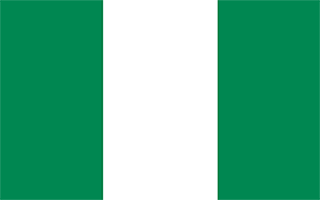
Three equal vertical bands of green (hoist side), white, and green; the color green represents the forests and abundant natural wealth of the country, white stands for peace and unity.
British influence and control over what would become Nigeria and Africa's most populous country grew through the 19th century. A series of constitutions after World War II granted Nigeria greater autonomy. After independence in 1960, politics were marked by coups and mostly military rule, until the death of a military head of state in 1998 allowed for a political transition. In 1999, a new constitution was adopted and a peaceful transition to civilian government was completed. The government continues to face the daunting task of institutionalizing democracy and reforming a petroleum-based economy, whose revenues have been squandered through corruption and mismanagement. In addition, Nigeria continues to experience longstanding ethnic and religious tensions. Although both the 2003 and 2007 presidential elections were marred by significant irregularities and violence, Nigeria is currently experiencing its longest period of civilian rule since independence. The general elections of April 2007 marked the first civilian-to-civilian transfer of power in the country's history and the elections of 2011 were generally regarded as credible. The 2015 election is considered the most well run in Nigeria since the return to civilian rule, with the umbrella opposition party, the All Progressives Congress, defeating the long-ruling People's Democratic Party that had governed since 1999.
Geography
| Area | ||
|---|---|---|
| Total (World Rank: 33) | 923,768 | sq km |
| Land (World Rank: 31) | 910,768 | sq km |
| Water (World Rank: 41) | 13,000 | sq km |
| Forest (World Rank: 47) | 33.30 | % |
| Comparative | about six times the size of Georgia; slightly more than twice the size of California | |
| Coastline | ||
| 853 | ||
| Landborder | ||
| 4477 | ||
| Elevation | ||
| Highest point (World Rank: 106) | 2,419 | m |
| Agricultural land | ||
| Total (World Rank: 8) | 78.00 | % |
| Arable (World Rank: 21) | 37.30 | % |
| Permanent crops (World Rank: 45) | 7.40 | % |
| Permanent pastures (World Rank: 47) | 33.30 | % |
| Irrigated land (World Rank: 70) | 2,930 | sq km |
| Map reference | ||
| Africa | ||
| Environment | ||
| Issues |
| |
| Agreement party |
| |
| Hazzards |
| |
| Location | ||
| Western Africa, bordering the Gulf of Guinea, between Benin and Cameroon | ||
| Climate | ||
| varies; equatorial in south, tropical in center, arid in north | ||
| Terrain | ||
| southern lowlands merge into central hills and plateaus; mountains in southeast, plains in north | ||
People
| Population | ||
|---|---|---|
| Total (World Rank: 7) | 190,632,000 | |
| Deathrate (World Rank: 19) | 1.24 | % |
| Birthrate (World Rank: 13) | 3.69 | % |
| Growthrate (World Rank: 25) | 2.43 | % |
| Migration rate (World Rank: 74) | -0.02 | % |
| Fertility rate (World Rank: 12) | 5.07 | % |
| Median age | ||
| Male (World Rank: 205) | 18.30 | |
| Female (World Rank: 210) | 18.50 | |
| Age structure | ||
| 0 14 male (World Rank: 3) | 41,506,300 | |
| 0 14 female (World Rank: 3) | 39,595,700 | |
| 15 24 male (World Rank: 6) | 19,094,900 | |
| 15 24 female (World Rank: 6) | 18,289,500 | |
| 25 54 male (World Rank: 9) | 30,066,200 | |
| 25 54 female (World Rank: 9) | 28,537,800 | |
| 55 64 male (World Rank: 17) | 3,699,950 | |
| 55 64 female (World Rank: 17) | 3,870,080 | |
| 65 x male (World Rank: 19) | 2,825,130 | |
| 65 x female (World Rank: 23) | 3,146,640 | |
| Health | ||
| Infant mortality rate (World Rank: 8) | 6.98 | % |
| Life expectancy total (World Rank: 211) | 54 | years |
| Life expectancy female (World Rank: 211) | 55 | years |
| Life expectancy male (World Rank: 213) | 53 | years |
| Physicians per 1000 (World Rank: 135) | 0.38 | |
| Sanitation access total (World Rank: 182) | 29.00 | % |
| Obesity adult (World Rank: 144) | 8.90 | % |
| Drinking water access (World Rank: 180) | 68.50 | % |
Energy
| Electricity | ||
|---|---|---|
| Production (World Rank: 64) | 29,830,000,000 | kWh |
| Consumption (World Rank: 67) | 24,570,000,000 | kWh |
| Source fossil (World Rank: 90) | 80.30 | % |
| Source nuclear (World Rank: 86) | 19.50 | % |
| Source renew (World Rank: 157) | 0.20 | % |
| Crude oil | ||
| Production (World Rank: 13) | 1,871,000 | bbl / day |
| Exports (World Rank: 6) | 2,279,000 | bbl / day |
| Proved reserves (World Rank: 10) | 37,060,000,000 | bbl |
| Refined products | ||
| Production (World Rank: 71) | 70,140 | bbl / day |
| Consumption (World Rank: 42) | 316,000 | bbl / day |
| Export (World Rank: 81) | 11,010 | bbl / day |
| Import (World Rank: 33) | 180,100 | bbl / day |
| Natural gas | ||
| Production (World Rank: 17) | 45,150,000,000 | m³ |
| Consumption (World Rank: 37) | 26,860,000,000 | m³ |
| Export (World Rank: 13) | 26,330,000,000 | m³ |
| Carbon footprint | ||
| 97000000 | ||
Nation
| Budget | ||
|---|---|---|
| Military (World Rank: 146) | 0 | % of GDP |
| Health (World Rank: 167) | 4 | % of GDP |
| Surplus (World Rank: 105) | -3 | % of GDP |
| National symbol | ||
| eagle | ||
| National colours | ||
| white | ||
| Adjective | ||
| Nigerian | ||
| Noun | ||
| Nigerian(s) | ||
| Background | ||
| British influence and control over what would become Nigeria and Africa's most populous country grew through the 19th century. A series of constitutions after World War II granted Nigeria greater autonomy. After independence in 1960, politics were marked by coups and mostly military rule, until the death of a military head of state in 1998 allowed for a political transition. In 1999, a new constitution was adopted and a peaceful transition to civilian government was completed. The government continues to face the daunting task of institutionalizing democracy and reforming a petroleum-based economy, whose revenues have been squandered through corruption and mismanagement. In addition, Nigeria continues to experience longstanding ethnic and religious tensions. Although both the 2003 and 2007 presidential elections were marred by significant irregularities and violence, Nigeria is currently experiencing its longest period of civilian rule since independence. The general elections of April 2007 marked the first civilian-to-civilian transfer of power in the country's history and the elections of 2011 were generally regarded as credible. The 2015 election is considered the most well run in Nigeria since the return to civilian rule, with the umbrella opposition party, the All Progressives Congress, defeating the long-ruling People's Democratic Party that had governed since 1999. | ||
| Flag description | ||
| three equal vertical bands of green (hoist side), white, and green; the color green represents the forests and abundant natural wealth of the country, white stands for peace and unity | ||
Economy
| Gdp | ||
|---|---|---|
| Purchasing power parity (World Rank: 23) | 1,090,000,000,000 | USD |
| Real growth rate (World Rank: 197) | -1.60 | % |
| Per capita purchasing power parity (World Rank: 160) | 5,900 | USD |
| Source agriculture (World Rank: 45) | 21.20 | % |
| Source industry (World Rank: 162) | 18.40 | % |
| Source service (World Rank: 119) | 60.40 | % |
| Labourforce | ||
| Total (World Rank: 10) | 58,810,000 | |
| In poverty (World Rank: 6) | 70.00 | % |
| Products | ||
| Industries |
| |
| Agriculture |
| |
| Exports |
| |
| Imports |
| |
Communication
| Phone | ||
|---|---|---|
| Landline total (World Rank: 127) | 154,513 | |
| Landline per 100 (World Rank: 205) | 1.00 | |
| Mobile per 100 (World Rank: 161) | 83.00 | |
| Assessment | 0 | |
| Internet | ||
| Users (World Rank: 14) | 47,759,900 | |
| Population (World Rank: 168) | 25.70 | % |
Transport
| Air | ||
|---|---|---|
| Airports paved (World Rank: 49) | 40.00 | |
| Airports unpaved (World Rank: 119) | 14.00 | |
| Heliports (World Rank: 36) | 5.00 | |
| Rail | ||
| Total length (World Rank: 51) | 3,798 | |
| Road | ||
| Total length (World Rank: 29) | 193,200 | |
| Paved length (World Rank: 55) | 28,980 | |
| Unpaved length (World Rank: 13) | 164,220 | |
| Water | ||
| Total length (World Rank: 15) | 8,600 | |
This is a list of famous places in this country in alphabetical order.
 Aba
Aba- Abakaliki
- Abeokuta
- Abuja
- Ado-Ekiti
- Afikpo
- Agbor
- Akure
- Aramoko-Ekiti
- Asaba
- Auchi
- Awka
- Azare
- Bama
- Bauchi
- Benin City
- Bida
- Birnin Kebbi
- Bonny
- Buguma
- Calabar
- Damaturu
- Ebute Ikorodu
- Efon-Alaaye
- Ejigbo
- Emure-Ekiti
- Enugu
- Funtua
- Gamboru
- Gashua
- Gbongan
- Gombe
- Gusau
- Hadejia
- Ibadan
- Idah
- Igbo-Ora
- Igboho
- Igede-Ekiti
- Ihiala
- Ijebu-Igbo
- Ijebu-Ode
- Ijero-Ekiti
- Ikeja
- Ikere-Ekiti
- Ikire
- Ikirun
- Ikot Ekpene
- Ila Orangun
- Ilesa
- Ilobu
- Ilorin
- Ise-Ekiti
- Iwo
- Jalingo
- Jimeta
- Jos
- Kaduna
- Kafanchan
- Kano
- Katsina
- Kisi
- Lafia
- Lagos
- Lokoja
- Maiduguri
- Makurdi
- Minna
- Mubi
- Nguru
- Nnewi
- Numan
- Offa
- Ogaminana
- Okene
- Okigwe
- Okrika
- Ondo
- Onitsha
- Osogbo
- Owerri
- Owo
- Oyo
- Port Harcourt
- Potiskum
- Saki
- Sapele
- Shagamu
- Sokoto
- Suleja
- Twon-Brass
- Ugep
- Ughelli
- Umuahia
- Uyo
- Warri
- Wukari
- Yenagoa
- Yola
- Zaria