New Zealand
in Australia and New Zealand
Oceania
- Currency and Currency Code:
- Dollar - NZD
- Spoken languages:
- English, Maori
- Local electricity:
- 230 V - 50 Hz (plugs: I)
- Mobile phone / cellular frequencies (MHz):
- 900 MHz, 1800 MHz, 3G, 4G
- ISO 2-Letter code:
- NZ
- Internet top level domain:
- .nz
- Country phone prefix:
- +64
- Local Time (capital):
- Timezone:
- UTC/GMT offset: hours
Safety Score: 3,0 of 5.0 based on data from 9 authorites. Meaning we advice caution when travelling to New Zealand.
Travel warnings are updated daily. Source: Travel Warning New Zealand. Last Update: 2024-04-19 08:03:45
Explore New Zealand
New Zealand with its capital Wellington is located in Oceania (Oceania, islands in the South Pacific Ocean). It covers some 268,839 square kilometers (almost twice the size of North Carolina) with 4,510,330 citizens. English and Maori are the common languages used in New Zealand. This country shares no land borders with another country.
New Zealand is known in the native Maori language as Aotearoa, often translated as The land of the long white cloud. New Zealand is a country of stunning and diverse natural beauty which includes: jagged mountains, steep fiords, pristine lakes, raging rivers, scenic beaches, and active volcanic features. The islands are one of Earth's richest flora zones and is inhabited by some unique fauna, including many flightless birds such as the kiwi, which is the national symbol. The country is sparsely populated but easily accessible. New Zealand has modern visitor facilities, and developed transportation networks. New Zealand consists of two main islands and many smaller ones in the South Pacific Ocean approximately 1,600 km (1,000 mi) southeast of Australia. With a population of four million in a country about the size of the United Kingdom, many areas are sparsely settled.
Popular Destinations in New Zealand
Administrative regions of New Zealand
- Auckland
- Bay of Plenty
- Canterbury
- Chatham Islands
- Gisborne
- Hawke's Bay
- Manawatu-Wanganui
- Marlborough
- Nelson
- Northland
- Otago
- Southland
- Taranaki
- Tasman
- Waikato
- Wellington
- West Coast
About the country
Website: New Zealand Tourism
Conventions and Incentives New Zealand
P.O. Box 31 202
Takapuna, Auckland
New Zealand
Phone: +64 9 486 4128
Fax: +64 9 486 4126
Mail: admin@nzconventions.co.nz
The landscape is predominately mountainous with large coastal plains. The average density of population is about 17 per km². The climate in New Zealand can be described as temperate with sharp regional contrasts. Potential threats by nature are earthquakes are common, though usually not severe, significant volcanism on North Island; Ruapehu (2,797 m), which last erupted in 2007, has a history of large eruptions in the past century; Taranaki has the potential to produce dangerous avalanches and lahars; other historically active volcanoes include and volcanic activity.
To reach someone New Zealand dial +64 prior to a number. The local cellular networks are operated on 900 MHz, 1800 MHz, 3G, 4G. Websites typically end with the top level domain ".nz". If you want to bring electric appliances (e.g. battery chaarger), keep in min the local 230 V - 50 Hz (plugs: I). The sign for the locally used currency Dollar is NZD.
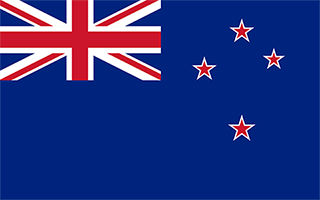
Blue with the flag of the UK in the upper hoist-side quadrant with four red five-pointed stars edged in white centered in the outer half of the flag; the stars represent the Southern Cross constellation.
The Polynesian Maori reached New Zealand in about A.D. 800. In 1840, their chieftains entered into a compact with Britain, the Treaty of Waitangi, in which they ceded sovereignty to Queen Victoria while retaining territorial rights. That same year, the British began the first organized colonial settlement. A series of land wars between 1843 and 1872 ended with the defeat of the native peoples. The British colony of New Zealand became an independent dominion in 1907 and supported the UK militarily in both world wars. New Zealand's full participation in a number of defense alliances lapsed by the 1980s. In recent years, the government has sought to address longstanding Maori grievances. New Zealand assumed a nonpermanent seat on the UN Security Council for the 2015-16 term.
Geography
| Area | ||
|---|---|---|
| Total (World Rank: 77) | 268,838 | sq km |
| Land (World Rank: 76) | 264,537 | sq km |
| Water (World Rank: 71) | 4,301 | sq km |
| Forest (World Rank: 36) | 41.10 | % |
| Comparative | almost twice the size of North Carolina; about the size of Colorado | |
| Note | includes Antipodes Islands, Auckland Islands, Bounty Islands, Campbell Island, Chatham Islands, and Kermadec Islands | |
| Coastline | ||
| 15134 | ||
| Elevation | ||
| Highest point (World Rank: 49) | 3,724 | m |
| Agricultural land | ||
| Total (World Rank: 93) | 43.20 | % |
| Arable (World Rank: 186) | 1.80 | % |
| Permanent crops (World Rank: 161) | 0.30 | % |
| Permanent pastures (World Rank: 36) | 41.10 | % |
| Irrigated land (World Rank: 51) | 7,210 | sq km |
| Map reference | ||
| Oceania | ||
| Environment | ||
| Issues |
| |
| Agreement party |
| |
| Agreement signed |
| |
| Hazzards |
| |
| Location | ||
| Oceania, islands in the South Pacific Ocean, southeast of Australia | ||
| Climate | ||
| temperate with sharp regional contrasts | ||
| Terrain | ||
| predominately mountainous with large coastal plains | ||
People
| Population | ||
|---|---|---|
| Total (World Rank: 126) | 4,510,330 | |
| Deathrate (World Rank: 107) | 0.75 | % |
| Birthrate (World Rank: 148) | 1.32 | % |
| Growthrate (World Rank: 131) | 0.79 | % |
| Migration rate (World Rank: 42) | 0.22 | % |
| Fertility rate (World Rank: 114) | 2.02 | % |
| Median age | ||
| Male (World Rank: 56) | 37.10 | |
| Female (World Rank: 61) | 38.80 | |
| Age structure | ||
| 0 14 male (World Rank: 129) | 454,982 | |
| 0 14 female (World Rank: 127) | 432,877 | |
| 15 24 male (World Rank: 128) | 309,707 | |
| 15 24 female (World Rank: 127) | 292,586 | |
| 25 54 male (World Rank: 126) | 900,374 | |
| 25 54 female (World Rank: 123) | 895,615 | |
| 55 64 male (World Rank: 99) | 261,097 | |
| 55 64 female (World Rank: 100) | 275,151 | |
| 65 x male (World Rank: 85) | 318,089 | |
| 65 x female (World Rank: 90) | 369,849 | |
| Health | ||
| Infant mortality rate (World Rank: 178) | 0.44 | % |
| Life expectancy total (World Rank: 28) | 81 | years |
| Life expectancy female (World Rank: 32) | 84 | years |
| Life expectancy male (World Rank: 23) | 79 | years |
| Physicians per 1000 (World Rank: 45) | 2.85 | |
| Hospital bed per 1000 (World Rank: 91) | 2.30 | |
| Obesity adult (World Rank: 22) | 30.80 | % |
| Drinking water access (World Rank: 10) | 100.00 | % |
Energy
| Electricity | ||
|---|---|---|
| Production (World Rank: 57) | 42,770,000,000 | kWh |
| Consumption (World Rank: 56) | 39,930,000,000 | kWh |
| Source fossil (World Rank: 191) | 24.00 | % |
| Source nuclear (World Rank: 30) | 56.50 | % |
| Source renew (World Rank: 29) | 19.70 | % |
| Crude oil | ||
| Production (World Rank: 59) | 34,730 | bbl / day |
| Exports (World Rank: 49) | 30,560 | bbl / day |
| Imports (World Rank: 43) | 109,200 | bbl / day |
| Proved reserves (World Rank: 78) | 56,900,000 | bbl |
| Refined products | ||
| Production (World Rank: 64) | 117,100 | bbl / day |
| Consumption (World Rank: 62) | 167,700 | bbl / day |
| Export (World Rank: 100) | 3,863 | bbl / day |
| Import (World Rank: 76) | 54,750 | bbl / day |
| Natural gas | ||
| Production (World Rank: 50) | 4,954,000,000 | m³ |
| Consumption (World Rank: 55) | 9,080,000,000 | m³ |
| Carbon footprint | ||
| 37000000 | ||
Nation
| Budget | ||
|---|---|---|
| Education (World Rank: 28) | 6 | % of GDP |
| Military (World Rank: 107) | 1 | % of GDP |
| Health (World Rank: 14) | 11 | % of GDP |
| Surplus (World Rank: 28) | 1 | % of GDP |
| National symbol | ||
| Southern Cross constellation | ||
| National colours | ||
| white | ||
| Adjective | ||
| New Zealand | ||
| Noun | ||
| New Zealander(s) | ||
| Background | ||
| The Polynesian Maori reached New Zealand in about A.D. 800. In 1840, their chieftains entered into a compact with Britain, the Treaty of Waitangi, in which they ceded sovereignty to Queen Victoria while retaining territorial rights. That same year, the British began the first organized colonial settlement. A series of land wars between 1843 and 1872 ended with the defeat of the native peoples. The British colony of New Zealand became an independent dominion in 1907 and supported the UK militarily in both world wars. New Zealand's full participation in a number of defense alliances lapsed by the 1980s. In recent years, the government has sought to address longstanding Maori grievances. New Zealand assumed a nonpermanent seat on the UN Security Council for the 2015-16 term. | ||
| Flag description | ||
| blue with the flag of the UK in the upper hoist-side quadrant with four red five-pointed stars edged in white centered in the outer half of the flag; the stars represent the Southern Cross constellation | ||
Economy
| Gdp | ||
|---|---|---|
| Purchasing power parity (World Rank: 69) | 176,400,000,000 | USD |
| Real growth rate (World Rank: 74) | 3.60 | % |
| Per capita purchasing power parity (World Rank: 48) | 37,200 | USD |
| Source agriculture (World Rank: 141) | 3.90 | % |
| Source industry (World Rank: 108) | 26.30 | % |
| Source service (World Rank: 68) | 69.80 | % |
| Labourforce | ||
| Total (World Rank: 113) | 2,598,000 | |
| Products | ||
| Industries |
| |
| Agriculture |
| |
| Exports |
| |
| Imports |
| |
Communication
| Phone | ||
|---|---|---|
| Landline total (World Rank: 59) | 1,820,000 | |
| Landline per 100 (World Rank: 34) | 41.00 | |
| Mobile per 100 (World Rank: 52) | 130.00 | |
| Assessment | 0 | |
| Internet | ||
| Users (World Rank: 88) | 3,958,640 | |
| Population (World Rank: 27) | 88.50 | % |
Transport
| Air | ||
|---|---|---|
| Airports paved (World Rank: 52) | 39.00 | |
| Airports unpaved (World Rank: 41) | 84.00 | |
| Rail | ||
| Total length (World Rank: 44) | 4,128 | |
| Road | ||
| Total length (World Rank: 52) | 94,902 | |
| Paved length (World Rank: 42) | 62,759 | |
| Unpaved length (World Rank: 48) | 32,143 | |
This is a list of famous places in this country in alphabetical order.
 Akaroa
- Arrowtown
- Arthur's Pass
- Ashburton
- Auckland
- Blenheim
- Brooklyn
- Bulls
- Cambridge
- Castlepoint
- Christchurch
- Clyde
- Coromandel
- Dargaville
- Dunedin
- Franz Josef
- Gisborne
- Gore
- Greymouth
- Hamilton
- Hanmer Springs
- Hastings
- Havelock
- Hawera
- Hokitika
- Invercargill
- Kaiapoi
- Kaikoura
- Katikati
- Kawakawa
- Kawerau
- Kerikeri
- Lake Tekapo
- Lincoln
- Lower Hutt
- Manapouri
- Mangere
- Manukau City
- Mapua
- Masterton
- Matamata
- Milford Sound
- Motueka
- Napier
- Nelson
- New Plymouth
- Oamaru
- Oban
- Opotiki
- Otaki
- Otorohanga
- Oxford
- Paihia
- Pakuranga
- Palmerston North
- Papakura
- Paraparaumu
- Picton
- Porirua
- Portobello
- Queenstown
- Raglan
- Rakaia
- Richmond
- Rolleston
- Rotorua
- Russell
- Taipa
- Tairua
- Takaka
- Takanini
- Taupo
- Tauranga
- Te Anau
- Thames
- Timaru
- Tinwald
- Tokoroa
- Turangi
- Upper Hutt
- Waihi
- Waihi Beach
- Waimate North
- Waiouru
- Waitakere
- Waitangi
- Waitangi
- Waitara
- Waiuku
- Wakefield
- Wanaka
- Wanganui
- Warkworth
- Wellington
- Westport
- Whakatane
- Whangamata
- Whangarei
- Whitianga
- Woodend