
Nepal
in Southern Asia
Asia
 China
China India
India- Currency and Currency Code:
- Rupee - NPR
- Spoken languages:
- Nepali, English
- Local electricity:
- 230 V - 50 Hz (plugs: C, D, M)
- Mobile phone / cellular frequencies (MHz):
- 900 MHz, 1800 MHz, 3G, 4G
- ISO 2-Letter code:
- NP
- Internet top level domain:
- .np
- Country phone prefix:
- +977
- Local Time (capital):
- Timezone:
- UTC/GMT offset: hours
Safety Score: 3,3 of 5.0 based on data from 9 authorites. Meaning please reconsider your need to travel to Nepal.
Travel warnings are updated daily. Source: Travel Warning Nepal. Last Update: 2024-04-25 08:17:04
Explore Nepal
Nepal with its capital Kathmandu is located in Asia (Southern Asia, between China and India). It covers some 147,182 square kilometers (slightly larger than New York state) with a population of 29,384,300. Nepali and English are some of the languages spoken by the majority in Nepal. Did you know that is sharing borders with China and India.
Nepal is a landlocked country in Southern Asia, between the Tibet autonomous region of China and India. It contains eight of the world's 10 highest peaks, including Mount Everest - the world's tallest - on the border with Tibet, and Lumbini, the birth place of Gautama Buddha, the founder of Buddhism. A total of 101,320 trekkers visited Nepal in 2007. Out of total 60,237 (59.4%) visited Annapurna area while those visiting the Everest and Langtang regions accounted for 26,511 (26.5%) and 8,165 (8.1%) respectively. Ethno-tourism is increasingly popular in Nepal and is designed to maximize social and economic benefits to the local communities and minimize negative impacts to cultural heritage and the environment. Ethno-tourism is a specialized type of cultural tourism and can be defined as any excursion which focuses on the works of humans rather than nature, and attempts to give the tourist an understanding of the lifestyles of local people.
Popular Destinations in Nepal
Administrative regions of Nepal
About the country
Website: Nepal Tourism
Tourist Service center
Po Box 11018
Bhrikuti Mandap
Nepal
Phone: +977 256229
Fax: +977 256910
Mail: info@ntb.wlink.com.np
The terrain is Tarai or flat river plain of the Ganges in south having central hill region with rugged Himalayas in north. The average density of population is about 200 per km². The climate in Nepal can be described as varying from cool summers and severe winters in north to subtropical summers and mild winters in south. Possible natural disasters include drought and famine depending on the timing, intensity, and duration of the summer monsoons, flooding, landslides and severe thunderstorms.
To reach someone Nepal dial +977 prior to a number. The local cellular networks are operated on 900 MHz, 1800 MHz, 3G, 4G. Websites typically end with the top level domain ".np". If you want to bring electric appliances (e.g. battery chaarger), keep in min the local 230 V - 50 Hz (plugs: C, D, M). The sign for the locally used currency Rupee is NPR.
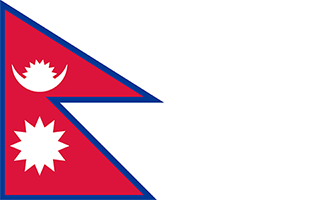
Crimson red with a blue border around the unique shape of two overlapping right triangles; the smaller, upper triangle bears a white stylized moon and the larger, lower triangle displays a white 12-pointed sun; the color red represents the rhododendron (Nepal's national flower) and is a sign of victory and bravery, the blue border signifies peace and harmony; the two right triangles are a combination of two single pennons (pennants) that originally symbolized the Himalaya Mountains while their charges represented the families of the king (upper) and the prime minister, but today they are understood to denote Hinduism and Buddhism, the country's two main religions; the moon represents the serenity of the Nepalese people and the shade and cool weather in the Himalayas, while the sun depicts the heat and higher temperatures of the lower parts of Nepal; the moon and the sun are also said to express the hope that the nation will endure as long as these heavenly bodies.
During the late 18th-early 19th centuries, the principality of Gorkha united many of the other principalities and states of the sub-Himalayan region into a Nepalese Kingdom. Nepal retained its independence following the Anglo-Nepalese War of 1814-16 and the subsequent peace treaty laid the foundations for two centuries of amicable relations between Britain and Nepal. (The Brigade of Gurkhas continues to serve in the British Army to the present day.) In 1951, the Nepali monarch ended the century-old system of rule by hereditary premiers and instituted a cabinet system that brought political parties into the government. That arrangement lasted until 1960, when political parties were again banned, but was reinstated in 1990 with the establishment of a multiparty democracy within the framework of a constitutional monarchy. An insurgency led by Maoists broke out in 1996. The ensuing 10-year civil war between Maoist and government forces witnessed the dissolution of the cabinet and parliament and the re-assumption of absolute power by the king in 2002. A peace accord in 2006 led to the promulgation of an interim constitution in 2007. Following a nationwide Constituent Assembly (CA) election in 2008, the newly formed CA declared Nepal a federal democratic republic, abolished the monarchy, and elected the country's first president. After the CA failed to draft a constitution by a May 2012 deadline set by the Supreme Court, then-Prime Minister Baburam BHATTARAI dissolved the CA. Months of negotiations ensued until March 2013 when the major political parties agreed to create an interim government headed by then-Chief Justice Khil Raj REGMI with a mandate to hold elections for a new CA. Elections were held in November 2013, in which the Nepali Congress won the largest share of seats in the CA and in February 2014 formed a coalition government with the second place Communist Party of Nepal-Unified Marxist-Leninist and with Nepali Congress President Sushil KOIRALA as prime minister. Nepal's new constitution came into effect in September 2015, at which point the CA became the Legislature Parliament. Khagda Prasad Sharma OLI served as the first post-constitution prime minister from October 2015-August 2016, when a new coalition led by Maoist leader Pushpa Kamal DAHAL (aka “Prachanda”) took over the premiership. The constitution provides for a transitional period during which three sets of elections – local, provincial, and national – must take place before 21 January 2018. The government scheduled local elections, the first in 20 years, for May 2017.
Geography
| Area | ||
|---|---|---|
| Total (World Rank: 96) | 147,181 | sq km |
| Land (World Rank: 93) | 143,351 | sq km |
| Water (World Rank: 76) | 3,830 | sq km |
| Forest (World Rank: 120) | 12.50 | % |
| Comparative | slightly larger than New York state | |
| Landborder | ||
| 3159 | ||
| Elevation | ||
| Lowest point (World Rank: 30) | 70 | m |
| Highest point (World Rank: 1) | 8,848 | m |
| Agricultural land | ||
| Total (World Rank: 141) | 28.80 | % |
| Arable (World Rank: 80) | 15.10 | % |
| Permanent crops (World Rank: 115) | 1.20 | % |
| Permanent pastures (World Rank: 120) | 12.50 | % |
| Irrigated land (World Rank: 41) | 13,320 | sq km |
| Map reference | ||
| Asia | ||
| Environment | ||
| Issues |
| |
| Agreement party |
| |
| Agreement signed | Marine Life Conservation | |
| Hazzards |
| |
| Location | ||
| Southern Asia, between China and India | ||
| Climate | ||
| varies from cool summers and severe winters in north to subtropical summers and mild winters in south | ||
| Terrain | ||
| Tarai or flat river plain of the Ganges in south; central hill region with rugged Himalayas in north | ||
People
| Population | ||
|---|---|---|
| Total (World Rank: 45) | 29,384,300 | |
| Deathrate (World Rank: 175) | 0.56 | % |
| Birthrate (World Rank: 82) | 1.95 | % |
| Growthrate (World Rank: 96) | 1.16 | % |
| Migration rate (World Rank: 131) | -0.22 | % |
| Fertility rate (World Rank: 102) | 2.12 | % |
| Median age | ||
| Male (World Rank: 167) | 22.80 | |
| Female (World Rank: 156) | 25.30 | |
| Age structure | ||
| 0 14 male (World Rank: 41) | 4,610,860 | |
| 0 14 female (World Rank: 46) | 4,264,580 | |
| 15 24 male (World Rank: 34) | 3,220,430 | |
| 15 24 female (World Rank: 33) | 3,164,290 | |
| 25 54 male (World Rank: 50) | 4,847,430 | |
| 25 54 female (World Rank: 43) | 5,900,440 | |
| 55 64 male (World Rank: 46) | 897,999 | |
| 55 64 female (World Rank: 49) | 959,405 | |
| 65 x male (World Rank: 51) | 753,771 | |
| 65 x female (World Rank: 61) | 765,089 | |
| Health | ||
| Infant mortality rate (World Rank: 67) | 2.79 | % |
| Life expectancy total (World Rank: 152) | 71 | years |
| Life expectancy female (World Rank: 160) | 72 | years |
| Life expectancy male (World Rank: 134) | 70 | years |
| Sanitation access total (World Rank: 165) | 45.80 | % |
| Obesity adult (World Rank: 187) | 4.10 | % |
| Drinking water access (World Rank: 129) | 91.60 | % |
Energy
| Electricity | ||
|---|---|---|
| Production (World Rank: 129) | 3,342,000,000 | kWh |
| Consumption (World Rank: 128) | 3,746,000,000 | kWh |
| Export (World Rank: 92) | 3,250,000 | kWh |
| Import (World Rank: 56) | 1,758,000,000 | kWh |
| Source fossil (World Rank: 202) | 6.30 | % |
| Source nuclear (World Rank: 10) | 89.80 | % |
| Source renew (World Rank: 103) | 3.60 | % |
| Crude oil | ||
| Exports (World Rank: 7) | 2,016,000 | bbl / day |
| Imports (World Rank: 6) | 2,016,000 | bbl / day |
| Refined products | ||
| Consumption (World Rank: 117) | 32,000 | bbl / day |
| Import (World Rank: 99) | 30,590 | bbl / day |
| Natural gas | ||
| Consumption (World Rank: 119) | 30 | m³ |
| Carbon footprint | ||
| 4200000 | ||
Nation
| Budget | ||
|---|---|---|
| Education (World Rank: 116) | 4 | % of GDP |
| Military (World Rank: 72) | 2 | % of GDP |
| Health (World Rank: 112) | 6 | % of GDP |
| Surplus (World Rank: 17) | 1 | % of GDP |
| National symbol | ||
| rhododendron blossom | ||
| Adjective | ||
| Nepali | ||
| Noun | ||
| Nepali (singular and plural) | ||
| Background | ||
| During the late 18th-early 19th centuries, the principality of Gorkha united many of the other principalities and states of the sub-Himalayan region into a Nepalese Kingdom. Nepal retained its independence following the Anglo-Nepalese War of 1814-16 and the subsequent peace treaty laid the foundations for two centuries of amicable relations between Britain and Nepal. (The Brigade of Gurkhas continues to serve in the British Army to the present day.) In 1951, the Nepali monarch ended the century-old system of rule by hereditary premiers and instituted a cabinet system that brought political parties into the government. That arrangement lasted until 1960, when political parties were again banned, but was reinstated in 1990 with the establishment of a multiparty democracy within the framework of a constitutional monarchy. An insurgency led by Maoists broke out in 1996. The ensuing 10-year civil war between Maoist and government forces witnessed the dissolution of the cabinet and parliament and the re-assumption of absolute power by the king in 2002. A peace accord in 2006 led to the promulgation of an interim constitution in 2007. Following a nationwide Constituent Assembly (CA) election in 2008, the newly formed CA declared Nepal a federal democratic republic, abolished the monarchy, and elected the country's first president. After the CA failed to draft a constitution by a May 2012 deadline set by the Supreme Court, then-Prime Minister Baburam BHATTARAI dissolved the CA. Months of negotiations ensued until March 2013 when the major political parties agreed to create an interim government headed by then-Chief Justice Khil Raj REGMI with a mandate to hold elections for a new CA. Elections were held in November 2013, in which the Nepali Congress won the largest share of seats in the CA and in February 2014 formed a coalition government with the second place Communist Party of Nepal-Unified Marxist-Leninist and with Nepali Congress President Sushil KOIRALA as prime minister. Nepal's new constitution came into effect in September 2015, at which point the CA became the Legislature Parliament. Khagda Prasad Sharma OLI served as the first post-constitution prime minister from October 2015-August 2016, when a new coalition led by Maoist leader Pushpa Kamal DAHAL (aka “Prachanda”) took over the premiership. The constitution provides for a transitional period during which three sets of elections – local, provincial, and national – must take place before 21 January 2018. The government scheduled local elections, the first in 20 years, for May 2017. | ||
| Flag description | ||
| crimson red with a blue border around the unique shape of two overlapping right triangles; the smaller, upper triangle bears a white stylized moon and the larger, lower triangle displays a white 12-pointed sun; the color red represents the rhododendron (Nepal's national flower) and is a sign of victory and bravery, the blue border signifies peace and harmony; the two right triangles are a combination of two single pennons (pennants) that originally symbolized the Himalaya Mountains while their charges represented the families of the king (upper) and the prime minister, but today they are understood to denote Hinduism and Buddhism, the country's two main religions; the moon represents the serenity of the Nepalese people and the shade and cool weather in the Himalayas, while the sun depicts the heat and higher temperatures of the lower parts of Nepal; the moon and the sun are also said to express the hope that the nation will endure as long as these heavenly bodies | ||
Economy
| Gdp | ||
|---|---|---|
| Purchasing power parity (World Rank: 95) | 71,820,000,000 | USD |
| Real growth rate (World Rank: 183) | 0.40 | % |
| Per capita purchasing power parity (World Rank: 194) | 2,500 | USD |
| Source agriculture (World Rank: 18) | 29.20 | % |
| Source industry (World Rank: 189) | 13.10 | % |
| Source service (World Rank: 175) | 50.00 | % |
| Labourforce | ||
| Total (World Rank: 38) | 15,600,000 | |
| In poverty (World Rank: 79) | 25.20 | % |
| Products | ||
| Industries |
| |
| Agriculture |
| |
| Exports |
| |
| Imports |
| |
Communication
| Phone | ||
|---|---|---|
| Landline total (World Rank: 81) | 858,237 | |
| Landline per 100 (World Rank: 169) | 3.00 | |
| Mobile per 100 (World Rank: 101) | 111.00 | |
| Assessment | 0 | |
| Internet | ||
| Users (World Rank: 69) | 5,716,420 | |
| Population (World Rank: 188) | 19.70 | % |
Transport
| Air | ||
|---|---|---|
| Airports paved (World Rank: 108) | 11.00 | |
| Airports unpaved (World Rank: 76) | 36.00 | |
| Rail | ||
| Total length (World Rank: 131) | 53.00 | |
| Road | ||
| Total length (World Rank: 97) | 27,990 | |
| Paved length (World Rank: 72) | 11,890 | |
| Unpaved length (World Rank: 70) | 16,100 | |
This is a list of famous places in this country in alphabetical order.
 Bagarchhap
- Baglung
- Bakhrigau
- Banepa
- Barhabise
- Baudhatinchule
- Besisahar
- Bhadrapur
- Bhaisesui
- Bhaktapur
- Bharatpur
- Bhattarai Danda
- Bhojpur
- Bhojpur
- Biratnagar
- Birendranagar
- Birganj
- Budhanilkantha
- Butwal
- Charikot
- Chhibro
- Chitre
- Chobhar
- Dada
- Dadeldhura
- Dailekh
- Daksinkali
- Darchula
- Dhangarhi
- Dhankuta
- Dharampur
- Dharan Bazar
- Dingboche
- Dipayal
- Gaur
- Gorkha
- Gulariya
- Hari Bdr Tamang House
- Hetauda
- Ilam
- Jaleswar
- Janakpur
- Jiri
- Jomsom
- Jumla
- Kalimate
- Kathmandu
- Khadwari
- Khandbari
- Kharpu
- Kirtipur
- Kothari
- Lahan
- Lakeside
- Lipin
- Lobujya
- Lukla
- Mahankai
- Mahendranagar
- Malangawa
- Manang
- Mohami
- Muktinath
- Mustang
- Nagarkot
- Namche Bazar
- Narayangarh
- Nayanbasti
- Nepalgunj
- Paga Bisnudevi
- Panauti
- Pangboche
- Pashupatinath
- Patan
- Phorcha
- Phubari
- Phulchikigau
- Pokhara
- Putlikhet
- Pyuthan
- Rajbiraj
- Rummin-dei
- Sakhu
- Salyan
- Siddharthanagar
- Simikot
- Siraha
- Sundar Basti
- Sundarijal
- Tansen
- Tehrathum
- Thonje
- Thukla
- Thyangboche
- Tikapur
- Titahari
- Tokha
- Tulsipur
- Waling
- kankrabari Dovan