Morocco
in Northern Africa
Africa
 Algeria
 Spain
Spain Western Sahara
- Currency and Currency Code:
- Dirham - MAD
- Spoken languages:
- Arabic, French
- Local electricity:
- 220 V - 50 Hz (plugs: C, E)
- Mobile phone / cellular frequencies (MHz):
- 900 MHz, 1800 MHz, 3G, 4G
- ISO 2-Letter code:
- MA
- Internet top level domain:
- .ma
- Country phone prefix:
- +212
- Local Time (capital):
- Timezone:
- UTC/GMT offset: hours
Safety Score: 3,0 of 5.0 based on data from 9 authorites. Meaning we advice caution when travelling to Morocco.
Travel warnings are updated daily. Source: Travel Warning Morocco. Last Update: 2024-04-25 08:17:04
Explore Morocco
Morocco with its capital Rabat is located in Africa (Northern Africa, bordering the North Atlantic Ocean and the Mediterranean Sea). It covers some 446,551 square kilometers (slightly more than three times the size of New York) with a population of 33,986,700. Arabic and French are the languages spoken by people in Morocco. Algeria, Spain and Western Sahara are bordering countries.
Morocco is a North African country that has a coastline on both the North Atlantic Ocean and the Mediterranean Sea. At just a few hours from the main European cities, Morocco has everything to overwhelm you with the amazing colors, smells and sounds of Islamic Africa. Imagine bustling souqs and spice markets, stunning mosques, white-washed sea side towns and medieval city centres. With panoramic views varying from snow-covered peaks in the High Atlas to the endless sand dunes of the Sahara, no-one ever has to be bored in this beautiful country.
Popular Destinations in Morocco
Administrative regions of Morocco
- Beni Mellal-Khenifra
- Casablanca-Settat
- Dakhla-Oued Ed-Dahab
- Draa-Tafilalet
- Fes-Meknes
- Guelmim-Oued Noun
- Laayoune-Sakia El Hamra
- Marrakesh-Safi
- Oriental
- Rabat-Sale-Kenitra
- Souss-Massa
- Tanger-Tetouan-Al Hoceima
About the country
Website: Morocco Tourism
The terrain is mountainous northern coast (Rif Mountains) and interior (Atlas Mountains) bordered by large plateaus with intermontane valleys, and fertile coastal plains. The average density of population is about 76 per km². The climate in Morocco can be described as Mediterranean, becoming more extreme in the interior. Possible natural disasters include flash floods, landslides, northern mountains geologically unstable and subject to earthquakes, periodic droughts and windstorms.
To reach someone Morocco dial +212 prior to a number. The local cellular networks are operated on 900 MHz, 1800 MHz, 3G, 4G. Websites typically end with the top level domain ".ma". If you want to bring electric appliances (e.g. battery chaarger), keep in min the local 220 V - 50 Hz (plugs: C, E). The sign for the locally used currency Dirham is MAD.
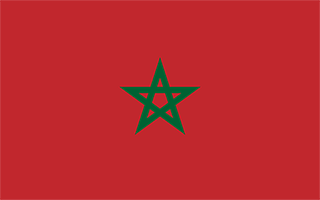
Red with a green pentacle (five-pointed, linear star) known as Sulayman's (Solomon's) seal in the center of the flag; red and green are traditional colors in Arab flags, although the use of red is more commonly associated with the Arab states of the Persian Gulf; the pentacle represents the five pillars of Islam and signifies the association between God and the nation; design dates to 1912.
In 788, about a century after the Arab conquest of North Africa, a series of Moroccan Muslim dynasties began to rule in Morocco. In the 16th century, the Sa'adi monarchy, particularly under Ahmad al-MANSUR (1578-1603), repelled foreign invaders and inaugurated a golden age. The Alaouite Dynasty, to which the current Moroccan royal family belongs, dates from the 17th century. In 1860, Spain occupied northern Morocco and ushered in a half century of trade rivalry among European powers that saw Morocco's sovereignty steadily erode; in 1912, the French imposed a protectorate over the country. A protracted independence struggle with France ended successfully in 1956. The internationalized city of Tangier and most Spanish possessions were turned over to the new country that same year. Sultan MOHAMMED V, the current monarch's grandfather, organized the new state as a constitutional monarchy and in 1957 assumed the title of king. Since Spain's 1976 withdrawal from what is today called Western Sahara, Morocco has extended its de facto administrative control to roughly 80% of this territory; however, the UN does not recognize Morocco as the administering power for Western Sahara. The UN since 1991 has monitored a cease-fire between Morocco and the Polisario Front - Western Sahara's liberation movement - and leads ongoing negotiations over the status of the territory. King MOHAMMED VI in early 2011 responded to the spread of pro-democracy protests in the region by implementing a reform program that included a new constitution, passed by popular referendum in July 2011, under which some new powers were extended to parliament and the prime minister but ultimate authority remains in the hands of the monarch. In November 2011, the Justice and Development Party (PJD) - a moderate Islamist party - won the largest number of seats in parliamentary elections, becoming the first Islamist party to lead the Moroccan Government. In September 2015, Morocco held its first ever direct elections for regional councils, one of the reforms included in the 2011 constitution. The PJD again won the largest number of seats in nationwide parliamentary elections in October 2016.
Geography
| Area | ||
|---|---|---|
| Total (World Rank: 59) | 446,550 | sq km |
| Land (World Rank: 55) | 446,300 | sq km |
| Water (World Rank: 132) | 250 | sq km |
| Forest (World Rank: 23) | 47.10 | % |
| Comparative | slightly more than three times the size of New York; slightly larger than California | |
| Coastline | ||
| 1835 | ||
| Landborder | ||
| 2362.5 | ||
| Elevation | ||
| Lowest point (World Rank: 62) | -59 | m |
| Highest point (World Rank: 41) | 4,165 | m |
| Agricultural land | ||
| Total (World Rank: 29) | 67.50 | % |
| Arable (World Rank: 65) | 17.50 | % |
| Permanent crops (World Rank: 76) | 2.90 | % |
| Permanent pastures (World Rank: 23) | 47.10 | % |
| Irrigated land (World Rank: 36) | 14,850 | sq km |
| Map reference | ||
| Africa | ||
| Environment | ||
| Issues |
| |
| Agreement party |
| |
| Agreement signed | Environmental Modification | |
| Hazzards |
| |
| Location | ||
| Northern Africa, bordering the North Atlantic Ocean and the Mediterranean Sea, between Algeria and Western Sahara | ||
| Climate | ||
| Mediterranean, becoming more extreme in the interior | ||
| Terrain | ||
| mountainous northern coast (Rif Mountains) and interior (Atlas Mountains) bordered by large plateaus with intermontane valleys, and fertile coastal plains | ||
People
| Population | ||
|---|---|---|
| Total (World Rank: 40) | 33,986,700 | |
| Deathrate (World Rank: 195) | 0.49 | % |
| Birthrate (World Rank: 103) | 1.77 | % |
| Growthrate (World Rank: 116) | 0.97 | % |
| Migration rate (World Rank: 142) | -0.32 | % |
| Fertility rate (World Rank: 103) | 2.11 | % |
| Median age | ||
| Male (World Rank: 124) | 28.60 | |
| Female (World Rank: 115) | 29.90 | |
| Age structure | ||
| 0 14 male (World Rank: 45) | 4,450,360 | |
| 0 14 female (World Rank: 44) | 4,308,960 | |
| 15 24 male (World Rank: 38) | 2,879,830 | |
| 15 24 female (World Rank: 38) | 2,910,030 | |
| 25 54 male (World Rank: 37) | 6,956,190 | |
| 25 54 female (World Rank: 35) | 7,428,130 | |
| 55 64 male (World Rank: 35) | 1,365,610 | |
| 55 64 female (World Rank: 35) | 1,398,550 | |
| 65 x male (World Rank: 38) | 1,034,190 | |
| 65 x female (World Rank: 39) | 1,254,820 | |
| Health | ||
| Infant mortality rate (World Rank: 76) | 2.19 | % |
| Life expectancy total (World Rank: 75) | 77 | years |
| Life expectancy female (World Rank: 72) | 80 | years |
| Life expectancy male (World Rank: 79) | 74 | years |
| Physicians per 1000 (World Rank: 125) | 0.62 | |
| Hospital bed per 1000 (World Rank: 152) | 0.90 | |
| Sanitation access total (World Rank: 130) | 76.70 | % |
| Obesity adult (World Rank: 44) | 26.10 | % |
| Drinking water access (World Rank: 152) | 85.40 | % |
Energy
| Electricity | ||
|---|---|---|
| Production (World Rank: 66) | 27,370,000,000 | kWh |
| Consumption (World Rank: 63) | 26,830,000,000 | kWh |
| Export (World Rank: 77) | 165,000,000 | kWh |
| Import (World Rank: 38) | 5,140,000,000 | kWh |
| Source fossil (World Rank: 110) | 67.50 | % |
| Source nuclear (World Rank: 96) | 16.20 | % |
| Source renew (World Rank: 59) | 12.50 | % |
| Crude oil | ||
| Production (World Rank: 98) | 160 | bbl / day |
| Imports (World Rank: 39) | 129,800 | bbl / day |
| Proved reserves (World Rank: 99) | 684,000 | bbl |
| Refined products | ||
| Production (World Rank: 60) | 139,400 | bbl / day |
| Consumption (World Rank: 44) | 286,000 | bbl / day |
| Export (World Rank: 65) | 24,830 | bbl / day |
| Import (World Rank: 30) | 187,400 | bbl / day |
| Natural gas | ||
| Production (World Rank: 80) | 94,000,000 | m³ |
| Consumption (World Rank: 90) | 1,480,000,000 | m³ |
| Import (World Rank: 10) | 0 | m³ |
| Carbon footprint | ||
| 39000000 | ||
Nation
| Budget | ||
|---|---|---|
| Education (World Rank: 51) | 5 | % of GDP |
| Military (World Rank: 27) | 3 | % of GDP |
| Health (World Rank: 105) | 6 | % of GDP |
| Surplus (World Rank: 141) | -5 | % of GDP |
| National symbol | ||
| pentacle symbol | ||
| National colours | ||
| red | ||
| Adjective | ||
| Moroccan | ||
| Noun | ||
| Moroccan(s) | ||
| Background | ||
| In 788, about a century after the Arab conquest of North Africa, a series of Moroccan Muslim dynasties began to rule in Morocco. In the 16th century, the Sa'adi monarchy, particularly under Ahmad al-MANSUR (1578-1603), repelled foreign invaders and inaugurated a golden age. The Alaouite Dynasty, to which the current Moroccan royal family belongs, dates from the 17th century. In 1860, Spain occupied northern Morocco and ushered in a half century of trade rivalry among European powers that saw Morocco's sovereignty steadily erode; in 1912, the French imposed a protectorate over the country. A protracted independence struggle with France ended successfully in 1956. The internationalized city of Tangier and most Spanish possessions were turned over to the new country that same year. Sultan MOHAMMED V, the current monarch's grandfather, organized the new state as a constitutional monarchy and in 1957 assumed the title of king. Since Spain's 1976 withdrawal from what is today called Western Sahara, Morocco has extended its de facto administrative control to roughly 80% of this territory; however, the UN does not recognize Morocco as the administering power for Western Sahara. The UN since 1991 has monitored a cease-fire between Morocco and the Polisario Front - Western Sahara's liberation movement - and leads ongoing negotiations over the status of the territory. King MOHAMMED VI in early 2011 responded to the spread of pro-democracy protests in the region by implementing a reform program that included a new constitution, passed by popular referendum in July 2011, under which some new powers were extended to parliament and the prime minister but ultimate authority remains in the hands of the monarch. In November 2011, the Justice and Development Party (PJD) - a moderate Islamist party - won the largest number of seats in parliamentary elections, becoming the first Islamist party to lead the Moroccan Government. In September 2015, Morocco held its first ever direct elections for regional councils, one of the reforms included in the 2011 constitution. The PJD again won the largest number of seats in nationwide parliamentary elections in October 2016. | ||
| Flag description | ||
| red with a green pentacle (five-pointed, linear star) known as Sulayman's (Solomon's) seal in the center of the flag; red and green are traditional colors in Arab flags, although the use of red is more commonly associated with the Arab states of the Persian Gulf; the pentacle represents the five pillars of Islam and signifies the association between God and the nation; design dates to 1912 | ||
Economy
| Gdp | ||
|---|---|---|
| Purchasing power parity (World Rank: 58) | 281,400,000,000 | USD |
| Real growth rate (World Rank: 166) | 1.20 | % |
| Per capita purchasing power parity (World Rank: 146) | 8,200 | USD |
| Source agriculture (World Rank: 70) | 13.60 | % |
| Source industry (World Rank: 80) | 29.50 | % |
| Source service (World Rank: 143) | 56.80 | % |
| Labourforce | ||
| Total (World Rank: 50) | 11,750,000 | |
| In poverty (World Rank: 132) | 15.00 | % |
| Products | ||
| Industries |
| |
| Agriculture |
| |
| Exports |
| |
| Imports |
| |
Communication
| Phone | ||
|---|---|---|
| Landline total (World Rank: 55) | 2,070,170 | |
| Landline per 100 (World Rank: 151) | 6.00 | |
| Mobile per 100 (World Rank: 71) | 123.00 | |
| Assessment | 0 | |
| Internet | ||
| Users (World Rank: 34) | 19,611,600 | |
| Population (World Rank: 100) | 58.30 | % |
Transport
| Air | ||
|---|---|---|
| Airports paved (World Rank: 58) | 31.00 | |
| Airports unpaved (World Rank: 94) | 24.00 | |
| Heliports (World Rank: 100) | 1.00 | |
| Rail | ||
| Total length (World Rank: 74) | 2,067 | |
| Road | ||
| Total length (World Rank: 74) | 58,395 | |
| Paved length (World Rank: 51) | 41,116 | |
| Unpaved length (World Rank: 66) | 17,279 | |
This is a list of famous places in this country in alphabetical order.
 Agadir
- Agdz
- Ahfir
- Al Fqih Ben Calah
- Al Hoceima
- Asilah
- Azemmour
- Azilal
- Azrou
- Beni Mellal
- Berkane
- Berrechid
- Bhalil
- Boujniba
- Bouznika
- Casablanca
- Chefchaouene
- El Aioun
- El Hajeb
- El Jadid
- Errachidia
- Essaouira
- Fes
- Figuig (Centre)
- Guelmim
- Gueltat Zemmour
- Guercif
- Ifrane
- Ifrane
- Imlili
- Imzouren
- Inezgane
- Jerada
- Kariat Arkmane
- Kasba Tadla
- Kenitra
- Khemisset
- Khenifra
- Khouribga
- Ksar El Kebir
- Larache
- Marrakesh
- Martil
- Mechraa Bel Ksiri
- Meknes
- Mhamid
- Midar
- Midelt
- Mnoud
- Mohammedia
- Moulay Brahim
- Moulay Yacoub
- Nador
- Ouarzazat
- Oued Laou
- Oued Zem
- Ouezzane
- Oujda-Angad
- Oulad Tayeb
- Oulad Teima
- Rabat
- Safi
- Sale
- Sefrou
- Settat
- Sidi Bennour
- Sidi Harazem
- Sidi Ifni
- Sidi Qacem
- Sidi Slimane
- Sidi Smai'il
- Sidi Yahia El Gharb
- Skhirate
- Smara
- Souq Larb'a al Gharb
- Tafraout
- Taghazout
- Tahla
- Tan-Tan
- Tangier
- Taounate
- Taourirt
- Tarfaya
- Taroudant
- Tata
- Taza
- Telouet
- Tetouan
- Tiflet
- Tinghir
- Tirhanimine
- Tiznit
- Tmourghout
- Touama
- Youssoufia
- Zagora
- Zaio
- Zawyat an Nwacer
- Zawyat ech Cheikh
- Zerkten