Malaysia
in South-Eastern Asia
Asia
 Brunei
 Indonesia
 Thailand
- Currency and Currency Code:
- Ringgit - MYR
- Spoken languages:
- Malay, English, Chinese, Tamil, Telugu, Malayalam, Panjabi, Thai
- Local electricity:
- 240 V - 50 Hz (plugs: G)
- Mobile phone / cellular frequencies (MHz):
- 900 MHz, 1800 MHz, 3G, 4G
- ISO 2-Letter code:
- MY
- Internet top level domain:
- .my
- Country phone prefix:
- +60
- Local Time (capital):
- Timezone:
- UTC/GMT offset: hours
Safety Score: 2,8 of 5.0 based on data from 9 authorites. Meaning we advice caution when travelling to Malaysia.
Travel warnings are updated daily. Source: Travel Warning Malaysia. Last Update: 2024-04-25 08:17:04
Explore Malaysia
Malaysia with its capital Kuala Lumpur is located in Asia (Southeastern Asia, peninsula bordering Thailand and northern one-third of the island of Borneo). It covers some 329,848 square kilometers (slightly larger than New Mexico) with a population of 31,382,000. Malay, English, Chinese, Tamil, Telugu, Malayalam, Panjabi and Thai are some of the languages spoken by the majority in Malaysia (consider regional differences). Brunei, Indonesia and Thailand are bordering countries.
Malaysia is a country in Southeast Asia, located partly on a peninsula of the Asian mainland and partly on the northern third of the island of Borneo. Malaysia is a mix of the modern world and a developing nation. With its investment in the high technology industries and moderate oil wealth, it has become a rich nation in Southeast Asia. Malaysia, for most visitors, presents a happy mix: there is high-tech infrastructure and things generally work well and more or less on schedule, but prices remain more reasonable than, say, Singapore.
Popular Destinations in Malaysia
Administrative regions of Malaysia
- Johor
- Kedah
- Kelantan
- Kuala Lumpur
- Labuan
- Melaka
- Negeri Sembilan
- Pahang
- Perak
- Perlis
- Pulau Pinang
- Putrajaya
- Sabah
- Sarawak
- Selangor
- Terengganu
About the country
Website: Malaysia Tourism
Sarawak Tourism Board
6th &7th Floor
Bangunan Yayasan Sarawak
Jalan Masjid
93400 Kuching
Malaysia
Phone: +60 82 423 600
Fax: +60 82 416 700
Mail: stb@sarawaktourism.com
The terrain is coastal plains rising to hills and mountains. The average density of population is about 95 per km². The climate in Malaysia can be described as tropical with annual southwest (April to October) and northeast (October to February) monsoons. Possible natural disasters include flooding, forest fires and landslides.
To reach someone Malaysia dial +60 prior to a number. The local cellular networks are operated on 900 MHz, 1800 MHz, 3G, 4G. Websites typically end with the top level domain ".my". If you want to bring electric appliances (e.g. battery chaarger), keep in min the local 240 V - 50 Hz (plugs: G). The sign for the locally used currency Ringgit is MYR.
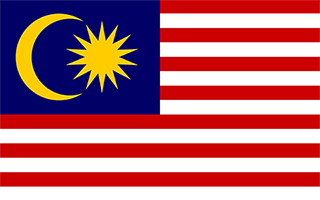
14 equal horizontal stripes of red (top) alternating with white (bottom); there is a dark blue rectangle in the upper hoist-side corner bearing a yellow crescent and a yellow 14-pointed star; the flag is often referred to as Jalur Gemilang (Stripes of Glory); the 14 stripes stand for the equal status in the federation of the 13 member states and the federal government; the 14 points on the star represent the unity between these entities; the crescent is a traditional symbol of Islam; blue symbolizes the unity of the Malay people and yellow is the royal color of Malay rulers.
During the late 18th and 19th centuries, Great Britain established colonies and protectorates in the area of current Malaysia; these were occupied by Japan from 1942 to 1945. In 1948, the British-ruled territories on the Malay Peninsula except Singapore formed the Federation of Malaya, which became independent in 1957. Malaysia was formed in 1963 when the former British colonies of Singapore, as well as Sabah and Sarawak on the northern coast of Borneo, joined the Federation. The first several years of the country's independence were marred by a communist insurgency, Indonesian confrontation with Malaysia, Philippine claims to Sabah, and Singapore's withdrawal in 1965. During the 22-year term of Prime Minister MAHATHIR bin Mohamad (1981-2003), Malaysia was successful in diversifying its economy from dependence on exports of raw materials to the development of manufacturing, services, and tourism. Prime Minister Mohamed NAJIB bin Abdul Razak (in office since April 2009) has continued these pro-business policies.
Geography
| Area | ||
|---|---|---|
| Total (World Rank: 68) | 329,847 | sq km |
| Land (World Rank: 64) | 328,657 | sq km |
| Water (World Rank: 106) | 1,190 | sq km |
| Forest (World Rank: 190) | 0.90 | % |
| Comparative | slightly larger than New Mexico | |
| Coastline | ||
| 4675 | ||
| Landborder | ||
| 2742 | ||
| Elevation | ||
| Highest point (World Rank: 42) | 4,095 | m |
| Agricultural land | ||
| Total (World Rank: 153) | 23.20 | % |
| Arable (World Rank: 169) | 2.90 | % |
| Permanent crops (World Rank: 12) | 19.40 | % |
| Permanent pastures (World Rank: 190) | 0.90 | % |
| Irrigated land (World Rank: 62) | 3,800 | sq km |
| Map reference | ||
| Southeast Asia | ||
| Environment | ||
| Issues |
| |
| Agreement party |
| |
| Hazzards |
| |
| Location | ||
| Southeastern Asia, peninsula bordering Thailand and northern one-third of the island of Borneo, bordering Indonesia, Brunei, and the South China Sea, south of Vietnam | ||
| Climate | ||
| tropical; annual southwest (April to October) and northeast (October to February) monsoons | ||
| Terrain | ||
| coastal plains rising to hills and mountains | ||
People
| Population | ||
|---|---|---|
| Total (World Rank: 41) | 31,382,000 | |
| Deathrate (World Rank: 189) | 0.51 | % |
| Birthrate (World Rank: 84) | 1.91 | % |
| Growthrate (World Rank: 81) | 1.37 | % |
| Migration rate (World Rank: 82) | -0.03 | % |
| Fertility rate (World Rank: 79) | 2.50 | % |
| Median age | ||
| Male (World Rank: 126) | 28.20 | |
| Female (World Rank: 127) | 28.80 | |
| Age structure | ||
| 0 14 male (World Rank: 44) | 4,493,080 | |
| 0 14 female (World Rank: 47) | 4,238,990 | |
| 15 24 male (World Rank: 44) | 2,677,830 | |
| 15 24 female (World Rank: 44) | 2,598,960 | |
| 25 54 male (World Rank: 40) | 6,507,500 | |
| 25 54 female (World Rank: 41) | 6,358,760 | |
| 55 64 male (World Rank: 37) | 1,316,330 | |
| 55 64 female (World Rank: 40) | 1,277,560 | |
| 65 x male (World Rank: 45) | 907,850 | |
| 65 x female (World Rank: 50) | 1,005,120 | |
| Health | ||
| Infant mortality rate (World Rank: 114) | 1.25 | % |
| Life expectancy total (World Rank: 108) | 75 | years |
| Life expectancy female (World Rank: 107) | 78 | years |
| Life expectancy male (World Rank: 111) | 72 | years |
| Physicians per 1000 (World Rank: 102) | 1.28 | |
| Hospital bed per 1000 (World Rank: 111) | 1.90 | |
| Sanitation access total (World Rank: 67) | 96.00 | % |
| Obesity adult (World Rank: 125) | 15.60 | % |
| Drinking water access (World Rank: 77) | 98.20 | % |
Energy
| Electricity | ||
|---|---|---|
| Production (World Rank: 29) | 141,900,000,000 | kWh |
| Consumption (World Rank: 28) | 133,000,000,000 | kWh |
| Export (World Rank: 93) | 3,000,000 | kWh |
| Import (World Rank: 110) | 13,000,000 | kWh |
| Source fossil (World Rank: 84) | 82.10 | % |
| Source nuclear (World Rank: 103) | 14.00 | % |
| Source renew (World Rank: 101) | 4.00 | % |
| Crude oil | ||
| Production (World Rank: 25) | 666,900 | bbl / day |
| Exports (World Rank: 25) | 310,900 | bbl / day |
| Imports (World Rank: 32) | 194,400 | bbl / day |
| Proved reserves (World Rank: 28) | 3,600,000,000 | bbl |
| Refined products | ||
| Production (World Rank: 30) | 512,900 | bbl / day |
| Consumption (World Rank: 28) | 760,000 | bbl / day |
| Export (World Rank: 31) | 231,400 | bbl / day |
| Import (World Rank: 22) | 409,500 | bbl / day |
| Natural gas | ||
| Production (World Rank: 13) | 63,430,000,000 | m³ |
| Consumption (World Rank: 28) | 40,670,000,000 | m³ |
| Export (World Rank: 9) | 34,990,000,000 | m³ |
| Import (World Rank: 4) | 0 | m³ |
| Carbon footprint | ||
| 208000000 | ||
Nation
| Budget | ||
|---|---|---|
| Education (World Rank: 70) | 5 | % of GDP |
| Military (World Rank: 83) | 1 | % of GDP |
| Health (World Rank: 162) | 4 | % of GDP |
| Surplus (World Rank: 115) | -3 | % of GDP |
| National symbol | ||
| tiger | ||
| National colours | ||
| yellow | ||
| Adjective | ||
| Malaysian | ||
| Noun | ||
| Malaysian(s) | ||
| Background | ||
| During the late 18th and 19th centuries, Great Britain established colonies and protectorates in the area of current Malaysia; these were occupied by Japan from 1942 to 1945. In 1948, the British-ruled territories on the Malay Peninsula except Singapore formed the Federation of Malaya, which became independent in 1957. Malaysia was formed in 1963 when the former British colonies of Singapore, as well as Sabah and Sarawak on the northern coast of Borneo, joined the Federation. The first several years of the country's independence were marred by a communist insurgency, Indonesian confrontation with Malaysia, Philippine claims to Sabah, and Singapore's withdrawal in 1965. During the 22-year term of Prime Minister MAHATHIR bin Mohamad (1981-2003), Malaysia was successful in diversifying its economy from dependence on exports of raw materials to the development of manufacturing, services, and tourism. Prime Minister Mohamed NAJIB bin Abdul Razak (in office since April 2009) has continued these pro-business policies. | ||
| Flag description | ||
| 14 equal horizontal stripes of red (top) alternating with white (bottom); there is a dark blue rectangle in the upper hoist-side corner bearing a yellow crescent and a yellow 14-pointed star; the flag is often referred to as Jalur Gemilang (Stripes of Glory); the 14 stripes stand for the equal status in the federation of the 13 member states and the federal government; the 14 points on the star represent the unity between these entities; the crescent is a traditional symbol of Islam; blue symbolizes the unity of the Malay people and yellow is the royal color of Malay rulers | ||
Economy
| Gdp | ||
|---|---|---|
| Purchasing power parity (World Rank: 28) | 863,300,000,000 | USD |
| Real growth rate (World Rank: 59) | 4.20 | % |
| Per capita purchasing power parity (World Rank: 67) | 27,300 | USD |
| Source agriculture (World Rank: 97) | 8.70 | % |
| Source industry (World Rank: 37) | 37.00 | % |
| Source service (World Rank: 155) | 54.40 | % |
| Labourforce | ||
| Total (World Rank: 39) | 14,700,000 | |
| In poverty (World Rank: 165) | 3.80 | % |
| Products | ||
| Industries |
| |
| Agriculture |
| |
| Exports |
| |
| Imports |
| |
Communication
| Phone | ||
|---|---|---|
| Landline total (World Rank: 32) | 4,510,200 | |
| Landline per 100 (World Rank: 115) | 15.00 | |
| Mobile per 100 (World Rank: 36) | 142.00 | |
| Assessment | 0 | |
| Internet | ||
| Users (World Rank: 29) | 24,385,000 | |
| Population (World Rank: 50) | 78.80 | % |
Transport
| Air | ||
|---|---|---|
| Airports paved (World Rank: 50) | 39.00 | |
| Airports unpaved (World Rank: 48) | 75.00 | |
| Heliports (World Rank: 39) | 4.00 | |
| Rail | ||
| Total length (World Rank: 77) | 1,851 | |
| Road | ||
| Total length (World Rank: 35) | 144,403 | |
| Paved length (World Rank: 27) | 116,169 | |
| Unpaved length (World Rank: 55) | 28,234 | |
| Water | ||
| Total length (World Rank: 20) | 7,200 | |
This is a list of famous places in this country in alphabetical order.
 Alor Gajah
- Alor Setar
- Bahau
- Bakri
- Banting
- Batu Berendam
- Batu Feringgi
- Batu Gajah
- Batu Pahat
- Beaufort
- Bidur
- Bintulu
- Bukit Mertajam
- Butterworth
- Cukai
- Donggongon
- George Town
- Gurun
- Ipoh
- Johor Bahru
- Kampong Baharu Balakong
- Kampong Dungun
- Kampung Ayer Keroh
- Kampung Baharu Nilai
- Kampung Baru Subang
- Kampung Bukit Baharu
- Kampung Pasir Gudang Baru
- Kampung Sungai Ara
- Kangar
- Kapit
- Keningau
- Kertih
- Klang
- Klebang Besar
- Kluang
- Kota Bharu
- Kota Kinabalu
- Kota Tinggi
- Kuah
- Kuala Kangsar
- Kuala Lumpur
- Kuala Perlis
- Kuala Pilah
- Kuala Selangor
- Kuala Terengganu
- Kuantan
- Kuching
- Kulai
- Kulim
- Labis
- Lahad Datu
- Limbang
- Lumut
- Malacca
- Marang
- Mentekab
- Mersing
- Miri
- Muar
- Nibong Tebal
- Paka
- Pantai Cenang
- Pasir Mas
- Pekan
- Pelabuhan Klang
- Perai
- Petaling Jaya
- Pontian Kechil
- Port Dickson
- Putatan
- Putrajaya
- Ranau
- Raub
- Rawang
- Sandakan
- Segamat
- Semenyih
- Semporna
- Sepang
- Seremban
- Shah Alam
- Sibu
- Simanggang
- Simpang Empat
- Sungai Petani
- Taiping
- Taman Senai
- Tampin
- Tanah Merah
- Tanah Rata
- Tangkak
- Tanjung Tokong
- Tasek Glugor
- Tawau
- Teluk Intan
- Temerluh
- Tumpat
- Ulu Tiram
- Victoria
- Yong Peng