Lithuania
in Northern Europe
Europe
 Belarus
 Latvia
 Poland
 Russia
- Currency and Currency Code:
- Litas - LTL
- Spoken languages:
- Lithuanian, Russian, Polish
- Local electricity:
- 230 V - 50 Hz (plugs: C, F)
- Mobile phone / cellular frequencies (MHz):
- 900 MHz, 1800 MHz, 3G, 4G
- ISO 2-Letter code:
- LT
- Internet top level domain:
- .lt
- Country phone prefix:
- +370
- Local Time (capital):
- Timezone:
- UTC/GMT offset: hours
Safety Score: 2,6 of 5.0 based on data from 9 authorites. Meaning we advice caution when travelling to Lithuania.
Travel warnings are updated daily. Source: Travel Warning Lithuania. Last Update: 2024-04-19 08:03:45
Explore Lithuania
Lithuania with its capital Vilnius is located in Europe (Eastern Europe, bordering the Baltic Sea). It covers some 65,301 square kilometers (slightly larger than West Virginia) with 2,823,860 citizens. Lithuanian, Russian and Polish are the common languages used in Lithuania (consider regional differences). Belarus, Latvia, Poland and Russia are bordering countries.
Lithuania is a Baltic country in Northern Europe. It has a Baltic Sea coastline in the west and surrounded by Latvia to the north, Belarus to the east, Poland to the southwest, and Russia (Kaliningrad) to the west. Lithuania, first formed in the middle of the 13th century, was a huge feudal country stretching from the Baltic to the Black sea in the middle ages and in 1569 entered an union with Poland to form a commonwealth. The most southern of the Baltic countries, Lithuania's historic heritage sets it quite apart from the other two. Visiting this small but colourful country today, few travelers might guess that this was once the largest nation in Europe. A few monuments remind of those golden ages, when the Grand Duchy of Lithuania stretched out far into modern day Russia, Poland and Moldova, but even fewer are still inside the Lithuanian borders.
Popular Destinations in Lithuania
Administrative regions of Lithuania
- Alytus County
- Kaunas County
- Klaipeda County
- Marijampole County
- Panevezys
- Siauliai County
- Taurage County
- Telsiu apskritis
- Utena County
- Vilniaus apskritis
About the country
Website: Lithuania Tourism
Vilniaus 4/35
2600 Vilnius
Lithuania
Phone: +370 2 62 26 10
Fax: +370 2 22 68 19
Mail: tb@tourism.lt
The topography is lowland, many scattered small lakes, fertile soil. The average density of population is about 43 per km². The climate in Lithuania can be described as transitional, between maritime and continental with wet, moderate winters and summers. Potential natural disasters are occasional floods, droughts.
To reach someone Lithuania dial +370 prior to a number. The local cellular networks are operated on 900 MHz, 1800 MHz, 3G, 4G. Websites typically end with the top level domain ".lt". If you want to bring electric appliances (e.g. battery chaarger), keep in min the local 230 V - 50 Hz (plugs: C, F). The sign for the locally used currency Litas is LTL.
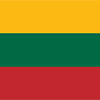
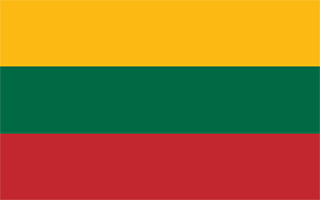
Three equal horizontal bands of yellow (top), green, and red; yellow symbolizes golden fields, as well as the sun, light, and goodness; green represents the forests of the countryside, in addition to nature, freedom, and hope; red stands for courage and the blood spilled in defense of the homeland.
Lithuanian lands were united under MINDAUGAS in 1236; over the next century, through alliances and conquest, Lithuania extended its territory to include most of present-day Belarus and Ukraine. By the end of the 14th century Lithuania was the largest state in Europe. An alliance with Poland in 1386 led the two countries into a union through the person of a common ruler. In 1569, Lithuania and Poland formally united into a single dual state, the Polish-Lithuanian Commonwealth. This entity survived until 1795 when its remnants were partitioned by surrounding countries. Lithuania regained its independence following World War I but was annexed by the USSR in 1940 - an action never recognized by the US and many other countries. On 11 March 1990, Lithuania became the first of the Soviet republics to declare its independence, but Moscow did not recognize this proclamation until September of 1991 (following the abortive coup in Moscow). The last Russian troops withdrew in 1993. Lithuania subsequently restructured its economy for integration into Western European institutions; it joined both NATO and the EU in the spring of 2004. In January 2014, Lithuania assumed a nonpermanent seat on the UN Security Council for the 2014-15 term; in January 2015, Lithuania joined the euro zone.
Geography
| Area | ||
|---|---|---|
| Total (World Rank: 124) | 65,300 | sq km |
| Land (World Rank: 122) | 62,680 | sq km |
| Water (World Rank: 83) | 2,620 | sq km |
| Forest (World Rank: 132) | 9.40 | % |
| Comparative | slightly larger than West Virginia | |
| Coastline | ||
| 90 | ||
| Landborder | ||
| 1549 | ||
| Elevation | ||
| Highest point (World Rank: 208) | 294 | m |
| Agricultural land | ||
| Total (World Rank: 82) | 44.80 | % |
| Arable (World Rank: 23) | 34.90 | % |
| Permanent crops (World Rank: 150) | 0.50 | % |
| Permanent pastures (World Rank: 132) | 9.40 | % |
| Irrigated land (World Rank: 150) | 44 | sq km |
| Map reference | ||
| Europe | ||
| Environment | ||
| Issues | contamination of soil and groundwater with petroleum products and chemicals at military bases | |
| Agreement party |
| |
| Hazzards | occasional floods, droughts | |
| Location | ||
| Eastern Europe, bordering the Baltic Sea, between Latvia and Russia, west of Belarus | ||
| Climate | ||
| transitional, between maritime and continental; wet, moderate winters and summers | ||
| Terrain | ||
| lowland, many scattered small lakes, fertile soil | ||
People
| Population | ||
|---|---|---|
| Total (World Rank: 140) | 2,823,860 | |
| Deathrate (World Rank: 2) | 1.46 | % |
| Birthrate (World Rank: 192) | 0.99 | % |
| Growthrate (World Rank: 223) | -1.08 | % |
| Migration rate (World Rank: 163) | -0.61 | % |
| Fertility rate (World Rank: 182) | 1.59 | % |
| Median age | ||
| Male (World Rank: 40) | 39.70 | |
| Female (World Rank: 4) | 47.10 | |
| Age structure | ||
| 0 14 male (World Rank: 150) | 217,438 | |
| 0 14 female (World Rank: 150) | 206,533 | |
| 15 24 male (World Rank: 150) | 161,965 | |
| 15 24 female (World Rank: 149) | 151,197 | |
| 25 54 male (World Rank: 141) | 557,504 | |
| 25 54 female (World Rank: 139) | 573,364 | |
| 55 64 male (World Rank: 123) | 177,157 | |
| 55 64 female (World Rank: 118) | 223,110 | |
| 65 x male (World Rank: 105) | 187,859 | |
| 65 x female (World Rank: 91) | 367,732 | |
| Health | ||
| Infant mortality rate (World Rank: 192) | 0.38 | % |
| Life expectancy total (World Rank: 111) | 75 | years |
| Life expectancy female (World Rank: 64) | 81 | years |
| Life expectancy male (World Rank: 146) | 70 | years |
| Physicians per 1000 (World Rank: 10) | 4.33 | |
| Hospital bed per 1000 (World Rank: 13) | 7.00 | |
| Sanitation access total (World Rank: 85) | 92.40 | % |
| Obesity adult (World Rank: 43) | 26.30 | % |
| Drinking water access (World Rank: 96) | 96.60 | % |
Energy
| Electricity | ||
|---|---|---|
| Production (World Rank: 128) | 3,433,000,000 | kWh |
| Consumption (World Rank: 93) | 9,848,000,000 | kWh |
| Export (World Rank: 60) | 730,000,000 | kWh |
| Import (World Rank: 30) | 7,938,000,000 | kWh |
| Source fossil (World Rank: 130) | 59.90 | % |
| Source nuclear (World Rank: 131) | 3.20 | % |
| Source renew (World Rank: 33) | 18.30 | % |
| Crude oil | ||
| Production (World Rank: 88) | 2,000 | bbl / day |
| Exports (World Rank: 70) | 1,238 | bbl / day |
| Imports (World Rank: 35) | 160,800 | bbl / day |
| Proved reserves (World Rank: 90) | 12,000,000 | bbl |
| Refined products | ||
| Production (World Rank: 54) | 174,800 | bbl / day |
| Consumption (World Rank: 101) | 53,000 | bbl / day |
| Export (World Rank: 35) | 145,600 | bbl / day |
| Import (World Rank: 101) | 27,520 | bbl / day |
| Natural gas | ||
| Consumption (World Rank: 76) | 2,930,000,000 | m³ |
| Import (World Rank: 18) | 0 | m³ |
| Carbon footprint | ||
| 11200000 | ||
Nation
| Budget | ||
|---|---|---|
| Education (World Rank: 84) | 5 | % of GDP |
| Military (World Rank: 74) | 1 | % of GDP |
| Health (World Rank: 89) | 7 | % of GDP |
| Surplus (World Rank: 38) | 0 | % of GDP |
| National symbol | ||
| white stork | ||
| National colours | ||
| yellow | ||
| Adjective | ||
| Lithuanian | ||
| Noun | ||
| Lithuanian(s) | ||
| Background | ||
| Lithuanian lands were united under MINDAUGAS in 1236; over the next century, through alliances and conquest, Lithuania extended its territory to include most of present-day Belarus and Ukraine. By the end of the 14th century Lithuania was the largest state in Europe. An alliance with Poland in 1386 led the two countries into a union through the person of a common ruler. In 1569, Lithuania and Poland formally united into a single dual state, the Polish-Lithuanian Commonwealth. This entity survived until 1795 when its remnants were partitioned by surrounding countries. Lithuania regained its independence following World War I but was annexed by the USSR in 1940 - an action never recognized by the US and many other countries. On 11 March 1990, Lithuania became the first of the Soviet republics to declare its independence, but Moscow did not recognize this proclamation until September of 1991 (following the abortive coup in Moscow). The last Russian troops withdrew in 1993. Lithuania subsequently restructured its economy for integration into Western European institutions; it joined both NATO and the EU in the spring of 2004. In January 2014, Lithuania assumed a nonpermanent seat on the UN Security Council for the 2014-15 term; in January 2015, Lithuania joined the euro zone. | ||
| Flag description | ||
| three equal horizontal bands of yellow (top), green, and red; yellow symbolizes golden fields, as well as the sun, light, and goodness; green represents the forests of the countryside, in addition to nature, freedom, and hope; red stands for courage and the blood spilled in defense of the homeland | ||
Economy
| Gdp | ||
|---|---|---|
| Purchasing power parity (World Rank: 87) | 86,050,000,000 | USD |
| Real growth rate (World Rank: 121) | 2.30 | % |
| Per capita purchasing power parity (World Rank: 61) | 30,000 | USD |
| Source agriculture (World Rank: 147) | 3.30 | % |
| Source industry (World Rank: 88) | 28.70 | % |
| Source service (World Rank: 77) | 68.10 | % |
| Labourforce | ||
| Total (World Rank: 131) | 1,478,000 | |
| In poverty (World Rank: 93) | 22.20 | % |
| Products | ||
| Industries |
| |
| Agriculture |
| |
| Exports |
| |
| Imports |
| |
Communication
| Phone | ||
|---|---|---|
| Landline total (World Rank: 92) | 530,871 | |
| Landline per 100 (World Rank: 93) | 19.00 | |
| Mobile per 100 (World Rank: 30) | 147.00 | |
| Assessment | 0 | |
| Internet | ||
| Users (World Rank: 110) | 2,122,880 | |
| Population (World Rank: 64) | 74.40 | % |
Transport
| Air | ||
|---|---|---|
| Airports paved (World Rank: 74) | 22.00 | |
| Airports unpaved (World Rank: 72) | 39.00 | |
| Rail | ||
| Total length (World Rank: 79) | 1,768 | |
| Road | ||
| Total length (World Rank: 59) | 84,166 | |
| Paved length (World Rank: 37) | 72,297 | |
| Unpaved length (World Rank: 74) | 11,869 | |
| Water | ||
| Total length (World Rank: 88) | 441 | |
This is a list of famous places in this country in alphabetical order.
 Akademija (Kaunas)
- Akmene
- Alytus
- Anyksciai
- Ariogala
- Aukstadvaris
- Birstonas
- Birzai
- Druskininkai
- Dukstas
- Dusetos
- Eisiskes
- Elektrenai
- Gargzdai
- Garliava
- Gelgaudiskis
- Ignalina
- Jonava
- Joniskis
- Juodkrante
- Juodupe
- Jurbarkas
- Kaisiadorys
- Kalvarija
- Karmelava
- Kaunas
- Kavarskas
- Kazlu Ruda
- Kedainiai
- Kelme
- Kernave
- Klaipeda
- Kretinga
- Kudirkos Naumiestis
- Kulautuva
- Kupiskis
- Kursenai
- Kybartai
- Lazdijai
- Lentvaris
- Marijampole
- Mazeikiai
- Moletai
- Naujoji Akmene
- Nemencine
- Nida
- Pabrade
- Pagegiai
- Pakruojis
- Palanga
- Pandelys
- Panevezys
- Pasvalys
- Plateliai
- Plunge
- Priekule
- Prienai
- Radviliskis
- Ramygala
- Raseiniai
- Rietavas
- Rokiskis
- Rudiskes
- Rusne
- Sakiai
- Salantai
- Salcininkai
- Seduva
- Senieji Trakai
- Siauliai
- Silale
- Silute
- Simnas
- Sirvintos
- Skuodas
- Smalininkai
- Svencioneliai
- Svencionys
- Sventoji
- Taurage
- Telsiai
- Trakai
- Ukmerge
- Utena
- Uzventis
- Vabalninkas
- Varena
- Varniai
- Veisiejai
- Vepriai
- Vieksniai
- Vievis
- Vilkaviskis
- Vilkija
- Vilnius
- Visaginas
- Zagare
- Zarasai
- Zemaiciu Naumiestis
- Ziezmariai