Lebanon
in Western Asia
Asia
 Israel
 Syria
Syria- Currency and Currency Code:
- Pound - LBP
- Spoken languages:
- Arabic, French, English, Armenian
- Local electricity:
- 230 V - 50 Hz (plugs: C, D, G)
- Mobile phone / cellular frequencies (MHz):
- 900 MHz, 3G, 4G
- ISO 2-Letter code:
- LB
- Internet top level domain:
- .lb
- Country phone prefix:
- +961
- Local Time (capital):
- Timezone:
- UTC/GMT offset: hours
Safety Score: 4,1 of 5.0 based on data from 9 authorites. Meaning please reconsider your need to travel to Lebanon.
Travel warnings are updated daily. Source: Travel Warning Lebanon. Last Update: 2024-04-18 08:12:24
Explore Lebanon
Lebanon with its capital Beirut is located in Asia (Middle East, bordering the Mediterranean Sea). It covers some 10,401 square kilometers (about one-third the size of Maryland) with a population of 6,229,790. Arabic, French, English and Armenian are the languages spoken by people in Lebanon (consider regional differences). Did you know that is sharing borders with Israel and Syria.
Lebanon is a small country (10,452 sq km or 4076 sq mi in area with 3.7 million inhabitants) within the Middle East region with its capital being Beirut. The Lebanese people have had to adapt to the political turmoil. Lebanon is easily the party capital of the Middle East. Beirut features many different and distinct nightlife neighborhoods, such as Gemmayze district, mostly full of bars and restaurants, or the Monot Street which features nightclubs and bars. Lebanon is also known for it's open-air nightclubs such as Sky Bar, White, and Isis. Greater Beirut is a sleepless city, as the great majority of it open 24 hours a day.
Popular Destinations in Lebanon
Administrative regions of Lebanon
- Beyrouth
- Mohafazat Aakkar
- Mohafazat Baalbek-Hermel
- Mohafazat Beqaa
- Mohafazat Liban-Nord
- Mohafazat Liban-Sud
- Mohafazat Mont-Liban
- Mohafazat Nabatiye
About the country
Website: Lebanon Tourism
The terrain is narrow coastal plain having El Beqaa (Bekaa Valley) separates Lebanon and Anti-Lebanon Mountains. The average density of population is about 599 per km². The climate in Lebanon can be described as Mediterraneanmild to cool, wet winters with hot, dry summers, the Lebanon Mountains experience heavy winter snows. Possible natural disasters include dust storms, sandstorms earthquakes
To reach someone Lebanon dial +961 prior to a number. The local cellular networks are operated on 900 MHz, 3G, 4G. Websites typically end with the top level domain ".lb". If you want to bring electric appliances (e.g. battery chaarger), keep in min the local 230 V - 50 Hz (plugs: C, D, G). The sign for the locally used currency Pound is LBP.
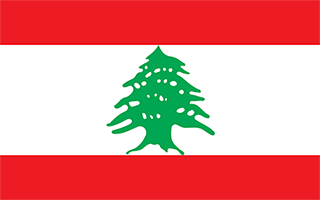
Three horizontal bands consisting of red (top), white (middle, double width), and red (bottom) with a green cedar tree centered in the white band; the red bands symbolize blood shed for liberation, the white band denotes peace, the snow of the mountains, and purity; the green cedar tree is the symbol of Lebanon and represents eternity, steadiness, happiness, and prosperity.
Following World War I, France acquired a mandate over the northern portion of the former Ottoman Empire province of Syria. The French demarcated the region of Lebanon in 1920 and granted this area independence in 1943. Since independence the country has been marked by periods of political turmoil interspersed with prosperity built on its position as a regional center for finance and trade. The country's 1975-90 civil war that resulted in an estimated 120,000 fatalities, was followed by years of social and political instability. Sectarianism is a key element of Lebanese political life. Neighboring Syria has historically influenced Lebanon's foreign policy and internal policies, and its military occupied Lebanon from 1976 until 2005. The Lebanon-based Hizballah militia and Israel continued attacks and counterattacks against each other after Syria's withdrawal, and fought a brief war in 2006. Lebanon's borders with Syria and Israel remain unresolved.
Geography
| Area | ||
|---|---|---|
| Total (World Rank: 169) | 10,400 | sq km |
| Land (World Rank: 165) | 10,230 | sq km |
| Water (World Rank: 136) | 170 | sq km |
| Forest (World Rank: 39) | 39.10 | % |
| Comparative | about one-third the size of Maryland | |
| Coastline | ||
| 225 | ||
| Landborder | ||
| 484 | ||
| Elevation | ||
| Highest point (World Rank: 63) | 3,088 | m |
| Agricultural land | ||
| Total (World Rank: 38) | 63.30 | % |
| Arable (World Rank: 95) | 11.90 | % |
| Permanent crops (World Rank: 20) | 12.30 | % |
| Permanent pastures (World Rank: 39) | 39.10 | % |
| Irrigated land (World Rank: 90) | 1,040 | sq km |
| Map reference | ||
| Middle East | ||
| Environment | ||
| Issues |
| |
| Agreement party |
| |
| Agreement signed |
| |
| Hazzards |
| |
| Location | ||
| Middle East, bordering the Mediterranean Sea, between Israel and Syria | ||
| Climate | ||
| Mediterranean; mild to cool, wet winters with hot, dry summers; the Lebanon Mountains experience heavy winter snows | ||
| Terrain | ||
| narrow coastal plain; El Beqaa (Bekaa Valley) separates Lebanon and Anti-Lebanon Mountains | ||
People
| Population | ||
|---|---|---|
| Total (World Rank: 107) | 6,229,790 | |
| Deathrate (World Rank: 191) | 0.50 | % |
| Birthrate (World Rank: 134) | 1.43 | % |
| Growthrate (World Rank: 224) | -1.10 | % |
| Migration rate (World Rank: 184) | -2.03 | % |
| Fertility rate (World Rank: 166) | 1.72 | % |
| Median age | ||
| Male (World Rank: 110) | 29.90 | |
| Female (World Rank: 108) | 31.10 | |
| Age structure | ||
| 0 14 male (World Rank: 108) | 768,282 | |
| 0 14 female (World Rank: 107) | 732,773 | |
| 15 24 male (World Rank: 106) | 523,380 | |
| 15 24 female (World Rank: 105) | 499,582 | |
| 25 54 male (World Rank: 105) | 1,412,110 | |
| 25 54 female (World Rank: 105) | 1,378,460 | |
| 55 64 male (World Rank: 105) | 232,198 | |
| 55 64 female (World Rank: 105) | 260,685 | |
| 65 x male (World Rank: 106) | 183,995 | |
| 65 x female (World Rank: 109) | 238,321 | |
| Health | ||
| Infant mortality rate (World Rank: 157) | 0.74 | % |
| Life expectancy total (World Rank: 65) | 78 | years |
| Life expectancy female (World Rank: 90) | 79 | years |
| Life expectancy male (World Rank: 52) | 77 | years |
| Physicians per 1000 (World Rank: 64) | 2.38 | |
| Hospital bed per 1000 (World Rank: 61) | 3.50 | |
| Sanitation access total (World Rank: 123) | 80.70 | % |
| Obesity adult (World Rank: 19) | 32.00 | % |
| Drinking water access (World Rank: 68) | 99.00 | % |
Energy
| Electricity | ||
|---|---|---|
| Production (World Rank: 80) | 17,320,000,000 | kWh |
| Consumption (World Rank: 76) | 15,660,000,000 | kWh |
| Import (World Rank: 87) | 268,000,000 | kWh |
| Source fossil (World Rank: 71) | 87.20 | % |
| Source nuclear (World Rank: 110) | 12.20 | % |
| Source renew (World Rank: 137) | 0.90 | % |
| Refined products | ||
| Consumption (World Rank: 69) | 143,000 | bbl / day |
| Import (World Rank: 44) | 148,800 | bbl / day |
| Natural gas | ||
| Consumption (World Rank: 111) | 150,100,000 | m³ |
| Import (World Rank: 15) | 0 | m³ |
| Carbon footprint | ||
| 16000000 | ||
Nation
| Budget | ||
|---|---|---|
| Education (World Rank: 151) | 3 | % of GDP |
| Military (World Rank: 10) | 5 | % of GDP |
| Health (World Rank: 94) | 6 | % of GDP |
| Surplus (World Rank: 189) | -10 | % of GDP |
| National symbol | ||
| cedar tree | ||
| National colours | ||
| white | ||
| Adjective | ||
| Lebanese | ||
| Noun | ||
| Lebanese (singular and plural) | ||
| Background | ||
| Following World War I, France acquired a mandate over the northern portion of the former Ottoman Empire province of Syria. The French demarcated the region of Lebanon in 1920 and granted this area independence in 1943. Since independence the country has been marked by periods of political turmoil interspersed with prosperity built on its position as a regional center for finance and trade. The country's 1975-90 civil war that resulted in an estimated 120,000 fatalities, was followed by years of social and political instability. Sectarianism is a key element of Lebanese political life. Neighboring Syria has historically influenced Lebanon's foreign policy and internal policies, and its military occupied Lebanon from 1976 until 2005. The Lebanon-based Hizballah militia and Israel continued attacks and counterattacks against each other after Syria's withdrawal, and fought a brief war in 2006. Lebanon's borders with Syria and Israel remain unresolved. | ||
| Flag description | ||
| three horizontal bands consisting of red (top), white (middle, double width), and red (bottom) with a green cedar tree centered in the white band; the red bands symbolize blood shed for liberation, the white band denotes peace, the snow of the mountains, and purity; the green cedar tree is the symbol of Lebanon and represents eternity, steadiness, happiness, and prosperity | ||
Economy
| Gdp | ||
|---|---|---|
| Purchasing power parity (World Rank: 89) | 85,110,000,000 | USD |
| Real growth rate (World Rank: 176) | 1.00 | % |
| Per capita purchasing power parity (World Rank: 88) | 19,100 | USD |
| Source agriculture (World Rank: 121) | 5.70 | % |
| Source industry (World Rank: 144) | 21.00 | % |
| Source service (World Rank: 53) | 73.30 | % |
| Labourforce | ||
| Total (World Rank: 122) | 2,166,000 | |
| In poverty (World Rank: 71) | 28.60 | % |
| Products | ||
| Industries |
| |
| Agriculture |
| |
| Exports |
| |
| Imports |
| |
Communication
| Phone | ||
|---|---|---|
| Landline total (World Rank: 75) | 1,068,000 | |
| Landline per 100 (World Rank: 104) | 17.00 | |
| Mobile per 100 (World Rank: 167) | 78.00 | |
| Assessment | 0 | |
| Internet | ||
| Users (World Rank: 79) | 4,747,540 | |
| Population (World Rank: 60) | 76.10 | % |
Transport
| Air | ||
|---|---|---|
| Airports paved (World Rank: 147) | 5.00 | |
| Airports unpaved (World Rank: 159) | 3.00 | |
| Heliports (World Rank: 89) | 1.00 | |
| Rail | ||
| Total length (World Rank: 120) | 401 | |
| Road | ||
| Total length (World Rank: 147) | 6,970 | |
This is a list of famous places in this country in alphabetical order.
 Aabadiye
- Aaintoura
- Aaintourine
- Aajaltoun
- Aaley
- Aanjar
- Aassoun
- Ain Ebel
- Aintoura
- Al Hadath
- Amioun
- Baabda
- Baalbek
- Baalchmay
- Bainnaya
- Baissour
- Batroun
- Bcharre
- Beirut
- Beit Chabab
- Beit ed Dine
- Beit el Boumi
- Bent Jbail
- Beskinta
- Bhamdoun
- Bhamdoun
- Bikfaiya
- Blaouza
- Boqaata
- Borj Hammoud
- Borj el Branje
- Bqaa Safrine
- Bqorqacha
- Broummana
- Bteghrine
- Cheikhlar
- Chiyah
- Daraaoun
- Dbaiye
- Deir el Qamar
- Douma
- Ech Chmis
- Ed Damour
- Ed Daoura
- Ed Dimane
- Ehden
- El Aaqoura
- El Baouchriye
- El Bass
- El Forn
- El Ghabe
- El Hdaini
- El Hermel
- El Khenchara
- El Miyasse
- El Mogheiri
- El Ouadi
- En Naqoura
- Enfe
- Er Rouais
- Ez Zalqa
- Ghazir
- Habbouch
- Hadet ej Jobbe
- Hai Saidet Martine
- Hai el Lailaki
- Halba
- Hardine
- Haret Hreik
- Haret Sakhr
- Harissa
- Hasbaiya
- Ijd Aabrine
- Jall Al Dieb
- Jbail
- Jdaidet ech Chouf
- Jdaidet el Matn
- Jezzine
- Joubb Jannine
- Jounieh
- Kaifoun
- Marjayoun
- Mazraat Kassab
- Mazraat es Siyad
- Mont Michel
- Nabatieh
- Nabatiye et Tahta
- Ouata Houb
- Qana
- Qartaba
- Rachaiya el Ouadi
- Sahel Aalma
- Saqiet Zaidane
- Sidon
- Sir ed Danniye
- Thoum
- Tripoli
- Tyre
- Zahle
- Zgharta