Kenya
in Eastern Africa
Africa
 Ethiopia
 Somalia
 South Sudan
 Tanzania
 Uganda
- Currency and Currency Code:
- Shilling - KES
- Spoken languages:
- English, Swahili
- Local electricity:
- 240 V - 50 Hz (plugs: G)
- Mobile phone / cellular frequencies (MHz):
- 900 MHz, 1800 MHz, 3G, 4G
- ISO 2-Letter code:
- KE
- Internet top level domain:
- .ke
- Country phone prefix:
- +254
- Local Time (capital):
- Timezone:
- UTC/GMT offset: hours
Safety Score: 3,1 of 5.0 based on data from 9 authorites. Meaning please reconsider your need to travel to Kenya.
Travel warnings are updated daily. Source: Travel Warning Kenya. Last Update: 2024-04-18 08:12:24
Explore Kenya
Kenya with its capital Nairobi is located in Africa (Eastern Africa, bordering the Indian Ocean). It covers some 580,368 square kilometers (five times the size of Ohio) with a population of 47,615,700. English and Swahili are the languages spoken by people in Kenya. Ethiopia, Somalia, South Sudan, Tanzania and Uganda are bordering countries.
Kenya is a country in Eastern Africa. Its Indian Ocean coast lies between Somalia to the north east and Tanzania to the south. Watch a wildlife migration.Go for a game drive in many parks and reserves found in the country. If you are on a tight schedule take a game drive in the Nairobi National Park found less than 20 minutes drive from the Cental Business District. Major attractions, big cats including lions and leopards, buffallos, a variety of antelop species, baboons, monkeys amongs others.
Popular Destinations in Kenya
Administrative regions of Kenya
- Baringo District
- Bomet District
- Bungoma District
- Busia District
- Embu District
- Garissa District
- Homa Bay District
- Isiolo District
- Kajiado District
- Kakamega District
- Kericho District
- Kiambu District
- Kilifi District
- Kirinyaga District
- Kisii District
- Kisumu
- Kitui District
- Kwale District
- Laikipia District
- Lamu
- Machakos District
- Makueni District
- Mandera District
- Marakwet District
- Marsabit District
- Meru
- Migori District
- Mombasa District
- Murang'a District
- Nairobi Province
- Nakuru District
- Nandi South District
- Narok District
- Nyamira District
- Nyandarua District
- Nyeri District
- Samburu District
- Siaya District
- Taita Taveta District
- Tana River District
- Tharaka District
- Trans Nzoia District
- Turkana District
- Uasin Gishu
- Vihiga District
- Wajir District
- West Pokot District
About the country
Website: Kenya Tourism
Kenya tourist Board
Kenya Re Towers, Ragati Road, Upper Hill
P.O. Box 30630 Nairobi
Kenya
Phone: +254 2 724042
Fax: +254 2 724169
Mail: info@kenyatourism.org
The topography is low plains rise to central highlands bisected by Great Rift Valley with fertile plateau in west. The average density of population is about 82 per km². The climate in Kenya can be described as varying from tropical along coast to arid in interior. Potential natural disasters are flooding during rainy seasons, limited volcanic activity; the Barrier (1,032 m) last erupted in 1921; South Island is the only other historically active volcano and recurring drought.
To reach someone Kenya dial +254 prior to a number. The local cellular networks are operated on 900 MHz, 1800 MHz, 3G, 4G. Websites typically end with the top level domain ".ke". If you want to bring electric appliances (e.g. battery chaarger), keep in min the local 240 V - 50 Hz (plugs: G). The sign for the locally used currency Shilling is KES.
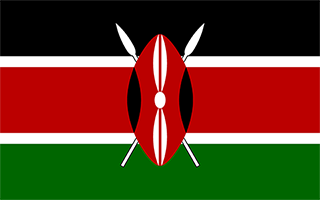
Three equal horizontal bands of black (top), red, and green; the red band is edged in white; a large Maasai warrior's shield covering crossed spears is superimposed at the center; black symbolizes the majority population, red the blood shed in the struggle for freedom, green stands for natural wealth, and white for peace; the shield and crossed spears symbolize the defense of freedom.
Founding president and liberation struggle icon Jomo KENYATTA led Kenya from independence in 1963 until his death in 1978, when Vice President Daniel MOI took power in a constitutional succession. The country was a de facto one-party state from 1969 until 1982 when the ruling Kenya African National Union (KANU) made itself the sole legal party in Kenya. MOI acceded to internal and external pressure for political liberalization in late 1991. The ethnically fractured opposition failed to dislodge KANU from power in elections in 1992 and 1997, which were marred by violence and fraud, but were viewed as having generally reflected the will of the Kenyan people. President MOI stepped down in December 2002 following fair and peaceful elections. Mwai KIBAKI, running as the candidate of the multiethnic, united opposition group, the National Rainbow Coalition (NARC), defeated KANU candidate Uhuru KENYATTA, the son of founding president Jomo KENYATTA, and assumed the presidency following a campaign centered on an anticorruption platform. KIBAKI's reelection in December 2007 brought charges of vote rigging from Orange Democratic Movement (ODM) candidate Raila ODINGA and unleashed two months of violence in which as many as 1,500 people died. African Union-sponsored mediation led by former UN Secretary General Kofi ANNAN in late February 2008 resulted in a power-sharing accord bringing ODINGA into the government in the restored position of prime minister. The power sharing accord included a broad reform agenda, the centerpiece of which was constitutional reform. In August 2010, Kenyans overwhelmingly adopted a new constitution in a national referendum. The new constitution introduced additional checks and balances to executive power and significant devolution of power and resources to 47 newly created counties. It also eliminated the position of prime minister following the first presidential election under the new constitution, which occurred in March 2013. Uhuru KENYATTA won the election and was sworn into office in April 2013.
Geography
| Area | ||
|---|---|---|
| Total (World Rank: 49) | 580,367 | sq km |
| Land (World Rank: 46) | 569,140 | sq km |
| Water (World Rank: 43) | 11,227 | sq km |
| Forest (World Rank: 42) | 37.40 | % |
| Comparative | five times the size of Ohio; slightly more than twice the size of Nevada | |
| Coastline | ||
| 536 | ||
| Landborder | ||
| 3457 | ||
| Elevation | ||
| Highest point (World Rank: 23) | 5,199 | m |
| Agricultural land | ||
| Total (World Rank: 72) | 48.10 | % |
| Arable (World Rank: 115) | 9.80 | % |
| Permanent crops (World Rank: 125) | 0.90 | % |
| Permanent pastures (World Rank: 42) | 37.40 | % |
| Irrigated land (World Rank: 91) | 1,030 | sq km |
| Map reference | ||
| Africa | ||
| Environment | ||
| Issues |
| |
| Agreement party |
| |
| Hazzards |
| |
| Location | ||
| Eastern Africa, bordering the Indian Ocean, between Somalia and Tanzania | ||
| Climate | ||
| varies from tropical along coast to arid in interior | ||
| Terrain | ||
| low plains rise to central highlands bisected by Great Rift Valley; fertile plateau in west | ||
People
| Population | ||
|---|---|---|
| Total (World Rank: 30) | 47,615,700 | |
| Deathrate (World Rank: 139) | 0.67 | % |
| Birthrate (World Rank: 58) | 2.39 | % |
| Growthrate (World Rank: 63) | 1.69 | % |
| Migration rate (World Rank: 77) | -0.02 | % |
| Fertility rate (World Rank: 55) | 2.98 | % |
| Median age | ||
| Male (World Rank: 188) | 19.60 | |
| Female (World Rank: 195) | 19.90 | |
| Age structure | ||
| 0 14 male (World Rank: 19) | 9,557,270 | |
| 0 14 female (World Rank: 20) | 9,497,870 | |
| 15 24 male (World Rank: 23) | 4,552,450 | |
| 15 24 female (World Rank: 23) | 4,567,890 | |
| 25 54 male (World Rank: 33) | 8,170,260 | |
| 25 54 female (World Rank: 34) | 7,976,750 | |
| 55 64 male (World Rank: 47) | 856,092 | |
| 55 64 female (World Rank: 48) | 1,009,080 | |
| 65 x male (World Rank: 58) | 614,751 | |
| 65 x female (World Rank: 59) | 813,320 | |
| Health | ||
| Infant mortality rate (World Rank: 49) | 3.71 | % |
| Life expectancy total (World Rank: 183) | 64 | years |
| Life expectancy female (World Rank: 187) | 66 | years |
| Life expectancy male (World Rank: 176) | 63 | years |
| Physicians per 1000 (World Rank: 147) | 0.20 | |
| Hospital bed per 1000 (World Rank: 130) | 1.40 | |
| Sanitation access total (World Rank: 180) | 30.10 | % |
| Obesity adult (World Rank: 161) | 7.10 | % |
| Drinking water access (World Rank: 184) | 63.20 | % |
Energy
| Electricity | ||
|---|---|---|
| Production (World Rank: 103) | 9,548,000,000 | kWh |
| Consumption (World Rank: 104) | 7,666,000,000 | kWh |
| Export (World Rank: 88) | 45,000,000 | kWh |
| Import (World Rank: 100) | 67,000,000 | kWh |
| Source fossil (World Rank: 182) | 31.90 | % |
| Source nuclear (World Rank: 55) | 35.60 | % |
| Source renew (World Rank: 2) | 53.60 | % |
| Crude oil | ||
| Imports (World Rank: 72) | 11,870 | bbl / day |
| Refined products | ||
| Production (World Rank: 96) | 14,320 | bbl / day |
| Consumption (World Rank: 82) | 93,000 | bbl / day |
| Export (World Rank: 112) | 345 | bbl / day |
| Import (World Rank: 65) | 76,090 | bbl / day |
| Natural gas | ||
| Consumption (World Rank: 153) | 11 | m³ |
| Carbon footprint | ||
| 13000000 | ||
Nation
| Budget | ||
|---|---|---|
| Education (World Rank: 55) | 5 | % of GDP |
| Military (World Rank: 89) | 1 | % of GDP |
| Health (World Rank: 116) | 6 | % of GDP |
| Surplus (World Rank: 178) | -7 | % of GDP |
| National symbol | ||
| lion | ||
| National colours | ||
| white | ||
| Adjective | ||
| Kenyan | ||
| Noun | ||
| Kenyan(s) | ||
| Background | ||
| Founding president and liberation struggle icon Jomo KENYATTA led Kenya from independence in 1963 until his death in 1978, when Vice President Daniel MOI took power in a constitutional succession. The country was a de facto one-party state from 1969 until 1982 when the ruling Kenya African National Union (KANU) made itself the sole legal party in Kenya. MOI acceded to internal and external pressure for political liberalization in late 1991. The ethnically fractured opposition failed to dislodge KANU from power in elections in 1992 and 1997, which were marred by violence and fraud, but were viewed as having generally reflected the will of the Kenyan people. President MOI stepped down in December 2002 following fair and peaceful elections. Mwai KIBAKI, running as the candidate of the multiethnic, united opposition group, the National Rainbow Coalition (NARC), defeated KANU candidate Uhuru KENYATTA, the son of founding president Jomo KENYATTA, and assumed the presidency following a campaign centered on an anticorruption platform. KIBAKI's reelection in December 2007 brought charges of vote rigging from Orange Democratic Movement (ODM) candidate Raila ODINGA and unleashed two months of violence in which as many as 1,500 people died. African Union-sponsored mediation led by former UN Secretary General Kofi ANNAN in late February 2008 resulted in a power-sharing accord bringing ODINGA into the government in the restored position of prime minister. The power sharing accord included a broad reform agenda, the centerpiece of which was constitutional reform. In August 2010, Kenyans overwhelmingly adopted a new constitution in a national referendum. The new constitution introduced additional checks and balances to executive power and significant devolution of power and resources to 47 newly created counties. It also eliminated the position of prime minister following the first presidential election under the new constitution, which occurred in March 2013. Uhuru KENYATTA won the election and was sworn into office in April 2013. | ||
| Flag description | ||
| three equal horizontal bands of black (top), red, and green; the red band is edged in white; a large Maasai warrior's shield covering crossed spears is superimposed at the center; black symbolizes the majority population, red the blood shed in the struggle for freedom, green stands for natural wealth, and white for peace; the shield and crossed spears symbolize the defense of freedom | ||
Economy
| Gdp | ||
|---|---|---|
| Purchasing power parity (World Rank: 74) | 152,900,000,000 | USD |
| Real growth rate (World Rank: 31) | 5.80 | % |
| Per capita purchasing power parity (World Rank: 185) | 3,400 | USD |
| Source agriculture (World Rank: 14) | 35.60 | % |
| Source industry (World Rank: 168) | 17.20 | % |
| Source service (World Rank: 185) | 47.30 | % |
| Labourforce | ||
| Total (World Rank: 32) | 19,140,000 | |
| In poverty (World Rank: 34) | 43.40 | % |
| Products | ||
| Industries |
| |
| Agriculture |
| |
| Exports |
| |
| Imports |
| |
Communication
| Phone | ||
|---|---|---|
| Landline total (World Rank: 148) | 72,801 | |
| Landline per 100 (World Rank: 195) | 1.00 | |
| Mobile per 100 (World Rank: 159) | 83.00 | |
| Assessment | 0 | |
| Internet | ||
| Users (World Rank: 44) | 12,165,600 | |
| Population (World Rank: 165) | 26.00 | % |
Transport
| Air | ||
|---|---|---|
| Airports paved (World Rank: 91) | 16.00 | |
| Airports unpaved (World Rank: 19) | 181.00 | |
| Rail | ||
| Total length (World Rank: 50) | 3,806 | |
| Road | ||
| Total length (World Rank: 32) | 161,452 | |
| Paved length (World Rank: 68) | 14,420 | |
| Unpaved length (World Rank: 17) | 147,032 | |
This is a list of famous places in this country in alphabetical order.
 Ahero
Ahero- Athi River
- Baringo
- Bomet
- Bondo
- Bungoma
- Busia
- Butere
- Chuka
- Eldama Ravine
- Eldoret
- Embu
- Garissa
- Gazi
- Hola
- Homa Bay
- Isiolo
- Kabarnet
- Kajiado
- Kakamega
- Kangema
- Kangundo
- Kapenguria
- Kapsabet
- Kapsowar
- Karuri
- Kericho
- Keroka
- Keruguya
- Kiambu
- Kihancha
- Kijabe
- Kikuyu
- Kilifi
- Kipkelion
- Kisii
- Kisumu
- Kitale
- Kitui
- Kwale
- Lamu
- Limuru
- Litein
- Lodwar
- Londiani
- Luanda
- Lugulu
- Machakos
- Magadi
- Makueni
- Malaba
- Malikisi
- Malindi
- Mandera
- Maralal
- Mariakani
- Marsabit
- Maua
- Mbale
- Meru
- Migori
- Molo
- Mombasa
- Moyale
- Mtito Andei
- Muhoroni
- Mumias
- Murang'a
- Nairobi
- Naivasha
- Nakuru
- Namanga
- Nanyuki
- Naro Moru
- Narok
- Ngong
- Nyahururu
- Nyamira
- Nyeri
- Ogembo
- Ol Kalou
- Othaya
- Oyugis
- Port Bunyala
- Rongai
- Sagana
- Sawa Sawa
- Shimoni
- Siaya
- Sotik
- Takaungu
- Taveta
- Thika
- Voi
- Wajir
- Webuye
- Witu
- Wote
- Wundanyi
- Yala