Japan
in Eastern Asia
Asia
- Currency and Currency Code:
- Yen - JPY
- Spoken languages:
- Japanese
- Local electricity:
- 100 V - 50 Hz / 60 Hz (plugs: A, B)
- Mobile phone / cellular frequencies (MHz):
- 3G, 4G
- ISO 2-Letter code:
- JP
- Internet top level domain:
- .jp
- Country phone prefix:
- +81
- Local Time (capital):
- Timezone:
- UTC/GMT offset: hours
Safety Score: 2,8 of 5.0 based on data from 9 authorites. Meaning we advice caution when travelling to Japan.
Travel warnings are updated daily. Source: Travel Warning Japan. Last Update: 2024-04-23 08:18:23
Explore Japan
Japan with its capital Tokyo is located in Asia (Eastern Asia, island chain between the North Pacific Ocean and the Sea of Japan). It covers some 377,916 square kilometers (slightly smaller than California) with 126,451,000 citizens. Japanese is the official language used in Japan. Thiscountry has no land-based border with any other country.
Japan known as Nihon or Nippon in Japanese, is an island nation in East Asia.The Land of the Rising Sun is a country where the past meets the future. Japanese culture stretches back millennia, yet has also adopted (and created) the latest modern fashions and trends. Cities are as modern and high tech as anywhere else, but tumbledown wooden shacks can still be spotted next to glass fronted designer condominiums. On an average subway ride, you might see childishly cute character toys and incredibly violent pornography - sometimes enjoyed by the same passenger, at the same time!
Popular Destinations in Japan
Administrative regions of Japan
- Aichi-ken
- Akita
- Aomori
- Chiba
- Ehime
- Fukui
- Fukuoka
- Fukushima-ken
- Gifu
- Gunma
- Hiroshima
- Hokkaido
- Hyogo
- Ibaraki
- Ishikawa-ken
- Iwate
- Kagawa-ken
- Kagoshima-ken
- Kanagawa
- Kochi
- Kumamoto
- Kyoto
- Mie-ken
- Miyagi
- Miyazaki
- Nagano
- Nagasaki
- Nara-ken
- Niigata
- Oita Prefecture
- Okayama-ken
- Okinawa
- Osaka
- Saga-ken
- Saitama
- Shiga
- Shimane
- Shizuoka
- Tochigi
- Tokushima
- Tokyo
- Tottori
- Toyama
- Wakayama
- Yamagata
- Yamaguchi
- Yamanashi
About the country
Website: Japan Tourism
The topography is mostly rugged and mountainous. The average density of population is about 335 per km². The climate in Japan can be described as varying from tropical in south to cool temperate in north. Potential natural disasters are about 1,500 seismic occurrences (mostly tremors but occasional severe earthquakes) every year, both Unzen (1,500 m) and Sakura-jima (1,117 m), which lies near the densely populated city of Kagoshima, have been deemed Decade Volcanoes by the International Association of Volcanology and Chemistry of the Earth's Interior, worthy of study due to their , many dormant and some active volcanoes, tsunamis and typhoons.
To reach someone Japan dial +81 prior to a number. The local cellular networks are operated on 3G, 4G. Websites typically end with the top level domain ".jp". If you want to bring electric appliances (e.g. battery chaarger), keep in min the local 100 V - 50 Hz / 60 Hz (plugs: A, B). The sign for the locally used currency Yen is JPY.
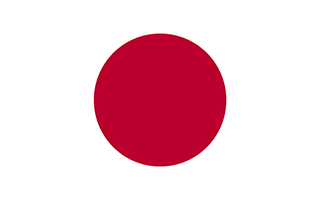
White with a large red disk (representing the sun without rays) in the center.
In 1603, after decades of civil warfare, the Tokugawa shogunate (a military-led, dynastic government) ushered in a long period of relative political stability and isolation from foreign influence. For more than two centuries this policy enabled Japan to enjoy a flowering of its indigenous culture. Japan opened its ports after signing the Treaty of Kanagawa with the US in 1854 and began to intensively modernize and industrialize. During the late 19th and early 20th centuries, Japan became a regional power that was able to defeat the forces of both China and Russia. It occupied Korea, Formosa (Taiwan), and southern Sakhalin Island. In 1931-32 Japan occupied Manchuria, and in 1937 it launched a full-scale invasion of China. Japan attacked US forces in 1941 - triggering America's entry into World War II - and soon occupied much of East and Southeast Asia. After its defeat in World War II, Japan recovered to become an economic power and an ally of the US. While the emperor retains his throne as a symbol of national unity, elected politicians hold actual decision-making power. Following three decades of unprecedented growth, Japan's economy experienced a major slowdown starting in the 1990s, but the country remains an economic power. In March 2011, Japan's strongest-ever earthquake, and an accompanying tsunami, devastated the northeast part of Honshu island, killed thousands, and damaged several nuclear power plants. The catastrophe hobbled the country's economy and its energy infrastructure, and tested its ability to deal with humanitarian disasters. Prime Minister Shinzo ABE was reelected to office in December 2012, and has since embarked on ambitious economic and security reforms to improve Japan's economy and bolster the country's international standing.
Geography
| Area | ||
|---|---|---|
| Total (World Rank: 63) | 377,915 | sq km |
| Land (World Rank: 61) | 364,485 | sq km |
| Water (World Rank: 39) | 13,430 | sq km |
| Comparative | slightly smaller than California | |
| Note | includes Bonin Islands (Ogasawara-gunto), Daito-shoto, Minami-jima, Okino-tori-shima, Ryukyu Islands (Nansei-shoto), and Volcano Islands (Kazan-retto) | |
| Coastline | ||
| 29751 | ||
| Elevation | ||
| Lowest point (World Rank: 46) | -4 | m |
| Highest point (World Rank: 48) | 3,776 | m |
| Agricultural land | ||
| Total (World Rank: 182) | 12.50 | % |
| Arable (World Rank: 98) | 11.70 | % |
| Permanent crops (World Rank: 132) | 0.80 | % |
| Irrigated land (World Rank: 24) | 24,690 | sq km |
| Map reference | ||
| Asia | ||
| Environment | ||
| Issues |
| |
| Agreement party |
| |
| Hazzards |
| |
| Location | ||
| Eastern Asia, island chain between the North Pacific Ocean and the Sea of Japan, east of the Korean Peninsula | ||
| Climate | ||
| varies from tropical in south to cool temperate in north | ||
| Terrain | ||
| mostly rugged and mountainous | ||
People
| Population | ||
|---|---|---|
| Total (World Rank: 10) | 126,451,000 | |
| Deathrate (World Rank: 43) | 0.98 | % |
| Birthrate (World Rank: 220) | 0.77 | % |
| Growthrate (World Rank: 204) | -0.21 | % |
| Fertility rate (World Rank: 207) | 1.41 | % |
| Median age | ||
| Male (World Rank: 3) | 46.00 | |
| Female (World Rank: 2) | 48.70 | |
| Age structure | ||
| 0 14 male (World Rank: 21) | 8,361,610 | |
| 0 14 female (World Rank: 21) | 7,875,040 | |
| 15 24 male (World Rank: 17) | 6,417,080 | |
| 15 24 female (World Rank: 18) | 5,778,900 | |
| 25 54 male (World Rank: 11) | 23,435,300 | |
| 25 54 female (World Rank: 11) | 23,980,800 | |
| 55 64 male (World Rank: 7) | 7,692,420 | |
| 55 64 female (World Rank: 7) | 7,665,160 | |
| 65 x male (World Rank: 4) | 15,397,300 | |
| 65 x female (World Rank: 4) | 19,847,800 | |
| Health | ||
| Infant mortality rate (World Rank: 220) | 0.20 | % |
| Life expectancy total (World Rank: 2) | 85 | years |
| Life expectancy female (World Rank: 2) | 89 | years |
| Life expectancy male (World Rank: 3) | 82 | years |
| Physicians per 1000 (World Rank: 66) | 2.30 | |
| Hospital bed per 1000 (World Rank: 2) | 13.70 | |
| Sanitation access total (World Rank: 15) | 100.00 | % |
| Obesity adult (World Rank: 186) | 4.30 | % |
| Drinking water access (World Rank: 22) | 100.00 | % |
Energy
| Electricity | ||
|---|---|---|
| Production (World Rank: 5) | 976,300,000,000 | kWh |
| Consumption (World Rank: 4) | 933,600,000,000 | kWh |
| Source fossil (World Rank: 131) | 59.50 | % |
| Source nuclear (World Rank: 109) | 12.50 | % |
| Source renew (World Rank: 46) | 15.00 | % |
| Crude oil | ||
| Production (World Rank: 83) | 3,918 | bbl / day |
| Imports (World Rank: 4) | 3,181,000 | bbl / day |
| Proved reserves (World Rank: 79) | 44,120,000 | bbl |
| Refined products | ||
| Production (World Rank: 5) | 3,536,000 | bbl / day |
| Consumption (World Rank: 4) | 4,026,000 | bbl / day |
| Export (World Rank: 20) | 381,100 | bbl / day |
| Import (World Rank: 4) | 1,141,000 | bbl / day |
| Natural gas | ||
| Production (World Rank: 52) | 4,453,000,000 | m³ |
| Consumption (World Rank: 9) | 123,600,000,000 | m³ |
| Import (World Rank: 39) | 0 | m³ |
| Carbon footprint | ||
| 1257000000 | ||
Nation
| Budget | ||
|---|---|---|
| Education (World Rank: 115) | 4 | % of GDP |
| Military (World Rank: 120) | 1 | % of GDP |
| Health (World Rank: 24) | 10 | % of GDP |
| Surplus (World Rank: 144) | -5 | % of GDP |
| National symbol | ||
| red sun disc | ||
| National colours | ||
| white | ||
| Adjective | ||
| Japanese | ||
| Noun | ||
| Japanese (singular and plural) | ||
| Background | ||
| In 1603, after decades of civil warfare, the Tokugawa shogunate (a military-led, dynastic government) ushered in a long period of relative political stability and isolation from foreign influence. For more than two centuries this policy enabled Japan to enjoy a flowering of its indigenous culture. Japan opened its ports after signing the Treaty of Kanagawa with the US in 1854 and began to intensively modernize and industrialize. During the late 19th and early 20th centuries, Japan became a regional power that was able to defeat the forces of both China and Russia. It occupied Korea, Formosa (Taiwan), and southern Sakhalin Island. In 1931-32 Japan occupied Manchuria, and in 1937 it launched a full-scale invasion of China. Japan attacked US forces in 1941 - triggering America's entry into World War II - and soon occupied much of East and Southeast Asia. After its defeat in World War II, Japan recovered to become an economic power and an ally of the US. While the emperor retains his throne as a symbol of national unity, elected politicians hold actual decision-making power. Following three decades of unprecedented growth, Japan's economy experienced a major slowdown starting in the 1990s, but the country remains an economic power. In March 2011, Japan's strongest-ever earthquake, and an accompanying tsunami, devastated the northeast part of Honshu island, killed thousands, and damaged several nuclear power plants. The catastrophe hobbled the country's economy and its energy infrastructure, and tested its ability to deal with humanitarian disasters. Prime Minister Shinzo ABE was reelected to office in December 2012, and has since embarked on ambitious economic and security reforms to improve Japan's economy and bolster the country's international standing. | ||
| Flag description | ||
| white with a large red disk (representing the sun without rays) in the center | ||
Economy
| Gdp | ||
|---|---|---|
| Purchasing power parity (World Rank: 4) | 5,233,000,000,000 | USD |
| Real growth rate (World Rank: 172) | 1.00 | % |
| Per capita purchasing power parity (World Rank: 41) | 41,200 | USD |
| Source agriculture (World Rank: 195) | 1.10 | % |
| Source industry (World Rank: 78) | 29.60 | % |
| Source service (World Rank: 71) | 69.40 | % |
| Labourforce | ||
| Total (World Rank: 8) | 66,730,000 | |
| In poverty (World Rank: 125) | 16.10 | % |
| Products | ||
| Industries |
| |
| Agriculture |
| |
| Exports |
| |
| Imports |
| |
Communication
| Phone | ||
|---|---|---|
| Landline total (World Rank: 3) | 64,024,900 | |
| Landline per 100 (World Rank: 18) | 51.00 | |
| Mobile per 100 (World Rank: 51) | 130.00 | |
| Assessment | 0 | |
| Internet | ||
| Users (World Rank: 5) | 116,566,000 | |
| Population (World Rank: 18) | 92.00 | % |
Transport
| Air | ||
|---|---|---|
| Airports paved (World Rank: 16) | 142.00 | |
| Airports unpaved (World Rank: 78) | 33.00 | |
| Heliports (World Rank: 15) | 16.00 | |
| Rail | ||
| Total length (World Rank: 11) | 27,311 | |
| Road | ||
| Total length (World Rank: 6) | 1,218,770 | |
| Paved length (World Rank: 4) | 992,835 | |
| Unpaved length (World Rank: 10) | 225,937 | |
| Water | ||
| Total length (World Rank: 46) | 1,770 | |
This is a list of famous places in this country in alphabetical order.
 Akita
Akita- Amagasaki
- Anjo
- Aomori
- Asahikawa
- Atsugi
- Chiba
- Fujisawa
- Fukui-shi
- Fukuoka
- Fukushima
- Fukuyama
- Gifu-shi
- Hachioji
- Hakodate
- Hamamatsu
- Handa
- Himeji
- Hiratsuka
- Hirosaki
- Hiroshima
- Hitachi
- Ibaraki
- Ichihara
- Ichinomiya
- Ise
- Ishinomaki
- Iwaki
- Iwakuni
- Izumo
- Kagoshima
- Kamakura
- Kanazawa
- Kashiwa
- Kawagoe
- Kawaguchi
- Kawasaki
- Kitakyushu
- Kobe
- Kochi
- Kofu
- Koriyama
- Koshigaya
- Kumamoto
- Kurume
- Kushiro
- Kyoto
- Machida
- Maebashi
- Maizuru
- Matsudo
- Matsue
- Matsumoto
- Matsuyama
- Mihara
- Mito
- Miyazaki
- Morioka
- Nagano
- Nagaoka
- Nagasaki
- Nagoya
- Naha
- Nara-shi
- Niigata
- Nishinomiya-hama
- Nobeoka
- Numazu
- Obihiro
- Oita
- Okayama
- Okazaki
- Onomichi
- Osaka
- Otaru
- Otsu
- Saitama
- Sakai
- Sapporo
- Sasebo
- Sendai
- Shizuoka
- Takamatsu
- Tokorozawa
- Tokushima
- Tokyo
- Tottori
- Toyama
- Toyohashi
- Toyota
- Tsu
- Uji
- Utsunomiya
- Wakayama
- Yamaguchi
- Yokkaichi
- Yokohama
- Yokosuka
- Yonago
- Yonezawa