Italy
in Southern Europe
Europe
 Austria
 France
 San Marino
 Slovenia
 Switzerland
 Vatican
- Currency and Currency Code:
- Euro - EUR
- Spoken languages:
- Italian, German, French, Sardinian, Catalan, Corsican, Slovenian
- Local electricity:
- 230 V - 50 Hz (plugs: C, F, L)
- Mobile phone / cellular frequencies (MHz):
- 900 MHz, 1800 MHz, 3G, 4G
- ISO 2-Letter code:
- IT
- Internet top level domain:
- .it
- Country phone prefix:
- +39
- Local Time (capital):
- Timezone:
- UTC/GMT offset: hours
Safety Score: 3,0 of 5.0 based on data from 9 authorites. Meaning we advice caution when travelling to Italy.
Travel warnings are updated daily. Source: Travel Warning Italy. Last Update: 2024-04-25 08:17:04
Explore Italy
Italy with its capital Rome is located in Europe (Southern Europe, a peninsula extending into the central Mediterranean Sea). It covers some 301,341 square kilometers (almost twice the size of Georgia) with 62,137,800 citizens. Italian, German, French, Sardinian, Catalan, Corsican and Slovenian are the languages commonly used by the people in Italy (consider regional differences). Austria, France, San Marino, Slovenia, Switzerland and Vatican are bordering countries.
Italy is a large country in Southern Europe. Start with a visit to Piazza Michelangelo in Florence to admire the famous view. Then set about exploring the many museums, both inside and outside Florence, that house Renaissance masterpieces. You could visit Italy's cities, never go in a church, museum or Roman ruin, and still have a great time. Just wander around, keeping your eyes open.
Popular Destinations in Italy
Administrative regions of Italy
- Abruzzo
- Aosta Valley
- Apulia
- Basilicate
- Calabria
- Campania
- Emilia-Romagna
- Friuli Venezia Giulia
- Latium
- Liguria
- Lombardy
- Molise
- Piedmont
- Sardinia
- Sicily
- The Marches
- Trentino-Alto Adige
- Tuscany
- Umbria
- Veneto
About the country
Website: Italy Tourism
Via Marghera 2/6
00185 Roma
Italy
Phone: +39 6 49711
Fax: +39 6 4463379
Mail: sedecentrale@enit.it
The landscape is mostly rugged and mountainous and some plains, coastal lowlands. The average density of population is about 206 per km². The climate in Italy can be described as predominantly Mediterraneanalpine in far north, hot, dry in south. Potential threats by nature are land subsidence in Venice, regional risks include landslides, mudflows, avalanches, earthquakes, volcanic eruptions, flooding and significant volcanic activity; Etna (3,330 m), which is in eruption as of 2010, is Europe's most active volcano; flank eruptions pose a threat to nearby Sicilian villages; Etna, along with the famous Vesuvius, which remains a threat to the millions of nea.
To reach someone Italy dial +39 prior to a number. The local cellular networks are operated on 900 MHz, 1800 MHz, 3G, 4G. Websites typically end with the top level domain ".it". If you want to bring electric appliances (e.g. battery chaarger), keep in min the local 230 V - 50 Hz (plugs: C, F, L). The sign for the locally used currency Euro is EUR.
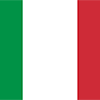
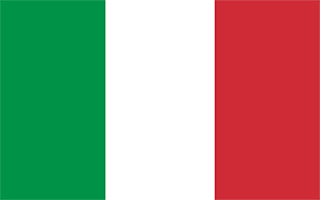
Three equal vertical bands of green (hoist side), white, and red; design inspired by the French flag brought to Italy by Napoleon in 1797; colors are those of Milan (red and white) combined with the green uniform color of the Milanese civic guard.
Italy became a nation-state in 1861 when the regional states of the peninsula, along with Sardinia and Sicily, were united under King Victor EMMANUEL II. An era of parliamentary government came to a close in the early 1920s when Benito MUSSOLINI established a Fascist dictatorship. His alliance with Nazi Germany led to Italy's defeat in World War II. A democratic republic replaced the monarchy in 1946 and economic revival followed. Italy is a charter member of NATO and the European Economic Community (EEC) and its subsequent successors the EC and the EU. It has been at the forefront of European economic and political unification, joining the Economic and Monetary Union in 1999. Persistent problems include sluggish economic growth, high youth and female unemployment, organized crime, corruption, and economic disparities between southern Italy and the more prosperous north.
Geography
| Area | ||
|---|---|---|
| Total (World Rank: 73) | 301,340 | sq km |
| Land (World Rank: 72) | 294,140 | sq km |
| Water (World Rank: 60) | 7,200 | sq km |
| Forest (World Rank: 110) | 15.70 | % |
| Comparative | almost twice the size of Georgia; slightly larger than Arizona | |
| Note | includes Sardinia and Sicily | |
| Coastline | ||
| 7600 | ||
| Landborder | ||
| 1836.4 | ||
| Elevation | ||
| Highest point (World Rank: 32) | 4,748 | m |
| Agricultural land | ||
| Total (World Rank: 76) | 47.10 | % |
| Arable (World Rank: 47) | 22.80 | % |
| Permanent crops (World Rank: 40) | 8.60 | % |
| Permanent pastures (World Rank: 110) | 15.70 | % |
| Irrigated land (World Rank: 15) | 39,500 | sq km |
| Map reference | ||
| Europe | ||
| Environment | ||
| Issues |
| |
| Agreement party |
| |
| Hazzards |
| |
| Location | ||
| Southern Europe, a peninsula extending into the central Mediterranean Sea, northeast of Tunisia | ||
| Climate | ||
| predominantly Mediterranean; alpine in far north; hot, dry in south | ||
| Terrain | ||
| mostly rugged and mountainous; some plains, coastal lowlands | ||
People
| Population | ||
|---|---|---|
| Total (World Rank: 23) | 62,137,800 | |
| Deathrate (World Rank: 34) | 1.04 | % |
| Birthrate (World Rank: 212) | 0.86 | % |
| Growthrate (World Rank: 180) | 0.19 | % |
| Migration rate (World Rank: 30) | 0.37 | % |
| Fertility rate (World Rank: 204) | 1.44 | % |
| Median age | ||
| Male (World Rank: 6) | 44.40 | |
| Female (World Rank: 6) | 46.50 | |
| Age structure | ||
| 0 14 male (World Rank: 48) | 4,334,460 | |
| 0 14 female (World Rank: 49) | 4,146,730 | |
| 15 24 male (World Rank: 37) | 3,008,230 | |
| 15 24 female (World Rank: 36) | 2,996,850 | |
| 25 54 male (World Rank: 21) | 12,933,600 | |
| 25 54 female (World Rank: 20) | 13,265,500 | |
| 55 64 male (World Rank: 13) | 3,914,060 | |
| 55 64 female (World Rank: 15) | 4,159,860 | |
| 65 x male (World Rank: 9) | 5,758,200 | |
| 65 x female (World Rank: 9) | 7,620,240 | |
| Health | ||
| Infant mortality rate (World Rank: 208) | 0.33 | % |
| Life expectancy total (World Rank: 13) | 82 | years |
| Life expectancy female (World Rank: 12) | 85 | years |
| Life expectancy male (World Rank: 18) | 80 | years |
| Physicians per 1000 (World Rank: 16) | 3.95 | |
| Hospital bed per 1000 (World Rank: 66) | 3.40 | |
| Sanitation access total (World Rank: 25) | 99.50 | % |
| Obesity adult (World Rank: 106) | 19.90 | % |
| Drinking water access (World Rank: 24) | 100.00 | % |
Energy
| Electricity | ||
|---|---|---|
| Production (World Rank: 14) | 269,300,000,000 | kWh |
| Consumption (World Rank: 12) | 296,000,000,000 | kWh |
| Export (World Rank: 30) | 6,155,000,000 | kWh |
| Import (World Rank: 2) | 43,180,000,000 | kWh |
| Source fossil (World Rank: 146) | 52.80 | % |
| Source nuclear (World Rank: 108) | 12.50 | % |
| Source renew (World Rank: 17) | 28.60 | % |
| Crude oil | ||
| Production (World Rank: 48) | 70,670 | bbl / day |
| Exports (World Rank: 58) | 11,610 | bbl / day |
| Imports (World Rank: 9) | 1,231,000 | bbl / day |
| Proved reserves (World Rank: 47) | 556,700,000 | bbl |
| Refined products | ||
| Production (World Rank: 12) | 1,567,000 | bbl / day |
| Consumption (World Rank: 19) | 1,253,000 | bbl / day |
| Export (World Rank: 13) | 572,000 | bbl / day |
| Import (World Rank: 18) | 449,600 | bbl / day |
| Natural gas | ||
| Production (World Rank: 48) | 5,785,000,000 | m³ |
| Consumption (World Rank: 17) | 70,910,000,000 | m³ |
| Export (World Rank: 52) | 21,200,000 | m³ |
| Import (World Rank: 66) | 0 | m³ |
| Carbon footprint | ||
| 362000000 | ||
Nation
| Budget | ||
|---|---|---|
| Education (World Rank: 100) | 4 | % of GDP |
| Military (World Rank: 73) | 2 | % of GDP |
| Health (World Rank: 37) | 9 | % of GDP |
| Surplus (World Rank: 92) | -2 | % of GDP |
| National symbol | ||
| white | ||
| National colours | ||
| white | ||
| Adjective | ||
| Italian | ||
| Noun | ||
| Italian(s) | ||
| Background | ||
| Italy became a nation-state in 1861 when the regional states of the peninsula, along with Sardinia and Sicily, were united under King Victor EMMANUEL II. An era of parliamentary government came to a close in the early 1920s when Benito MUSSOLINI established a Fascist dictatorship. His alliance with Nazi Germany led to Italy's defeat in World War II. A democratic republic replaced the monarchy in 1946 and economic revival followed. Italy is a charter member of NATO and the European Economic Community (EEC) and its subsequent successors the EC and the EU. It has been at the forefront of European economic and political unification, joining the Economic and Monetary Union in 1999. Persistent problems include sluggish economic growth, high youth and female unemployment, organized crime, corruption, and economic disparities between southern Italy and the more prosperous north. | ||
| Flag description | ||
| three equal vertical bands of green (hoist side), white, and red; design inspired by the French flag brought to Italy by Napoleon in 1797; colors are those of Milan (red and white) combined with the green uniform color of the Milanese civic guard | ||
Economy
| Gdp | ||
|---|---|---|
| Purchasing power parity (World Rank: 12) | 2,234,000,000,000 | USD |
| Real growth rate (World Rank: 177) | 0.90 | % |
| Per capita purchasing power parity (World Rank: 49) | 36,800 | USD |
| Source agriculture (World Rank: 174) | 2.10 | % |
| Source industry (World Rank: 118) | 24.10 | % |
| Source service (World Rank: 49) | 73.80 | % |
| Labourforce | ||
| Total (World Rank: 24) | 25,760,000 | |
| In poverty (World Rank: 63) | 29.90 | % |
| Products | ||
| Industries |
| |
| Agriculture |
| |
| Exports |
| |
| Imports |
| |
Communication
| Phone | ||
|---|---|---|
| Landline total (World Rank: 12) | 20,267,200 | |
| Landline per 100 (World Rank: 57) | 33.00 | |
| Mobile per 100 (World Rank: 40) | 139.00 | |
| Assessment | 0 | |
| Internet | ||
| Users (World Rank: 18) | 38,025,700 | |
| Population (World Rank: 90) | 61.30 | % |
Transport
| Air | ||
|---|---|---|
| Airports paved (World Rank: 24) | 98.00 | |
| Airports unpaved (World Rank: 82) | 31.00 | |
| Heliports (World Rank: 37) | 5.00 | |
| Rail | ||
| Total length (World Rank: 14) | 20,182 | |
| Road | ||
| Total length (World Rank: 15) | 487,700 | |
| Paved length (World Rank: 8) | 487,700 | |
| Water | ||
| Total length (World Rank: 37) | 2,400 | |
This is a list of famous places in this country in alphabetical order.
 Agrigento
- Alessandria
- Alghero
- Ancona
- Andria
- Aosta
- Arezzo
- Ascoli Piceno
- Asti
- Aversa
- Bari
- Barletta
- Benevento
- Bergamo
- Biella
- Bologna
- Bolzano
- Brescia
- Brindisi
- Cagliari
- Caltanissetta
- Campobasso
- Caserta
- Catania
- Cesena
- Chieti
- Civitavecchia
- Como
- Cosenza
- Cremona
- Crotone
- Florence
- Foggia
- Forli
- Genoa
- Gorizia
- Imperia
- L'Aquila
- La Spezia
- Latina
- Lecce
- Lecco
- Livorno
- Lodi
- Lucca
- Macerata
- Mantova
- Marsala
- Matera
- Messina
- Milan
- Modena
- Monza
- Naples
- Novara
- Nuoro
- Padova
- Palermo
- Parma
- Pavia
- Perugia
- Pesaro
- Pescara
- Piacenza
- Pisa
- Pistoia
- Potenza
- Prato
- Ragusa
- Ravenna
- Reggio Calabria
- Reggio nell'Emilia
- Rieti
- Rimini
- Rome
- Rovereto
- Rovigo
- Salerno
- San Remo
- Sassari
- Savona
- Sesto San Giovanni
- Siena
- Siracusa
- Taranto
- Teramo
- Terni
- Torre del Greco
- Trapani
- Trento
- Treviso
- Trieste
- Turin
- Udine
- Varese
- Venice
- Vercelli
- Verona
- Vicenza
- Viterbo