India
in Southern Asia
Asia
 Bangladesh
 Bhutan
 China
China Myanmar
 Nepal
Nepal Pakistan
- Currency and Currency Code:
- Rupee - INR
- Spoken languages:
- English, Hindi, Bengali, Telugu, Marathi, Tamil, Urdu, Gujarati, Kannada, Malayalam, Oriya, Panjabi, Assamese, Bihari , Kashmiri, Nepali, Sindhi, Sanskrit, French
- Local electricity:
- 230 V - 50 Hz (plugs: C, D, M)
- Mobile phone / cellular frequencies (MHz):
- 900 MHz, 1800 MHz, 3G, 4G
- ISO 2-Letter code:
- IN
- Internet top level domain:
- .in
- Country phone prefix:
- +91
- Local Time (capital):
- Timezone:
- UTC/GMT offset: hours
Safety Score: 3,4 of 5.0 based on data from 9 authorites. Meaning please reconsider your need to travel to India.
Travel warnings are updated daily. Source: Travel Warning India. Last Update: 2024-04-19 08:03:45
Explore India
India with its capital New Delhi is located in Asia (Southern Asia, bordering the Arabian Sea and the Bay of Bengal). It covers some 3,287,261 square kilometers (slightly more than one-third the size of the US) with a population of 1,281,940,000. English, Hindi, Bengali, Telugu, Marathi, Tamil, Urdu, Gujarati, Kannada, Malayalam, Oriya, Panjabi, Assamese, Bihari, Kashmiri, Nepali, Sindhi, Sanskrit and French are the languages spoken by people in India (consider regional differences). Bangladesh, Bhutan, China, Myanmar, Nepal and Pakistan are bordering countries.
India is the largest country in the Indian subcontinent. Befitting its size and population, India's culture and heritage are a rich amalgam of the past and the present. India has a very rich and diverse mix of culture and tradition, dominated by religious and spiritual themes. India has 22 official languages and drinking alcohol can either be frowned upon or openly accepted, depending on the region and religion of the area within which you are drinking. There is no single unified Indian culture, and it's probably the only country where people of so many different origins, religious beliefs, languages and ethnic backgrounds coexist. India is big and has many outstanding landmarks and areas of outstanding beauty. If you really want to see all the worth visiting places in India, one tourist visa of six months can be argued to be considered enough. Allow considerable buffer time for any journey with a fixed deadline (eg. your flight back). Cannabis in its many forms is widely available throughout India, but they are all illegal in the vast majority of the country, and may mean years in jail! As a rule India is quite safe for foreigners, apart from instances of petty crime and theft common to any developing country.
Popular Destinations in India
Administrative regions of India
- Assam
- Chhattisgarh
- Goa
- Haryana
- Himachal Pradesh
- Jharkhand
- Kerala
- Lakshadweep
- Madhya Pradesh
- Manipur
- Meghalaya
- Mizoram
- National Capital Territory of Delhi
- Puducherry
- Punjab
- Rajasthan
- Sikkim
- State of Andhra Pradesh
- State of Arunachal Pradesh
- State of Bihar
- State of Gujarat
- State of Jammu and Kashmir
- State of Karnataka
- State of Maharashtra
- State of Nagaland
- State of Odisha
- State of Tamil Nadu
- State of Uttarakhand
- Telangana
- Tripura
- Union Territory of Andaman and Nicobar Islands
- Union Territory of Chandigarh
- Union Territory of Dadra and Nagar Haveli
- Union Territory of Daman and Diu
- Uttar Pradesh
- West Bengal
About the country

Website: India Tourism
KFC Building
48 Church Street
Bangalore-560 001
Karnataka
India
Phone: +91 80 5585417
The topography is upland plain (Deccan Plateau) in south, flat to rolling plain along the Ganges, deserts in west, Himalayas in north. The average density of population is about 390 per km². The climate in India can be described as varying from tropical monsoon in south to temperate in north. Potential natural disasters are Barren Island (354 m) in the Andaman Sea has been active in recent years, droughts, earthquakes, flash floods, as well as widespread and destructive flooding from monsoonal rains and severe thunderstorms.
To reach someone India dial +91 prior to a number. The local cellular networks are operated on 900 MHz, 1800 MHz, 3G, 4G. Websites typically end with the top level domain ".in". If you want to bring electric appliances (e.g. battery chaarger), keep in min the local 230 V - 50 Hz (plugs: C, D, M). The sign for the locally used currency Rupee is INR.
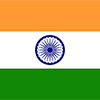
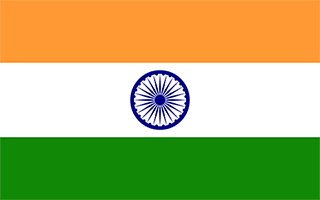
Three equal horizontal bands of saffron (subdued orange) (top), white, and green, with a blue chakra (24-spoked wheel) centered in the white band; saffron represents courage, sacrifice, and the spirit of renunciation; white signifies purity and truth; green stands for faith and fertility; the blue chakra symbolizes the wheel of life in movement and death in stagnation.
The Indus Valley civilization, one of the world's oldest, flourished during the 3rd and 2nd millennia B.C. and extended into northwestern India. Aryan tribes from the northwest infiltrated the Indian subcontinent about 1500 B.C.; their merger with the earlier Dravidian inhabitants created the classical Indian culture. The Maurya Empire of the 4th and 3rd centuries B.C. - which reached its zenith under ASHOKA - united much of South Asia. The Golden Age ushered in by the Gupta dynasty (4th to 6th centuries A.D.) saw a flowering of Indian science, art, and culture. Islam spread across the subcontinent over a period of 700 years. In the 10th and 11th centuries, Turks and Afghans invaded India and established the Delhi Sultanate. In the early 16th century, the Emperor BABUR established the Mughal Dynasty, which ruled India for more than three centuries. European explorers began establishing footholds in India during the 16th century. By the 19th century, Great Britain had become the dominant political power on the subcontinent. The British Indian Army played a vital role in both World Wars. Years of nonviolent resistance to British rule, led by Mohandas GANDHI and Jawaharlal NEHRU, eventually resulted in Indian independence, which was granted in 1947. Large-scale communal violence took place before and after the subcontinent partition into two separate states - India and Pakistan. The neighboring nations have fought three wars since independence, the last of which was in 1971 and resulted in East Pakistan becoming the separate nation of Bangladesh. India's nuclear weapons tests in 1998 emboldened Pakistan to conduct its own tests that same year. In November 2008, terrorists originating from Pakistan conducted a series of coordinated attacks in Mumbai, India's financial capital. Despite pressing problems such as significant overpopulation, environmental degradation, extensive poverty, and widespread corruption, economic growth following the launch of economic reforms in 1991 and a massive youthful population are driving India's emergence as a regional and global power.
Geography
| Area | ||
|---|---|---|
| Total (World Rank: 8) | 3,287,260 | sq km |
| Land (World Rank: 8) | 2,973,190 | sq km |
| Water (World Rank: 4) | 314,070 | sq km |
| Forest (World Rank: 171) | 3.50 | % |
| Comparative | slightly more than one-third the size of the US | |
| Coastline | ||
| 7000 | ||
| Landborder | ||
| 13888 | ||
| Elevation | ||
| Highest point (World Rank: 4) | 8,586 | m |
| Agricultural land | ||
| Total (World Rank: 41) | 60.50 | % |
| Arable (World Rank: 6) | 52.80 | % |
| Permanent crops (World Rank: 61) | 4.20 | % |
| Permanent pastures (World Rank: 171) | 3.50 | % |
| Irrigated land (World Rank: 2) | 667,000 | sq km |
| Map reference | ||
| Asia | ||
| Environment | ||
| Issues |
| |
| Agreement party |
| |
| Hazzards |
| |
| Location | ||
| Southern Asia, bordering the Arabian Sea and the Bay of Bengal, between Burma and Pakistan | ||
| Climate | ||
| varies from tropical monsoon in south to temperate in north | ||
| Terrain | ||
| upland plain (Deccan Plateau) in south, flat to rolling plain along the Ganges, deserts in west, Himalayas in north | ||
People
| Population | ||
|---|---|---|
| Total (World Rank: 2) | 1,281,940,000 | |
| Deathrate (World Rank: 118) | 0.73 | % |
| Birthrate (World Rank: 86) | 1.90 | % |
| Growthrate (World Rank: 95) | 1.17 | % |
| Fertility rate (World Rank: 80) | 2.43 | % |
| Median age | ||
| Male (World Rank: 138) | 27.20 | |
| Female (World Rank: 131) | 28.60 | |
| Age structure | ||
| 0 14 male (World Rank: 1) | 186,088,000 | |
| 0 14 female (World Rank: 1) | 164,398,000 | |
| 15 24 male (World Rank: 1) | 121,880,000 | |
| 15 24 female (World Rank: 1) | 107,583,000 | |
| 25 54 male (World Rank: 2) | 271,745,000 | |
| 25 54 female (World Rank: 2) | 254,835,000 | |
| 55 64 male (World Rank: 2) | 47,846,100 | |
| 55 64 female (World Rank: 2) | 47,632,500 | |
| 65 x male (World Rank: 2) | 37,837,800 | |
| 65 x female (World Rank: 2) | 42,091,100 | |
| Health | ||
| Infant mortality rate (World Rank: 47) | 3.91 | % |
| Life expectancy total (World Rank: 161) | 69 | years |
| Life expectancy female (World Rank: 166) | 70 | years |
| Life expectancy male (World Rank: 149) | 68 | years |
| Physicians per 1000 (World Rank: 124) | 0.73 | |
| Hospital bed per 1000 (World Rank: 164) | 0.70 | |
| Sanitation access total (World Rank: 173) | 39.60 | % |
| Obesity adult (World Rank: 188) | 3.90 | % |
| Drinking water access (World Rank: 117) | 94.10 | % |
Energy
| Electricity | ||
|---|---|---|
| Production (World Rank: 3) | 1,289,000,000,000 | kWh |
| Consumption (World Rank: 3) | 1,048,000,000,000 | kWh |
| Export (World Rank: 36) | 5,150,000,000 | kWh |
| Import (World Rank: 37) | 5,244,000,000 | kWh |
| Source fossil (World Rank: 102) | 71.50 | % |
| Source nuclear (World Rank: 143) | 1.60 | % |
| Source renew (World Rank: 47) | 14.60 | % |
| Crude oil | ||
| Production (World Rank: 24) | 734,500 | bbl / day |
| Imports (World Rank: 3) | 3,789,000 | bbl / day |
| Proved reserves (World Rank: 24) | 4,621,000,000 | bbl |
| Refined products | ||
| Production (World Rank: 4) | 4,793,000 | bbl / day |
| Consumption (World Rank: 3) | 4,142,000 | bbl / day |
| Export (World Rank: 6) | 1,371,000 | bbl / day |
| Import (World Rank: 17) | 481,900 | bbl / day |
| Natural gas | ||
| Production (World Rank: 24) | 31,240,000,000 | m³ |
| Consumption (World Rank: 12) | 102,300,000,000 | m³ |
| Export (World Rank: 45) | 270,000,000 | m³ |
| Import (World Rank: 68) | 0 | m³ |
| Carbon footprint | ||
| 1887000000 | ||
Nation
| Budget | ||
|---|---|---|
| Education (World Rank: 113) | 4 | % of GDP |
| Military (World Rank: 38) | 2 | % of GDP |
| Health (World Rank: 149) | 5 | % of GDP |
| Surplus (World Rank: 124) | -4 | % of GDP |
| National symbol | ||
| the Lion Capital of Ashoka | ||
| National colours | ||
| white | ||
| Adjective | ||
| Indian | ||
| Noun | ||
| Indian(s) | ||
| Background | ||
| The Indus Valley civilization, one of the world's oldest, flourished during the 3rd and 2nd millennia B.C. and extended into northwestern India. Aryan tribes from the northwest infiltrated the Indian subcontinent about 1500 B.C.; their merger with the earlier Dravidian inhabitants created the classical Indian culture. The Maurya Empire of the 4th and 3rd centuries B.C. - which reached its zenith under ASHOKA - united much of South Asia. The Golden Age ushered in by the Gupta dynasty (4th to 6th centuries A.D.) saw a flowering of Indian science, art, and culture. Islam spread across the subcontinent over a period of 700 years. In the 10th and 11th centuries, Turks and Afghans invaded India and established the Delhi Sultanate. In the early 16th century, the Emperor BABUR established the Mughal Dynasty, which ruled India for more than three centuries. European explorers began establishing footholds in India during the 16th century. By the 19th century, Great Britain had become the dominant political power on the subcontinent. The British Indian Army played a vital role in both World Wars. Years of nonviolent resistance to British rule, led by Mohandas GANDHI and Jawaharlal NEHRU, eventually resulted in Indian independence, which was granted in 1947. Large-scale communal violence took place before and after the subcontinent partition into two separate states - India and Pakistan. The neighboring nations have fought three wars since independence, the last of which was in 1971 and resulted in East Pakistan becoming the separate nation of Bangladesh. India's nuclear weapons tests in 1998 emboldened Pakistan to conduct its own tests that same year. In November 2008, terrorists originating from Pakistan conducted a series of coordinated attacks in Mumbai, India's financial capital. Despite pressing problems such as significant overpopulation, environmental degradation, extensive poverty, and widespread corruption, economic growth following the launch of economic reforms in 1991 and a massive youthful population are driving India's emergence as a regional and global power. | ||
| Flag description | ||
| three equal horizontal bands of saffron (subdued orange) (top), white, and green, with a blue chakra (24-spoked wheel) centered in the white band; saffron represents courage, sacrifice, and the spirit of renunciation; white signifies purity and truth; green stands for faith and fertility; the blue chakra symbolizes the wheel of life in movement and death in stagnation | ||
Economy
| Gdp | ||
|---|---|---|
| Purchasing power parity (World Rank: 3) | 8,701,000,000,000 | USD |
| Real growth rate (World Rank: 10) | 7.10 | % |
| Per capita purchasing power parity (World Rank: 155) | 6,700 | USD |
| Source agriculture (World Rank: 58) | 17.40 | % |
| Source industry (World Rank: 87) | 28.80 | % |
| Source service (World Rank: 190) | 46.20 | % |
| Labourforce | ||
| Total (World Rank: 2) | 510,100,000 | |
| In poverty (World Rank: 98) | 21.90 | % |
| Products | ||
| Industries |
| |
| Agriculture |
| |
| Exports |
| |
| Imports |
| |
Communication
| Phone | ||
|---|---|---|
| Landline total (World Rank: 11) | 24,404,000 | |
| Landline per 100 (World Rank: 174) | 2.00 | |
| Mobile per 100 (World Rank: 150) | 89.00 | |
| Assessment | 0 | |
| Internet | ||
| Users (World Rank: 2) | 374,328,000 | |
| Population (World Rank: 158) | 29.50 | % |
Transport
| Air | ||
|---|---|---|
| Airports paved (World Rank: 10) | 253 | |
| Airports unpaved (World Rank: 35) | 93.00 | |
| Heliports (World Rank: 7) | 45.00 | |
| Rail | ||
| Total length (World Rank: 5) | 68,525 | |
| Road | ||
| Total length (World Rank: 2) | 4,699,020 | |
| Water | ||
| Total length (World Rank: 9) | 14,500 | |
This is a list of famous places in this country in alphabetical order.
 Agartala
- Agra
- Ahmedabad
- Aizawl
- Ajmer
- Allahabad
- Ambattur
- Amravati
- Amritsar
- Aurangabad
- Bathinda
- Belgaum
- Bellary
- Bengaluru
- Bhavnagar
- Bhopal
- Bhubaneshwar
- Bijapur
- Bikaner
- Chandigarh
- Chennai
- Cochin
- Coimbatore
- Cuttack
- Daman
- Dehra Dun
- Delhi
- Dibrugarh
- Faridabad
- Gangtok
- Ghaziabad
- Gorakhpur
- Gulbarga
- Guwahati
- Haridwar
- Hospet
- Hubli
- Hyderabad
- Imphal
- Indore
- Itanagar
- Jabalpur
- Jaipur
- Jalandhar
- Jalpaiguri
- Jammu
- Jamnagar
- Jamshedpur
- Jodhpur
- Kanpur
- Kohima
- Kolkata
- Kollam
- Kota
- Kozhikode
- Latur
- Lucknow
- Ludhiana
- Madura
- Meerut
- Mumbai
- Mysore
- Nagpur
- Nashik
- New Delhi
- Noida
- Panchkula
- Panjim
- Patna
- Port Blair
- Puducherry
- Pune
- Raipur
- Rajkot
- Ranchi
- Ratnagiri
- Salem
- Shiliguri
- Shillong
- Shimla
- Shimoga
- Silvassa
- Solapur
- Srinagar
- Surat
- Tanjore
- Thiruvananthapuram
- Tinnevelly
- Tiruchirappalli
- Tirupati
- Trichur
- Udaipur
- Ujjain
- Vadodara
- Valsad
- Varanasi
- Vijayawada
- Visakhapatnam
- Vizianagaram
- Warangal