Greece
in Southern Europe
Europe
 Albania
 Bulgaria
 Macedonia
 Turkey
- Currency and Currency Code:
- Euro - EUR
- Spoken languages:
- Modern Greek, English, French
- Local electricity:
- 230 V - 50 Hz (plugs: C, F)
- Mobile phone / cellular frequencies (MHz):
- 900 MHz, 1800 MHz, 3G, 4G
- ISO 2-Letter code:
- GR
- Internet top level domain:
- .gr
- Country phone prefix:
- +30
- Local Time (capital):
- Timezone:
- UTC/GMT offset: hours
Safety Score: 2,8 of 5.0 based on data from 9 authorites. Meaning we advice caution when travelling to Greece.
Travel warnings are updated daily. Source: Travel Warning Greece. Last Update: 2024-04-24 08:14:40
Explore Greece
Greece with its capital Athens is located in Europe (Southern Europe, bordering the Aegean Sea). It covers some 131,958 square kilometers (slightly smaller than Alabama) with a population of 10,768,500. Modern Greek, English and French are some of the languages spoken by the majority in Greece (consider regional differences). Albania, Bulgaria, Macedonia and Turkey are bordering countries.
Greece is a country in Southern Europe, on the southernmost tip of the Balkan peninsula, with extensive coastlines and islands in the Aegean, Ionian, and Mediterranean Seas. Greece is one of the world's most popular tourist destinations, ranking in the world's top 20 countries. According to the Greek Ministry of Tourism, the nation received about 17 million visitors from January to mid August 2007, a large number for a small country of 11 million. Visitors are drawn to the country's beaches and reliable sunny summer weather, its nightlife, historical sites and natural beauty.
Popular Destinations in Greece
Administrative regions of Greece
- Attica
- Autonomous Monastic State of the Holy Mountain
- Central Greece
- Central Macedonia
- Crete
- East Macedonia and Thrace
- Epirus
- Ionian Islands
- North Aegean
- Peloponnese
- South Aegean
- Thessaly
- West Greece
- West Macedonia
About the country
Website: Greece Tourism
2, Amerikis Street
105 64 Athens
Greece
Phone: +30 1 3271300
Mail: info@gnto.gr
The terrain is mountainous with ranges extending into the sea as peninsulas or chains of islands. The average density of population is about 82 per km². The climate in Greece can be described as temperatemild, wet winters, hot, dry summers. Possible natural disasters include Santorini (367 m) has been deemed a Decade Volcano by the International Association of Volcanology and Chemistry of the Earth's Interior, worthy of study due to its explosive history and close proximity to human populations; although there have been very severe earthquakes
To reach someone Greece dial +30 prior to a number. The local cellular networks are operated on 900 MHz, 1800 MHz, 3G, 4G. Websites typically end with the top level domain ".gr". If you want to bring electric appliances (e.g. battery chaarger), keep in min the local 230 V - 50 Hz (plugs: C, F). The sign for the locally used currency Euro is EUR.
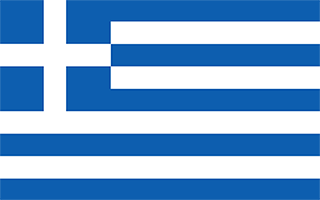
Nine equal horizontal stripes of blue alternating with white; a blue square bearing a white cross appears in the upper hoist-side corner; the cross symbolizes Greek Orthodoxy, the established religion of the country; there is no agreed upon meaning for the nine stripes or for the colors.
Greece achieved independence from the Ottoman Empire in 1830. During the second half of the 19th century and the first half of the 20th century, it gradually added neighboring islands and territories, most with Greek-speaking populations. In World War II, Greece was first invaded by Italy (1940) and subsequently occupied by Germany (1941-44); fighting endured in a protracted civil war between supporters of the king and other anti-communist and communist rebels. Following the latter's defeat in 1949, Greece joined NATO in 1952. In 1967, a group of military officers seized power, establishing a military dictatorship that suspended many political liberties and forced the king to flee the country. In 1974 following the collapse of the dictatorship, democratic elections and a referendum created a parliamentary republic and abolished the monarchy. In 1981, Greece joined the EC (now the EU); it became the 12th member of the European Economic and Monetary Union (EMU) in 2001. Greece has suffered a severe economic crisis since late 2009, due to nearly a decade of chronic overspending and structural rigidities. Since 2010, Greece has entered three bailout agreements with the European Commission, the European Central Bank (ECB), the IMF, and with the third, the European Stability Mechanism (ESM). The Greek Government agreed to its current, $96 billion bailout in August 2015, which will conclude in August 2018.
Geography
| Area | ||
|---|---|---|
| Total (World Rank: 98) | 131,957 | sq km |
| Land (World Rank: 95) | 130,647 | sq km |
| Water (World Rank: 103) | 1,310 | sq km |
| Forest (World Rank: 45) | 34.80 | % |
| Comparative | slightly smaller than Alabama | |
| Coastline | ||
| 13676 | ||
| Landborder | ||
| 1110 | ||
| Elevation | ||
| Highest point (World Rank: 76) | 2,917 | m |
| Agricultural land | ||
| Total (World Rank: 36) | 63.40 | % |
| Arable (World Rank: 56) | 19.70 | % |
| Permanent crops (World Rank: 37) | 8.90 | % |
| Permanent pastures (World Rank: 45) | 34.80 | % |
| Irrigated land (World Rank: 34) | 15,550 | sq km |
| Map reference | ||
| Europe | ||
| Environment | ||
| Issues |
| |
| Agreement party |
| |
| Agreement signed |
| |
| Hazzards |
| |
| Location | ||
| Southern Europe, bordering the Aegean Sea, Ionian Sea, and the Mediterranean Sea, between Albania and Turkey | ||
| Climate | ||
| temperate; mild, wet winters; hot, dry summers | ||
| Terrain | ||
| mountainous with ranges extending into the sea as peninsulas or chains of islands | ||
People
| Population | ||
|---|---|---|
| Total (World Rank: 85) | 10,768,500 | |
| Deathrate (World Rank: 27) | 1.13 | % |
| Birthrate (World Rank: 215) | 0.84 | % |
| Growthrate (World Rank: 198) | -0.06 | % |
| Migration rate (World Rank: 39) | 0.23 | % |
| Fertility rate (World Rank: 205) | 1.43 | % |
| Median age | ||
| Male (World Rank: 9) | 43.50 | |
| Female (World Rank: 10) | 45.60 | |
| Age structure | ||
| 0 14 male (World Rank: 109) | 767,245 | |
| 0 14 female (World Rank: 109) | 722,313 | |
| 15 24 male (World Rank: 104) | 532,179 | |
| 15 24 female (World Rank: 104) | 509,487 | |
| 25 54 male (World Rank: 76) | 2,275,980 | |
| 25 54 female (World Rank: 74) | 2,295,080 | |
| 55 64 male (World Rank: 54) | 692,420 | |
| 55 64 female (World Rank: 54) | 721,641 | |
| 65 x male (World Rank: 40) | 986,816 | |
| 65 x female (World Rank: 38) | 1,265,310 | |
| Health | ||
| Infant mortality rate (World Rank: 175) | 0.46 | % |
| Life expectancy total (World Rank: 36) | 81 | years |
| Life expectancy female (World Rank: 34) | 83 | years |
| Life expectancy male (World Rank: 36) | 78 | years |
| Physicians per 1000 (World Rank: 5) | 6.26 | |
| Hospital bed per 1000 (World Rank: 41) | 4.80 | |
| Sanitation access total (World Rank: 35) | 99.00 | % |
| Obesity adult (World Rank: 54) | 24.90 | % |
| Drinking water access (World Rank: 11) | 100.00 | % |
Energy
| Electricity | ||
|---|---|---|
| Production (World Rank: 53) | 48,340,000,000 | kWh |
| Consumption (World Rank: 47) | 53,050,000,000 | kWh |
| Export (World Rank: 57) | 1,037,000,000 | kWh |
| Import (World Rank: 25) | 9,833,000,000 | kWh |
| Source fossil (World Rank: 139) | 56.80 | % |
| Source nuclear (World Rank: 102) | 14.20 | % |
| Source renew (World Rank: 18) | 26.80 | % |
| Crude oil | ||
| Production (World Rank: 84) | 3,172 | bbl / day |
| Exports (World Rank: 65) | 3,082 | bbl / day |
| Imports (World Rank: 21) | 477,400 | bbl / day |
| Proved reserves (World Rank: 92) | 10,000,000 | bbl |
| Refined products | ||
| Production (World Rank: 27) | 626,000 | bbl / day |
| Consumption (World Rank: 43) | 299,600 | bbl / day |
| Export (World Rank: 22) | 351,700 | bbl / day |
| Import (World Rank: 32) | 181,000 | bbl / day |
| Natural gas | ||
| Production (World Rank: 99) | 4,000,000 | m³ |
| Consumption (World Rank: 69) | 4,354,000,000 | m³ |
| Import (World Rank: 70) | 0 | m³ |
| Carbon footprint | ||
| 78000000 | ||
Nation
| Budget | ||
|---|---|---|
| Military (World Rank: 36) | 3 | % of GDP |
| Health (World Rank: 54) | 8 | % of GDP |
| Surplus (World Rank: 31) | 1 | % of GDP |
| National symbol | ||
| Greek cross | ||
| National colours | ||
| white | ||
| Adjective | ||
| Greek | ||
| Noun | ||
| Greek(s) | ||
| Background | ||
| Greece achieved independence from the Ottoman Empire in 1830. During the second half of the 19th century and the first half of the 20th century, it gradually added neighboring islands and territories, most with Greek-speaking populations. In World War II, Greece was first invaded by Italy (1940) and subsequently occupied by Germany (1941-44); fighting endured in a protracted civil war between supporters of the king and other anti-communist and communist rebels. Following the latter's defeat in 1949, Greece joined NATO in 1952. In 1967, a group of military officers seized power, establishing a military dictatorship that suspended many political liberties and forced the king to flee the country. In 1974 following the collapse of the dictatorship, democratic elections and a referendum created a parliamentary republic and abolished the monarchy. In 1981, Greece joined the EC (now the EU); it became the 12th member of the European Economic and Monetary Union (EMU) in 2001. Greece has suffered a severe economic crisis since late 2009, due to nearly a decade of chronic overspending and structural rigidities. Since 2010, Greece has entered three bailout agreements with the European Commission, the European Central Bank (ECB), the IMF, and with the third, the European Stability Mechanism (ESM). The Greek Government agreed to its current, $96 billion bailout in August 2015, which will conclude in August 2018. | ||
| Flag description | ||
| nine equal horizontal stripes of blue alternating with white; a blue square bearing a white cross appears in the upper hoist-side corner; the cross symbolizes Greek Orthodoxy, the established religion of the country; there is no agreed upon meaning for the nine stripes or for the colors | ||
Economy
| Gdp | ||
|---|---|---|
| Purchasing power parity (World Rank: 57) | 289,300,000,000 | USD |
| Per capita purchasing power parity (World Rank: 70) | 26,800 | USD |
| Source agriculture (World Rank: 139) | 4.00 | % |
| Source industry (World Rank: 173) | 15.80 | % |
| Source service (World Rank: 26) | 80.20 | % |
| Labourforce | ||
| Total (World Rank: 84) | 4,785,000 | |
| In poverty (World Rank: 46) | 36.00 | % |
| Products | ||
| Industries |
| |
| Agriculture |
| |
| Exports |
| |
| Imports |
| |
Communication
| Phone | ||
|---|---|---|
| Landline total (World Rank: 28) | 5,126,000 | |
| Landline per 100 (World Rank: 24) | 48.00 | |
| Mobile per 100 (World Rank: 89) | 116.00 | |
| Assessment | 0 | |
| Internet | ||
| Users (World Rank: 57) | 7,443,020 | |
| Population (World Rank: 78) | 69.10 | % |
Transport
| Air | ||
|---|---|---|
| Airports paved (World Rank: 34) | 68.00 | |
| Airports unpaved (World Rank: 137) | 9.00 | |
| Heliports (World Rank: 22) | 9.00 | |
| Rail | ||
| Total length (World Rank: 67) | 2,548 | |
| Road | ||
| Total length (World Rank: 41) | 116,960 | |
| Paved length (World Rank: 50) | 41,357 | |
| Unpaved length (World Rank: 27) | 75,603 | |
| Water | ||
| Total length (World Rank: 108) | 6.00 | |
This is a list of famous places in this country in alphabetical order.
 Acharnes
- Agia Paraskevi
- Agia Varvara
- Agios Dimitrios
- Agios Nikolaos
- Agrinio
- Aigaleo
- Aigio
- Alexandroupoli
- Alimos
- Argos
- Argostoli
- Arta
- Athens
- Chaidari
- Chalandri
- Chalkida
- Chania
- Chios
- Cholargos
- Corfu
- Corinth
- Drama
- Edessa
- Elefsina
- Ermoupolis
- Florina
- Galatsi
- Giannitsa
- Glyfada
- Ierapetra
- Igoumenitsa
- Ilion
- Ilioupoli
- Ioannina
- Irakleio
- Irakleion
- Kalamaria
- Kalamata
- Kallithea
- Kalymnos
- Kalyvia Thorikou
- Karditsa
- Kastoria
- Katerini
- Kavala
- Keratsini
- Kiato
- Kifissia
- Kilkis
- Kissamos
- Komotini
- Korydallos
- Kos
- Kozani
- Lamia
- Larisa
- Lefkada
- Livadeia
- Loutraki
- Marousi
- Megara
- Mesolongi
- Metamorfosi
- Mykonos
- Mytilene
- Nafpaktos
- Nafplio
- Naxos
- Nea Filadelfeia
- Nea Ionia
- Nea Smyrni
- Nikaia
- Palaio Faliro
- Patrai
- Peristeri
- Petroupolis
- Piraeus
- Polygyros
- Preveza
- Ptolemaida
- Pyrgos
- Rethymno
- Rhodes
- Salamina
- Samos
- Serres
- Sparti
- Sykies
- Thessaloniki
- Trikala
- Tripoli
- Veroia
- Volos
- Voula
- Vyronas
- Xanthi
- Xylokastro
- Zakynthos
- Zografos