Germany
in Western Europe
Europe
 Austria
 Belgium
 Czechia
 Denmark
 France
 Luxembourg
 Netherlands
 Poland
 Switzerland
- Currency and Currency Code:
- Euro - EUR
- Spoken languages:
- German
- Local electricity:
- 230 V - 50 Hz (plugs: C, F)
- Mobile phone / cellular frequencies (MHz):
- 900 MHz, 1800 MHz, 3G, 4G
- ISO 2-Letter code:
- DE
- Internet top level domain:
- .de
- Country phone prefix:
- +49
- Local Time (capital):
- Timezone:
- UTC/GMT offset: hours
Safety Score: 3,0 of 5.0 based on data from 9 authorites. Meaning we advice caution when travelling to Germany.
Travel warnings are updated daily. Source: Travel Warning Germany. Last Update: 2024-04-25 08:17:04
Explore Germany
Germany with its capital Berlin is located in Europe (Central Europe, bordering the Baltic Sea and the North Sea). It covers some 357,023 square kilometers (three times the size of Pennsylvania) with a population of 80,594,000. German is the official language spoken by people in Germany. Austria, Belgium, Czechia, Denmark, France, Luxembourg, Netherlands, Poland and Switzerland are bordering countries.
Germany is the largest country in Central Europe. Germany is a federation of 16 states, each with its own distinct and unique culture. If you have perceptions of Germany as homogeneous, it will surprise you with its regions and diversity. Germany is an economic powerhouse. It has the largest population and biggest economy in Europe. Germany offers virtually every activity you can imagine - due to the federal structure every region has its own specific activities. Most Germans are members of a sports club and visit cultural events less often. Due to its size and location in central Europe, Germany boasts a large variety of different landscapes, offering many activities related to nature, from hiking in the forests to exploring the picturesque islands off the northern coasts!
Popular Destinations in Germany
Administrative regions of Germany
- Baden-Wurttemberg
- Bavaria
- Brandenburg
- Bremen
- Free State of Thuringia
- Hamburg
- Hesse
- Land Berlin
- Lower Saxony
- Mecklenburg-Vorpommern
- North Rhine-Westphalia
- Rhineland-Palatinate
- Saarland
- Saxony
- Saxony-Anhalt
- Schleswig-Holstein
About the country
Website: Germany Tourism
Deutsche Zentrale fuer Tourismus e.V.
Beethovenstr. 69
D-60325 Frankfurt
Germany
Phone: +49 69 97 46 40
Fax: +49 69 75 19 03
Mail: info@d-z-t.com
The topography is lowlands in north, uplands in center, Bavarian Alps in south. The average density of population is about 226 per km². The climate in Germany can be described as temperate and marinecool, cloudy, wet winters and summers, occasional warm mountain (foehn) wind. Potential natural disasters are flooding.
To reach someone Germany dial +49 prior to a number. The local cellular networks are operated on 900 MHz, 1800 MHz, 3G, 4G. Websites typically end with the top level domain ".de". If you want to bring electric appliances (e.g. battery chaarger), keep in min the local 230 V - 50 Hz (plugs: C, F). The sign for the locally used currency Euro is EUR.
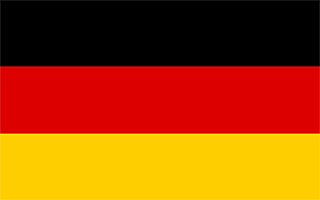
Three equal horizontal bands of black (top), red, and gold; these colors have played an important role in German history and can be traced back to the medieval banner of the Holy Roman Emperor - a black eagle with red claws and beak on a gold field.
As Europe's largest economy and second most populous nation (after Russia), Germany is a key member of the continent's economic, political, and defense organizations. European power struggles immersed Germany in two devastating World Wars in the first half of the 20th century and left the country occupied by the victorious Allied powers of the US, UK, France, and the Soviet Union in 1945. With the advent of the Cold War, two German states were formed in 1949: the western Federal Republic of Germany (FRG) and the eastern German Democratic Republic (GDR). The democratic FRG embedded itself in key western economic and security organizations, the EC, which became the EU, and NATO, while the communist GDR was on the front line of the Soviet-led Warsaw Pact. The decline of the USSR and the end of the Cold War allowed for German reunification in 1990. Since then, Germany has expended considerable funds to bring eastern productivity and wages up to western standards. In January 1999, Germany and 10 other EU countries introduced a common European exchange currency, the euro.
Geography
| Area | ||
|---|---|---|
| Total (World Rank: 64) | 357,022 | sq km |
| Land (World Rank: 62) | 348,672 | sq km |
| Water (World Rank: 54) | 8,350 | sq km |
| Forest (World Rank: 117) | 13.30 | % |
| Comparative | three times the size of Pennsylvania; slightly smaller than Montana | |
| Coastline | ||
| 2389 | ||
| Landborder | ||
| 3714 | ||
| Elevation | ||
| Lowest point (World Rank: 45) | -4 | m |
| Highest point (World Rank: 70) | 2,963 | m |
| Agricultural land | ||
| Total (World Rank: 73) | 48.00 | % |
| Arable (World Rank: 25) | 34.10 | % |
| Permanent crops (World Rank: 143) | 0.60 | % |
| Permanent pastures (World Rank: 117) | 13.30 | % |
| Irrigated land (World Rank: 53) | 6,500 | sq km |
| Map reference | ||
| Europe | ||
| Environment | ||
| Issues |
| |
| Agreement party |
| |
| Hazzards | flooding | |
| Location | ||
| Central Europe, bordering the Baltic Sea and the North Sea, between the Netherlands and Poland, south of Denmark | ||
| Climate | ||
| temperate and marine; cool, cloudy, wet winters and summers; occasional warm mountain (foehn) wind | ||
| Terrain | ||
| lowlands in north, uplands in center, Bavarian Alps in south | ||
People
| Population | ||
|---|---|---|
| Total (World Rank: 19) | 80,594,000 | |
| Deathrate (World Rank: 24) | 1.17 | % |
| Birthrate (World Rank: 210) | 0.86 | % |
| Growthrate (World Rank: 202) | -0.16 | % |
| Migration rate (World Rank: 52) | 0.15 | % |
| Fertility rate (World Rank: 200) | 1.45 | % |
| Median age | ||
| Male (World Rank: 2) | 46.00 | |
| Female (World Rank: 3) | 48.20 | |
| Age structure | ||
| 0 14 male (World Rank: 37) | 5,304,340 | |
| 0 14 female (World Rank: 38) | 5,028,780 | |
| 15 24 male (World Rank: 25) | 4,145,490 | |
| 15 24 female (World Rank: 26) | 3,986,300 | |
| 25 54 male (World Rank: 17) | 16,468,000 | |
| 25 54 female (World Rank: 17) | 16,134,000 | |
| 55 64 male (World Rank: 8) | 5,834,180 | |
| 55 64 female (World Rank: 8) | 5,913,320 | |
| 65 x male (World Rank: 6) | 7,822,220 | |
| 65 x female (World Rank: 7) | 9,957,450 | |
| Health | ||
| Infant mortality rate (World Rank: 205) | 0.34 | % |
| Life expectancy total (World Rank: 35) | 81 | years |
| Life expectancy female (World Rank: 35) | 83 | years |
| Life expectancy male (World Rank: 31) | 79 | years |
| Physicians per 1000 (World Rank: 11) | 4.13 | |
| Hospital bed per 1000 (World Rank: 8) | 8.20 | |
| Sanitation access total (World Rank: 30) | 99.20 | % |
| Obesity adult (World Rank: 78) | 22.30 | % |
| Drinking water access (World Rank: 4) | 100.00 | % |
Energy
| Electricity | ||
|---|---|---|
| Production (World Rank: 7) | 588,500,000,000 | kWh |
| Consumption (World Rank: 7) | 514,600,000,000 | kWh |
| Export (World Rank: 1) | 78,860,000,000 | kWh |
| Import (World Rank: 5) | 28,340,000,000 | kWh |
| Source fossil (World Rank: 166) | 42.60 | % |
| Source nuclear (World Rank: 127) | 5.30 | % |
| Source renew (World Rank: 3) | 49.90 | % |
| Crude oil | ||
| Production (World Rank: 57) | 46,590 | bbl / day |
| Exports (World Rank: 68) | 1,987 | bbl / day |
| Imports (World Rank: 7) | 1,837,000 | bbl / day |
| Proved reserves (World Rank: 65) | 145,400,000 | bbl |
| Refined products | ||
| Production (World Rank: 9) | 2,198,000 | bbl / day |
| Consumption (World Rank: 9) | 2,410,000 | bbl / day |
| Export (World Rank: 16) | 474,300 | bbl / day |
| Import (World Rank: 9) | 800,500 | bbl / day |
| Natural gas | ||
| Production (World Rank: 43) | 8,730,000,000 | m³ |
| Consumption (World Rank: 1) | 773,200,000,000 | m³ |
| Export (World Rank: 11) | 32,510,000,000 | m³ |
| Import (World Rank: 47) | 0 | m³ |
| Carbon footprint | ||
| 744000000 | ||
Nation
| Budget | ||
|---|---|---|
| Education (World Rank: 76) | 5 | % of GDP |
| Military (World Rank: 99) | 1 | % of GDP |
| Health (World Rank: 10) | 11 | % of GDP |
| Surplus (World Rank: 29) | 1 | % of GDP |
| National symbol | ||
| golden eagle | ||
| National colours | ||
| yellow | ||
| Adjective | ||
| German | ||
| Noun | ||
| German(s) | ||
| Background | ||
| As Europe's largest economy and second most populous nation (after Russia), Germany is a key member of the continent's economic, political, and defense organizations. European power struggles immersed Germany in two devastating World Wars in the first half of the 20th century and left the country occupied by the victorious Allied powers of the US, UK, France, and the Soviet Union in 1945. With the advent of the Cold War, two German states were formed in 1949: the western Federal Republic of Germany (FRG) and the eastern German Democratic Republic (GDR). The democratic FRG embedded itself in key western economic and security organizations, the EC, which became the EU, and NATO, while the communist GDR was on the front line of the Soviet-led Warsaw Pact. The decline of the USSR and the end of the Cold War allowed for German reunification in 1990. Since then, Germany has expended considerable funds to bring eastern productivity and wages up to western standards. In January 1999, Germany and 10 other EU countries introduced a common European exchange currency, the euro. | ||
| Flag description | ||
| three equal horizontal bands of black (top), red, and gold; these colors have played an important role in German history and can be traced back to the medieval banner of the Holy Roman Emperor - a black eagle with red claws and beak on a gold field | ||
Economy
| Gdp | ||
|---|---|---|
| Purchasing power parity (World Rank: 5) | 3,997,000,000,000 | USD |
| Real growth rate (World Rank: 141) | 1.90 | % |
| Per capita purchasing power parity (World Rank: 29) | 48,400 | USD |
| Source agriculture (World Rank: 207) | 0.60 | % |
| Source industry (World Rank: 76) | 30.30 | % |
| Source service (World Rank: 72) | 69.10 | % |
| Labourforce | ||
| Total (World Rank: 14) | 45,420,000 | |
| In poverty (World Rank: 120) | 16.70 | % |
| Products | ||
| Industries |
| |
| Agriculture |
| |
| Exports |
| |
| Imports |
| |
Communication
| Phone | ||
|---|---|---|
| Landline total (World Rank: 4) | 44,310,000 | |
| Landline per 100 (World Rank: 15) | 55.00 | |
| Mobile per 100 (World Rank: 86) | 117.00 | |
| Assessment | 0 | |
| Internet | ||
| Users (World Rank: 8) | 72,365,600 | |
| Population (World Rank: 25) | 89.60 | % |
Transport
| Air | ||
|---|---|---|
| Airports paved (World Rank: 7) | 318 | |
| Airports unpaved (World Rank: 17) | 221.00 | |
| Heliports (World Rank: 13) | 23.00 | |
| Rail | ||
| Total length (World Rank: 6) | 43,468 | |
| Road | ||
| Total length (World Rank: 12) | 645,000 | |
| Paved length (World Rank: 7) | 645,000 | |
| Water | ||
| Total length (World Rank: 19) | 7,467 | |
This is a list of famous places in this country in alphabetical order.
 Aachen
- Aschaffenburg
- Augsburg
- Bayreuth
- Berlin
- Bielefeld
- Bochum
- Bonn
- Bottrop
- Braunschweig
- Bremen
- Bremerhaven
- Chemnitz
- Cologne
- Cottbus
- Darmstadt
- Delmenhorst
- Detmold
- Dortmund
- Dresden
- Duesseldorf
- Duisburg
- Erfurt
- Erlangen
- Essen
- Flensburg
- Frankfurt am Main
- Freiburg
- Friedrichshafen
- Fulda
- Gelsenkirchen
- Giessen
- Goerlitz
- Goettingen
- Guetersloh
- Hagen
- Halle (Saale)
- Hamburg
- Hannover
- Heidelberg
- Heilbronn
- Herne
- Hildesheim
- Ingolstadt
- Jena
- Kaiserslautern
- Karlsruhe
- Kassel
- Kiel
- Koblenz
- Konstanz
- Krefeld
- Leipzig
- Leverkusen
- Lindau
- Ludwigsburg
- Ludwigshafen am Rhein
- Luebeck
- Lueneburg
- Magdeburg
- Mainz
- Mannheim
- Marburg an der Lahn
- Meissen
- Moenchengladbach
- Muelheim
- Muenster
- Munich
- Neumuenster
- Neuss
- Nordhausen
- Nuremberg
- Oberhausen
- Oldenburg
- Osnabrueck
- Paderborn
- Passau
- Pforzheim
- Potsdam
- Recklinghausen
- Regensburg
- Remscheid
- Rostock
- Saarbruecken
- Schwerin
- Solingen
- Stralsund
- Stuttgart
- Trier
- Tuebingen
- Ulm
- Weimar
- Wetzlar
- Wiesbaden
- Wismar
- Wolfenbuettel
- Wolfsburg
- Worms
- Wuerzburg
- Wuppertal