Finland
in Northern Europe
Europe
 Norway
 Russia
 Sweden
- Currency and Currency Code:
- Euro - EUR
- Spoken languages:
- Finnish, Swedish
- Local electricity:
- 230 V - 50 Hz (plugs: C, F)
- Mobile phone / cellular frequencies (MHz):
- 900 MHz, 1800 MHz, 3G, 4G
- ISO 2-Letter code:
- FI
- Internet top level domain:
- .fi
- Country phone prefix:
- +358
- Local Time (capital):
- Timezone:
- UTC/GMT offset: hours
Safety Score: 3,0 of 5.0 based on data from 9 authorites. Meaning we advice caution when travelling to Finland.
Travel warnings are updated daily. Source: Travel Warning Finland. Last Update: 2024-04-17 08:01:42
Explore Finland
Finland with its capital Helsinki is located in Europe (Northern Europe, bordering the Baltic Sea). It covers some 338,146 square kilometers (slightly more than two times the size of Georgia) with 5,518,370 citizens. Finnish and Swedish are the languages commonly used by the people in Finland. Norway, Russia and Sweden are bordering countries.


Finland is in Northern Europe and has borders with Russia to the east, Norway to the north, and Sweden to the west. Not much is known about Finland's early history, with archaeologists still debating when and where a tribe of Finno-Ugric speakers cropped up. Roman historian Tacitus mentions a tribe primitive and savage Fenni in 100 AD and even the Vikings chose not to settle, trading and plundering along the coasts. Buffeted by its neighbors for centuries and absorbing influences from west, east and south, Finnish culture as a distinct identity was only born in the 19th century: we are not Swedes, and we do not wish to become Russian, so let us be Finns.
Popular Destinations in Finland
Administrative regions of Finland
- Etela-Pohjanmaa
- Etelae-Karjala
- Kainuu
- Kanta-Haeme
- Keski-Pohjanmaa
- Keski-Suomi
- Kymenlaakso
- Lapland
- Paijanne-Tavastland
- Pirkanmaa
- Pohjanmaa
- Pohjois-Karjala
- Pohjois-Pohjanmaa
- Pohjois-Savo
- Satakunta
- Southern Savonia
- Southwest Finland
- Uusimaa
About the country

Website: Finland Tourism
Matkailun Keskusyksikko
Toolonkatu 11, PL 625
00101 Helsinki
Finland
Phone: +358 9 417 6911
Fax: +358 9 4176 9333
Mail: mek@mek.fi
The landscape is mostly low, flat to rolling plains interspersed with lakes and low hills. The average density of population is about 16 per km². The climate in Finland can be described as cold temperate with potentially subarctic but comparatively mild because of moderating influence of the North Atlantic Current, Baltic Sea, and more than 60,000 lakes. Potential threats by nature are severe winters in the north.
To reach someone Finland dial +358 prior to a number. The local cellular networks are operated on 900 MHz, 1800 MHz, 3G, 4G. Websites typically end with the top level domain ".fi". If you want to bring electric appliances (e.g. battery chaarger), keep in min the local 230 V - 50 Hz (plugs: C, F). The sign for the locally used currency Euro is EUR.
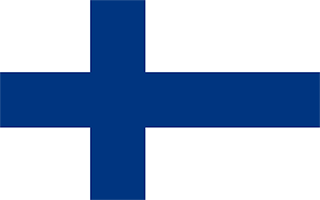
White with a blue cross extending to the edges of the flag; the vertical part of the cross is shifted to the hoist side in the style of the Dannebrog (Danish flag); the blue represents the thousands of lakes scattered across the country, while the white is for the snow that covers the land in winter.
Finland was a province and then a grand duchy under Sweden from the 12th to the 19th centuries, and an autonomous grand duchy of Russia after 1809. It gained complete independence in 1917. During World War II, Finland successfully defended its independence through cooperation with Germany and resisted subsequent invasions by the Soviet Union - albeit with some loss of territory. In the subsequent half century, Finland transformed from a farm/forest economy to a diversified modern industrial economy; per capita income is among the highest in Western Europe. A member of the EU since 1995, Finland was the only Nordic state to join the euro single currency at its initiation in January 1999. In the 21st century, the key features of Finland's modern welfare state are high quality education, promotion of equality, and a national social welfare system - currently challenged by an aging population and the fluctuations of an export-driven economy.
Geography
| Area | ||
|---|---|---|
| Total (World Rank: 66) | 338,145 | sq km |
| Land (World Rank: 70) | 303,815 | sq km |
| Water (World Rank: 18) | 34,330 | sq km |
| Forest (World Rank: 202) | 0.10 | % |
| Comparative | slightly more than two times the size of Georgia; slightly smaller than Montana | |
| Coastline | ||
| 1250 | ||
| Landborder | ||
| 2563 | ||
| Elevation | ||
| Highest point (World Rank: 151) | 1,328 | m |
| Agricultural land | ||
| Total (World Rank: 202) | 7.50 | % |
| Arable (World Rank: 131) | 7.40 | % |
| Permanent pastures (World Rank: 202) | 0.10 | % |
| Irrigated land (World Rank: 110) | 690 | sq km |
| Map reference | ||
| Europe | ||
| Environment | ||
| Issues |
| |
| Agreement party |
| |
| Hazzards | severe winters in the north | |
| Location | ||
| Northern Europe, bordering the Baltic Sea, Gulf of Bothnia, and Gulf of Finland, between Sweden and Russia | ||
| Climate | ||
| cold temperate; potentially subarctic but comparatively mild because of moderating influence of the North Atlantic Current, Baltic Sea, and more than 60,000 lakes | ||
| Terrain | ||
| mostly low, flat to rolling plains interspersed with lakes and low hills | ||
People
| Population | ||
|---|---|---|
| Total (World Rank: 117) | 5,518,370 | |
| Deathrate (World Rank: 40) | 1.00 | % |
| Birthrate (World Rank: 181) | 1.07 | % |
| Growthrate (World Rank: 163) | 0.36 | % |
| Migration rate (World Rank: 34) | 0.29 | % |
| Fertility rate (World Rank: 158) | 1.75 | % |
| Median age | ||
| Male (World Rank: 27) | 40.90 | |
| Female (World Rank: 22) | 44.30 | |
| Age structure | ||
| 0 14 male (World Rank: 127) | 463,432 | |
| 0 14 female (World Rank: 126) | 443,384 | |
| 15 24 male (World Rank: 125) | 321,609 | |
| 15 24 female (World Rank: 125) | 307,458 | |
| 25 54 male (World Rank: 120) | 1,064,430 | |
| 25 54 female (World Rank: 120) | 1,020,280 | |
| 55 64 male (World Rank: 82) | 360,821 | |
| 55 64 female (World Rank: 83) | 372,794 | |
| 65 x male (World Rank: 65) | 506,342 | |
| 65 x female (World Rank: 63) | 657,819 | |
| Health | ||
| Infant mortality rate (World Rank: 217) | 0.25 | % |
| Life expectancy total (World Rank: 31) | 81 | years |
| Life expectancy female (World Rank: 26) | 84 | years |
| Life expectancy male (World Rank: 37) | 78 | years |
| Physicians per 1000 (World Rank: 40) | 3.01 | |
| Hospital bed per 1000 (World Rank: 46) | 4.53 | |
| Sanitation access total (World Rank: 53) | 97.60 | % |
| Obesity adult (World Rank: 80) | 22.20 | % |
| Drinking water access (World Rank: 25) | 100.00 | % |
Energy
| Electricity | ||
|---|---|---|
| Production (World Rank: 41) | 65,170,000,000 | kWh |
| Consumption (World Rank: 36) | 79,070,000,000 | kWh |
| Export (World Rank: 41) | 3,159,000,000 | kWh |
| Import (World Rank: 8) | 22,110,000,000 | kWh |
| Source fossil (World Rank: 161) | 44.50 | % |
| Source nuclear (World Rank: 93) | 17.30 | % |
| Source renew (World Rank: 24) | 23.50 | % |
| Crude oil | ||
| Imports (World Rank: 29) | 220,400 | bbl / day |
| Refined products | ||
| Production (World Rank: 40) | 303,600 | bbl / day |
| Consumption (World Rank: 54) | 200,700 | bbl / day |
| Export (World Rank: 34) | 167,200 | bbl / day |
| Import (World Rank: 45) | 147,600 | bbl / day |
| Natural gas | ||
| Production (World Rank: 96) | 8,000,000 | m³ |
| Consumption (World Rank: 73) | 3,243,000,000 | m³ |
| Import (World Rank: 71) | 0 | m³ |
| Carbon footprint | ||
| 43000000 | ||
Nation
| Budget | ||
|---|---|---|
| Education (World Rank: 18) | 7 | % of GDP |
| Military (World Rank: 87) | 1 | % of GDP |
| Health (World Rank: 29) | 10 | % of GDP |
| Surplus (World Rank: 81) | -2 | % of GDP |
| National symbol | ||
| lion | ||
| National colours | ||
| white | ||
| Adjective | ||
| Finnish | ||
| Noun | ||
| Finn(s) | ||
| Background | ||
| Finland was a province and then a grand duchy under Sweden from the 12th to the 19th centuries, and an autonomous grand duchy of Russia after 1809. It gained complete independence in 1917. During World War II, Finland successfully defended its independence through cooperation with Germany and resisted subsequent invasions by the Soviet Union - albeit with some loss of territory. In the subsequent half century, Finland transformed from a farm/forest economy to a diversified modern industrial economy; per capita income is among the highest in Western Europe. A member of the EU since 1995, Finland was the only Nordic state to join the euro single currency at its initiation in January 1999. In the 21st century, the key features of Finland's modern welfare state are high quality education, promotion of equality, and a national social welfare system - currently challenged by an aging population and the fluctuations of an export-driven economy. | ||
| Flag description | ||
| white with a blue cross extending to the edges of the flag; the vertical part of the cross is shifted to the hoist side in the style of the Dannebrog (Danish flag); the blue represents the thousands of lakes scattered across the country, while the white is for the snow that covers the land in winter | ||
Economy
| Gdp | ||
|---|---|---|
| Purchasing power parity (World Rank: 62) | 231,900,000,000 | USD |
| Real growth rate (World Rank: 140) | 1.90 | % |
| Per capita purchasing power parity (World Rank: 38) | 42,300 | USD |
| Source agriculture (World Rank: 155) | 2.70 | % |
| Source industry (World Rank: 101) | 27.10 | % |
| Source service (World Rank: 63) | 70.20 | % |
| Labourforce | ||
| Total (World Rank: 110) | 2,685,000 | |
| Products | ||
| Industries |
| |
| Agriculture |
| |
| Exports |
| |
| Imports |
| |
Communication
| Phone | ||
|---|---|---|
| Landline total (World Rank: 96) | 457,300 | |
| Landline per 100 (World Rank: 141) | 8.00 | |
| Mobile per 100 (World Rank: 47) | 134.00 | |
| Assessment | 0 | |
| Internet | ||
| Users (World Rank: 77) | 4,822,130 | |
| Population (World Rank: 30) | 87.70 | % |
Transport
| Air | ||
|---|---|---|
| Airports paved (World Rank: 30) | 74.00 | |
| Airports unpaved (World Rank: 49) | 74.00 | |
| Rail | ||
| Total length (World Rank: 32) | 5,923 | |
| Road | ||
| Total length (World Rank: 16) | 454,000 | |
| Water | ||
| Total length (World Rank: 18) | 8,000 | |
This is a list of famous places in this country in alphabetical order.
 AEaenekoski
- Akaa
- Alahaermae
- Alavus
- Ekenaes
- Espoo
- Forssa
- Haemeenlinna
- Hamina
- Hanko
- Heinola
- Helsinki
- Huittinen
- Hyvinge
- Ii
- Iisalmi
- Ikaalinen
- Ilmajoki
- Imatra
- Inari
- Inga
- Ivalo
- Jaemsae
- Jaervenpaeae
- Jakobstad
- Janakkala
- Joensuu
- Joroinen
- Jyvaeskylae
- Kaarina
- Kajaani
- Kangasala
- Karkkila
- Kauhajoki
- Kauniainen
- Kemi
- Keminmaa
- Kerava
- Keuruu
- Kirkkonummi
- Kitee
- Kokemaeki
- Kokkola
- Kotka
- Kouvola
- Kristinestad
- Kuhmo
- Kuopio
- Kuusamo
- Lahti
- Lappeenranta
- Lapua
- Laukaa
- Lempaeaelae
- Leppaevirta
- Lieksa
- Lohja
- Lovisa
- Maentsaelae
- Mikkeli
- Muurame
- Naantali
- Nokia
- Nurmes
- Nurmijaervi
- Nykarleby
- Orimattila
- Oulu
- Pargas
- Pirkkala
- Pori
- Porvoo
- Raahe
- Raisio
- Rauma
- Riihimaeki
- Rovaniemi
- Saarijaervi
- Salo
- Savonlinna
- Seinaejoki
- Sibbo
- Siuntio
- Sodankylae
- Suomussalmi
- Suonenjoki
- Tampere
- Tornio
- Turku
- Tuusula
- Uusikaupunki
- Vaasa
- Valkeakoski
- Vammala
- Vantaa
- Varkaus
- Vihti
- Viitasaari
- Ylivieska
- Yloejaervi