Eritrea
in Eastern Africa
Africa
 Djibouti
 Ethiopia
 Sudan
Sudan- Currency and Currency Code:
- Nakfa - ERN
- Spoken languages:
- Afar, Arabic, Tigrinya
- Local electricity:
- 230 V - 50 Hz (plugs: C, L)
- Mobile phone / cellular frequencies (MHz):
- 900 MHz
- ISO 2-Letter code:
- ER
- Internet top level domain:
- .er
- Country phone prefix:
- +291
- Local Time (capital):
- Timezone:
- UTC/GMT offset: hours
Safety Score: 3,2 of 5.0 based on data from 9 authorites. Meaning please reconsider your need to travel to Eritrea.
Travel warnings are updated daily. Source: Travel Warning Eritrea. Last Update: 2024-04-24 08:14:40
Explore Eritrea
Eritrea with its capital Asmara is located in Africa (Eastern Africa, bordering the Red Sea). It covers some 117,601 square kilometers (slightly larger than Pennsylvania) with a population of 5,918,920. Afar, Arabic and Tigrinya are the languages spoken by people in Eritrea (consider regional differences). Djibouti, Ethiopia and Sudan are bordering countries.
Eritrea is in East Africa, bordering the Red Sea, between Djibouti and Sudan, with a long disputed border with Ethiopia.Hot, dry desert strip along Red Sea coast; cooler and wetter in the central highlands (up to 610mm (24 in) of rainfall annually); semiarid in western hills and lowlands; rainfall heaviest during June-September except in the coastal desert. Bordering Ethiopia, there are north-south trending highlands, descending on the east to a coastal desert plain, on the northwest to hilly terrain and on the southwest to rolling plains. Eritrea retained the entire coastline of Ethiopia along the Red Sea upon declaring independence from Ethiopia in 1993.
Popular Destinations in Eritrea
Administrative regions of Eritrea
- Anseba Region
- Debub Region
- Gash-Barka Region
- Maekel Region
- Northern Red Sea Region
- Southern Red Sea Region
About the country
The topography is dominated by extension of Ethiopian north-south trending highlands, descending on the east to a coastal desert plain, on the northwest to hilly terrain and on the southwest to flat-to-rolling plains. The average density of population is about 50 per km². The climate in Eritrea can be described as hot, dry desert strip along Red Sea coastcooler and wetter in the central highlands (up to 61 cm of rainfall annually, heaviest June to September), semiarid in western hills and lowlands. Potential natural disasters are Dubbi (1,625 m), which last erupted in 1861, was the country's only historically active volcano until Nabro (2,218 m) came to life on 12 June 2011, frequent droughts, rare earthquakes and volcanoes and locust swarms.
To reach someone Eritrea dial +291 prior to a number. The local cellular networks are operated on 900 MHz. Websites typically end with the top level domain ".er". If you want to bring electric appliances (e.g. battery chaarger), keep in min the local 230 V - 50 Hz (plugs: C, L). The sign for the locally used currency Nakfa is ERN.
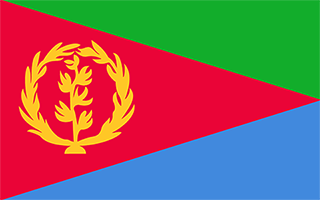
Red isosceles triangle (based on the hoist side) dividing the flag into two right triangles; the upper triangle is green, the lower one is blue; a gold wreath encircling a gold olive branch is centered on the hoist side of the red triangle; green stands for the country's agriculture economy, red signifies the blood shed in the fight for freedom, and blue symbolizes the bounty of the sea; the wreath-olive branch symbol is similar to that on the first flag of Eritrea from 1952; the shape of the red triangle broadly mimics the shape of the country.
After independence from Italian colonial control in 1941 and 10 years of British administrative control, the UN established Eritrea as an autonomous region within the Ethiopian federation in 1952. Ethiopia's full annexation of Eritrea as a province 10 years later sparked a violent 30-year struggle for independence that ended in 1991 with Eritrean rebels defeating government forces. Eritreans overwhelmingly approved independence in a 1993 referendum. ISAIAS Afworki has been Eritrea's only president since independence; his rule, particularly since 2001, has been highly autocratic and repressive. His government has created a highly militarized society by pursuing an unpopular program of mandatory conscription into national service, sometimes of indefinite length. A two-and-a-half-year border war with Ethiopia that erupted in 1998 ended under UN auspices in December 2000. A UN peacekeeping operation was established that monitored a 25 km-wide Temporary Security Zone. The Eritrea-Ethiopia Boundary Commission (EEBC) created in April 2003 was tasked "to delimit and demarcate the colonial treaty border based on pertinent colonial treaties (1900, 1902, and 1908) and applicable international law." The EEBC on 30 November 2007 remotely demarcated the border, assigning the town of Badme to Eritrea, despite Ethiopia's maintaining forces there from the time of the 1998-2000 war. Eritrea insisted that the UN terminate its peacekeeping mission on 31 July 2008. Eritrea has accepted the EEBC's "virtual demarcation" decision and repeatedly called on Ethiopia to remove its troops. Ethiopia has not accepted the demarcation decision, and neither party has entered into meaningful dialogue to resolve the impasse. Eritrea is subject to several UN Security Council Resolutions (initially in 2009 and renewed annually) imposing an arms embargo and a travel ban and assets freeze on certain individuals, in view of evidence that it has supported armed opposition groups in the region.
Geography
| Area | ||
|---|---|---|
| Total (World Rank: 102) | 117,600 | sq km |
| Land (World Rank: 104) | 101,000 | sq km |
| Water (World Rank: 34) | 16,600 | sq km |
| Forest (World Rank: 13) | 68.30 | % |
| Comparative | slightly larger than Pennsylvania | |
| Coastline | ||
| 2234 | ||
| Landborder | ||
| 1840 | ||
| Elevation | ||
| Lowest point (World Rank: 63) | -75 | m |
| Highest point (World Rank: 65) | 3,018 | m |
| Agricultural land | ||
| Total (World Rank: 12) | 75.10 | % |
| Arable (World Rank: 136) | 6.80 | % |
| Permanent pastures (World Rank: 13) | 68.30 | % |
| Irrigated land (World Rank: 135) | 210 | sq km |
| Map reference | ||
| Africa | ||
| Environment | ||
| Issues |
| |
| Agreement party |
| |
| Hazzards |
| |
| Location | ||
| Eastern Africa, bordering the Red Sea, between Djibouti and Sudan | ||
| Climate | ||
| hot, dry desert strip along Red Sea coast; cooler and wetter in the central highlands (up to 61 cm of rainfall annually, heaviest June to September); semiarid in western hills and lowlands | ||
| Terrain | ||
| dominated by extension of Ethiopian north-south trending highlands, descending on the east to a coastal desert plain, on the northwest to hilly terrain and on the southwest to flat-to-rolling plains | ||
People
| Population | ||
|---|---|---|
| Total (World Rank: 112) | 5,918,920 | |
| Deathrate (World Rank: 123) | 0.72 | % |
| Birthrate (World Rank: 39) | 2.96 | % |
| Growthrate (World Rank: 126) | 0.85 | % |
| Migration rate (World Rank: 180) | -1.39 | % |
| Fertility rate (World Rank: 35) | 3.99 | % |
| Median age | ||
| Male (World Rank: 198) | 19.20 | |
| Female (World Rank: 192) | 20.10 | |
| Age structure | ||
| 0 14 male (World Rank: 90) | 1,195,210 | |
| 0 14 female (World Rank: 89) | 1,182,600 | |
| 15 24 male (World Rank: 100) | 576,315 | |
| 15 24 female (World Rank: 98) | 582,143 | |
| 25 54 male (World Rank: 122) | 950,121 | |
| 25 54 female (World Rank: 121) | 981,163 | |
| 55 64 male (World Rank: 138) | 94,767 | |
| 55 64 female (World Rank: 133) | 124,528 | |
| 65 x male (World Rank: 133) | 97,530 | |
| 65 x female (World Rank: 134) | 134,539 | |
| Health | ||
| Infant mortality rate (World Rank: 41) | 4.50 | % |
| Life expectancy total (World Rank: 176) | 65 | years |
| Life expectancy female (World Rank: 175) | 68 | years |
| Life expectancy male (World Rank: 179) | 63 | years |
| Hospital bed per 1000 (World Rank: 161) | 0.70 | |
| Sanitation access total (World Rank: 199) | 15.70 | % |
| Obesity adult (World Rank: 183) | 5.00 | % |
| Drinking water access (World Rank: 191) | 57.80 | % |
Energy
| Electricity | ||
|---|---|---|
| Production (World Rank: 171) | 383,800,000 | kWh |
| Consumption (World Rank: 177) | 329,800,000 | kWh |
| Source fossil (World Rank: 39) | 98.60 | % |
| Source renew (World Rank: 128) | 1.40 | % |
| Refined products | ||
| Consumption (World Rank: 180) | 3,600 | bbl / day |
| Import (World Rank: 172) | 3,598 | bbl / day |
| Natural gas | ||
| Consumption (World Rank: 115) | 39 | m³ |
| Carbon footprint | ||
| 800000 | ||
Nation
| Budget | ||
|---|---|---|
| Health (World Rank: 178) | 3 | % of GDP |
| Surplus (World Rank: 195) | -11 | % of GDP |
| National symbol | ||
| camel | ||
| National colours | ||
| red | ||
| Adjective | ||
| Eritrean | ||
| Noun | ||
| Eritrean(s) | ||
| Background | ||
| After independence from Italian colonial control in 1941 and 10 years of British administrative control, the UN established Eritrea as an autonomous region within the Ethiopian federation in 1952. Ethiopia's full annexation of Eritrea as a province 10 years later sparked a violent 30-year struggle for independence that ended in 1991 with Eritrean rebels defeating government forces. Eritreans overwhelmingly approved independence in a 1993 referendum. ISAIAS Afworki has been Eritrea's only president since independence; his rule, particularly since 2001, has been highly autocratic and repressive. His government has created a highly militarized society by pursuing an unpopular program of mandatory conscription into national service, sometimes of indefinite length. A two-and-a-half-year border war with Ethiopia that erupted in 1998 ended under UN auspices in December 2000. A UN peacekeeping operation was established that monitored a 25 km-wide Temporary Security Zone. The Eritrea-Ethiopia Boundary Commission (EEBC) created in April 2003 was tasked "to delimit and demarcate the colonial treaty border based on pertinent colonial treaties (1900, 1902, and 1908) and applicable international law." The EEBC on 30 November 2007 remotely demarcated the border, assigning the town of Badme to Eritrea, despite Ethiopia's maintaining forces there from the time of the 1998-2000 war. Eritrea insisted that the UN terminate its peacekeeping mission on 31 July 2008. Eritrea has accepted the EEBC's "virtual demarcation" decision and repeatedly called on Ethiopia to remove its troops. Ethiopia has not accepted the demarcation decision, and neither party has entered into meaningful dialogue to resolve the impasse. Eritrea is subject to several UN Security Council Resolutions (initially in 2009 and renewed annually) imposing an arms embargo and a travel ban and assets freeze on certain individuals, in view of evidence that it has supported armed opposition groups in the region. | ||
| Flag description | ||
| red isosceles triangle (based on the hoist side) dividing the flag into two right triangles; the upper triangle is green, the lower one is blue; a gold wreath encircling a gold olive branch is centered on the hoist side of the red triangle; green stands for the country's agriculture economy, red signifies the blood shed in the fight for freedom, and blue symbolizes the bounty of the sea; the wreath-olive branch symbol is similar to that on the first flag of Eritrea from 1952; the shape of the red triangle broadly mimics the shape of the country | ||
Economy
| Gdp | ||
|---|---|---|
| Purchasing power parity (World Rank: 160) | 9,167,000,000 | USD |
| Real growth rate (World Rank: 73) | 3.70 | % |
| Per capita purchasing power parity (World Rank: 218) | 1,400 | USD |
| Source agriculture (World Rank: 78) | 12.10 | % |
| Source industry (World Rank: 79) | 29.50 | % |
| Source service (World Rank: 135) | 58.50 | % |
| Labourforce | ||
| Total (World Rank: 111) | 2,623,000 | |
| In poverty (World Rank: 21) | 50.00 | % |
| Products | ||
| Industries |
| |
| Agriculture |
| |
| Exports |
| |
| Imports |
| |
Communication
| Phone | ||
|---|---|---|
| Landline total (World Rank: 150) | 66,086 | |
| Landline per 100 (World Rank: 187) | 1.00 | |
| Mobile per 100 (World Rank: 216) | 9.00 | |
| Assessment | 0 | |
| Internet | ||
| Users (World Rank: 179) | 69,095 | |
| Population (World Rank: 224) | 1.20 | % |
Transport
| Air | ||
|---|---|---|
| Airports paved (World Rank: 157) | 4.00 | |
| Airports unpaved (World Rank: 136) | 9.00 | |
| Heliports (World Rank: 96) | 1.00 | |
| Rail | ||
| Total length (World Rank: 122) | 306 | |
| Road | ||
| Total length (World Rank: 158) | 4,010 | |
| Paved length (World Rank: 147) | 874 | |
| Unpaved length (World Rank: 113) | 3,136 | |
This is a list of famous places in this country in alphabetical order.
 Abbi Adi
- Ad Abeito
- Ad Dredi
- Ad Mocada
- Ad Teclai
- Adengefom
- Adi Ark'ay
- Adi Gebray
- Adi Gwa'idad
- Adi Hadid
- Adi Harre
- Adi Imneger
- Adi Katina
- Adi Kesaemti
- Adi Keyh
- Adi Zarna
- Adi-Gureto
- Adi-Nebri
- Adi-Quala
- Adi-Teklezan
- Af'abet
- Ak'ordat
- Akrur
- Aligider
- Amatere
- Asmara
- Assab
- Badme
- Barentu
- Bel'ebuy
- Beleza
- Beylul
- Bizione
- Dbarwa
- Dek'emhare
- Dengolo Tahtay
- Dildil
- Dissei
- Dogali
- Edd
- Emba-Derho
- Embatkala
- Enda-Ghergis
- Foro
- Fredarb
- Gahtielay
- Ghinda'e
- Godaif
- Gudela
- Gwelej
- Hadamu
- Hagaz
- Halib-Mentel
- Hashela
- Hatsina
- Hayelo
- Haykota
- Hibo
- Himbirti
- Himora
- Hinzi
- Hirgigo
- Hit'imlo
- Hit'ublo
- Keren
- Kudo-Felasi
- Kulul
- Mai-Mne
- Massawa
- Matara
- May Maho
- Megarih
- Mek'erka
- Mendefera
- Mersa Fat'ma
- Mets'alu
- Mihlab
- Nak'fa
- Nefasit
- Nokra
- Omhajer
- Ona
- Querbarya
- Raheita
- Sebar Guma
- Segheneyti
- Sen`afe
- Serejeka
- Sheh Abdel K'adir
- Shiketi
- Tantarua
- Tera-Emni
- Tinishu Assab
- Tio
- Tokombiya
- Tsa'edakristyan
- Uarare
- Wekerti
- Yigi'ar
- Zagr