El Salvador
in Central America
North America
 Guatemala
 Honduras
- Currency and Currency Code:
- Dollar - USD
- Spoken languages:
- Spanish
- Local electricity:
- 120 V - 60 Hz (plugs: A, B)
- Mobile phone / cellular frequencies (MHz):
- 850 MHz, 900 MHz, 1900 MHz, 3G, 4G
- ISO 2-Letter code:
- SV
- Internet top level domain:
- .sv
- Country phone prefix:
- +503
- Local Time (capital):
- Timezone:
- UTC/GMT offset: hours
Safety Score: 3,3 of 5.0 based on data from 9 authorites. Meaning please reconsider your need to travel to El Salvador.
Travel warnings are updated daily. Source: Travel Warning El Salvador. Last Update: 2024-04-23 08:18:23
Explore El Salvador
El Salvador with its capital San Salvador is located in North America (Central America, bordering the North Pacific Ocean). It covers some 21,042 square kilometers (about the same size as New Jersey) with 6,172,010 citizens. Spanish is the language commonly spoken used by the people in El Salvador. Interesting info is sharing borders with Guatemala and Honduras.
El Salvador is a country in Central America and, geographically, is part of continental North America. El Salvador is gaining a reputation for having some of the best surfing in the world. Tourists from all over Central America are discovering the surfing meccas of La Libertad (near San Salvador), El Sunzal, El Zonte and El Cuco (near San Miguel ), transforming El Salvador into the fastest growing surf tourism hot-spot in Central America. The countryside of El Salvador is breathtaking, with volcanoes and mountains offering green adventurers exactly what they are looking for. Many of environmentally-oriented community-based organizations promote eco-tourism, and there are a number of beautiful and secluded beaches and forests scattered throughout the country.
Popular Destinations in El Salvador
Administrative regions of El Salvador
- Departamento de Ahuachapan
- Departamento de Cabanas
- Departamento de Chalatenango
- Departamento de Cuscatlan
- Departamento de La Libertad
- Departamento de La Paz
- Departamento de La Union
- Departamento de Morazan
- Departamento de San Miguel
- Departamento de San Salvador
- Departamento de San Vicente
- Departamento de Santa Ana
- Departamento de Sonsonate
- Departamento de Usulutan
About the country

The landscape is mostly mountains with narrow coastal belt and central plateau. The average density of population is about 293 per km². The climate in El Salvador can be described as tropicalrainy season (May to October), dry season (November to April), tropical on coast, temperate in uplands. Potential threats by nature are extremely susceptible to hurricanes, frequent and sometimes destructive earthquakes and volcanic activity, known as the Land of Volcanoes and significant volcanic activity; San Salvador (1,893 m), which last erupted in 1917, has the potential to cause major harm to the country's capital, which lies just below the volcano's slopes; San Miguel (2,130 m), which last erupted in 2002, is one of the .
To reach someone El Salvador dial +503 prior to a number. The local cellular networks are operated on 850 MHz, 900 MHz, 1900 MHz, 3G, 4G. Websites typically end with the top level domain ".sv". If you want to bring electric appliances (e.g. battery chaarger), keep in min the local 120 V - 60 Hz (plugs: A, B). The sign for the locally used currency Dollar is USD.
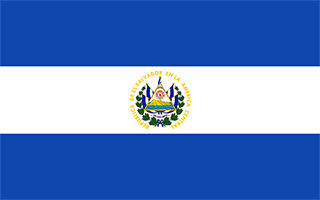
Three equal horizontal bands of cobalt blue (top), white, and cobalt blue with the national coat of arms centered in the white band; the coat of arms features a round emblem encircled by the words REPUBLICA DE EL SALVADOR EN LA AMERICA CENTRAL; the banner is based on the former blue-white-blue flag of the Federal Republic of Central America; the blue bands symbolize the Pacific Ocean and the Caribbean Sea, while the white band represents the land between the two bodies of water, as well as peace and prosperity.
El Salvador achieved independence from Spain in 1821 and from the Central American Federation in 1839. A 12-year civil war, which cost about 75,000 lives, was brought to a close in 1992 when the government and leftist rebels signed a treaty that provided for military and political reforms. El Salvador is beset by one of the world’s highest homicide rates and pervasive criminal gangs.
Geography
| Area | ||
|---|---|---|
| Total (World Rank: 153) | 21,041 | sq km |
| Land (World Rank: 151) | 20,721 | sq km |
| Water (World Rank: 127) | 320 | sq km |
| Forest (World Rank: 53) | 30.70 | % |
| Comparative | about the same size as New Jersey | |
| Coastline | ||
| 307 | ||
| Landborder | ||
| 590 | ||
| Elevation | ||
| Highest point (World Rank: 89) | 2,730 | m |
| Agricultural land | ||
| Total (World Rank: 15) | 74.70 | % |
| Arable (World Rank: 28) | 33.10 | % |
| Permanent crops (World Rank: 28) | 10.90 | % |
| Permanent pastures (World Rank: 53) | 30.70 | % |
| Irrigated land (World Rank: 117) | 452 | sq km |
| Map reference | ||
| Central America and the Caribbean | ||
| Environment | ||
| Issues |
| |
| Agreement party |
| |
| Agreement signed | Law of the Sea | |
| Hazzards |
| |
| Location | ||
| Central America, bordering the North Pacific Ocean, between Guatemala and Honduras | ||
| Climate | ||
| tropical; rainy season (May to October); dry season (November to April); tropical on coast; temperate in uplands | ||
| Terrain | ||
| mostly mountains with narrow coastal belt and central plateau | ||
People
| Population | ||
|---|---|---|
| Total (World Rank: 108) | 6,172,010 | |
| Deathrate (World Rank: 171) | 0.58 | % |
| Birthrate (World Rank: 112) | 1.62 | % |
| Growthrate (World Rank: 176) | 0.25 | % |
| Migration rate (World Rank: 170) | -0.80 | % |
| Fertility rate (World Rank: 141) | 1.87 | % |
| Median age | ||
| Male (World Rank: 147) | 25.60 | |
| Female (World Rank: 130) | 28.60 | |
| Age structure | ||
| 0 14 male (World Rank: 106) | 820,255 | |
| 0 14 female (World Rank: 106) | 779,306 | |
| 15 24 male (World Rank: 97) | 628,535 | |
| 15 24 female (World Rank: 96) | 620,230 | |
| 25 54 male (World Rank: 116) | 1,120,700 | |
| 25 54 female (World Rank: 108) | 1,300,770 | |
| 55 64 male (World Rank: 118) | 194,360 | |
| 55 64 female (World Rank: 110) | 246,164 | |
| 65 x male (World Rank: 100) | 203,320 | |
| 65 x female (World Rank: 103) | 258,365 | |
| Health | ||
| Infant mortality rate (World Rank: 96) | 1.68 | % |
| Life expectancy total (World Rank: 117) | 75 | years |
| Life expectancy female (World Rank: 106) | 78 | years |
| Life expectancy male (World Rank: 121) | 72 | years |
| Physicians per 1000 (World Rank: 76) | 1.92 | |
| Hospital bed per 1000 (World Rank: 144) | 1.10 | |
| Sanitation access total (World Rank: 136) | 75.00 | % |
| Obesity adult (World Rank: 56) | 24.60 | % |
| Drinking water access (World Rank: 119) | 93.80 | % |
Energy
| Electricity | ||
|---|---|---|
| Production (World Rank: 117) | 5,482,000,000 | kWh |
| Consumption (World Rank: 112) | 6,351,000,000 | kWh |
| Export (World Rank: 81) | 74,300,000 | kWh |
| Import (World Rank: 65) | 1,066,000,000 | kWh |
| Source fossil (World Rank: 148) | 51.60 | % |
| Source nuclear (World Rank: 72) | 25.60 | % |
| Source renew (World Rank: 19) | 25.70 | % |
| Crude oil | ||
| Exports (World Rank: 79) | 220 | bbl / day |
| Refined products | ||
| Consumption (World Rank: 104) | 46,000 | bbl / day |
| Export (World Rank: 118) | 225 | bbl / day |
| Import (World Rank: 84) | 45,540 | bbl / day |
| Natural gas | ||
| Consumption (World Rank: 162) | 5 | m³ |
| Carbon footprint | ||
| 4318000 | ||
Nation
| Budget | ||
|---|---|---|
| Education (World Rank: 125) | 3 | % of GDP |
| Military (World Rank: 126) | 1 | % of GDP |
| Health (World Rank: 86) | 7 | % of GDP |
| Surplus (World Rank: 107) | -3 | % of GDP |
| National symbol | ||
| turquoise-browed motmot | ||
| National colours | ||
| white | ||
| Adjective | ||
| Salvadoran | ||
| Noun | ||
| Salvadoran(s) | ||
| Background | ||
| El Salvador achieved independence from Spain in 1821 and from the Central American Federation in 1839. A 12-year civil war, which cost about 75,000 lives, was brought to a close in 1992 when the government and leftist rebels signed a treaty that provided for military and political reforms. El Salvador is beset by one of the world’s highest homicide rates and pervasive criminal gangs. | ||
| Flag description | ||
| three equal horizontal bands of cobalt blue (top), white, and cobalt blue with the national coat of arms centered in the white band; the coat of arms features a round emblem encircled by the words REPUBLICA DE EL SALVADOR EN LA AMERICA CENTRAL; the banner is based on the former blue-white-blue flag of the Federal Republic of Central America; the blue bands symbolize the Pacific Ocean and the Caribbean Sea, while the white band represents the land between the two bodies of water, as well as peace and prosperity | ||
Economy
| Gdp | ||
|---|---|---|
| Purchasing power parity (World Rank: 107) | 54,670,000,000 | USD |
| Real growth rate (World Rank: 113) | 2.40 | % |
| Per capita purchasing power parity (World Rank: 140) | 8,600 | USD |
| Source agriculture (World Rank: 85) | 10.60 | % |
| Source industry (World Rank: 116) | 24.60 | % |
| Source service (World Rank: 92) | 64.80 | % |
| Labourforce | ||
| Total (World Rank: 108) | 2,760,000 | |
| In poverty (World Rank: 49) | 34.90 | % |
| Products | ||
| Industries |
| |
| Agriculture |
| |
| Exports |
| |
| Imports |
| |
Communication
| Phone | ||
|---|---|---|
| Landline total (World Rank: 78) | 933,377 | |
| Landline per 100 (World Rank: 113) | 15.00 | |
| Mobile per 100 (World Rank: 29) | 148.00 | |
| Assessment | 0 | |
| Internet | ||
| Users (World Rank: 117) | 1,785,250 | |
| Population (World Rank: 160) | 29.00 | % |
Transport
| Air | ||
|---|---|---|
| Airports paved (World Rank: 148) | 5.00 | |
| Airports unpaved (World Rank: 52) | 63.00 | |
| Heliports (World Rank: 63) | 2.00 | |
| Rail | ||
| Total length (World Rank: 135) | 12.50 | |
| Road | ||
| Total length (World Rank: 146) | 6,979 | |
| Paved length (World Rank: 103) | 4,414 | |
| Unpaved length (World Rank: 115) | 2,565 | |
This is a list of famous places in this country in alphabetical order.
 Acajutla
- Aguilares
- Ahuachapan
- Anamoros
- Antiguo Cuscatlan
- Apastepeque
- Apopa
- Armenia
- Atiquizaya
- Ayutuxtepeque
- Berlin
- Cacaopera
- Candelaria de La Frontera
- Chalatenango
- Chalchuapa
- Chapeltique
- Chinameca
- Chirilagua
- Ciudad Arce
- Ciudad Barrios
- Coatepeque
- Cojutepeque
- Concepcion Batres
- Concepcion de Ataco
- Conchagua
- Corinto
- Cuscatancingo
- Delgado
- El Congo
- El Paisnal
- El Rosario
- El Transito
- Guatajiagua
- Guaymango
- Guazapa
- Ilopango
- Intipuca
- Izalco
- Jiquilisco
- Jocoro
- Juayua
- Jucuapa
- Jucuaran
- Jujutla
- La Libertad
- La Union
- Lolotique
- Mejicanos
- Metapan
- Moncagua
- Nahuizalco
- Nueva Concepcion
- Nueva Esparta
- Nueva Guadalupe
- Nuevo Cuscatlan
- Olocuilta
- Ozatlan
- Panchimalco
- Pasaquina
- Puerto El Triunfo
- Quezaltepeque
- Rosario de Mora
- San Agustin
- San Alejo
- San Antonio del Monte
- San Francisco
- San Francisco Menendez
- San Juan Opico
- San Marcos
- San Martin
- San Miguel
- San Pablo Tacachico
- San Pedro Masahuat
- San Rafael Oriente
- San Salvador
- San Sebastian
- San Vicente
- Santa Ana
- Santa Elena
- Santa Rosa de Lima
- Santa Tecla
- Santiago Nonualco
- Santiago de Maria
- Santo Tomas
- Sensuntepeque
- Sesori
- Sociedad
- Sonsonate
- Sonzacate
- Soyapango
- Suchitoto
- Tacuba
- Tecoluca
- Tenancingo
- Texistepeque
- Tonacatepeque
- Usulutan
- Victoria
- Zacatecoluca
- Zaragoza