Egypt
in Northern Africa
Africa
 Israel
 Libya
Libya Palestinian Territory
 Sudan
Sudan- Currency and Currency Code:
- Pound - EGP
- Spoken languages:
- Arabic, English, French
- Local electricity:
- 220 V - 50 Hz (plugs: C, F)
- Mobile phone / cellular frequencies (MHz):
- 900 MHz, 1800 MHz, 3G, 4G
- ISO 2-Letter code:
- EG
- Internet top level domain:
- .eg
- Country phone prefix:
- +20
- Local Time (capital):
- Timezone:
- UTC/GMT offset: hours
Safety Score: 3,4 of 5.0 based on data from 9 authorites. Meaning please reconsider your need to travel to Egypt.
Travel warnings are updated daily. Source: Travel Warning Egypt. Last Update: 2024-04-19 08:03:45
Explore Egypt
Egypt with its capital Cairo is located in Africa (Northern Africa, bordering the Mediterranean Sea). It covers some 1,001,451 square kilometers (more than eight times the size of Ohio) with a population of 97,041,100. Arabic, English and French are the languages spoken by people in Egypt (consider regional differences). Israel, Libya, Palestinian Territory and Sudan are bordering countries.
Egypt is in north-eastern Africa. Egypt is perhaps best known as the home of the ancient Egyptian civilization, with its temples, hieroglyphs, mummies, and pyramids. It is probably one of the most popular tourist destinations world-wide. Tourist attractions include Roman and Greek monuments, Bibliotheca Alexandria, Qa'edbay's Castle, and Qasr El Montaza (El Montaza Palace). Egypt can be a fantastic place to sample a unique range of food: not too spicy and well-flavoured with herbs. There is a full range of accommodation options, from basic backpacker hostels to five-star resorts. Egypt is a predominanty Muslim nation and alcoholic drinks are religiously forbidden (haram) - though not legally. Egypt is generally a safe and friendly country to travel. Egyptians on the whole are very friendly - if you are in need of assistance they will generally try to help you as much as they are able. Pickpocketing is a problem in Egypt's bigger cities, particularly Cairo. Many locals opt not to carry wallets at all, instead keeping their money in a clip in their pocket. Egypt is largely a desert, an extension of the great Sahara that bands North Africa. Save for the thin strip of watered land along the Nile River, very little could survive here.
Popular Destinations in Egypt
Administrative regions of Egypt
- Alexandria Governorate
- Aswan Governorate
- Asyut Governorate
- Beheira Governorate
- Beni Suweif Governorate
- Cairo Governorate
- Dakahlia Governorate
- Damietta Governorate
- Faiyum Governorate
- Gharbia Governorate
- Giza Governorate
- Ismailia Governorate
- Kafr el-Sheikh Governorate
- Luxor Governorate
- Matruh Governorate
- Minya Governorate
- Monufia Governorate
- New Valley Governorate
- North Sinai Governorate
- Port Said Governorate
- Qalyubia Governorate
- Qena Governorate
- Red Sea Governorate
- Sharqia Province
- Sohag Governorate
- South Sinai Governorate
- Suez Governorate
About the country
The topography is vast desert plateau interrupted by Nile valley and delta. The average density of population is about 97 per km². The climate in Egypt can be described as desert with hot, dry summers with moderate winters. Potential natural disasters are dust storms, flash floods, frequent earthquakes, hot, driving windstorms called khamsin occur in spring, landslides, periodic droughts and sandstorms.
To reach someone Egypt dial +20 prior to a number. The local cellular networks are operated on 900 MHz, 1800 MHz, 3G, 4G. Websites typically end with the top level domain ".eg". If you want to bring electric appliances (e.g. battery chaarger), keep in min the local 220 V - 50 Hz (plugs: C, F). The sign for the locally used currency Pound is EGP.
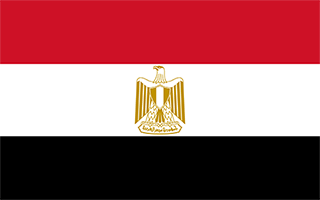
Three equal horizontal bands of red (top), white, and black; the national emblem (a gold Eagle of Saladin facing the hoist side with a shield superimposed on its chest above a scroll bearing the name of the country in Arabic) centered in the white band; the band colors derive from the Arab Liberation flag and represent oppression (black), overcome through bloody struggle (red), to be replaced by a bright future (white).
The regularity and richness of the annual Nile River flood, coupled with semi-isolation provided by deserts to the east and west, allowed for the development of one of the world's great civilizations. A unified kingdom arose circa 3200 B.C., and a series of dynasties ruled in Egypt for the next three millennia. The last native dynasty fell to the Persians in 341 B.C., who in turn were replaced by the Greeks, Romans, and Byzantines. It was the Arabs who introduced Islam and the Arabic language in the 7th century and who ruled for the next six centuries. A local military caste, the Mamluks took control about 1250 and continued to govern after the conquest of Egypt by the Ottoman Turks in 1517. Completion of the Suez Canal in 1869 elevated Egypt as an important world transportation hub. Ostensibly to protect its investments, Britain seized control of Egypt's government in 1882, but nominal allegiance to the Ottoman Empire continued until 1914. Partially independent from the UK in 1922, Egypt acquired full sovereignty from Britain in 1952. The completion of the Aswan High Dam in 1971 and the resultant Lake Nasser have altered the time-honored place of the Nile River in the agriculture and ecology of Egypt. A rapidly growing population (the largest in the Arab world), limited arable land, and dependence on the Nile all continue to overtax resources and stress society. The government has struggled to meet the demands of Egypt's population through economic reform and massive investment in communications and physical infrastructure. Inspired by the 2010 Tunisian revolution, Egyptian opposition groups led demonstrations and labor strikes countrywide, culminating in President Hosni MUBARAK's ouster in 2011. Egypt's military assumed national leadership until a new parliament was in place in early 2012; later that same year, Mohammed MORSI won the presidential election. Following often violent protests throughout the spring of 2013 against MORSI's government and the Muslim Brotherhood, the Egyptian Armed Forces intervened and removed MORSI from power in July 2013 and replaced him with interim president Adly MANSOUR. In January 2014, voters approved a new constitution by referendum and in May 2014 elected Abdelfattah ELSISI president. Egypt elected a new legislature in December 2015, the first parliament since 2012.
Geography
| Area | ||
|---|---|---|
| Total (World Rank: 31) | 1,001,450 | sq km |
| Land (World Rank: 30) | 995,450 | sq km |
| Water (World Rank: 63) | 6,000 | sq km |
| Comparative | more than eight times the size of Ohio; slightly more than three times the size of New Mexico | |
| Coastline | ||
| 2450 | ||
| Landborder | ||
| 2612 | ||
| Elevation | ||
| Lowest point (World Rank: 69) | -133 | m |
| Highest point (World Rank: 94) | 2,629 | m |
| Agricultural land | ||
| Total (World Rank: 213) | 3.60 | % |
| Arable (World Rank: 172) | 2.80 | % |
| Permanent crops (World Rank: 129) | 0.80 | % |
| Irrigated land (World Rank: 17) | 36,500 | sq km |
| Map reference | ||
| Africa | ||
| Environment | ||
| Issues |
| |
| Agreement party |
| |
| Hazzards |
| |
| Location | ||
| Northern Africa, bordering the Mediterranean Sea, between Libya and the Gaza Strip, and the Red Sea north of Sudan, and includes the Asian Sinai Peninsula | ||
| Climate | ||
| desert; hot, dry summers with moderate winters | ||
| Terrain | ||
| vast desert plateau interrupted by Nile valley and delta | ||
People
| Population | ||
|---|---|---|
| Total (World Rank: 14) | 97,041,100 | |
| Deathrate (World Rank: 202) | 0.46 | % |
| Birthrate (World Rank: 38) | 2.96 | % |
| Growthrate (World Rank: 22) | 2.45 | % |
| Migration rate (World Rank: 92) | -0.05 | % |
| Fertility rate (World Rank: 43) | 3.47 | % |
| Median age | ||
| Male (World Rank: 162) | 23.60 | |
| Female (World Rank: 162) | 24.20 | |
| Age structure | ||
| 0 14 male (World Rank: 13) | 16,720,300 | |
| 0 14 female (World Rank: 13) | 15,583,000 | |
| 15 24 male (World Rank: 12) | 9,464,260 | |
| 15 24 female (World Rank: 12) | 8,919,610 | |
| 25 54 male (World Rank: 15) | 18,545,400 | |
| 25 54 female (World Rank: 15) | 17,944,600 | |
| 55 64 male (World Rank: 22) | 2,861,140 | |
| 55 64 female (World Rank: 24) | 2,911,590 | |
| 65 x male (World Rank: 26) | 1,993,250 | |
| 65 x female (World Rank: 28) | 2,097,900 | |
| Health | ||
| Infant mortality rate (World Rank: 84) | 1.90 | % |
| Life expectancy total (World Rank: 139) | 73 | years |
| Life expectancy female (World Rank: 152) | 74 | years |
| Life expectancy male (World Rank: 122) | 72 | years |
| Physicians per 1000 (World Rank: 119) | 0.81 | |
| Hospital bed per 1000 (World Rank: 171) | 0.50 | |
| Sanitation access total (World Rank: 76) | 94.70 | % |
| Obesity adult (World Rank: 18) | 32.00 | % |
| Drinking water access (World Rank: 60) | 99.40 | % |
Energy
| Electricity | ||
|---|---|---|
| Production (World Rank: 22) | 171,900,000,000 | kWh |
| Consumption (World Rank: 23) | 150,400,000,000 | kWh |
| Export (World Rank: 56) | 1,158,000,000 | kWh |
| Import (World Rank: 104) | 43,000,000 | kWh |
| Source fossil (World Rank: 63) | 90.50 | % |
| Source nuclear (World Rank: 122) | 7.30 | % |
| Source renew (World Rank: 113) | 2.20 | % |
| Crude oil | ||
| Production (World Rank: 28) | 494,300 | bbl / day |
| Exports (World Rank: 31) | 197,700 | bbl / day |
| Imports (World Rank: 52) | 60,940 | bbl / day |
| Proved reserves (World Rank: 25) | 4,400,000,000 | bbl |
| Refined products | ||
| Production (World Rank: 34) | 471,800 | bbl / day |
| Consumption (World Rank: 27) | 802,000 | bbl / day |
| Export (World Rank: 55) | 39,220 | bbl / day |
| Import (World Rank: 29) | 206,100 | bbl / day |
| Natural gas | ||
| Production (World Rank: 54) | 3,610,000,000 | m³ |
| Consumption (World Rank: 15) | 77,930,000,000 | m³ |
| Export (World Rank: 39) | 720,000,000 | m³ |
| Import (World Rank: 73) | 0 | m³ |
| Carbon footprint | ||
| 207000000 | ||
Nation
| Budget | ||
|---|---|---|
| Education (World Rank: 114) | 4 | % of GDP |
| Military (World Rank: 65) | 2 | % of GDP |
| Health (World Rank: 122) | 6 | % of GDP |
| Surplus (World Rank: 191) | -10 | % of GDP |
| National symbol | ||
| white lotus | ||
| National colours | ||
| white | ||
| Adjective | ||
| Egyptian | ||
| Noun | ||
| Egyptian(s) | ||
| Background | ||
| The regularity and richness of the annual Nile River flood, coupled with semi-isolation provided by deserts to the east and west, allowed for the development of one of the world's great civilizations. A unified kingdom arose circa 3200 B.C., and a series of dynasties ruled in Egypt for the next three millennia. The last native dynasty fell to the Persians in 341 B.C., who in turn were replaced by the Greeks, Romans, and Byzantines. It was the Arabs who introduced Islam and the Arabic language in the 7th century and who ruled for the next six centuries. A local military caste, the Mamluks took control about 1250 and continued to govern after the conquest of Egypt by the Ottoman Turks in 1517. Completion of the Suez Canal in 1869 elevated Egypt as an important world transportation hub. Ostensibly to protect its investments, Britain seized control of Egypt's government in 1882, but nominal allegiance to the Ottoman Empire continued until 1914. Partially independent from the UK in 1922, Egypt acquired full sovereignty from Britain in 1952. The completion of the Aswan High Dam in 1971 and the resultant Lake Nasser have altered the time-honored place of the Nile River in the agriculture and ecology of Egypt. A rapidly growing population (the largest in the Arab world), limited arable land, and dependence on the Nile all continue to overtax resources and stress society. The government has struggled to meet the demands of Egypt's population through economic reform and massive investment in communications and physical infrastructure. Inspired by the 2010 Tunisian revolution, Egyptian opposition groups led demonstrations and labor strikes countrywide, culminating in President Hosni MUBARAK's ouster in 2011. Egypt's military assumed national leadership until a new parliament was in place in early 2012; later that same year, Mohammed MORSI won the presidential election. Following often violent protests throughout the spring of 2013 against MORSI's government and the Muslim Brotherhood, the Egyptian Armed Forces intervened and removed MORSI from power in July 2013 and replaced him with interim president Adly MANSOUR. In January 2014, voters approved a new constitution by referendum and in May 2014 elected Abdelfattah ELSISI president. Egypt elected a new legislature in December 2015, the first parliament since 2012. | ||
| Flag description | ||
| three equal horizontal bands of red (top), white, and black; the national emblem (a gold Eagle of Saladin facing the hoist side with a shield superimposed on its chest above a scroll bearing the name of the country in Arabic) centered in the white band; the band colors derive from the Arab Liberation flag and represent oppression (black), overcome through bloody struggle (red), to be replaced by a bright future (white) | ||
Economy
| Gdp | ||
|---|---|---|
| Purchasing power parity (World Rank: 22) | 1,132,000,000,000 | USD |
| Real growth rate (World Rank: 52) | 4.30 | % |
| Per capita purchasing power parity (World Rank: 118) | 12,600 | USD |
| Source agriculture (World Rank: 81) | 11.90 | % |
| Source industry (World Rank: 59) | 32.90 | % |
| Source service (World Rank: 151) | 55.20 | % |
| Labourforce | ||
| Total (World Rank: 22) | 28,900,000 | |
| In poverty (World Rank: 78) | 25.20 | % |
| Products | ||
| Industries |
| |
| Agriculture |
| |
| Exports |
| |
| Imports |
| |
Communication
| Phone | ||
|---|---|---|
| Landline total (World Rank: 26) | 6,118,250 | |
| Landline per 100 (World Rank: 149) | 6.00 | |
| Mobile per 100 (World Rank: 130) | 103.00 | |
| Assessment | 0 | |
| Internet | ||
| Users (World Rank: 19) | 37,122,500 | |
| Population (World Rank: 141) | 39.20 | % |
Transport
| Air | ||
|---|---|---|
| Airports paved (World Rank: 32) | 72.00 | |
| Airports unpaved (World Rank: 129) | 11.00 | |
| Heliports (World Rank: 29) | 7.00 | |
| Rail | ||
| Total length (World Rank: 38) | 5,085 | |
| Road | ||
| Total length (World Rank: 39) | 137,430 | |
| Paved length (World Rank: 25) | 126,742 | |
| Unpaved length (World Rank: 82) | 10,688 | |
| Water | ||
| Total length (World Rank: 30) | 3,500 | |
This is a list of famous places in this country in alphabetical order.
 Abu Kabir
- Abu Qurqas
- Abu Simbel
- Abu Tij
- Abu al Matamir
- Ad Dilinjat
- Aja
- Akhmim
- Al -Arish
- Al Bajur
- Al Balyana
- Al Bawiti
- Al Fayyum
- Al Hamul
- Al Jammaliyah
- Al Kharijah
- Al Mahallah al Kubra
- Al Mansurah
- Al Manzalah
- Al Matariyah
- Al Qanatir al Khayriyah
- Al Qurayn
- Al Qusayr
- Al Qusiyah
- Alexandria
- Ash Shuhada'
- Ashmun
- Aswan
- Asyut
- Awsim
- Az Zarqa
- Banha
- Bani Suwayf
- Bilbays
- Bilqas
- Cairo
- Dahab
- Damanhur
- Damietta
- Dayrut
- Dikirnis
- Disuq
- Diyarb Najm
- El Alamein
- El Gouna
- El-Tor
- Faqus
- Faraskur
- Fuwwah
- Giza
- Halwan
- Hihya
- Hurghada
- Idfu
- Idku
- Ismailia
- Isna
- Jirja
- Juhaynah
- Kafr Saqr
- Kafr ad Dawwar
- Kafr ash Shaykh
- Kafr az Zayyat
- Kawm Umbu
- Kousa
- Luxor
- Makadi Bay
- Mallawi
- Manfalut
- Marsa Alam
- Marsa Matruh
- Matay
- Minya
- Minyat an Nasr
- Munuf
- Naja' Hammadi
- Nuweiba
- Port Said
- Qalyub
- Qina
- Qutur
- Quwaysina
- Rosetta
- Safaga
- Samannud
- Sharm el Sheikh
- Shibin al Kawm
- Shibin al Qanatir
- Shirbin
- Siwah
- Sohag
- Suez
- Tahta
- Tala
- Talkha
- Tanda
- Toukh
- Zagazig
- Zifta
- `Izbat al Burj