Ecuador
in South America
South America
 Colombia
 Peru
Peru- Currency and Currency Code:
- Dollar - USD
- Spoken languages:
- Spanish
- Local electricity:
- 120 V - 60 Hz (plugs: A, B)
- Mobile phone / cellular frequencies (MHz):
- 850 MHz, 1900 MHz, 3G, 4G
- ISO 2-Letter code:
- EC
- Internet top level domain:
- .ec
- Country phone prefix:
- +593
- Local Time (capital):
- Timezone:
- UTC/GMT offset: hours
Safety Score: 3,3 of 5.0 based on data from 9 authorites. Meaning please reconsider your need to travel to Ecuador.
Travel warnings are updated daily. Source: Travel Warning Ecuador. Last Update: 2024-04-19 08:03:45
Explore Ecuador
Ecuador with its capital Quito is located in South America (Western South America, bordering the Pacific Ocean at the Equator). It covers some 283,562 square kilometers (slightly smaller than Nevada) with 16,290,900 citizens. Spanish is the official language used in Ecuador. As an interesting fact, is sharing borders with Colombia and Peru.
Ecuador is a country in South America with a Pacific Ocean coastline and the world's highest active volcano (Cotopaxi). Intercity buses travel to almost everywhere in Ecuador. Many cities have a central bus terminal, known as the terminal terrestre. Quito is a great place to learn Spanish. Quite a few private Spanish academies exist. Quality varies greatly, so check reviews online and speak to current students before enrolling. Ecuador uses the U.S. dollar as its currency. Other types of currency are not readily accepted. Water from the tap is unsafe to drink. Even Ecuadorians generally only drink bottled (or boiled) water. Ecuador offers great opportunities for hiking and climbing, unfortunately, some travelers have been attacked and robbed in remote sections of well known climbs. Travelers are urged to avoid solo hikes and to go in a large group for safety reasons. You can always ask tourist police officers, police officers or in Tourist information center for the dangerous regions. Outside the major cities and tourist areas, malaria can be a problem along the coast during the rainy season.
Popular Destinations in Ecuador
Administrative regions of Ecuador
- Provincia de Bolivar
- Provincia de Cotopaxi
- Provincia de El Oro
- Provincia de Esmeraldas
- Provincia de Francisco de Orellana
- Provincia de Galapagos
- Provincia de Imbabura
- Provincia de Loja
- Provincia de Los Rios
- Provincia de Manabi
- Provincia de Morona-Santiago
- Provincia de Napo
- Provincia de Pichincha
- Provincia de Santa Elena
- Provincia de Santo Domingo de los Tsachilas
- Provincia de Sucumbios
- Provincia de Zamora-Chinchipe
- Provincia del Azuay
- Provincia del Canar
- Provincia del Carchi
- Provincia del Chimborazo
- Provincia del Guayas
- Provincia del Pastaza
- Provincia del Tungurahua
About the country

The topography is coastal plain (costa), inter-Andean central highlands (sierra), and flat to rolling eastern jungle (oriente). The average density of population is about 57 per km². The climate in Ecuador can be described as tropical along coast, becoming cooler inland at higher elevations with tropical in Amazonian jungle lowlands. Potential natural disasters are floods, frequent earthquakes, landslides, periodic droughts, volcanic activity and volcanic activity concentrated along the Andes Mountains; Sangay (5,230 m), which erupted in 2010, is mainland Ecuador's most active volcano; other historically active volcanoes in the Andes include Antisana, Cayambe, Chacana, Cotopaxi, Guagua Pichincha, .
To reach someone Ecuador dial +593 prior to a number. The local cellular networks are operated on 850 MHz, 1900 MHz, 3G, 4G. Websites typically end with the top level domain ".ec". If you want to bring electric appliances (e.g. battery chaarger), keep in min the local 120 V - 60 Hz (plugs: A, B). The sign for the locally used currency Dollar is USD.
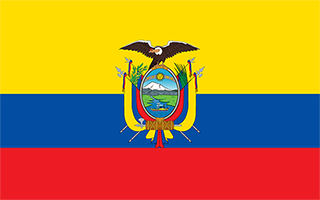
Three horizontal bands of yellow (top, double width), blue, and red with the coat of arms superimposed at the center of the flag; the flag retains the three main colors of the banner of Gran Colombia, the South American republic that broke up in 1830; the yellow color represents sunshine, grain, and mineral wealth, blue the sky, sea, and rivers, and red the blood of patriots spilled in the struggle for freedom and justice.
What is now Ecuador formed part of the northern Inca Empire until the Spanish conquest in 1533. Quito became a seat of Spanish colonial government in 1563 and part of the Viceroyalty of New Granada in 1717. The territories of the Viceroyalty - New Granada (Colombia), Venezuela, and Quito - gained their independence between 1819 and 1822 and formed a federation known as Gran Colombia. When Quito withdrew in 1830, the traditional name was changed in favor of the "Republic of the Equator." Between 1904 and 1942, Ecuador lost territories in a series of conflicts with its neighbors. A border war with Peru that flared in 1995 was resolved in 1999. Although Ecuador marked 30 years of civilian governance in 2004, the period was marred by political instability. Protests in Quito contributed to the mid-term ouster of three of Ecuador's last four democratically elected presidents. In late 2008, voters approved a new constitution, Ecuador's 20th since gaining independence. General elections were held in February 2013, and voters reelected President Rafael CORREA.
Geography
| Area | ||
|---|---|---|
| Total (World Rank: 75) | 283,561 | sq km |
| Land (World Rank: 73) | 276,841 | sq km |
| Water (World Rank: 61) | 6,720 | sq km |
| Forest (World Rank: 93) | 19.40 | % |
| Comparative | slightly smaller than Nevada | |
| Note | includes Galapagos Islands | |
| Coastline | ||
| 2237 | ||
| Landborder | ||
| 2237 | ||
| Elevation | ||
| Highest point (World Rank: 14) | 6,267 | m |
| Agricultural land | ||
| Total (World Rank: 139) | 29.70 | % |
| Arable (World Rank: 154) | 4.70 | % |
| Permanent crops (World Rank: 54) | 5.60 | % |
| Permanent pastures (World Rank: 93) | 19.40 | % |
| Irrigated land (World Rank: 35) | 15,000 | sq km |
| Map reference | ||
| South America | ||
| Environment | ||
| Issues |
| |
| Agreement party |
| |
| Hazzards |
| |
| Location | ||
| Western South America, bordering the Pacific Ocean at the Equator, between Colombia and Peru | ||
| Climate | ||
| tropical along coast, becoming cooler inland at higher elevations; tropical in Amazonian jungle lowlands | ||
| Terrain | ||
| coastal plain (costa), inter-Andean central highlands (sierra), and flat to rolling eastern jungle (oriente) | ||
People
| Population | ||
|---|---|---|
| Total (World Rank: 67) | 16,290,900 | |
| Deathrate (World Rank: 190) | 0.51 | % |
| Birthrate (World Rank: 100) | 1.79 | % |
| Growthrate (World Rank: 86) | 1.28 | % |
| Fertility rate (World Rank: 97) | 2.19 | % |
| Median age | ||
| Male (World Rank: 142) | 27.00 | |
| Female (World Rank: 135) | 28.40 | |
| Age structure | ||
| 0 14 male (World Rank: 74) | 2,250,000 | |
| 0 14 female (World Rank: 74) | 2,161,120 | |
| 15 24 male (World Rank: 65) | 1,519,260 | |
| 15 24 female (World Rank: 66) | 1,469,370 | |
| 25 54 male (World Rank: 64) | 3,145,950 | |
| 25 54 female (World Rank: 64) | 3,303,520 | |
| 55 64 male (World Rank: 62) | 599,032 | |
| 55 64 female (World Rank: 62) | 628,477 | |
| 65 x male (World Rank: 60) | 576,196 | |
| 65 x female (World Rank: 64) | 637,984 | |
| Health | ||
| Infant mortality rate (World Rank: 97) | 1.64 | % |
| Life expectancy total (World Rank: 76) | 77 | years |
| Life expectancy female (World Rank: 77) | 80 | years |
| Life expectancy male (World Rank: 78) | 74 | years |
| Physicians per 1000 (World Rank: 86) | 1.67 | |
| Hospital bed per 1000 (World Rank: 121) | 1.60 | |
| Sanitation access total (World Rank: 111) | 84.70 | % |
| Obesity adult (World Rank: 108) | 19.90 | % |
| Drinking water access (World Rank: 148) | 86.90 | % |
Energy
| Electricity | ||
|---|---|---|
| Production (World Rank: 70) | 24,950,000,000 | kWh |
| Consumption (World Rank: 69) | 22,140,000,000 | kWh |
| Export (World Rank: 87) | 46,000,000 | kWh |
| Import (World Rank: 79) | 512,000,000 | kWh |
| Source fossil (World Rank: 137) | 56.90 | % |
| Source nuclear (World Rank: 48) | 39.90 | % |
| Source renew (World Rank: 106) | 3.20 | % |
| Crude oil | ||
| Production (World Rank: 26) | 548,400 | bbl / day |
| Exports (World Rank: 23) | 400,700 | bbl / day |
| Proved reserves (World Rank: 17) | 8,273,000,000 | bbl |
| Refined products | ||
| Production (World Rank: 58) | 146,500 | bbl / day |
| Consumption (World Rank: 46) | 274,000 | bbl / day |
| Export (World Rank: 63) | 25,940 | bbl / day |
| Import (World Rank: 42) | 155,700 | bbl / day |
| Natural gas | ||
| Production (World Rank: 70) | 497,000,000 | m³ |
| Consumption (World Rank: 97) | 1,002,000,000 | m³ |
| Carbon footprint | ||
| 38000000 | ||
Nation
| Budget | ||
|---|---|---|
| Education (World Rank: 75) | 5 | % of GDP |
| Military (World Rank: 45) | 2 | % of GDP |
| Health (World Rank: 35) | 9 | % of GDP |
| Surplus (World Rank: 182) | -8 | % of GDP |
| National symbol | ||
| Andean condor | ||
| National colours | ||
| yellow | ||
| Adjective | ||
| Ecuadorian | ||
| Noun | ||
| Ecuadorian(s) | ||
| Background | ||
| What is now Ecuador formed part of the northern Inca Empire until the Spanish conquest in 1533. Quito became a seat of Spanish colonial government in 1563 and part of the Viceroyalty of New Granada in 1717. The territories of the Viceroyalty - New Granada (Colombia), Venezuela, and Quito - gained their independence between 1819 and 1822 and formed a federation known as Gran Colombia. When Quito withdrew in 1830, the traditional name was changed in favor of the "Republic of the Equator." Between 1904 and 1942, Ecuador lost territories in a series of conflicts with its neighbors. A border war with Peru that flared in 1995 was resolved in 1999. Although Ecuador marked 30 years of civilian governance in 2004, the period was marred by political instability. Protests in Quito contributed to the mid-term ouster of three of Ecuador's last four democratically elected presidents. In late 2008, voters approved a new constitution, Ecuador's 20th since gaining independence. General elections were held in February 2013, and voters reelected President Rafael CORREA. | ||
| Flag description | ||
| three horizontal bands of yellow (top, double width), blue, and red with the coat of arms superimposed at the center of the flag; the flag retains the three main colors of the banner of Gran Colombia, the South American republic that broke up in 1830; the yellow color represents sunshine, grain, and mineral wealth, blue the sky, sea, and rivers, and red the blood of patriots spilled in the struggle for freedom and justice | ||
Economy
| Gdp | ||
|---|---|---|
| Purchasing power parity (World Rank: 65) | 184,900,000,000 | USD |
| Real growth rate (World Rank: 195) | -1.50 | % |
| Per capita purchasing power parity (World Rank: 131) | 11,200 | USD |
| Source agriculture (World Rank: 114) | 6.40 | % |
| Source industry (World Rank: 52) | 33.80 | % |
| Source service (World Rank: 129) | 59.70 | % |
| Labourforce | ||
| Total (World Rank: 62) | 7,874,000 | |
| In poverty (World Rank: 76) | 25.60 | % |
| Products | ||
| Industries |
| |
| Agriculture |
| |
| Exports |
| |
| Imports |
| |
Communication
| Phone | ||
|---|---|---|
| Landline total (World Rank: 53) | 2,441,170 | |
| Landline per 100 (World Rank: 112) | 15.00 | |
| Mobile per 100 (World Rank: 154) | 86.00 | |
| Assessment | 0 | |
| Internet | ||
| Users (World Rank: 50) | 8,693,740 | |
| Population (World Rank: 109) | 54.10 | % |
Transport
| Air | ||
|---|---|---|
| Airports paved (World Rank: 22) | 104.00 | |
| Airports unpaved (World Rank: 14) | 328 | |
| Heliports (World Rank: 64) | 2.00 | |
| Rail | ||
| Total length (World Rank: 92) | 965 | |
| Road | ||
| Total length (World Rank: 84) | 43,670 | |
| Paved length (World Rank: 90) | 6,472 | |
| Unpaved length (World Rank: 43) | 37,198 | |
| Water | ||
| Total length (World Rank: 54) | 1,500 | |
This is a list of famous places in this country in alphabetical order.
 Alausi
- Ambato
- Atuntaqui
- Azogues
- Babahoyo
- Bahia de Caraquez
- Balao
- Balzar
- Banos
- Boca Suno
- Calceta
- Canar
- Cariamanga
- Catacocha
- Catamayo
- Catarama
- Cayambe
- Chone
- Colimes
- Coronel Marcelino Mariduena
- Cotacachi
- Cuenca
- El Angel
- Eloy Alfaro
- Esmeraldas
- Gualaceo
- Gualaquiza
- Guano
- Guaranda
- Guayaquil
- Huaquillas
- Ibarra
- Jipijapa
- La Libertad
- La Mana
- La Troncal
- La Union
- Latacunga
- Loja
- Macara
- Macas
- Machachi
- Machala
- Manta
- Milagro
- Montalvo
- Montecristi
- Muisne
- Naranjal
- Nueva Loja
- Otavalo
- Pajan
- Pasaje
- Pedernales
- Pedro Carbo
- Pelileo
- Pillaro
- Pimampiro
- Pinas
- Playas
- Portovelo
- Portoviejo
- Puerto Ayora
- Puerto Baquerizo Moreno
- Puerto Bolivar
- Puerto Francisco de Orellana
- Puerto Villamil
- Pujili
- Puyo
- Quevedo
- Quito
- Riobamba
- Rocafuerte
- Rosa Zarate
- Salinas
- Samborondon
- San Gabriel
- San Lorenzo de Esmeraldas
- San Miguel
- San Miguel de Salcedo
- Sangolqui
- Santa Ana
- Santa Elena
- Santa Lucia
- Santa Rosa
- Santo Domingo de los Colorados
- Saquisili
- Sucre
- Sucua
- Tena
- Tosagua
- Tulcan
- Valdez
- Velasco Ibarra
- Ventanas
- Vinces
- Yaguachi Nuevo
- Yantzaza
- Zamora
- Zaruma