Dominican Republic
in Caribbean
North America
 Haiti
Haiti- Currency and Currency Code:
- Peso - DOP
- Spoken languages:
- Spanish
- Local electricity:
- 120 V - 60 Hz (plugs: A, B, C)
- Mobile phone / cellular frequencies (MHz):
- 850 MHz, 900 MHz, 1800 MHz, 1900 MHz, 3G, 4G
- ISO 2-Letter code:
- DO
- Internet top level domain:
- .do
- Country phone prefix:
- +1-809 and +1-82
- Local Time (capital):
- Timezone:
- UTC/GMT offset: hours
Safety Score: 3,0 of 5.0 based on data from 9 authorites. Meaning we advice caution when travelling to Dominican Republic.
Travel warnings are updated daily. Source: Travel Warning Dominican Republic. Last Update: 2024-04-19 08:03:45
Explore Dominican Republic
Dominican Republic with its capital Santo Domingo is located in North America (Caribbean, eastern two-thirds of the island of Hispaniola). It covers some 48,671 square kilometers (slightly more than twice the size of New Jersey) with 10,734,200 citizens. Spanish is the language commonly spoken used by the people in Dominican Republic. Interesting info Haiti is the only bordering country.
The Dominican Republic is a Caribbean country; not to be confused with the Caribbean island country of Dominica. The island lies in the middle of the hurricane belt and is subject to severe storms from June to October. Citizens of most countries can purchase a tourist card on arrival. Guaguas are the traditional means of transport in the Dominican Republic. Guaguas will be filled to the brink with people and luggage; expect to squeeze to fit more people who will be picked up en route :D. Taxi services are available but potentially dangerous when dealing with unlicensed drivers. In all cases, it's a good idea to go with a licensed driver and negotiate a price for your destination before you leave. Do not drink tap water! Locals, even in the most rural areas, will either boil their water or purchase bottled water. Eating salads or other food that may be washed in tap water is not advisable. Dominicans are kind and peaceful people and the Dominican Republic is generally a safe country. Still a third world country, poverty is still rampant so you should take common sense precautions. Attempts at speaking Spanish are a good sign of respect for the local people.
Popular Destinations in Dominican Republic
Administrative regions of Dominican Republic
- Distrito Nacional
- Provincia Duarte
- Provincia Espaillat
- Provincia Maria Trinidad Sanchez
- Provincia Sanchez Ramirez
- Provincia de Azua
- Provincia de Baoruco
- Provincia de Barahona
- Provincia de Dajabon
- Provincia de El Seibo
- Provincia de Elias Pina
- Provincia de Hato Mayor
- Provincia de Hermanas Mirabal
- Provincia de Independencia
- Provincia de La Altagracia
- Provincia de La Romana
- Provincia de La Vega
- Provincia de Monsenor Nouel
- Provincia de Monte Cristi
- Provincia de Monte Plata
- Provincia de Pedernales
- Provincia de Peravia
- Provincia de San Cristobal
- Provincia de San Jose de Ocoa
- Provincia de San Juan
- Provincia de San Pedro de Macoris
- Provincia de Santiago
- Provincia de Santiago Rodriguez
- Provincia de Santo Domingo
- Provincia de Valverde
- Puerto Plata
- Samana
About the country

Website: Dominican Republic Tourism
The landscape is rugged highlands and mountains interspersed with fertile valleys. The average density of population is about 221 per km². The climate in Dominican Republic can be described as tropical maritimelittle seasonal temperature variation, seasonal variation in rainfall. Potential threats by nature are lies in the middle of the hurricane belt and subject to severe storms from June to October, occasional flooding and periodic droughts.
To reach someone Dominican Republic dial +1-809 and +1-82 prior to a number. The local cellular networks are operated on 850 MHz, 900 MHz, 1800 MHz, 1900 MHz, 3G, 4G. Websites typically end with the top level domain ".do". If you want to bring electric appliances (e.g. battery chaarger), keep in min the local 120 V - 60 Hz (plugs: A, B, C). The sign for the locally used currency Peso is DOP.
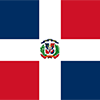
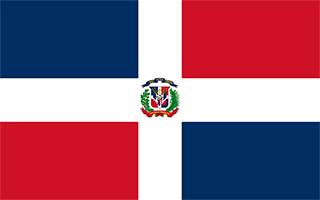
A centered white cross that extends to the edges divides the flag into four rectangles - the top ones are ultramarine blue (hoist side) and vermilion red, and the bottom ones are vermilion red (hoist side) and ultramarine blue; a small coat of arms featuring a shield supported by a laurel branch (left) and a palm branch (right) is at the center of the cross; above the shield a blue ribbon displays the motto, DIOS, PATRIA, LIBERTAD (God, Fatherland, Liberty), and below the shield, REPUBLICA DOMINICANA appears on a red ribbon; in the shield a bible is opened to a verse that reads "Y la verdad nos hara libre" (And the truth shall set you free); blue stands for liberty, white for salvation, and red for the blood of heroes.
The Taino - indigenous inhabitants of Hispaniola prior to the arrival of the Europeans - divided the island into five chiefdoms and territories. Christopher COLUMBUS explored and claimed the island on his first voyage in 1492; it became a springboard for Spanish conquest of the Caribbean and the American mainland. In 1697, Spain recognized French dominion over the western third of the island, which in 1804 became Haiti. The remainder of the island, by then known as Santo Domingo, sought to gain its own independence in 1821 but was conquered and ruled by the Haitians for 22 years; it finally attained independence as the Dominican Republic in 1844. In 1861, the Dominicans voluntarily returned to the Spanish Empire, but two years later they launched a war that restored independence in 1865. A legacy of unsettled, mostly non-representative rule followed, capped by the dictatorship of Rafael Leonidas TRUJILLO from 1930 to 1961. Juan BOSCH was elected president in 1962 but was deposed in a military coup in 1963. In 1965, the US led an intervention in the midst of a civil war sparked by an uprising to restore BOSCH. In 1966, Joaquin BALAGUER defeated BOSCH in the presidential election. BALAGUER maintained a tight grip on power for most of the next 30 years when international reaction to flawed elections forced him to curtail his term in 1996. Since then, regular competitive elections have been held in which opposition candidates have won the presidency. Former President Leonel FERNANDEZ Reyna (first term 1996-2000) won election to a new term in 2004 following a constitutional amendment allowing presidents to serve more than one term, and was later reelected to a second consecutive term. In 2012, Danilo MEDINA Sanchez became president; he was reelected in 2016.
Geography
| Area | ||
|---|---|---|
| Total (World Rank: 132) | 48,670 | sq km |
| Land (World Rank: 129) | 48,320 | sq km |
| Water (World Rank: 125) | 350 | sq km |
| Forest (World Rank: 73) | 24.80 | % |
| Comparative | slightly more than twice the size of New Jersey | |
| Coastline | ||
| 1288 | ||
| Landborder | ||
| 376 | ||
| Elevation | ||
| Lowest point (World Rank: 59) | -46 | m |
| Highest point (World Rank: 62) | 3,098 | m |
| Agricultural land | ||
| Total (World Rank: 66) | 51.50 | % |
| Arable (World Rank: 70) | 16.60 | % |
| Permanent crops (World Rank: 31) | 10.10 | % |
| Permanent pastures (World Rank: 73) | 24.80 | % |
| Irrigated land (World Rank: 68) | 3,070 | sq km |
| Map reference | ||
| Central America and the Caribbean | ||
| Environment | ||
| Issues |
| |
| Agreement party |
| |
| Agreement signed | Law of the Sea | |
| Hazzards |
| |
| Location | ||
| Caribbean, eastern two-thirds of the island of Hispaniola, between the Caribbean Sea and the North Atlantic Ocean, east of Haiti | ||
| Climate | ||
| tropical maritime; little seasonal temperature variation; seasonal variation in rainfall | ||
| Terrain | ||
| rugged highlands and mountains interspersed with fertile valleys | ||
People
| Population | ||
|---|---|---|
| Total (World Rank: 86) | 10,734,200 | |
| Deathrate (World Rank: 198) | 0.47 | % |
| Birthrate (World Rank: 91) | 1.84 | % |
| Growthrate (World Rank: 94) | 1.18 | % |
| Migration rate (World Rank: 124) | -0.19 | % |
| Fertility rate (World Rank: 91) | 2.29 | % |
| Median age | ||
| Male (World Rank: 132) | 27.90 | |
| Female (World Rank: 136) | 28.30 | |
| Age structure | ||
| 0 14 male (World Rank: 85) | 1,454,530 | |
| 0 14 female (World Rank: 84) | 1,404,540 | |
| 15 24 male (World Rank: 83) | 993,642 | |
| 15 24 female (World Rank: 82) | 957,466 | |
| 25 54 male (World Rank: 79) | 2,178,480 | |
| 25 54 female (World Rank: 82) | 2,078,370 | |
| 55 64 male (World Rank: 79) | 426,810 | |
| 55 64 female (World Rank: 81) | 421,727 | |
| 65 x male (World Rank: 75) | 378,226 | |
| 65 x female (World Rank: 79) | 440,463 | |
| Health | ||
| Infant mortality rate (World Rank: 92) | 1.75 | % |
| Life expectancy total (World Rank: 59) | 78 | years |
| Life expectancy female (World Rank: 66) | 81 | years |
| Life expectancy male (World Rank: 56) | 76 | years |
| Physicians per 1000 (World Rank: 95) | 1.49 | |
| Hospital bed per 1000 (World Rank: 119) | 1.70 | |
| Sanitation access total (World Rank: 112) | 84.00 | % |
| Obesity adult (World Rank: 37) | 27.60 | % |
| Drinking water access (World Rank: 153) | 84.70 | % |
Energy
| Electricity | ||
|---|---|---|
| Production (World Rank: 84) | 15,530,000,000 | kWh |
| Consumption (World Rank: 82) | 13,250,000,000 | kWh |
| Source fossil (World Rank: 87) | 80.80 | % |
| Source nuclear (World Rank: 97) | 16.10 | % |
| Source renew (World Rank: 89) | 5.70 | % |
| Crude oil | ||
| Imports (World Rank: 61) | 27,440 | bbl / day |
| Refined products | ||
| Production (World Rank: 87) | 27,060 | bbl / day |
| Consumption (World Rank: 75) | 114,000 | bbl / day |
| Import (World Rank: 61) | 84,370 | bbl / day |
| Natural gas | ||
| Consumption (World Rank: 87) | 1,895,000,000 | m³ |
| Import (World Rank: 59) | 0 | m³ |
| Carbon footprint | ||
| 22000000 | ||
Nation
| Budget | ||
|---|---|---|
| Education (World Rank: 163) | 2 | % of GDP |
| Military (World Rank: 136) | 1 | % of GDP |
| Health (World Rank: 158) | 4 | % of GDP |
| Surplus (World Rank: 106) | -3 | % of GDP |
| National symbol | ||
| palmchat | ||
| National colours | ||
| white | ||
| Adjective | ||
| Dominican | ||
| Noun | ||
| Dominican(s) | ||
| Background | ||
| The Taino - indigenous inhabitants of Hispaniola prior to the arrival of the Europeans - divided the island into five chiefdoms and territories. Christopher COLUMBUS explored and claimed the island on his first voyage in 1492; it became a springboard for Spanish conquest of the Caribbean and the American mainland. In 1697, Spain recognized French dominion over the western third of the island, which in 1804 became Haiti. The remainder of the island, by then known as Santo Domingo, sought to gain its own independence in 1821 but was conquered and ruled by the Haitians for 22 years; it finally attained independence as the Dominican Republic in 1844. In 1861, the Dominicans voluntarily returned to the Spanish Empire, but two years later they launched a war that restored independence in 1865. A legacy of unsettled, mostly non-representative rule followed, capped by the dictatorship of Rafael Leonidas TRUJILLO from 1930 to 1961. Juan BOSCH was elected president in 1962 but was deposed in a military coup in 1963. In 1965, the US led an intervention in the midst of a civil war sparked by an uprising to restore BOSCH. In 1966, Joaquin BALAGUER defeated BOSCH in the presidential election. BALAGUER maintained a tight grip on power for most of the next 30 years when international reaction to flawed elections forced him to curtail his term in 1996. Since then, regular competitive elections have been held in which opposition candidates have won the presidency. Former President Leonel FERNANDEZ Reyna (first term 1996-2000) won election to a new term in 2004 following a constitutional amendment allowing presidents to serve more than one term, and was later reelected to a second consecutive term. In 2012, Danilo MEDINA Sanchez became president; he was reelected in 2016. | ||
| Flag description | ||
| a centered white cross that extends to the edges divides the flag into four rectangles - the top ones are ultramarine blue (hoist side) and vermilion red, and the bottom ones are vermilion red (hoist side) and ultramarine blue; a small coat of arms featuring a shield supported by a laurel branch (left) and a palm branch (right) is at the center of the cross; above the shield a blue ribbon displays the motto, DIOS, PATRIA, LIBERTAD (God, Fatherland, Liberty), and below the shield, REPUBLICA DOMINICANA appears on a red ribbon; in the shield a bible is opened to a verse that reads "Y la verdad nos hara libre" (And the truth shall set you free); blue stands for liberty, white for salvation, and red for the blood of heroes | ||
Economy
| Gdp | ||
|---|---|---|
| Purchasing power parity (World Rank: 73) | 161,900,000,000 | USD |
| Real growth rate (World Rank: 20) | 6.60 | % |
| Per capita purchasing power parity (World Rank: 103) | 16,100 | USD |
| Source agriculture (World Rank: 123) | 5.50 | % |
| Source industry (World Rank: 54) | 33.40 | % |
| Source service (World Rank: 113) | 61.10 | % |
| Labourforce | ||
| Total (World Rank: 86) | 4,639,000 | |
| In poverty (World Rank: 58) | 30.50 | % |
| Products | ||
| Industries |
| |
| Agriculture |
| |
| Exports |
| |
| Imports |
| |
Communication
| Phone | ||
|---|---|---|
| Landline total (World Rank: 67) | 1,345,090 | |
| Landline per 100 (World Rank: 125) | 13.00 | |
| Mobile per 100 (World Rank: 162) | 82.00 | |
| Assessment | 0 | |
| Internet | ||
| Users (World Rank: 65) | 6,505,000 | |
| Population (World Rank: 91) | 61.30 | % |
Transport
| Air | ||
|---|---|---|
| Airports paved (World Rank: 92) | 16.00 | |
| Airports unpaved (World Rank: 107) | 20.00 | |
| Heliports (World Rank: 93) | 1.00 | |
| Rail | ||
| Total length (World Rank: 115) | 496 | |
| Road | ||
| Total length (World Rank: 111) | 19,705 | |
| Paved length (World Rank: 75) | 9,872 | |
| Unpaved length (World Rank: 88) | 9,833 | |
This is a list of famous places in this country in alphabetical order.
 Azua
Azua- Bajos de Haina
- Bani
- Bayaguana
- Boca Chica
- Boca de Yuma
- Bonao
- Cabarete
- Cabral
- Cabrera
- Cambita Garabitos
- Castanuelas
- Castillo
- Cercado Abajo
- Comendador
- Concepcion de La Vega
- Constanza
- Cotui
- Dajabon
- Duverge
- Enriquillo
- Esperalvillo
- Esperanza
- Fantino
- Fundacion
- Gaspar Hernandez
- Hato Mayor del Rey
- Hondo Valle
- Imbert
- Jarabacoa
- Jimani
- Joba Arriba
- La Cienaga
- La Descubierta
- La Julia
- La Romana
- Laguna Salada
- Las Guaranas
- Las Matas de Farfan
- Las Matas de Santa Cruz
- Las Terrenas
- Los Llanos
- Luperon
- Majagual
- Mao
- Mella
- Miches
- Moca
- Moncion
- Monte Plata
- Nagua
- Neiba
- Otra Banda
- Oviedo
- Padre Las Casas
- Palmar de Ocoa
- Paraiso
- Pedernales
- Pepillo Salcedo
- Piedra Blanca
- Pimentel
- Puerto Plata
- Punta Cana
- Ramon Santana
- Rio San Juan
- Sabana Buey
- Sabana Grande de Boya
- Sabana Iglesia
- Sabana de La Mar
- Sabaneta
- Salcedo
- Salvaleon de Higueey
- Samana
- San Cristobal
- San Fernando de Monte Cristi
- San Francisco de Macoris
- San Jose de Las Matas
- San Jose de Ocoa
- San Juan de la Maguana
- San Pedro de Macoris
- San Rafael del Yuma
- San Victor Arriba
- Sanchez
- Santa Cruz de Barahona
- Santa Cruz de El Seibo
- Santiago de los Caballeros
- Santo Domingo
- Santo Domingo Este
- Santo Domingo Oeste
- Tamayo
- Tamboril
- Tenares
- Vallejuelo
- Vicente Noble
- Villa Altagracia
- Villa Bisono
- Villa Gonzalez
- Villa Jaragua
- Villa Vasquez
- Yamasa