Cyprus
in Western Asia
Europe
- Currency and Currency Code:
- Pound - CYP
- Spoken languages:
- Modern Greek, Turkish, English
- Local electricity:
- 230 V - 50 Hz (plugs: G)
- Mobile phone / cellular frequencies (MHz):
- 900 MHz, 1800 MHz, 3G, 4G
- ISO 2-Letter code:
- CY
- Internet top level domain:
- .cy
- Country phone prefix:
- +357
- Local Time (capital):
- Timezone:
- UTC/GMT offset: hours
Safety Score: 3,0 of 5.0 based on data from 9 authorites. Meaning we advice caution when travelling to Cyprus.
Travel warnings are updated daily. Source: Travel Warning Cyprus. Last Update: 2024-04-19 08:03:45
Explore Cyprus
Cyprus with its capital Nicosia is located in Europe (Middle East, island in the Mediterranean Sea). It covers some 9,252 square kilometers (about 0.6 times the size of Connecticut) with a population of 1,221,550. Modern Greek, Turkish and English are the languages spoken by people in Cyprus (consider regional differences). Thiscountry has no land-based border with any other country.
Cyprus is an island in the Mediterranean Sea, south of Turkey. Public transportation in Cyprus has been revamped with all new buses in Nicosia. Still, most Cypriots drive by themselves. There are no railways in Cyprus. If you have any old Cypriot pounds lying around, the Central Bank of Cyprus in Nicosia will exchange them at a rate of CYP 0.585274 per €1 until 2017. There are countless hotels and hotel apartments of varying degrees of luxury within Cyprus. If you are considering an extended stay on the island, there are a number of educational courses that you can take. Popular options include Greek language courses and arts courses. Cyprus is a remarkably safe country, with very little violent crime. Cars and houses frequently go unlocked.
Popular Destinations in Cyprus
Administrative regions of Cyprus
About the country

The topography is central plain with mountains to north and south with scattered but significant plains along southern coast. The average density of population is about 132 per km². The climate in Cyprus can be described as temperate with Mediterranean with hot, dry summers and cool winters. Potential natural disasters are droughts moderate earthquake activity
To reach someone Cyprus dial +357 prior to a number. The local cellular networks are operated on 900 MHz, 1800 MHz, 3G, 4G. Websites typically end with the top level domain ".cy". If you want to bring electric appliances (e.g. battery chaarger), keep in min the local 230 V - 50 Hz (plugs: G). The sign for the locally used currency Pound is CYP.
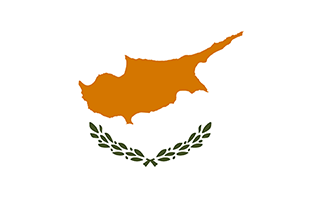
Centered on a white field is a copper-colored silhouette of the island (the island has long been famous for its copper deposits) above two olive-green-colored, crossed olive branches; the branches symbolize the hope for peace and reconciliation between the Greek and Turkish communities.
A former British colony, Cyprus became independent in 1960 following years of resistance to British rule. Tensions between the Greek Cypriot majority and Turkish Cypriot minority came to a head in December 1963, when violence broke out in the capital of Nicosia. Despite the deployment of UN peacekeepers in 1964, sporadic intercommunal violence continued, forcing most Turkish Cypriots into enclaves throughout the island. In 1974, a Greek Government-sponsored attempt to overthrow the elected president of Cyprus was met by military intervention from Turkey, which soon controlled more than a third of the island. In 1983, the Turkish Cypriot administered area declared itself the "Turkish Republic of Northern Cyprus" ("TRNC"), but it is recognized only by Turkey. A UN-mediated agreement, the Annan Plan, failed to win approval by both communities in 2004. In February 2014, after a hiatus of nearly two years, the leaders of the two communities resumed formal discussions under UN auspices aimed at reuniting the divided island. Talks were suspended in October 2014, but resumed in earnest in May 2015 following the election of a new Turkish Cypriot "president." The entire island entered the EU on 1 May 2004, although the EU acquis - the body of common rights and obligations - applies only to the areas under the internationally recognized government, and is suspended in the area administered by Turkish Cypriots. However, individual Turkish Cypriots able to document their eligibility for Republic of Cyprus citizenship legally enjoy the same rights accorded to other citizens of EU states.
Geography
| Area | ||
|---|---|---|
| Total (World Rank: 170) | 9,251 | sq km |
| Land (World Rank: 168) | 9,241 | sq km |
| Water (World Rank: 152) | 10 | sq km |
| Forest (World Rank: 198) | 0.40 | % |
| Comparative | about 0.6 times the size of Connecticut | |
| Coastline | ||
| 648 | ||
| Landborder | ||
| 156 | ||
| Elevation | ||
| Highest point (World Rank: 127) | 1,951 | m |
| Agricultural land | ||
| Total (World Rank: 180) | 13.40 | % |
| Arable (World Rank: 116) | 9.80 | % |
| Permanent crops (World Rank: 73) | 3.20 | % |
| Permanent pastures (World Rank: 198) | 0.40 | % |
| Irrigated land (World Rank: 116) | 460 | sq km |
| Map reference | ||
| Middle East | ||
| Environment | ||
| Issues |
| |
| Agreement party |
| |
| Hazzards |
| |
| Location | ||
| Middle East, island in the Mediterranean Sea, south of Turkey; note - Cyprus views itself as part of Europe; geopolitically, it can be classified as falling within Europe, the Middle East, or both | ||
| Climate | ||
| temperate; Mediterranean with hot, dry summers and cool winters | ||
| Terrain | ||
| central plain with mountains to north and south; scattered but significant plains along southern coast | ||
People
| Population | ||
|---|---|---|
| Total (World Rank: 158) | 1,221,550 | |
| Deathrate (World Rank: 134) | 0.68 | % |
| Birthrate (World Rank: 171) | 1.13 | % |
| Growthrate (World Rank: 84) | 1.32 | % |
| Migration rate (World Rank: 11) | 0.87 | % |
| Fertility rate (World Rank: 198) | 1.47 | % |
| Median age | ||
| Male (World Rank: 69) | 35.50 | |
| Female (World Rank: 67) | 38.30 | |
| Age structure | ||
| 0 14 male (World Rank: 167) | 97,955 | |
| 0 14 female (World Rank: 167) | 92,648 | |
| 15 24 male (World Rank: 157) | 91,846 | |
| 15 24 female (World Rank: 160) | 76,853 | |
| 25 54 male (World Rank: 152) | 303,297 | |
| 25 54 female (World Rank: 154) | 271,364 | |
| 55 64 male (World Rank: 148) | 67,053 | |
| 55 64 female (World Rank: 145) | 72,854 | |
| 65 x male (World Rank: 140) | 63,870 | |
| 65 x female (World Rank: 139) | 83,809 | |
| Health | ||
| Infant mortality rate (World Rank: 152) | 0.79 | % |
| Life expectancy total (World Rank: 55) | 79 | years |
| Life expectancy female (World Rank: 55) | 82 | years |
| Life expectancy male (World Rank: 57) | 76 | years |
| Physicians per 1000 (World Rank: 60) | 2.50 | |
| Hospital bed per 1000 (World Rank: 63) | 3.50 | |
| Sanitation access total (World Rank: 2) | 100.00 | % |
| Obesity adult (World Rank: 84) | 21.80 | % |
| Drinking water access (World Rank: 1) | 100.00 | % |
Energy
| Electricity | ||
|---|---|---|
| Production (World Rank: 122) | 4,243,000,000 | kWh |
| Consumption (World Rank: 126) | 4,028,000,000 | kWh |
| Source fossil (World Rank: 68) | 87.40 | % |
| Source renew (World Rank: 55) | 12.80 | % |
| Refined products | ||
| Consumption (World Rank: 105) | 46,000 | bbl / day |
| Import (World Rank: 83) | 45,740 | bbl / day |
| Carbon footprint | ||
| 9100000 | ||
Nation
| Budget | ||
|---|---|---|
| Education (World Rank: 26) | 6 | % of GDP |
| Military (World Rank: 61) | 2 | % of GDP |
| Health (World Rank: 70) | 7 | % of GDP |
| Surplus (World Rank: 35) | 0 | % of GDP |
| National symbol | ||
| white dove | ||
| National colours | ||
| white | ||
| Adjective | ||
| Cypriot | ||
| Noun | ||
| Cypriot(s) | ||
| Background | ||
| A former British colony, Cyprus became independent in 1960 following years of resistance to British rule. Tensions between the Greek Cypriot majority and Turkish Cypriot minority came to a head in December 1963, when violence broke out in the capital of Nicosia. Despite the deployment of UN peacekeepers in 1964, sporadic intercommunal violence continued, forcing most Turkish Cypriots into enclaves throughout the island. In 1974, a Greek Government-sponsored attempt to overthrow the elected president of Cyprus was met by military intervention from Turkey, which soon controlled more than a third of the island. In 1983, the Turkish Cypriot administered area declared itself the "Turkish Republic of Northern Cyprus" ("TRNC"), but it is recognized only by Turkey. A UN-mediated agreement, the Annan Plan, failed to win approval by both communities in 2004. In February 2014, after a hiatus of nearly two years, the leaders of the two communities resumed formal discussions under UN auspices aimed at reuniting the divided island. Talks were suspended in October 2014, but resumed in earnest in May 2015 following the election of a new Turkish Cypriot "president." The entire island entered the EU on 1 May 2004, although the EU acquis - the body of common rights and obligations - applies only to the areas under the internationally recognized government, and is suspended in the area administered by Turkish Cypriots. However, individual Turkish Cypriots able to document their eligibility for Republic of Cyprus citizenship legally enjoy the same rights accorded to other citizens of EU states. | ||
| Flag description | ||
| centered on a white field is a copper-colored silhouette of the island (the island has long been famous for its copper deposits) above two olive-green-colored, crossed olive branches; the branches symbolize the hope for peace and reconciliation between the Greek and Turkish communities | ||
Economy
| Gdp | ||
|---|---|---|
| Purchasing power parity (World Rank: 132) | 29,660,000,000 | USD |
| Real growth rate (World Rank: 103) | 2.80 | % |
| Per capita purchasing power parity (World Rank: 53) | 35,000 | USD |
| Source agriculture (World Rank: 170) | 2.30 | % |
| Source industry (World Rank: 199) | 11.00 | % |
| Source service (World Rank: 15) | 86.70 | % |
| Labourforce | ||
| Total (World Rank: 157) | 422,300 | |
| Products | ||
| Industries |
| |
| Agriculture |
| |
| Exports |
| |
| Imports |
| |
Communication
| Phone | ||
|---|---|---|
| Landline total (World Rank: 110) | 320,573 | |
| Landline per 100 (World Rank: 67) | 27.00 | |
| Mobile per 100 (World Rank: 139) | 94.00 | |
| Assessment | 0 | |
| Internet | ||
| Users (World Rank: 132) | 915,036 | |
| Population (World Rank: 61) | 75.90 | % |
Transport
| Air | ||
|---|---|---|
| Airports paved (World Rank: 105) | 13.00 | |
| Airports unpaved (World Rank: 168) | 2.00 | |
| Heliports (World Rank: 21) | 9.00 | |
| Road | ||
| Total length (World Rank: 109) | 20,006 | |
| Paved length (World Rank: 80) | 8,564 | |
| Unpaved length (World Rank: 105) | 4,442 | |
This is a list of famous places in this country in alphabetical order.
 Acheritou
- Agia Anna
- Agia Marinouda
- Agios Tychon
- Agros
- Akaki
- Alassa
- Anafotida
- Aradippou
- Arediou
- Argaka
- Astromeritis
- Athienou
- Avgorou
- Ayia Napa
- Chlorakas
- Choirokoitia
- Dali
- Deryneia
- Dhromolaxia
- Drouseia
- Empa
- Episkopeio
- Ergates
- Erimi
- Evrychou
- Famagusta
- Foini
- Foinikaria
- Frenaros
- Galata
- Geri
- Giolou
- Kakopetria
- Kalavasos
- Kalopanagiotis
- Kampia
- Kato Amiantos
- Kato Deftera
- Kato Pyrgos
- Kissonerga
- Kiti
- Kofinou
- Kokkinotrimithia
- Kolossi
- Konia
- Kouklia
- Kyperounta
- Kyrenia
- Lapithos
- Larnaca
- Lefka
- Lefkonoiko
- Lempa
- Leonariso
- Limassol
- Liopetri
- Livadia
- Lympia
- Lythrodontas
- Mazotos
- Mesogi
- Mitsero
- Morfou
- Moutoullas
- Mouttagiaka
- Nicosia
- Oikos
- Omodos
- Orounta
- Pachna
- Pano Deftera
- Pano Lefkara
- Pano Polemidia
- Paphos
- Paralimni
- Pedoulas
- Pegeia
- Pelendri
- Pera
- Pergamos
- Peristerona
- Perivolia
- Pissouri
- Polis
- Politiko
- Pomos
- Potamia
- Protaras
- Pyla
- Rizokarpaso
- Tala
- Tersefanou
- Timi
- Trikomo
- Tseri
- Voroklini
- Xylotymbou
- Ypsonas
- Zygi