Costa Rica
in Central America
North America
 Nicaragua
 Panama
- Currency and Currency Code:
- Colon - CRC
- Spoken languages:
- Spanish, English
- Local electricity:
- 120 V - 60 Hz (plugs: A, B)
- Mobile phone / cellular frequencies (MHz):
- 850 MHz, 1800 MHz, 3G, 4G
- ISO 2-Letter code:
- CR
- Internet top level domain:
- .cr
- Country phone prefix:
- +506
- Local Time (capital):
- Timezone:
- UTC/GMT offset: hours
Safety Score: 3,3 of 5.0 based on data from 9 authorites. Meaning please reconsider your need to travel to Costa Rica.
Travel warnings are updated daily. Source: Travel Warning Costa Rica. Last Update: 2024-04-20 08:25:34
Explore Costa Rica
Costa Rica with its capital San Jose is located in North America (Central America, bordering both the Caribbean Sea and the North Pacific Ocean). It covers some 51,101 square kilometers (slightly smaller than West Virginia) with 4,930,260 citizens. Spanish and English are the languages commonly used by the people in Costa Rica. Interesting info is sharing borders with Nicaragua and Panama.
Costa Rica is a country in Central America. It is one of the world's most popular destinations for eco-tourists because of its biodiversity, having bewilderingly diverse landscapes, flora, and fauna. From rain forests, to dry tropical and temperate forests, to volcanoes, to Caribbean and Pacific beaches, to high mountains, and marshy lowlands. You have to exercise caution when renting a car in Costa Rica; where it is not uncommon for rental companies to claim damage they insist you inflicted on the vehicle. Try to rent a car through a Costa Rican travel agent. If you are traveling on a package, your agent will sort this out. Spanish is the main language in Costa Rica. All major newspapers and official business are conducted in Spanish. English is used widely in areas populated by international tourists. Costa Rica is one of the countries with more rivers per square kilometer than anywhere else in the world. Anywhere you go you will find some kind of float trip to enjoy nature from a very unique point of view. Most places have potable water, so don't worry about drinking tap water. Bottled water is also available at low prices. The national drink is called guaro, which is made from fermented sugar cane. It is similar to vodka, and is usually drunk with water and lemon. Costa Rica has one of the highest levels of social care in the world. Its doctors are known worldwide as some of the best. International calls are fairly expensive. The cheapest way to make them is over the internet using a service such as Skype at an Internet café.
Popular Destinations in Costa Rica
Administrative regions of Costa Rica
- Provincia de Alajuela
- Provincia de Cartago
- Provincia de Guanacaste
- Provincia de Heredia
- Provincia de Limon
- Provincia de Puntarenas
- Provincia de San Jose
About the country

Website: Costa Rica Tourism
The landscape is coastal plains separated by rugged mountains including over 100 volcanic cones, of which several are major active volcanoes. The average density of population is about 96 per km². The climate in Costa Rica can be described as tropical and subtropicaldry season (December to April), rainy season (May to November), cooler in highlands. Potential threats by nature are active volcanoes, Arenal (1,670 m), which erupted in 2010, is the most active volcano in Costa Rica; a 1968 eruption destroyed the town of Tabacon; Irazu (3,432 m), situated just east of San Jose, has the potential to spew ash over the capital city as it did between 1963 a, frequent flooding of lowlands at onset of rainy season and landslides and occasional earthquakes, hurricanes along Atlantic coast.
To reach someone Costa Rica dial +506 prior to a number. The local cellular networks are operated on 850 MHz, 1800 MHz, 3G, 4G. Websites typically end with the top level domain ".cr". If you want to bring electric appliances (e.g. battery chaarger), keep in min the local 120 V - 60 Hz (plugs: A, B). The sign for the locally used currency Colon is CRC.
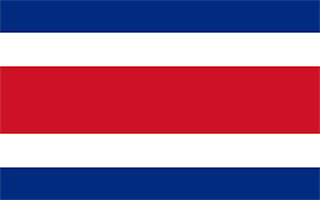
Five horizontal bands of blue (top), white, red (double width), white, and blue, with the coat of arms in a white elliptical disk placed toward the hoist side of the red band; Costa Rica retained the earlier blue-white-blue flag of Central America until 1848 when, in response to revolutionary activity in Europe, it was decided to incorporate the French colors into the national flag and a central red stripe was added; today the blue color is said to stand for the sky, opportunity, and perseverance, white denotes peace, happiness, and wisdom, while red represents the blood shed for freedom, as well as the generosity and vibrancy of the people.
Although explored by the Spanish early in the 16th century, initial attempts at colonizing Costa Rica proved unsuccessful due to a combination of factors, including disease from mosquito-infested swamps, brutal heat, resistance by natives, and pirate raids. It was not until 1563 that a permanent settlement of Cartago was established in the cooler, fertile central highlands. The area remained a colony for some two and a half centuries. In 1821, Costa Rica became one of several Central American provinces that jointly declared their independence from Spain. Two years later it joined the United Provinces of Central America, but this federation disintegrated in 1838, at which time Costa Rica proclaimed its sovereignty and independence. Since the late 19th century, only two brief periods of violence have marred the country's democratic development. In 1949, Costa Rica dissolved its armed forces. Although it still maintains a large agricultural sector, Costa Rica has expanded its economy to include strong technology and tourism industries. The standard of living is relatively high. Land ownership is widespread.
Geography
| Area | ||
|---|---|---|
| Total (World Rank: 130) | 51,100 | sq km |
| Land (World Rank: 128) | 51,060 | sq km |
| Water (World Rank: 145) | 40 | sq km |
| Forest (World Rank: 70) | 25.50 | % |
| Comparative | slightly smaller than West Virginia | |
| Note | includes Isla del Coco | |
| Coastline | ||
| 1290 | ||
| Landborder | ||
| 661 | ||
| Elevation | ||
| Highest point (World Rank: 46) | 3,819 | m |
| Agricultural land | ||
| Total (World Rank: 115) | 37.10 | % |
| Arable (World Rank: 151) | 4.90 | % |
| Permanent crops (World Rank: 49) | 6.70 | % |
| Permanent pastures (World Rank: 70) | 25.50 | % |
| Irrigated land (World Rank: 93) | 1,015 | sq km |
| Map reference | ||
| Central America and the Caribbean | ||
| Environment | ||
| Issues |
| |
| Agreement party |
| |
| Agreement signed | Marine Life Conservation | |
| Hazzards |
| |
| Location | ||
| Central America, bordering both the Caribbean Sea and the North Pacific Ocean, between Nicaragua and Panama | ||
| Climate | ||
| tropical and subtropical; dry season (December to April); rainy season (May to November); cooler in highlands | ||
| Terrain | ||
| coastal plains separated by rugged mountains including over 100 volcanic cones, of which several are major active volcanoes | ||
People
| Population | ||
|---|---|---|
| Total (World Rank: 123) | 4,930,260 | |
| Deathrate (World Rank: 200) | 0.47 | % |
| Birthrate (World Rank: 119) | 1.55 | % |
| Growthrate (World Rank: 97) | 1.16 | % |
| Migration rate (World Rank: 59) | 0.08 | % |
| Fertility rate (World Rank: 135) | 1.89 | % |
| Median age | ||
| Male (World Rank: 103) | 30.80 | |
| Female (World Rank: 104) | 31.80 | |
| Age structure | ||
| 0 14 male (World Rank: 116) | 570,063 | |
| 0 14 female (World Rank: 116) | 544,502 | |
| 15 24 male (World Rank: 117) | 410,993 | |
| 15 24 female (World Rank: 115) | 394,865 | |
| 25 54 male (World Rank: 117) | 1,092,500 | |
| 25 54 female (World Rank: 115) | 1,078,460 | |
| 55 64 male (World Rank: 107) | 220,879 | |
| 55 64 female (World Rank: 115) | 232,530 | |
| 65 x male (World Rank: 108) | 177,882 | |
| 65 x female (World Rank: 114) | 207,582 | |
| Health | ||
| Infant mortality rate (World Rank: 151) | 0.80 | % |
| Life expectancy total (World Rank: 57) | 79 | years |
| Life expectancy female (World Rank: 57) | 82 | years |
| Life expectancy male (World Rank: 55) | 76 | years |
| Physicians per 1000 (World Rank: 108) | 1.15 | |
| Hospital bed per 1000 (World Rank: 139) | 1.20 | |
| Sanitation access total (World Rank: 77) | 94.50 | % |
| Obesity adult (World Rank: 48) | 25.70 | % |
| Drinking water access (World Rank: 85) | 97.80 | % |
Energy
| Electricity | ||
|---|---|---|
| Production (World Rank: 98) | 10,380,000,000 | kWh |
| Consumption (World Rank: 97) | 9,113,000,000 | kWh |
| Export (World Rank: 61) | 643,000,000 | kWh |
| Import (World Rank: 78) | 537,000,000 | kWh |
| Source fossil (World Rank: 194) | 21.00 | % |
| Source nuclear (World Rank: 26) | 62.00 | % |
| Source renew (World Rank: 36) | 17.60 | % |
| Refined products | ||
| Consumption (World Rank: 99) | 54,000 | bbl / day |
| Import (World Rank: 78) | 53,140 | bbl / day |
| Natural gas | ||
| Consumption (World Rank: 174) | 1 | m³ |
| Carbon footprint | ||
| 7616000 | ||
Nation
| Budget | ||
|---|---|---|
| Education (World Rank: 12) | 8 | % of GDP |
| Health (World Rank: 34) | 9 | % of GDP |
| Surplus (World Rank: 152) | -5 | % of GDP |
| National symbol | ||
| yiguirro | ||
| National colours | ||
| white | ||
| Adjective | ||
| Costa Rican | ||
| Noun | ||
| Costa Rican(s) | ||
| Background | ||
| Although explored by the Spanish early in the 16th century, initial attempts at colonizing Costa Rica proved unsuccessful due to a combination of factors, including disease from mosquito-infested swamps, brutal heat, resistance by natives, and pirate raids. It was not until 1563 that a permanent settlement of Cartago was established in the cooler, fertile central highlands. The area remained a colony for some two and a half centuries. In 1821, Costa Rica became one of several Central American provinces that jointly declared their independence from Spain. Two years later it joined the United Provinces of Central America, but this federation disintegrated in 1838, at which time Costa Rica proclaimed its sovereignty and independence. Since the late 19th century, only two brief periods of violence have marred the country's democratic development. In 1949, Costa Rica dissolved its armed forces. Although it still maintains a large agricultural sector, Costa Rica has expanded its economy to include strong technology and tourism industries. The standard of living is relatively high. Land ownership is widespread. | ||
| Flag description | ||
| five horizontal bands of blue (top), white, red (double width), white, and blue, with the coat of arms in a white elliptical disk placed toward the hoist side of the red band; Costa Rica retained the earlier blue-white-blue flag of Central America until 1848 when, in response to revolutionary activity in Europe, it was decided to incorporate the French colors into the national flag and a central red stripe was added; today the blue color is said to stand for the sky, opportunity, and perseverance, white denotes peace, happiness, and wisdom, while red represents the blood shed for freedom, as well as the generosity and vibrancy of the people | ||
Economy
| Gdp | ||
|---|---|---|
| Purchasing power parity (World Rank: 91) | 80,680,000,000 | USD |
| Real growth rate (World Rank: 53) | 4.30 | % |
| Per capita purchasing power parity (World Rank: 101) | 16,400 | USD |
| Source agriculture (World Rank: 122) | 5.50 | % |
| Source industry (World Rank: 138) | 21.50 | % |
| Source service (World Rank: 55) | 73.00 | % |
| Labourforce | ||
| Total (World Rank: 118) | 2,206,000 | |
| In poverty (World Rank: 99) | 21.70 | % |
| Products | ||
| Industries |
| |
| Agriculture |
| |
| Exports |
| |
| Imports |
| |
Communication
| Phone | ||
|---|---|---|
| Landline total (World Rank: 83) | 827,000 | |
| Landline per 100 (World Rank: 103) | 17.00 | |
| Mobile per 100 (World Rank: 15) | 165.00 | |
| Assessment | 0 | |
| Internet | ||
| Users (World Rank: 94) | 3,217,280 | |
| Population (World Rank: 86) | 66.00 | % |
Transport
| Air | ||
|---|---|---|
| Airports paved (World Rank: 44) | 47.00 | |
| Airports unpaved (World Rank: 33) | 114.00 | |
| Rail | ||
| Total length (World Rank: 124) | 278 | |
| Road | ||
| Total length (World Rank: 90) | 39,018 | |
| Paved length (World Rank: 74) | 10,133 | |
| Unpaved length (World Rank: 54) | 28,885 | |
| Water | ||
| Total length (World Rank: 76) | 730 | |
This is a list of famous places in this country in alphabetical order.
 Alajuela
- Alajuelita
- Aserri
- Atenas
- Bagaces
- Batan
- Belen
- Buenos Aires
- Cahuita
- Calle Blancos
- Canas
- Canoas
- Cartago
- Chacarita
- Ciudad Cortes
- Colima
- Colon
- Concepcion
- Corredor
- Curridabat
- Daniel Flores
- Desamparados
- Escazu
- Esparza
- Fortuna
- Golfito
- Granadilla
- Guacimo
- Guadalupe
- Guapiles
- Heredia
- Hojancha
- Ipis
- Jaco
- Juntas
- La Asuncion
- La Cruz
- La Fortuna
- La Suiza
- Liberia
- Llorente
- Los Chiles
- Matina
- Mercedes
- Miramar
- Naranjo
- Nicoya
- Orosi
- Orotina
- Paraiso
- Patarra
- Pejibaye
- Pocora
- Puerto Limon
- Puntarenas
- Purral
- Quepos
- Quesada
- Roxana
- Sabanilla
- Sabanilla
- Salitral
- Salitrillos
- Samara
- San Antonio
- San Diego
- San Felipe
- San Francisco
- San Ignacio
- San Isidro
- San Jose
- San Jose
- San Josecito
- San Juan
- San Juan de Dios
- San Marcos
- San Miguel
- San Pablo
- San Pedro
- San Rafael
- San Rafael
- San Rafael Abajo
- San Rafael Arriba
- San Ramon
- San Vicente
- San Vicente de Moravia
- San Vito
- Santa Ana
- Santa Cruz
- Santiago
- Santo Domingo
- Sardinal
- Siquirres
- Tejar
- Tilaran
- Tobosi
- Tres Rios
- Turrialba
- Upala
- Zarcero