Chile
in South America
South America
 Argentina
 Bolivia
 Peru
Peru- Currency and Currency Code:
- Peso - CLP
- Spoken languages:
- Spanish
- Local electricity:
- 220 V - 50 Hz (plugs: C, L)
- Mobile phone / cellular frequencies (MHz):
- 850 MHz, 1900 MHz, 3G, 4G
- ISO 2-Letter code:
- CL
- Internet top level domain:
- .cl
- Country phone prefix:
- +56
- Local Time (capital):
- Timezone:
- UTC/GMT offset: hours
Safety Score: 3,3 of 5.0 based on data from 9 authorites. Meaning please reconsider your need to travel to Chile.
Travel warnings are updated daily. Source: Travel Warning Chile. Last Update: 2024-04-25 08:17:04
Explore Chile
Chile with its capital Santiago is located in South America (Southern South America, bordering the South Pacific Ocean). It covers some 756,103 square kilometers (slightly smaller than twice the size of Montana) with a population of 17,789,300. Spanish is the official language spoken by people in Chile. Argentina, Bolivia and Peru are bordering countries.
Chile narrowly stretches along the southern half of the west coast of South America, between the Andes and the Pacific Ocean. Spanish is the official language in the country and is spoken by almost the entire population. When entering Chile (by cruise, vehicle or plane), at customs, travelers will need to fill out a tourist card that allows them to stay for up to 90 days. Travelers will have to present the tourist card to Customs officials when leaving the country. Be aware that hotels waive Chile's 19% room tax when the guest shows this card and pays with U.S. dollars. Chile has a rather good airport infrastructure. The main hub for flights in Chile is the Arturo Merino Benitez International Airport (SCL) in Santiago, from where several airlines serve even the remotest corners of the country. Never exchange money on the streets, specially if a helper indicates you to follow them. It's not advisable to exchange currency in the hotel or the airport as the rates are awful. Just be patient. Banco Santander has a monopoly on the ATMs of the airport and will add a surcharge of 2500 CLP for retrieving cash - it's still better than the exchange bureaus. With such an enormous coastline, you can expect fish and seafood almost everywhere. Locals used to eat bundles of raw shellfish, but visitors should be cautious of raw shellfish because of frequent outbreaks of red tides.
Popular Destinations in Chile
Administrative regions of Chile
- Antofagasta
- Atacama
- Aysen
- Coquimbo
- Los Lagos
- Maule
- Region de Arica y Parinacota
- Region de Los Rios
- Region de Magallanes y de la Antartica Chilena
- Region de Valparaiso
- Region de la Araucania
- Region del Biobio
- Region del Libertador General Bernardo O'Higgins
- Santiago Metropolitan
- Tarapaca
About the country

Website: Chile Tourism
Providencia 1550
P.O. Box 14082
Santiago
Chile
Phone: +56 2 6967141
Fax: +56 2 6960981
Mail: info@sernatur.cl
The topography is low coastal mountains, fertile central valley, rugged Andes in east. The average density of population is about 24 per km². The climate in Chile can be described as temperatedesert in north, Mediterranean in central region, cool and damp in south. Potential natural disasters are active volcanism, severe earthquakes, significant volcanic activity due to more than three-dozen active volcanoes along the Andes Mountains; Lascar (5,592 m), which last erupted in 2007, is the most active volcano in the northern Chilean Andes; Llaima (3,125 m) in central Chile, which last er and tsunamis.
To reach someone Chile dial +56 prior to a number. The local cellular networks are operated on 850 MHz, 1900 MHz, 3G, 4G. Websites typically end with the top level domain ".cl". If you want to bring electric appliances (e.g. battery chaarger), keep in min the local 220 V - 50 Hz (plugs: C, L). The sign for the locally used currency Peso is CLP.
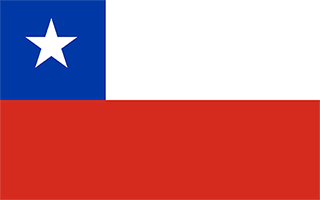
Two equal horizontal bands of white (top) and red; a blue square the same height as the white band at the hoist-side end of the white band; the square bears a white five-pointed star in the center representing a guide to progress and honor; blue symbolizes the sky, white is for the snow-covered Andes, and red represents the blood spilled to achieve independence.
Prior to the arrival of the Spanish in the 16th century, the Inca ruled northern Chile while an indigenous people, the Mapuche, inhabited central and southern Chile. Although Chile declared its independence in 1810, it did not achieve decisive victory over the Spanish until 1818. In the War of the Pacific (1879-83), Chile defeated Peru and Bolivia to win its present northern regions. In the 1880s, the Chilean central government gained control over the central and southern regions inhabited by the Mapuche. After a series of elected governments, the three-year-old Marxist government of Salvador ALLENDE was overthrown in 1973 by a military coup led by General Augusto PINOCHET, who ruled until a democratically-elected president was inaugurated in 1990. Sound economic policies, maintained consistently since the 1980s, contributed to steady growth, reduced poverty rates by over half, and helped secure the country's commitment to democratic and representative government. Chile has increasingly assumed regional and international leadership roles befitting its status as a stable, democratic nation.
Geography
| Area | ||
|---|---|---|
| Total (World Rank: 39) | 756,102 | sq km |
| Land (World Rank: 38) | 743,812 | sq km |
| Water (World Rank: 42) | 12,290 | sq km |
| Forest (World Rank: 97) | 18.80 | % |
| Comparative | slightly smaller than twice the size of Montana | |
| Note | includes Easter Island (Isla de Pascua) and Isla Sala y Gomez | |
| Coastline | ||
| 6435 | ||
| Landborder | ||
| 7801 | ||
| Elevation | ||
| Highest point (World Rank: 11) | 6,880 | m |
| Agricultural land | ||
| Total (World Rank: 161) | 21.10 | % |
| Arable (World Rank: 188) | 1.70 | % |
| Permanent crops (World Rank: 142) | 0.60 | % |
| Permanent pastures (World Rank: 97) | 18.80 | % |
| Irrigated land (World Rank: 42) | 11,100 | sq km |
| Map reference | ||
| South America | ||
| Environment | ||
| Issues |
| |
| Agreement party |
| |
| Hazzards |
| |
| Location | ||
| Southern South America, bordering the South Pacific Ocean, between Argentina and Peru | ||
| Climate | ||
| temperate; desert in north; Mediterranean in central region; cool and damp in south | ||
| Terrain | ||
| low coastal mountains, fertile central valley, rugged Andes in east | ||
People
| Population | ||
|---|---|---|
| Total (World Rank: 65) | 17,789,300 | |
| Deathrate (World Rank: 153) | 0.62 | % |
| Birthrate (World Rank: 141) | 1.36 | % |
| Growthrate (World Rank: 135) | 0.77 | % |
| Migration rate (World Rank: 65) | 0.03 | % |
| Fertility rate (World Rank: 148) | 1.80 | % |
| Median age | ||
| Male (World Rank: 85) | 33.20 | |
| Female (World Rank: 80) | 35.60 | |
| Age structure | ||
| 0 14 male (World Rank: 77) | 1,825,250 | |
| 0 14 female (World Rank: 77) | 1,751,740 | |
| 15 24 male (World Rank: 70) | 1,364,830 | |
| 15 24 female (World Rank: 70) | 1,311,220 | |
| 25 54 male (World Rank: 59) | 3,830,540 | |
| 25 54 female (World Rank: 60) | 3,832,990 | |
| 55 64 male (World Rank: 45) | 918,559 | |
| 55 64 female (World Rank: 47) | 1,031,150 | |
| 65 x male (World Rank: 49) | 805,880 | |
| 65 x female (World Rank: 48) | 1,117,110 | |
| Health | ||
| Infant mortality rate (World Rank: 161) | 0.66 | % |
| Life expectancy total (World Rank: 51) | 79 | years |
| Life expectancy female (World Rank: 49) | 82 | years |
| Life expectancy male (World Rank: 59) | 76 | years |
| Physicians per 1000 (World Rank: 111) | 1.03 | |
| Hospital bed per 1000 (World Rank: 99) | 2.10 | |
| Sanitation access total (World Rank: 33) | 99.10 | % |
| Obesity adult (World Rank: 32) | 28.00 | % |
| Drinking water access (World Rank: 69) | 99.00 | % |
Energy
| Electricity | ||
|---|---|---|
| Production (World Rank: 39) | 71,660,000,000 | kWh |
| Consumption (World Rank: 39) | 67,950,000,000 | kWh |
| Source fossil (World Rank: 128) | 60.80 | % |
| Source nuclear (World Rank: 66) | 30.00 | % |
| Source renew (World Rank: 41) | 16.10 | % |
| Crude oil | ||
| Production (World Rank: 81) | 4,423 | bbl / day |
| Imports (World Rank: 34) | 163,000 | bbl / day |
| Proved reserves (World Rank: 63) | 150,000,000 | bbl |
| Refined products | ||
| Production (World Rank: 49) | 215,300 | bbl / day |
| Consumption (World Rank: 40) | 337,400 | bbl / day |
| Export (World Rank: 94) | 4,500 | bbl / day |
| Import (World Rank: 41) | 160,900 | bbl / day |
| Natural gas | ||
| Production (World Rank: 66) | 1,008,000,000 | m³ |
| Consumption (World Rank: 62) | 5,230,000,000 | m³ |
| Import (World Rank: 44) | 0 | m³ |
| Carbon footprint | ||
| 76000000 | ||
Nation
| Budget | ||
|---|---|---|
| Education (World Rank: 80) | 5 | % of GDP |
| Military (World Rank: 53) | 2 | % of GDP |
| Health (World Rank: 60) | 8 | % of GDP |
| Surplus (World Rank: 103) | -3 | % of GDP |
| National symbol | ||
| huemul | ||
| National colours | ||
| white | ||
| Adjective | ||
| Chilean | ||
| Noun | ||
| Chilean(s) | ||
| Background | ||
| Prior to the arrival of the Spanish in the 16th century, the Inca ruled northern Chile while an indigenous people, the Mapuche, inhabited central and southern Chile. Although Chile declared its independence in 1810, it did not achieve decisive victory over the Spanish until 1818. In the War of the Pacific (1879-83), Chile defeated Peru and Bolivia to win its present northern regions. In the 1880s, the Chilean central government gained control over the central and southern regions inhabited by the Mapuche. After a series of elected governments, the three-year-old Marxist government of Salvador ALLENDE was overthrown in 1973 by a military coup led by General Augusto PINOCHET, who ruled until a democratically-elected president was inaugurated in 1990. Sound economic policies, maintained consistently since the 1980s, contributed to steady growth, reduced poverty rates by over half, and helped secure the country's commitment to democratic and representative government. Chile has increasingly assumed regional and international leadership roles befitting its status as a stable, democratic nation. | ||
| Flag description | ||
| two equal horizontal bands of white (top) and red; a blue square the same height as the white band at the hoist-side end of the white band; the square bears a white five-pointed star in the center representing a guide to progress and honor; blue symbolizes the sky, white is for the snow-covered Andes, and red represents the blood spilled to achieve independence | ||
Economy
| Gdp | ||
|---|---|---|
| Purchasing power parity (World Rank: 43) | 438,300,000,000 | USD |
| Real growth rate (World Rank: 151) | 1.60 | % |
| Per capita purchasing power parity (World Rank: 78) | 24,100 | USD |
| Source agriculture (World Rank: 136) | 4.30 | % |
| Source industry (World Rank: 70) | 31.30 | % |
| Source service (World Rank: 95) | 64.40 | % |
| Labourforce | ||
| Total (World Rank: 57) | 8,762,000 | |
| In poverty (World Rank: 134) | 14.40 | % |
| Products | ||
| Industries |
| |
| Agriculture |
| |
| Exports |
| |
| Imports |
| |
Communication
| Phone | ||
|---|---|---|
| Landline total (World Rank: 43) | 3,464,110 | |
| Landline per 100 (World Rank: 88) | 20.00 | |
| Mobile per 100 (World Rank: 50) | 130.00 | |
| Assessment | 0 | |
| Internet | ||
| Users (World Rank: 45) | 11,650,800 | |
| Population (World Rank: 85) | 66.00 | % |
Transport
| Air | ||
|---|---|---|
| Airports paved (World Rank: 26) | 90.00 | |
| Airports unpaved (World Rank: 13) | 391 | |
| Heliports (World Rank: 87) | 1.00 | |
| Rail | ||
| Total length (World Rank: 30) | 7,282 | |
| Road | ||
| Total length (World Rank: 62) | 77,764 | |
| Paved length (World Rank: 63) | 18,119 | |
| Unpaved length (World Rank: 31) | 59,645 | |
This is a list of famous places in this country in alphabetical order.
 Ancud
Ancud- Angol
- Antofagasta
- Arauco
- Arica
- Buin
- Cabrero
- Calama
- Calbuco
- Canete
- Carahue
- Cartagena
- Castro
- Cauquenes
- Chaiten
- Chiguayante
- Chillan
- Chonchi
- Collipulli
- Concepcion
- Constitucion
- Copiapo
- Coquimbo
- Coronel
- Coyhaique
- Curanilahue
- Curico
- El Monte
- Graneros
- Hanga Roa
- Illapel
- Iquique
- La Laja
- La Ligua
- La Pintana
- La Serena
- La Union
- Las Animas
- Lebu
- Limache
- Linares
- Lo Prado
- Los Andes
- Los Angeles
- Lota
- Machali
- Melipilla
- Molina
- Monte Patria
- Mulchen
- Nacimiento
- Nueva Imperial
- Osorno
- Ovalle
- Paine
- Panguipulli
- Parral
- Penco
- Pitrufquen
- Pucon
- Puente Alto
- Puerto Aisen
- Puerto Montt
- Puerto Natales
- Puerto Varas
- Punta Arenas
- Purranque
- Quellon
- Quillota
- Quilpue
- Rancagua
- Rengo
- Salamanca
- San Antonio
- San Bernardo
- San Carlos
- San Clemente
- San Felipe
- San Javier
- San Pedro de Atacama
- San Vicente de Tagua Tagua
- Santa Cruz
- Santiago
- Talagante
- Talca
- Talcahuano
- Taltal
- Temuco
- Tocopilla
- Tome
- Traiguen
- Valdivia
- Vallenar
- Valparaiso
- Victoria
- Vicuna
- Villa Alemana
- Villarrica
- Vina del Mar
- Yumbel