Central African Republic
in Middle Africa
Africa
 Cameroon
 Chad
Chad Democratic Republic of the Congo
 Republic of the Congo
 South Sudan
 Sudan
Sudan- Currency and Currency Code:
- Franc - XAF
- Spoken languages:
- French, Sango, Lingala, Kongo
- Local electricity:
- 220 V - 50 Hz (plugs: C, E)
- Mobile phone / cellular frequencies (MHz):
- 900 MHz, 1800 MHz, 4G
- ISO 2-Letter code:
- CF
- Internet top level domain:
- .cf
- Country phone prefix:
- +236
- Local Time (capital):
- Timezone:
- UTC/GMT offset: hours
Safety Score: 5,0 of 5.0 based on data from 9 authorites. Meaning it is not safe to travel Central African Republic.
Travel warnings are updated daily. Source: Travel Warning Central African Republic. Last Update: 2024-04-23 08:18:23
Explore Central African Republic
Central African Republic with its capital Bangui is located in Africa (Central Africa, north of Democratic Republic of the Congo). It covers some 622,985 square kilometers (slightly smaller than Texas) with 5,625,120 citizens. French, Sango, Lingala and Kongo are the languages commonly used by the people in Central African Republic (consider regional differences). Cameroon, Chad, Democratic Republic of the Congo, Republic of the Congo, South Sudan and Sudan are bordering countries.


Due to increasing rebel activity, travel here is strongly discouraged! Travel outside Bangui is strongly discouraged, including all land routes from Cameroon.
The Central African Republic is at the geographic center of Africa. The climate is generally tropical. The northern areas are subject to harmattan winds, which are hot, dry, and carry dust. The northern regions have been subject to desertification, and the northeast is desert. The remainder of the country is prone to flooding from nearby rivers. The main language is French with a dialect called Central African French.
Popular Destinations in Central African Republic
Administrative regions of Central African Republic
- Bamingui-Bangoran Prefecture
- Bangui Prefecture
- Basse-Kotto Prefecture
- Haut-Mbomou Prefecture
- Haute-Kotto Prefecture
- Kemo Prefecture
- Lobaye Prefecture
- Mambere-Kadei Prefecture
- Mbomou Prefecture
- Nana-Grebizi Prefecture
- Nana-Mambere Prefecture
- Ombella-M-Poko Prefecture
- Ouaka Prefecture
- Ouham Prefecture
- Ouham-Pende Prefecture
- Sangha-Mbaere Prefecture
- Vakaga Prefecture
About the country
The landscape is vast, flat to rolling plateau and scattered hills in northeast and southwest. The average density of population is about 9 per km². The climate in Central African Republic can be described as tropicalhot, dry winters, mild to hot, wet summers. Potential threats by nature are floods are common hot, dry, dusty harmattan winds affect northern areas
To reach someone Central African Republic dial +236 prior to a number. The local cellular networks are operated on 900 MHz, 1800 MHz, 4G. Websites typically end with the top level domain ".cf". If you want to bring electric appliances (e.g. battery chaarger), keep in min the local 220 V - 50 Hz (plugs: C, E). The sign for the locally used currency Franc is XAF.
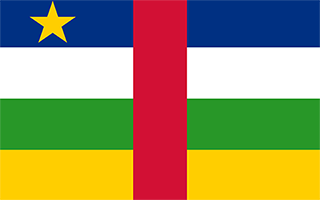
Four equal horizontal bands of blue (top), white, green, and yellow with a vertical red band in center; a yellow five-pointed star to the hoist side of the blue band; banner combines the Pan-African and French flag colors; red symbolizes the blood spilled in the struggle for independence, blue represents the sky and freedom, white peace and dignity, green hope and faith, and yellow tolerance; the star represents aspiration towards a vibrant future.
The former French colony of Ubangi-Shari became the Central African Republic upon independence in 1960. After three tumultuous decades of misrule - mostly by military governments - civilian rule was established in 1993 but lasted only a decade. In March 2003, President Ange-Felix PATASSE was deposed in a military coup led by General Francois BOZIZE, who established a transitional government. Elections held in 2005 affirmed General BOZIZE as president; he was reelected in 2011 in voting widely viewed as flawed. The government still lacks full control of the countryside, where lawlessness persists. Several rebel groups joined together in early December 2012 to launch a series of attacks that left them in control of numerous towns in the northern and central parts of the country. The rebels - unhappy with BOZIZE's government - participated in peace talks in early January 2013 which resulted in a coalition government including the rebellion's leadership. In March 2013, the coalition government dissolved, rebels seized the capital, and President BOZIZE fled the country. Rebel leader Michel DJOTODIA assumed the presidency and the following month established a National Transitional Council (CNT). In January 2014, the CNT elected Catherine SAMBA-PANZA as interim president. Elections completed in March 2016 installed independent candidate Faustin-Archange TOUADERA as president; he continues to work towards peace between the government and armed groups, and is developing a disarmament, demobilization, reintegration, and repatriation (DDRR) program to reintegrate the armed groups into society.
Geography
| Area | ||
|---|---|---|
| Total (World Rank: 45) | 622,984 | sq km |
| Land (World Rank: 43) | 622,984 | sq km |
| Forest (World Rank: 157) | 5.10 | % |
| Comparative | slightly smaller than Texas | |
| Landborder | ||
| 5920 | ||
| Elevation | ||
| Lowest point (World Rank: 11) | 335 | m |
| Highest point (World Rank: 148) | 1,410 | m |
| Agricultural land | ||
| Total (World Rank: 201) | 8.10 | % |
| Arable (World Rank: 170) | 2.90 | % |
| Permanent crops (World Rank: 184) | 0.10 | % |
| Permanent pastures (World Rank: 157) | 5.10 | % |
| Irrigated land (World Rank: 171) | 10 | sq km |
| Map reference | ||
| Africa | ||
| Environment | ||
| Issues |
| |
| Agreement party |
| |
| Agreement signed | Law of the Sea | |
| Hazzards |
| |
| Location | ||
| Central Africa, north of Democratic Republic of the Congo | ||
| Climate | ||
| tropical; hot, dry winters; mild to hot, wet summers | ||
| Terrain | ||
| vast, flat to rolling plateau; scattered hills in northeast and southwest | ||
People
| Population | ||
|---|---|---|
| Total (World Rank: 115) | 5,625,120 | |
| Deathrate (World Rank: 13) | 1.32 | % |
| Birthrate (World Rank: 23) | 3.43 | % |
| Growthrate (World Rank: 40) | 2.12 | % |
| Fertility rate (World Rank: 28) | 4.30 | % |
| Median age | ||
| Male (World Rank: 194) | 19.40 | |
| Female (World Rank: 194) | 20.00 | |
| Age structure | ||
| 0 14 male (World Rank: 94) | 1,133,360 | |
| 0 14 female (World Rank: 92) | 1,121,640 | |
| 15 24 male (World Rank: 101) | 563,730 | |
| 15 24 female (World Rank: 100) | 557,676 | |
| 25 54 male (World Rank: 125) | 913,363 | |
| 25 54 female (World Rank: 122) | 912,096 | |
| 55 64 male (World Rank: 136) | 106,651 | |
| 55 64 female (World Rank: 134) | 123,839 | |
| 65 x male (World Rank: 137) | 74,834 | |
| 65 x female (World Rank: 137) | 117,928 | |
| Health | ||
| Infant mortality rate (World Rank: 3) | 8.63 | % |
| Life expectancy total (World Rank: 214) | 53 | years |
| Life expectancy female (World Rank: 215) | 54 | years |
| Life expectancy male (World Rank: 216) | 51 | years |
| Physicians per 1000 (World Rank: 175) | 0.05 | |
| Hospital bed per 1000 (World Rank: 148) | 1.00 | |
| Sanitation access total (World Rank: 190) | 21.80 | % |
| Obesity adult (World Rank: 159) | 7.50 | % |
| Drinking water access (World Rank: 179) | 68.50 | % |
Energy
| Electricity | ||
|---|---|---|
| Production (World Rank: 191) | 174,000,000 | kWh |
| Consumption (World Rank: 194) | 161,800,000 | kWh |
| Source fossil (World Rank: 164) | 43.20 | % |
| Source nuclear (World Rank: 29) | 56.80 | % |
| Refined products | ||
| Consumption (World Rank: 186) | 3,000 | bbl / day |
| Import (World Rank: 179) | 2,828 | bbl / day |
| Natural gas | ||
| Consumption (World Rank: 130) | 24 | m³ |
| Carbon footprint | ||
| 400000 | ||
Nation
| Budget | ||
|---|---|---|
| Education (World Rank: 170) | 1 | % of GDP |
| Health (World Rank: 163) | 4 | % of GDP |
| Surplus (World Rank: 18) | 1 | % of GDP |
| National symbol | ||
| elephant | ||
| National colours | ||
| yellow | ||
| Adjective | ||
| Central African | ||
| Noun | ||
| Central African(s) | ||
| Background | ||
| The former French colony of Ubangi-Shari became the Central African Republic upon independence in 1960. After three tumultuous decades of misrule - mostly by military governments - civilian rule was established in 1993 but lasted only a decade. In March 2003, President Ange-Felix PATASSE was deposed in a military coup led by General Francois BOZIZE, who established a transitional government. Elections held in 2005 affirmed General BOZIZE as president; he was reelected in 2011 in voting widely viewed as flawed. The government still lacks full control of the countryside, where lawlessness persists. Several rebel groups joined together in early December 2012 to launch a series of attacks that left them in control of numerous towns in the northern and central parts of the country. The rebels - unhappy with BOZIZE's government - participated in peace talks in early January 2013 which resulted in a coalition government including the rebellion's leadership. In March 2013, the coalition government dissolved, rebels seized the capital, and President BOZIZE fled the country. Rebel leader Michel DJOTODIA assumed the presidency and the following month established a National Transitional Council (CNT). In January 2014, the CNT elected Catherine SAMBA-PANZA as interim president. Elections completed in March 2016 installed independent candidate Faustin-Archange TOUADERA as president; he continues to work towards peace between the government and armed groups, and is developing a disarmament, demobilization, reintegration, and repatriation (DDRR) program to reintegrate the armed groups into society. | ||
| Flag description | ||
| four equal horizontal bands of blue (top), white, green, and yellow with a vertical red band in center; a yellow five-pointed star to the hoist side of the blue band; banner combines the Pan-African and French flag colors; red symbolizes the blood spilled in the struggle for independence, blue represents the sky and freedom, white peace and dignity, green hope and faith, and yellow tolerance; the star represents aspiration towards a vibrant future | ||
Economy
| Gdp | ||
|---|---|---|
| Purchasing power parity (World Rank: 185) | 3,185,000,000 | USD |
| Real growth rate (World Rank: 49) | 4.50 | % |
| Per capita purchasing power parity (World Rank: 226) | 700 | USD |
| Source agriculture (World Rank: 8) | 42.90 | % |
| Source industry (World Rank: 172) | 16.00 | % |
| Source service (World Rank: 202) | 41.10 | % |
| Labourforce | ||
| Total (World Rank: 120) | 2,194,000 | |
| Products | ||
| Industries |
| |
| Agriculture |
| |
| Exports |
| |
| Imports |
| |
Communication
| Phone | ||
|---|---|---|
| Landline total (World Rank: 210) | 1,964 | |
| Landline per 100 (World Rank: 199) | 1.00 | |
| Mobile per 100 (World Rank: 214) | 18.00 | |
| Assessment | 0 | |
| Internet | ||
| Users (World Rank: 164) | 246,000 | |
| Population (World Rank: 218) | 4.60 | % |
Transport
| Air | ||
|---|---|---|
| Airports paved (World Rank: 176) | 2.00 | |
| Airports unpaved (World Rank: 75) | 37.00 | |
| Road | ||
| Total length (World Rank: 108) | 20,278 | |
| Paved length (World Rank: 135) | 1,385 | |
| Unpaved length (World Rank: 64) | 18,893 | |
| Water | ||
| Total length (World Rank: 35) | 2,800 | |
This is a list of famous places in this country in alphabetical order.
 Abbo Bougrima
- Alindao
- Am Dafok
- Asoulemaka
- Babadza
- Baboua
- Bacbaya
- Bakoui
- Bakouma
- Bambari
- Bambari
- Banda
- Banga
- Bangassou
- Bangui
- Baoro
- Batangafo
- Begoua
- Bekouna
- Belam
- Benengue
- Berberati
- Beya Basobo
- Bimbo
- Bira Boyare
- Birao
- Birao Post
- Boali
- Bobakada
- Bobaloko II
- Bobangui
- Bobassa I
- Bocaranga
- Boda
- Boese I
- Bogbo
- Bokiti
- Bombele
- Bondziako
- Bonganou
- Borofio
- Bossangoa
- Bossembele
- Bossongo I
- Bouali
- Bouar
- Bouca
- Boudalou I
- Boudayo
- Bousse Kana
- Boutili
- Bouyafe
- Boyangene
- Bozoum
- Bria
- Carnot
- Damara
- Dedengue
- Djema
- Firi
- Gaboua
- Gamaka
- Gambo
- Gamboula
- Gobongo
- Golongosso
- Goz Amar
- Gribingi Morobanda
- Ippy
- Kabo
- Kaga Bandoro
- Kazanga
- Kembe
- Kouango
- Les Moroubas
- Markounda
- Mbaiki
- Mbres
- Mobaye
- Mongoumba
- Mouka
- Nadziboro
- Ndele
- Nola
- Obo
- Ouadda
- Ouakana
- Ouanda Djalle
- Ouango
- Paoua
- Potopoto
- Rombatoui
- Sibut
- Tedoa
- Voudou I
- Wambilo
- Yaloke
- Yankouko
- Yimbi
- Zemio