Brazil
in South America
South America
 Argentina
 Bolivia
 Colombia
 French Guiana
 Guyana
 Paraguay
 Peru
Peru Suriname
 Uruguay
 Venezuela
- Currency and Currency Code:
- Real - BRL
- Spoken languages:
- Portuguese, Spanish, English, French
- Local electricity:
- 127 V / 220 V - 60 Hz (plugs: C, N)
- Mobile phone / cellular frequencies (MHz):
- 850 MHz, 900 MHz, 1800 MHz, 1900 MHz, 3G, 4G
- ISO 2-Letter code:
- BR
- Internet top level domain:
- .br
- Country phone prefix:
- +55
- Local Time (capital):
- Timezone:
- UTC/GMT offset: hours
Safety Score: 3,3 of 5.0 based on data from 9 authorites. Meaning please reconsider your need to travel to Brazil.
Travel warnings are updated daily. Source: Travel Warning Brazil. Last Update: 2024-04-24 08:14:40
Explore Brazil
Brazil with its capital Brasilia is located in South America (Eastern South America, bordering the Atlantic Ocean). It covers some 8,515,771 square kilometers (slightly smaller than the US) with 207,353,000 citizens. Portuguese, Spanish, English and French are the languages commonly used by the people in Brazil (consider regional differences). Argentina, Bolivia, Colombia, French Guiana, Guyana, Paraguay, Peru, Suriname, Uruguay and Venezuela are bordering countries.
Brazil is the largest country in South America. Famous for its football (soccer) tradition and its annual Carnaval in Rio de Janeiro, Salvador, Recife and Olinda. Owing to Brazil’s continental dimensions, varied geography, history and people, the country’s culture is rich and diverse. Music plays an important part in Brazilian identity. Styles like choro, samba and bossa nova are considered genuinely Brazilian. Brazil has many exciting cities, ranging from pretty colonial towns and coastal hideouts to hectic, lively metropolises. Brazil is a huge country with different climate zones. In the north, near the equator there is a wet and a dry season; from about Sao Paulo down to the south there is spring/summer/fall/winter. Brazil is one of a few countries that uses both 120 and 240 volts for everyday appliances. Expect the voltage to change back and forth as you travel from one place to the next -- even within the same Brazilian state, sometimes even within the same building. There is no physical difference in the electric outlets (power mains) for the two voltages.
Popular Destinations in Brazil
Administrative regions of Brazil
- Acre
- Alagoas
- Amapa
- Amazonas
- Ceara
- Espirito Santo
- Estado de Bahia
- Federal District
- Goias
- Maranhao
- Mato Grosso
- Mato Grosso do Sul
- Minas Gerais
- Para
- Paraiba
- Parana
- Pernambuco
- Piaui
- Rio Grande do Norte
- Rio Grande do Sul
- Rio de Janeiro
- Rondonia
- Roraima
- Santa Catarina
- Sao Paulo
- Sergipe
- Tocantins
About the country

The landscape is mostly flat to rolling lowlands in north and some plains, hills, mountains, and narrow coastal belt. The average density of population is about 24 per km². The climate in Brazil can be described as mostly tropical, but temperate in south. Potential threats by nature are floods and occasional frost in south recurring droughts in northeast
To reach someone Brazil dial +55 prior to a number. The local cellular networks are operated on 850 MHz, 900 MHz, 1800 MHz, 1900 MHz, 3G, 4G. Websites typically end with the top level domain ".br". If you want to bring electric appliances (e.g. battery chaarger), keep in min the local 127 V / 220 V - 60 Hz (plugs: C, N). The sign for the locally used currency Real is BRL.
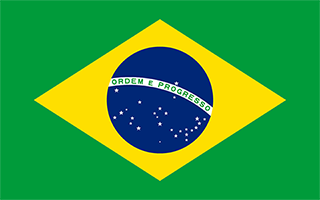
Green with a large yellow diamond in the center bearing a blue celestial globe with 27 white five-pointed stars; the globe has a white equatorial band with the motto ORDEM E PROGRESSO (Order and Progress); the current flag was inspired by the banner of the former Empire of Brazil (1822-1889); on the imperial flag, the green represented the House of Braganza of Pedro I, the first Emperor of Brazil, while the yellow stood for the Habsburg Family of his wife; on the modern flag the green represents the forests of the country and the yellow rhombus its mineral wealth (the diamond shape roughly mirrors that of the country); the blue circle and stars, which replaced the coat of arms of the original flag, depict the sky over Rio de Janeiro on the morning of 15 November 1889 - the day the Republic of Brazil was declared; the number of stars has changed with the creation of new states and has risen from an original 21 to the current 27 (one for each state and the Federal District).
Following more than three centuries under Portuguese rule, Brazil gained its independence in 1822, maintaining a monarchical system of government until the abolition of slavery in 1888 and the subsequent proclamation of a republic by the military in 1889. Brazilian coffee exporters politically dominated the country until populist leader Getulio VARGAS rose to power in 1930. By far the largest and most populous country in South America, Brazil underwent more than a half century of populist and military government until 1985, when the military regime peacefully ceded power to civilian rulers. Brazil continues to pursue industrial and agricultural growth and development of its interior. Having successfully weathered a period of global financial difficulty in the late 20th century, Brazil was seen as one of the world’s strongest emerging markets and a contributor to global growth. The awarding of the 2014 FIFA World Cup and 2016 Summer Olympic Games, the first ever to be held in South America, was seen as symbolic of the country’s rise. However, since about 2013, Brazil has been plagued by a shrinking economy, growing unemployment, and rising inflation. Political scandal resulted in the impeachment of President Dilma ROUSSEFF in May 2016, a conviction that was upheld by the Senate in August 2016; her vice president, Michel TEMER, will serve as president until 2018, completing her second term.
Geography
| Area | ||
|---|---|---|
| Total (World Rank: 6) | 8,515,770 | sq km |
| Land (World Rank: 6) | 8,358,140 | sq km |
| Water (World Rank: 6) | 157,630 | sq km |
| Forest (World Rank: 76) | 23.50 | % |
| Comparative | slightly smaller than the US | |
| Note | includes Arquipelago de Fernando de Noronha, Atol das Rocas, Ilha da Trindade, Ilhas Martin Vaz, and Penedos de Sao Pedro e Sao Paulo | |
| Coastline | ||
| 7491 | ||
| Landborder | ||
| 16145 | ||
| Elevation | ||
| Highest point (World Rank: 69) | 2,994 | m |
| Agricultural land | ||
| Total (World Rank: 126) | 32.90 | % |
| Arable (World Rank: 125) | 8.60 | % |
| Permanent crops (World Rank: 133) | 0.80 | % |
| Permanent pastures (World Rank: 76) | 23.50 | % |
| Irrigated land (World Rank: 9) | 54,000 | sq km |
| Map reference | ||
| South America | ||
| Environment | ||
| Issues |
| |
| Agreement party |
| |
| Hazzards |
| |
| Location | ||
| Eastern South America, bordering the Atlantic Ocean | ||
| Climate | ||
| mostly tropical, but temperate in south | ||
| Terrain | ||
| mostly flat to rolling lowlands in north; some plains, hills, mountains, and narrow coastal belt | ||
People
| Population | ||
|---|---|---|
| Total (World Rank: 5) | 207,353,000 | |
| Deathrate (World Rank: 138) | 0.67 | % |
| Birthrate (World Rank: 136) | 1.41 | % |
| Growthrate (World Rank: 140) | 0.73 | % |
| Migration rate (World Rank: 70) | -0.01 | % |
| Fertility rate (World Rank: 161) | 1.75 | % |
| Median age | ||
| Male (World Rank: 100) | 31.10 | |
| Female (World Rank: 96) | 32.80 | |
| Age structure | ||
| 0 14 male (World Rank: 7) | 23,599,900 | |
| 0 14 female (World Rank: 8) | 22,696,800 | |
| 15 24 male (World Rank: 7) | 17,212,000 | |
| 15 24 female (World Rank: 7) | 16,721,300 | |
| 25 54 male (World Rank: 5) | 45,114,100 | |
| 25 54 female (World Rank: 5) | 45,836,100 | |
| 55 64 male (World Rank: 5) | 8,931,060 | |
| 55 64 female (World Rank: 6) | 9,974,720 | |
| 65 x male (World Rank: 7) | 7,356,840 | |
| 65 x female (World Rank: 8) | 9,910,580 | |
| Health | ||
| Infant mortality rate (World Rank: 93) | 1.75 | % |
| Life expectancy total (World Rank: 124) | 74 | years |
| Life expectancy female (World Rank: 114) | 78 | years |
| Life expectancy male (World Rank: 133) | 71 | years |
| Physicians per 1000 (World Rank: 80) | 1.85 | |
| Hospital bed per 1000 (World Rank: 93) | 2.30 | |
| Sanitation access total (World Rank: 116) | 82.80 | % |
| Obesity adult (World Rank: 81) | 22.10 | % |
| Drinking water access (World Rank: 78) | 98.10 | % |
Energy
| Electricity | ||
|---|---|---|
| Production (World Rank: 8) | 559,200,000,000 | kWh |
| Consumption (World Rank: 8) | 500,600,000,000 | kWh |
| Export (World Rank: 73) | 219,000,000 | kWh |
| Import (World Rank: 3) | 34,640,000,000 | kWh |
| Source fossil (World Rank: 189) | 25.40 | % |
| Source nuclear (World Rank: 147) | 1.20 | % |
| Source renew (World Rank: 43) | 16.00 | % |
| Crude oil | ||
| Production (World Rank: 10) | 2,515,000 | bbl / day |
| Exports (World Rank: 22) | 518,800 | bbl / day |
| Imports (World Rank: 25) | 350,100 | bbl / day |
| Proved reserves (World Rank: 15) | 13,000,000,000 | bbl |
| Refined products | ||
| Production (World Rank: 7) | 2,899,000 | bbl / day |
| Consumption (World Rank: 7) | 3,102,000 | bbl / day |
| Export (World Rank: 28) | 269,400 | bbl / day |
| Import (World Rank: 14) | 559,000 | bbl / day |
| Natural gas | ||
| Production (World Rank: 31) | 20,410,000,000 | m³ |
| Consumption (World Rank: 25) | 43,400,000,000 | m³ |
| Export (World Rank: 47) | 100,000,000 | m³ |
| Import (World Rank: 49) | 0 | m³ |
| Carbon footprint | ||
| 535000000 | ||
Nation
| Budget | ||
|---|---|---|
| Education (World Rank: 35) | 6 | % of GDP |
| Military (World Rank: 88) | 1 | % of GDP |
| Health (World Rank: 51) | 8 | % of GDP |
| Surplus (World Rank: 61) | -1 | % of GDP |
| National symbol | ||
| Southern Cross constellation | ||
| National colours | ||
| yellow | ||
| Adjective | ||
| Brazilian | ||
| Noun | ||
| Brazilian(s) | ||
| Background | ||
| Following more than three centuries under Portuguese rule, Brazil gained its independence in 1822, maintaining a monarchical system of government until the abolition of slavery in 1888 and the subsequent proclamation of a republic by the military in 1889. Brazilian coffee exporters politically dominated the country until populist leader Getulio VARGAS rose to power in 1930. By far the largest and most populous country in South America, Brazil underwent more than a half century of populist and military government until 1985, when the military regime peacefully ceded power to civilian rulers. Brazil continues to pursue industrial and agricultural growth and development of its interior. Having successfully weathered a period of global financial difficulty in the late 20th century, Brazil was seen as one of the world’s strongest emerging markets and a contributor to global growth. The awarding of the 2014 FIFA World Cup and 2016 Summer Olympic Games, the first ever to be held in South America, was seen as symbolic of the country’s rise. However, since about 2013, Brazil has been plagued by a shrinking economy, growing unemployment, and rising inflation. Political scandal resulted in the impeachment of President Dilma ROUSSEFF in May 2016, a conviction that was upheld by the Senate in August 2016; her vice president, Michel TEMER, will serve as president until 2018, completing her second term. | ||
| Flag description | ||
| green with a large yellow diamond in the center bearing a blue celestial globe with 27 white five-pointed stars; the globe has a white equatorial band with the motto ORDEM E PROGRESSO (Order and Progress); the current flag was inspired by the banner of the former Empire of Brazil (1822-1889); on the imperial flag, the green represented the House of Braganza of Pedro I, the first Emperor of Brazil, while the yellow stood for the Habsburg Family of his wife; on the modern flag the green represents the forests of the country and the yellow rhombus its mineral wealth (the diamond shape roughly mirrors that of the country); the blue circle and stars, which replaced the coat of arms of the original flag, depict the sky over Rio de Janeiro on the morning of 15 November 1889 - the day the Republic of Brazil was declared; the number of stars has changed with the creation of new states and has risen from an original 21 to the current 27 (one for each state and the Federal District) | ||
Economy
| Gdp | ||
|---|---|---|
| Purchasing power parity (World Rank: 7) | 3,141,000,000,000 | USD |
| Real growth rate (World Rank: 207) | -3.60 | % |
| Per capita purchasing power parity (World Rank: 105) | 15,200 | USD |
| Source agriculture (World Rank: 120) | 5.80 | % |
| Source industry (World Rank: 146) | 20.90 | % |
| Source service (World Rank: 52) | 73.30 | % |
| Labourforce | ||
| Total (World Rank: 5) | 110,400,000 | |
| In poverty (World Rank: 166) | 3.70 | % |
| Products | ||
| Industries |
| |
| Agriculture |
| |
| Exports |
| |
| Imports |
| |
Communication
| Phone | ||
|---|---|---|
| Landline total (World Rank: 5) | 41,846,800 | |
| Landline per 100 (World Rank: 89) | 20.00 | |
| Mobile per 100 (World Rank: 81) | 119.00 | |
| Assessment | 0 | |
| Internet | ||
| Users (World Rank: 4) | 122,841,000 | |
| Population (World Rank: 95) | 59.70 | % |
Transport
| Air | ||
|---|---|---|
| Airports paved (World Rank: 2) | 698 | |
| Airports unpaved (World Rank: 2) | 3,395 | |
| Heliports (World Rank: 17) | 13.00 | |
| Rail | ||
| Total length (World Rank: 9) | 29,850 | |
| Road | ||
| Total length (World Rank: 4) | 1,580,960 | |
| Paved length (World Rank: 15) | 212,798 | |
| Unpaved length (World Rank: 2) | 1,368,170 | |
| Water | ||
| Total length (World Rank: 3) | 50,000 | |
This is a list of famous places in this country in alphabetical order.
 Ananindeua
- Angra dos Reis
- Aracaju
- Assis
- Atibaia
- Bauru
- Belem
- Belford Roxo
- Belo Horizonte
- Betim
- Blumenau
- Boa Vista
- Botucatu
- Braganca Paulista
- Brasilia
- Cachoeiro de Itapemirim
- Caldas Novas
- Campina Grande
- Campinas
- Campo Grande
- Campos dos Goytacazes
- Canoas
- Caruaru
- Caucaia
- Caxias do Sul
- Colombo
- Contagem
- Cuiaba
- Curitiba
- Duque de Caxias
- Florianopolis
- Fortaleza
- Foz do Iguacu
- Franca
- Goiania
- Governador Valadares
- Gravatai
- Guaruja
- Guarulhos
- Hortolandia
- Ilheus
- Indaiatuba
- Ipatinga
- Itajai
- Itanhaem
- Jaboatao dos Guararapes
- Joao Pessoa
- Joinville
- Juiz de Fora
- Jundiai
- Limeira
- Londrina
- Macapa
- Maceio
- Manaus
- Marilia
- Maringa
- Maua
- Montes Claros
- Natal
- Niteroi
- Nova Friburgo
- Nova Iguacu
- Novo Hamburgo
- Olinda
- Palhoca
- Palmas
- Parnamirim
- Paulinia
- Paulista
- Pelotas
- Petropolis
- Piracicaba
- Pocos de Caldas
- Ponta Grossa
- Porto Alegre
- Porto Velho
- Recife
- Ribeirao Preto
- Ribeirao das Neves
- Rio Branco
- Rio de Janeiro
- Salvador
- Santa Maria
- Santarem
- Santos
- Sao Joao de Meriti
- Sao Jose do Rio Preto
- Sao Jose dos Campos
- Sao Leopoldo
- Sao Luis
- Sao Paulo
- Sorocaba
- Sumare
- Taboao da Serra
- Taubate
- Teresina
- Ubatuba
- Vila Velha
- Vitoria