Armenia
in Western Asia
Asia
 Azerbaijan
 Georgia
 Iran
Iran Turkey
- Currency and Currency Code:
- Dram - AMD
- Spoken languages:
- Armenian
- Local electricity:
- 230 V - 50 Hz (plugs: C, F)
- Mobile phone / cellular frequencies (MHz):
- 900 MHz, 1800 MHz, 3G, 4G
- ISO 2-Letter code:
- AM
- Internet top level domain:
- .am
- Country phone prefix:
- +374
- Local Time (capital):
- Timezone:
- UTC/GMT offset: hours
Safety Score: 3,3 of 5.0 based on data from 9 authorites. Meaning please reconsider your need to travel to Armenia.
Travel warnings are updated daily. Source: Travel Warning Armenia. Last Update: 2024-04-18 08:12:24
Explore Armenia
Armenia with its capital Yerevan is located in Asia (Southwestern Asia, between Turkey (to the west) and Azerbaijan; note - Armenia views itself as part of Europe; geopolitically). It covers some 29,744 square kilometers (slightly smaller than Maryland) with a population of 3,045,190. Armenian is the official language spoken by people in Armenia. Azerbaijan, Georgia, Iran and Turkey are bordering countries.
Armenia (Armenian: Hayastan) is the only country remaining from 3,000 year old maps of Anatolia. It became the world’s first Christian country 1,707 years ago in 301 AD, and has a large Diaspora all over the world. As a former Soviet republic lying in the Caucasus region, straddling Asia and Europe, Armenia has an ancient and rich culture. Armenia is very easy to experience, thanks to very hospitable people. The many mountains and mountain valleys create a great number of micro climates, with scenery changing from arid to lush forest at the top of a mountain ridge.
Popular Destinations in Armenia
Administrative regions of Armenia
- Aragatsotni Marz
- Ararati Marz
- Armaviri Marz
- Geghark'unik'i Marz
- Kotayk'i Marz
- Lorru Marz
- Shiraki Marz
- Syunik'i Marz
- Tavushi Marz
- Vayots' Dzor
- Yerevan
About the country
The topography is Armenian Highland with mountains with little forest land, fast flowing rivers as well as good soil in Aras River valley. The average density of population is about 102 per km². The climate in Armenia can be described as highland continental, hot summers, cold winters. Potential natural disasters are droughts occasionally severe earthquakes
To reach someone Armenia dial +374 prior to a number. The local cellular networks are operated on 900 MHz, 1800 MHz, 3G, 4G. Websites typically end with the top level domain ".am". If you want to bring electric appliances (e.g. battery chaarger), keep in min the local 230 V - 50 Hz (plugs: C, F). The sign for the locally used currency Dram is AMD.
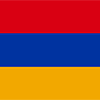
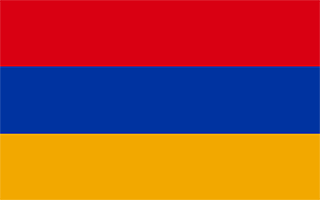
Three equal horizontal bands of red (top), blue, and orange; the color red recalls the blood shed for liberty, blue the Armenian skies as well as hope, and orange the land and the courage of the workers who farm it.
Armenia prides itself on being the first nation to formally adopt Christianity (early 4th century). Despite periods of autonomy, over the centuries Armenia came under the sway of various empires including the Roman, Byzantine, Arab, Persian, and Ottoman. During World War I in the western portion of Armenia, the Ottoman Empire instituted a policy of forced resettlement coupled with other harsh practices that resulted in at least 1 million Armenian deaths. The eastern area of Armenia was ceded by the Ottomans to Russia in 1828; this portion declared its independence in 1918, but was conquered by the Soviet Red Army in 1920. Armenian leaders remain preoccupied by the long conflict with Azerbaijan over Nagorno-Karabakh, a primarily Armenian-populated region, assigned to Soviet Azerbaijan in the 1920s by Moscow. Armenia and Azerbaijan began fighting over the area in 1988; the struggle escalated after both countries attained independence from the Soviet Union in 1991. By May 1994, when a trilateral cease-fire between Armenia, Azerbaijan, and Nagorno-Karabakh took hold, ethnic Armenian forces held not only Nagorno-Karabakh but also seven surrounding regions - approximately 14 percent of Azerbaijan’s territory. The economies of both sides have been hurt by their inability to make substantial progress toward a peaceful resolution. Turkey closed the common border with Armenia in 1993 in support of Azerbaijan in its conflict with Armenia over control of Nagorno-Karabakh and surrounding areas, further hampering Armenian economic growth. In 2009, senior Armenian leaders began pursuing rapprochement with Turkey, aiming to secure an opening of the border, but Turkey has not yet ratified the Protocols normalizing relations between the two countries. In January 2015, Armenia joined Russia, Belarus, and Kazakhstan as a member of the Eurasian Economic Union.
Geography
| Area | ||
|---|---|---|
| Total (World Rank: 143) | 29,743 | sq km |
| Land (World Rank: 140) | 28,203 | sq km |
| Water (World Rank: 98) | 1,540 | sq km |
| Forest (World Rank: 31) | 42.00 | % |
| Comparative | slightly smaller than Maryland | |
| Landborder | ||
| 1570 | ||
| Elevation | ||
| Lowest point (World Rank: 9) | 400 | m |
| Highest point (World Rank: 43) | 4,090 | m |
| Agricultural land | ||
| Total (World Rank: 45) | 59.70 | % |
| Arable (World Rank: 75) | 15.80 | % |
| Permanent crops (World Rank: 95) | 1.90 | % |
| Permanent pastures (World Rank: 31) | 42.00 | % |
| Irrigated land (World Rank: 72) | 2,740 | sq km |
| Map reference | ||
| Asia | ||
| Environment | ||
| Issues |
| |
| Agreement party |
| |
| Agreement signed | Air Pollution-Persistent Organic Pollutants | |
| Hazzards |
| |
| Location | ||
| Southwestern Asia, between Turkey (to the west) and Azerbaijan; note - Armenia views itself as part of Europe; geopolitically, it can be classified as falling within Europe, the Middle East, or both | ||
| Climate | ||
| highland continental, hot summers, cold winters | ||
| Terrain | ||
| Armenian Highland with mountains; little forest land; fast flowing rivers; good soil in Aras River valley | ||
People
| Population | ||
|---|---|---|
| Total (World Rank: 137) | 3,045,190 | |
| Deathrate (World Rank: 57) | 0.94 | % |
| Birthrate (World Rank: 151) | 1.29 | % |
| Growthrate (World Rank: 205) | -0.21 | % |
| Migration rate (World Rank: 159) | -0.57 | % |
| Fertility rate (World Rank: 174) | 1.64 | % |
| Median age | ||
| Male (World Rank: 83) | 33.30 | |
| Female (World Rank: 70) | 36.90 | |
| Age structure | ||
| 0 14 male (World Rank: 143) | 306,322 | |
| 0 14 female (World Rank: 143) | 270,388 | |
| 15 24 male (World Rank: 144) | 203,358 | |
| 15 24 female (World Rank: 144) | 189,092 | |
| 25 54 male (World Rank: 136) | 640,881 | |
| 25 54 female (World Rank: 132) | 681,784 | |
| 55 64 male (World Rank: 121) | 187,178 | |
| 55 64 female (World Rank: 119) | 221,071 | |
| 65 x male (World Rank: 121) | 138,458 | |
| 65 x female (World Rank: 115) | 206,659 | |
| Health | ||
| Infant mortality rate (World Rank: 111) | 1.27 | % |
| Life expectancy total (World Rank: 115) | 75 | years |
| Life expectancy female (World Rank: 98) | 79 | years |
| Life expectancy male (World Rank: 123) | 72 | years |
| Physicians per 1000 (World Rank: 47) | 2.80 | |
| Hospital bed per 1000 (World Rank: 52) | 3.90 | |
| Sanitation access total (World Rank: 101) | 89.50 | % |
| Obesity adult (World Rank: 104) | 20.20 | % |
| Drinking water access (World Rank: 40) | 100.00 | % |
Energy
| Electricity | ||
|---|---|---|
| Production (World Rank: 111) | 7,393,000,000 | kWh |
| Consumption (World Rank: 118) | 5,331,000,000 | kWh |
| Export (World Rank: 49) | 1,424,000,000 | kWh |
| Import (World Rank: 93) | 174,000,000 | kWh |
| Source fossil (World Rank: 134) | 58.80 | % |
| Source nuclear (World Rank: 117) | 9.20 | % |
| Source renew (World Rank: 159) | 0.10 | % |
| Refined products | ||
| Consumption (World Rank: 159) | 8,000 | bbl / day |
| Import (World Rank: 146) | 7,736 | bbl / day |
| Natural gas | ||
| Consumption (World Rank: 78) | 2,730,000,000 | m³ |
| Import (World Rank: 53) | 0 | m³ |
| Carbon footprint | ||
| 12000000 | ||
Nation
| Budget | ||
|---|---|---|
| Education (World Rank: 146) | 3 | % of GDP |
| Military (World Rank: 14) | 4 | % of GDP |
| Health (World Rank: 156) | 5 | % of GDP |
| Surplus (World Rank: 154) | -5 | % of GDP |
| National symbol | ||
| Mount Ararat | ||
| National colours | ||
| red | ||
| Adjective | ||
| Armenian | ||
| Noun | ||
| Armenian(s) | ||
| Background | ||
| Armenia prides itself on being the first nation to formally adopt Christianity (early 4th century). Despite periods of autonomy, over the centuries Armenia came under the sway of various empires including the Roman, Byzantine, Arab, Persian, and Ottoman. During World War I in the western portion of Armenia, the Ottoman Empire instituted a policy of forced resettlement coupled with other harsh practices that resulted in at least 1 million Armenian deaths. The eastern area of Armenia was ceded by the Ottomans to Russia in 1828; this portion declared its independence in 1918, but was conquered by the Soviet Red Army in 1920. Armenian leaders remain preoccupied by the long conflict with Azerbaijan over Nagorno-Karabakh, a primarily Armenian-populated region, assigned to Soviet Azerbaijan in the 1920s by Moscow. Armenia and Azerbaijan began fighting over the area in 1988; the struggle escalated after both countries attained independence from the Soviet Union in 1991. By May 1994, when a trilateral cease-fire between Armenia, Azerbaijan, and Nagorno-Karabakh took hold, ethnic Armenian forces held not only Nagorno-Karabakh but also seven surrounding regions - approximately 14 percent of Azerbaijan’s territory. The economies of both sides have been hurt by their inability to make substantial progress toward a peaceful resolution. Turkey closed the common border with Armenia in 1993 in support of Azerbaijan in its conflict with Armenia over control of Nagorno-Karabakh and surrounding areas, further hampering Armenian economic growth. In 2009, senior Armenian leaders began pursuing rapprochement with Turkey, aiming to secure an opening of the border, but Turkey has not yet ratified the Protocols normalizing relations between the two countries. In January 2015, Armenia joined Russia, Belarus, and Kazakhstan as a member of the Eurasian Economic Union. | ||
| Flag description | ||
| three equal horizontal bands of red (top), blue, and orange; the color red recalls the blood shed for liberty, blue the Armenian skies as well as hope, and orange the land and the courage of the workers who farm it | ||
Economy
| Gdp | ||
|---|---|---|
| Purchasing power parity (World Rank: 138) | 25,830,000,000 | USD |
| Real growth rate (World Rank: 185) | 0.20 | % |
| Per capita purchasing power parity (World Rank: 141) | 8,600 | USD |
| Source agriculture (World Rank: 56) | 17.80 | % |
| Source industry (World Rank: 98) | 27.50 | % |
| Source service (World Rank: 153) | 54.70 | % |
| Labourforce | ||
| Total (World Rank: 130) | 1,514,000 | |
| In poverty (World Rank: 53) | 32.00 | % |
| Products | ||
| Industries |
| |
| Agriculture |
| |
| Exports |
| |
| Imports |
| |
Communication
| Phone | ||
|---|---|---|
| Landline total (World Rank: 91) | 531,624 | |
| Landline per 100 (World Rank: 102) | 17.00 | |
| Mobile per 100 (World Rank: 95) | 113.00 | |
| Assessment | 0 | |
| Internet | ||
| Users (World Rank: 115) | 1,891,780 | |
| Population (World Rank: 89) | 62.00 | % |
Transport
| Air | ||
|---|---|---|
| Airports paved (World Rank: 118) | 10.00 | |
| Airports unpaved (World Rank: 184) | 1.00 | |
| Rail | ||
| Total length (World Rank: 98) | 780 | |
| Road | ||
| Total length (World Rank: 142) | 7,792 | |
This is a list of famous places in this country in alphabetical order.
 Abovyan
- Aghavnadzor
- Akhuryan
- Alaverdi
- Angeghakot'
- Aparan
- Ararat
- Areni
- Arevashogh
- Argavand
- Argel
- Armavir
- Artashat
- Artsvaberd
- Arzni
- Ashtarak
- Avshar
- Aygavan
- Aygezard
- Azatan
- Berd
- Bjni
- Byurakan
- Byureghavan
- Chambarak
- Dalarik
- Dilijan
- Dsegh
- Dvin
- Dzoraghbyur
- Fioletovo
- Garrni
- Gavarr
- Geghanist
- Getahovit
- Goravan
- Goris
- Gosh
- Gugark'
- Gyumri
- Haghartsin
- Hats'avan
- Hrazdan
- Ijevan
- Jermuk
- K'anak'erravan
- Kapan
- Karbi
- Khndzoresk
- Kosh
- Lchashen
- Lerrnakert
- Maralik
- Margahovit
- Margara
- Marmarashen
- Martuni
- Masis
- Meghradzor
- Meghri
- Mets Masrik
- Metsavan
- Myasnikyan
- Nerk'in Getashen
- Nor Geghi
- Noratus
- Noyemberyan
- Odzun
- Oshakan
- Parravak'ar
- Prroshyan
- Ptghni
- Sardarapat
- Sarukhan
- Sevan
- Shahumyan
- Shinuhayr
- Spitak
- Step'anavan
- T'alin
- Tashir
- Tatev
- Tegh
- Tsaghkadzor
- Tsovagyugh
- Tsovazard
- Vagharshapat
- Vanadzor
- Vardenik
- Vardenis
- Vayk'
- Vedi
- Verin Artashat
- Vosketap'
- Vostan
- Yeghegnadzor
- Yeghvard
- Yeranos
- Yerevan
- Zovuni